
Tips
How Diversity Works: What the Research Shows
How Diversity Works: What the Research Shows

Diversity has become one of the most studied topics in organizational research, and the findings are consistent: diverse teams make better decisions, generate more innovative solutions, and produce stronger financial outcomes than homogeneous ones. But the mechanism behind why diversity works is less intuitive than it seems.
The answer is not simply that diversity brings more perspectives to the table. It is that diversity creates a different social dynamic. People in diverse groups work harder to prepare, communicate more carefully, and challenge assumptions they would otherwise take for granted. The presence of difference changes how people think, not just what they think about.
This guide covers what research actually shows about how diversity works, why it produces the results it does, and how organizations and individuals can apply these findings in practice.
Key Takeaways
Diversity improves team performance primarily by disrupting conformity and forcing more rigorous thinking, not by simply adding perspectives
The performance benefits of diversity are real but require deliberate management; diverse teams do not self-organize effectively without intentional effort
Cognitive diversity, including differences in how and when people think best, is an underappreciated dimension that directly affects individual and team output
What Diversity Actually Is
Diversity in organizations takes several distinct forms, and understanding which type you are working with matters for predicting outcomes.
Demographic diversity refers to differences in gender, race, ethnicity, age, and similar characteristics. This is the most visible form of diversity and the one most commonly referenced in corporate discourse. Research on demographic diversity shows consistent performance benefits, particularly in innovation-heavy industries and senior leadership positions.
Cognitive diversity refers to differences in how people think: their problem-solving styles, their tolerance for ambiguity, their reasoning approaches, and their ways of structuring information. Cognitive diversity is often invisible on the surface and does not always correlate with demographic diversity. A team can be demographically homogeneous but cognitively diverse, and vice versa.
Experiential diversity refers to differences in educational backgrounds, career paths, industry experience, and cultural history. Someone who built their career in manufacturing brings different mental models to a software team than a colleague who came up through finance. These experiential differences produce distinct views on risk, quality, and process that demographic diversity alone does not capture.
Why Diverse Teams Perform Better
Researcher Katherine Phillips at Columbia Business School conducted a series of experiments that reveal the mechanism behind diversity's performance benefits. When people work alongside socially dissimilar colleagues, they feel less comfortable. They anticipate disagreement. They prepare more thoroughly. They work harder to articulate and defend their reasoning because they cannot assume their assumptions are shared.
This preparation and rigor produces better outcomes. A study of S&P 1500 companies by Dezsö and Ross found that firms adding women to senior leadership generated approximately $40 million more in annual value, but only in companies where innovation was a core strategic driver. The benefit of diversity was contingent on the type of work being done: it mattered most where novel thinking was rewarded over execution of established processes.
A second mechanism is error correction. In homogeneous groups, incorrect assumptions spread unchallenged. In diverse groups, the different reference points of team members create natural friction that surfaces errors before they compound. McKinsey research across hundreds of companies found that those in the top quartile for gender diversity were 15 percent more likely to have above-average financial returns than their industry peers, and those in the top quartile for ethnic diversity were 35 percent more likely.
The Discomfort Paradox
One of the most consistent and counterintuitive findings in diversity research is what Phillips calls the "discomfort paradox": people in diverse groups often report lower confidence and satisfaction than those in homogeneous groups, even when they are performing better.
Members of diverse teams feel less sure their views will be understood, less certain of social support, and more anxious about group dynamics. Yet their outputs, measured objectively, are stronger. The performance gain from diversity comes partly at the cost of the psychological comfort that homogeneity provides.
This has important practical implications for managers. If you assess team health by asking people how comfortable and cohesive they feel, diverse teams will often score lower than homogeneous ones, even when they are doing better work. Evaluating team performance on outputs rather than process satisfaction is more accurate when diverse teams are involved.
Cognitive Diversity and Individual Differences at Work
Cognitive diversity goes beyond thinking style. It includes differences in how and when people are capable of their best work. Chronobiological research has documented substantial variation in individual "chronotypes," meaning the natural timing of a person's peak cognitive performance. Some people are genuinely sharper in the early morning. Others reach their cognitive peak in late morning or early afternoon. Night owls do their best thinking in the evening.
Forcing every team member to do their most demanding work in a standardized morning window ignores this form of natural cognitive diversity. A meeting scheduled at 9am may be someone's peak and another person's worst hour. Acknowledging chronotype differences in how work is scheduled is one of the most underutilized forms of cognitive diversity management.
Understanding personal energy management gives individuals the tools to identify their own cognitive windows and protect them. The question of when to schedule deep work is not the same for every person on a team, and treating it as though it were wastes a significant portion of cognitive potential.
How to Make Diversity Work in Practice
The research on diversity makes clear that its benefits are not automatic. Diverse teams need specific conditions to perform well.
Psychological safety first. People in diverse teams will not share dissenting views or challenge incorrect assumptions unless they believe doing so is safe. Building norms of intellectual respect and explicitly rewarding disagreement-as-inquiry (not as criticism) is the foundation that makes cognitive diversity productive.
Structure over spontaneity. Homogeneous groups rely on implicit shared norms to coordinate. Diverse groups benefit from explicit structure: clear decision-making processes, documented reasoning, and formal mechanisms for surfacing dissent. Good team productivity tools support this by creating shared visibility into work and decisions.
Separate idea generation from evaluation. Research consistently shows that premature criticism kills the cognitive diversity benefit. Having people generate ideas independently before group discussion prevents the early anchoring that leads to homogenization of thought in group settings.
Respect different working rhythms. Good workplace habits include giving team members control over when they do their most demanding work. Respecting chronotype diversity through flexible scheduling, asynchronous communication norms, and protected focus time gives different cognitive profiles the conditions they need to contribute at their best.
Manage workload visibility. In diverse teams, invisible workload imbalances are more likely to go unaddressed because assumptions about contribution are harder to form. Building workload management tools into your team's workflow makes disparities visible before they create resentment or disengagement.
Give autonomy on how, not just what. Research on high-performing diverse teams finds that autonomy to make decisions about how work gets done is more motivating for diverse contributors than autonomy over topic alone. People with different working styles need flexibility in process, not just choice of task.
Best Tool for Supporting Cognitive Diversity on Teams
One of the most direct ways to put cognitive diversity principles into practice is to stop scheduling everyone's demanding work at the same time and instead support each person in working at their own cognitive peak.
Lifestack does this at the individual level. It reads each person's sleep quality, HRV, and energy patterns from their wearable and builds a daily schedule around their actual peak performance windows. One team member's best hours for strategic thinking might be 9 to 11am. Another's might be 1 to 3pm. Lifestack accounts for this automatically rather than treating everyone as cognitively identical.
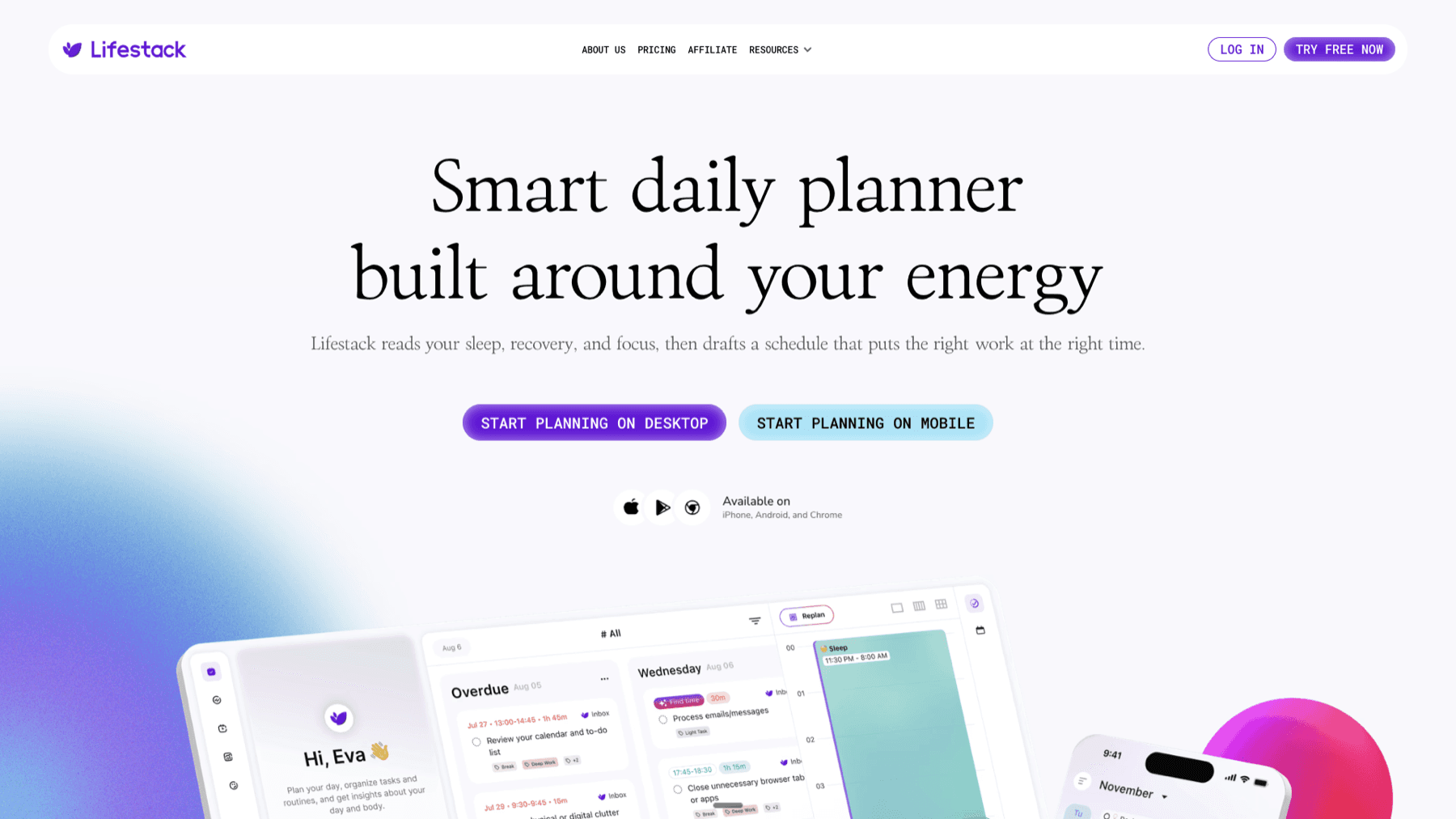
For remote and distributed teams where people work across different schedules, Lifestack provides each person with a day structured around their individual energy state. The result is that team members produce their best work when they are actually capable of it, not when a shared calendar says they should be.
Lifestack costs $7/month or $50/year and is available on iOS, Android, and as a Chrome extension.
Frequently Asked Questions
How does diversity improve team performance?
Diversity improves performance primarily by disrupting conformity. In diverse groups, people cannot assume their assumptions are shared. They prepare more thoroughly, articulate their reasoning more carefully, and challenge incorrect beliefs more actively. This rigor produces better decisions and more creative solutions than the comfortable consensus of homogeneous groups tends to generate.
Does diversity always improve outcomes?
Not automatically. Research shows diversity benefits are strongest when the work requires innovation, novel problem-solving, or decisions under uncertainty. For highly routine, execution-focused tasks with well-established processes, diversity's performance advantage is smaller. The benefit also depends on deliberate management: psychological safety, structured communication, and explicit decision-making processes make diverse teams perform better; without these, diverse teams can underperform due to miscommunication and unresolved conflict.
What is cognitive diversity?
Cognitive diversity refers to differences in how people think: their problem-solving approaches, reasoning styles, tolerance for ambiguity, and ways of structuring information. It also extends to individual differences in when people are most capable of focused thinking, a phenomenon determined by chronotype. Cognitive diversity does not always correlate with demographic diversity; two people from similar backgrounds can think very differently, while two people from different backgrounds can have similar cognitive styles.
Why do diverse teams sometimes report lower satisfaction?
This is what researchers call the "discomfort paradox." Diverse teams often feel less cohesive, less certain their views will be understood, and more uncertain about group dynamics. These feelings can reduce reported satisfaction even when objective performance is higher. It is a real psychological cost of diversity, and it is why psychological safety and deliberate team management are not optional add-ons in diverse teams; they are requirements for the performance benefits to materialize.
How do you manage cognitive diversity in a remote team?
For remote teams, managing cognitive diversity means building flexibility into how and when work happens. Asynchronous communication reduces the pressure to be present and responsive during hours that are not your cognitive peak. Documented decisions and explicit reasoning reduce the reliance on shared implicit context. Individual scheduling tools that respect each person's energy patterns, rather than imposing a uniform workday structure, allow different cognitive profiles to contribute at their actual best.
What is the difference between diversity and inclusion?
Diversity refers to who is in the room: the differences in background, identity, experience, and thinking style within a group. Inclusion refers to whether those differences are actually drawn on: whether people with different perspectives feel safe sharing them, whether dissent is welcomed, and whether different working styles are accommodated. You can have diversity without inclusion (a diverse team where only certain voices are heard), and that produces the psychological costs without the performance benefits. Inclusion is what activates diversity's value.
Diversity has become one of the most studied topics in organizational research, and the findings are consistent: diverse teams make better decisions, generate more innovative solutions, and produce stronger financial outcomes than homogeneous ones. But the mechanism behind why diversity works is less intuitive than it seems.
The answer is not simply that diversity brings more perspectives to the table. It is that diversity creates a different social dynamic. People in diverse groups work harder to prepare, communicate more carefully, and challenge assumptions they would otherwise take for granted. The presence of difference changes how people think, not just what they think about.
This guide covers what research actually shows about how diversity works, why it produces the results it does, and how organizations and individuals can apply these findings in practice.
Key Takeaways
Diversity improves team performance primarily by disrupting conformity and forcing more rigorous thinking, not by simply adding perspectives
The performance benefits of diversity are real but require deliberate management; diverse teams do not self-organize effectively without intentional effort
Cognitive diversity, including differences in how and when people think best, is an underappreciated dimension that directly affects individual and team output
What Diversity Actually Is
Diversity in organizations takes several distinct forms, and understanding which type you are working with matters for predicting outcomes.
Demographic diversity refers to differences in gender, race, ethnicity, age, and similar characteristics. This is the most visible form of diversity and the one most commonly referenced in corporate discourse. Research on demographic diversity shows consistent performance benefits, particularly in innovation-heavy industries and senior leadership positions.
Cognitive diversity refers to differences in how people think: their problem-solving styles, their tolerance for ambiguity, their reasoning approaches, and their ways of structuring information. Cognitive diversity is often invisible on the surface and does not always correlate with demographic diversity. A team can be demographically homogeneous but cognitively diverse, and vice versa.
Experiential diversity refers to differences in educational backgrounds, career paths, industry experience, and cultural history. Someone who built their career in manufacturing brings different mental models to a software team than a colleague who came up through finance. These experiential differences produce distinct views on risk, quality, and process that demographic diversity alone does not capture.
Why Diverse Teams Perform Better
Researcher Katherine Phillips at Columbia Business School conducted a series of experiments that reveal the mechanism behind diversity's performance benefits. When people work alongside socially dissimilar colleagues, they feel less comfortable. They anticipate disagreement. They prepare more thoroughly. They work harder to articulate and defend their reasoning because they cannot assume their assumptions are shared.
This preparation and rigor produces better outcomes. A study of S&P 1500 companies by Dezsö and Ross found that firms adding women to senior leadership generated approximately $40 million more in annual value, but only in companies where innovation was a core strategic driver. The benefit of diversity was contingent on the type of work being done: it mattered most where novel thinking was rewarded over execution of established processes.
A second mechanism is error correction. In homogeneous groups, incorrect assumptions spread unchallenged. In diverse groups, the different reference points of team members create natural friction that surfaces errors before they compound. McKinsey research across hundreds of companies found that those in the top quartile for gender diversity were 15 percent more likely to have above-average financial returns than their industry peers, and those in the top quartile for ethnic diversity were 35 percent more likely.
The Discomfort Paradox
One of the most consistent and counterintuitive findings in diversity research is what Phillips calls the "discomfort paradox": people in diverse groups often report lower confidence and satisfaction than those in homogeneous groups, even when they are performing better.
Members of diverse teams feel less sure their views will be understood, less certain of social support, and more anxious about group dynamics. Yet their outputs, measured objectively, are stronger. The performance gain from diversity comes partly at the cost of the psychological comfort that homogeneity provides.
This has important practical implications for managers. If you assess team health by asking people how comfortable and cohesive they feel, diverse teams will often score lower than homogeneous ones, even when they are doing better work. Evaluating team performance on outputs rather than process satisfaction is more accurate when diverse teams are involved.
Cognitive Diversity and Individual Differences at Work
Cognitive diversity goes beyond thinking style. It includes differences in how and when people are capable of their best work. Chronobiological research has documented substantial variation in individual "chronotypes," meaning the natural timing of a person's peak cognitive performance. Some people are genuinely sharper in the early morning. Others reach their cognitive peak in late morning or early afternoon. Night owls do their best thinking in the evening.
Forcing every team member to do their most demanding work in a standardized morning window ignores this form of natural cognitive diversity. A meeting scheduled at 9am may be someone's peak and another person's worst hour. Acknowledging chronotype differences in how work is scheduled is one of the most underutilized forms of cognitive diversity management.
Understanding personal energy management gives individuals the tools to identify their own cognitive windows and protect them. The question of when to schedule deep work is not the same for every person on a team, and treating it as though it were wastes a significant portion of cognitive potential.
How to Make Diversity Work in Practice
The research on diversity makes clear that its benefits are not automatic. Diverse teams need specific conditions to perform well.
Psychological safety first. People in diverse teams will not share dissenting views or challenge incorrect assumptions unless they believe doing so is safe. Building norms of intellectual respect and explicitly rewarding disagreement-as-inquiry (not as criticism) is the foundation that makes cognitive diversity productive.
Structure over spontaneity. Homogeneous groups rely on implicit shared norms to coordinate. Diverse groups benefit from explicit structure: clear decision-making processes, documented reasoning, and formal mechanisms for surfacing dissent. Good team productivity tools support this by creating shared visibility into work and decisions.
Separate idea generation from evaluation. Research consistently shows that premature criticism kills the cognitive diversity benefit. Having people generate ideas independently before group discussion prevents the early anchoring that leads to homogenization of thought in group settings.
Respect different working rhythms. Good workplace habits include giving team members control over when they do their most demanding work. Respecting chronotype diversity through flexible scheduling, asynchronous communication norms, and protected focus time gives different cognitive profiles the conditions they need to contribute at their best.
Manage workload visibility. In diverse teams, invisible workload imbalances are more likely to go unaddressed because assumptions about contribution are harder to form. Building workload management tools into your team's workflow makes disparities visible before they create resentment or disengagement.
Give autonomy on how, not just what. Research on high-performing diverse teams finds that autonomy to make decisions about how work gets done is more motivating for diverse contributors than autonomy over topic alone. People with different working styles need flexibility in process, not just choice of task.
Best Tool for Supporting Cognitive Diversity on Teams
One of the most direct ways to put cognitive diversity principles into practice is to stop scheduling everyone's demanding work at the same time and instead support each person in working at their own cognitive peak.
Lifestack does this at the individual level. It reads each person's sleep quality, HRV, and energy patterns from their wearable and builds a daily schedule around their actual peak performance windows. One team member's best hours for strategic thinking might be 9 to 11am. Another's might be 1 to 3pm. Lifestack accounts for this automatically rather than treating everyone as cognitively identical.
For remote and distributed teams where people work across different schedules, Lifestack provides each person with a day structured around their individual energy state. The result is that team members produce their best work when they are actually capable of it, not when a shared calendar says they should be.
Lifestack costs $7/month or $50/year and is available on iOS, Android, and as a Chrome extension.
Frequently Asked Questions
How does diversity improve team performance?
Diversity improves performance primarily by disrupting conformity. In diverse groups, people cannot assume their assumptions are shared. They prepare more thoroughly, articulate their reasoning more carefully, and challenge incorrect beliefs more actively. This rigor produces better decisions and more creative solutions than the comfortable consensus of homogeneous groups tends to generate.
Does diversity always improve outcomes?
Not automatically. Research shows diversity benefits are strongest when the work requires innovation, novel problem-solving, or decisions under uncertainty. For highly routine, execution-focused tasks with well-established processes, diversity's performance advantage is smaller. The benefit also depends on deliberate management: psychological safety, structured communication, and explicit decision-making processes make diverse teams perform better; without these, diverse teams can underperform due to miscommunication and unresolved conflict.
What is cognitive diversity?
Cognitive diversity refers to differences in how people think: their problem-solving approaches, reasoning styles, tolerance for ambiguity, and ways of structuring information. It also extends to individual differences in when people are most capable of focused thinking, a phenomenon determined by chronotype. Cognitive diversity does not always correlate with demographic diversity; two people from similar backgrounds can think very differently, while two people from different backgrounds can have similar cognitive styles.
Why do diverse teams sometimes report lower satisfaction?
This is what researchers call the "discomfort paradox." Diverse teams often feel less cohesive, less certain their views will be understood, and more uncertain about group dynamics. These feelings can reduce reported satisfaction even when objective performance is higher. It is a real psychological cost of diversity, and it is why psychological safety and deliberate team management are not optional add-ons in diverse teams; they are requirements for the performance benefits to materialize.
How do you manage cognitive diversity in a remote team?
For remote teams, managing cognitive diversity means building flexibility into how and when work happens. Asynchronous communication reduces the pressure to be present and responsive during hours that are not your cognitive peak. Documented decisions and explicit reasoning reduce the reliance on shared implicit context. Individual scheduling tools that respect each person's energy patterns, rather than imposing a uniform workday structure, allow different cognitive profiles to contribute at their actual best.
What is the difference between diversity and inclusion?
Diversity refers to who is in the room: the differences in background, identity, experience, and thinking style within a group. Inclusion refers to whether those differences are actually drawn on: whether people with different perspectives feel safe sharing them, whether dissent is welcomed, and whether different working styles are accommodated. You can have diversity without inclusion (a diverse team where only certain voices are heard), and that produces the psychological costs without the performance benefits. Inclusion is what activates diversity's value.



FOLLOW ON
FOLLOW ON
FOLLOW ON


Copyright 2026 © Lifestack. All rights reserved
Copyright 2026 © Lifestack. All rights reserved

