
Tips
Good Workplace Habits: 8 That Actually Stick
Good Workplace Habits: 8 That Actually Stick

Most advice about good workplace habits focuses on working harder. Get up earlier. Plan more. Move faster. But the people who sustain high performance over years do not work harder than everyone else. They work with better systems, and those systems become habits so ingrained that they stop requiring willpower to maintain.
The gap between a stressful workday and a focused one usually comes down to a handful of behaviors. Not personality, not talent. Behaviors. The good news is that behaviors can be changed. The challenging part is that changing them takes deliberate practice for long enough that the new pattern becomes automatic.
This guide covers 8 good workplace habits worth building. Each one is practical, specific, and backed by how high-performing people actually structure their days. Whether you are improving your organizational skills from scratch or refining a system that mostly works, these habits give you a clear starting point.
Key Takeaways
Good workplace habits work because they remove the daily decision of how to structure your time
Energy management matters as much as time management: scheduling hard work during low-energy windows is a silent productivity drain
A shutdown ritual and weekly review are two of the highest-ROI habits because they prevent problems rather than fixing them
Habit 1: Start Every Day With a Planning Session
One of the most common reasons workdays feel chaotic is that they start reactively. You open your laptop, check messages, respond to whatever feels urgent, and suddenly two hours are gone with nothing meaningful accomplished. A daily planning session breaks this pattern before it starts.
The session does not need to be long. Ten to fifteen minutes is enough. The goal is to identify your one to three most important tasks for the day, estimate realistic time for each, and block those tasks in your calendar before anything else fills the slots. You are setting the agenda instead of letting the agenda set itself.
The best daily planner apps support this by pulling together your calendar, tasks, and priorities in one view so the planning session takes minutes rather than an hour of gathering context. When your day has a plan, interruptions stay interruptions instead of becoming the entire day.
Habit 2: Single-Task to Protect Your Focus
Multitasking feels productive. The research says otherwise. Switching between tasks carries a cognitive cost every time, and that cost accumulates across a workday into something close to having lost two or three hours of productive thinking.
Single-tasking means working on one thing with full attention until it is done, or until a deliberate stopping point, before switching. It sounds obvious because it is obvious. The challenge is that email notifications, Slack pings, and low-priority interruptions make it structurally difficult to do in most work environments.
The fix is environmental as much as behavioral. Close other tabs. Put your phone face-down. Use app focus modes. Make distraction harder to reach than focus. Once the single-tasking habit is established, you will find that two hours of real focused work produces more output than four hours of fragmented switching.
Habit 3: Manage Your Energy, Not Just Your Hours
A calendar with twelve hours of tasks does not guarantee twelve hours of productive output. Most people have a cognitive peak window of three to five hours per day. Outside that window, the same work takes longer and produces worse results.
Energy-based planning matches your hardest tasks to your best hours. If you know your mornings are sharp and your early afternoons are flat, deep analytical work belongs in the morning. Email, meetings, and administrative tasks belong in the trough. This is not a radical insight, but very few people actually structure their calendar this way.
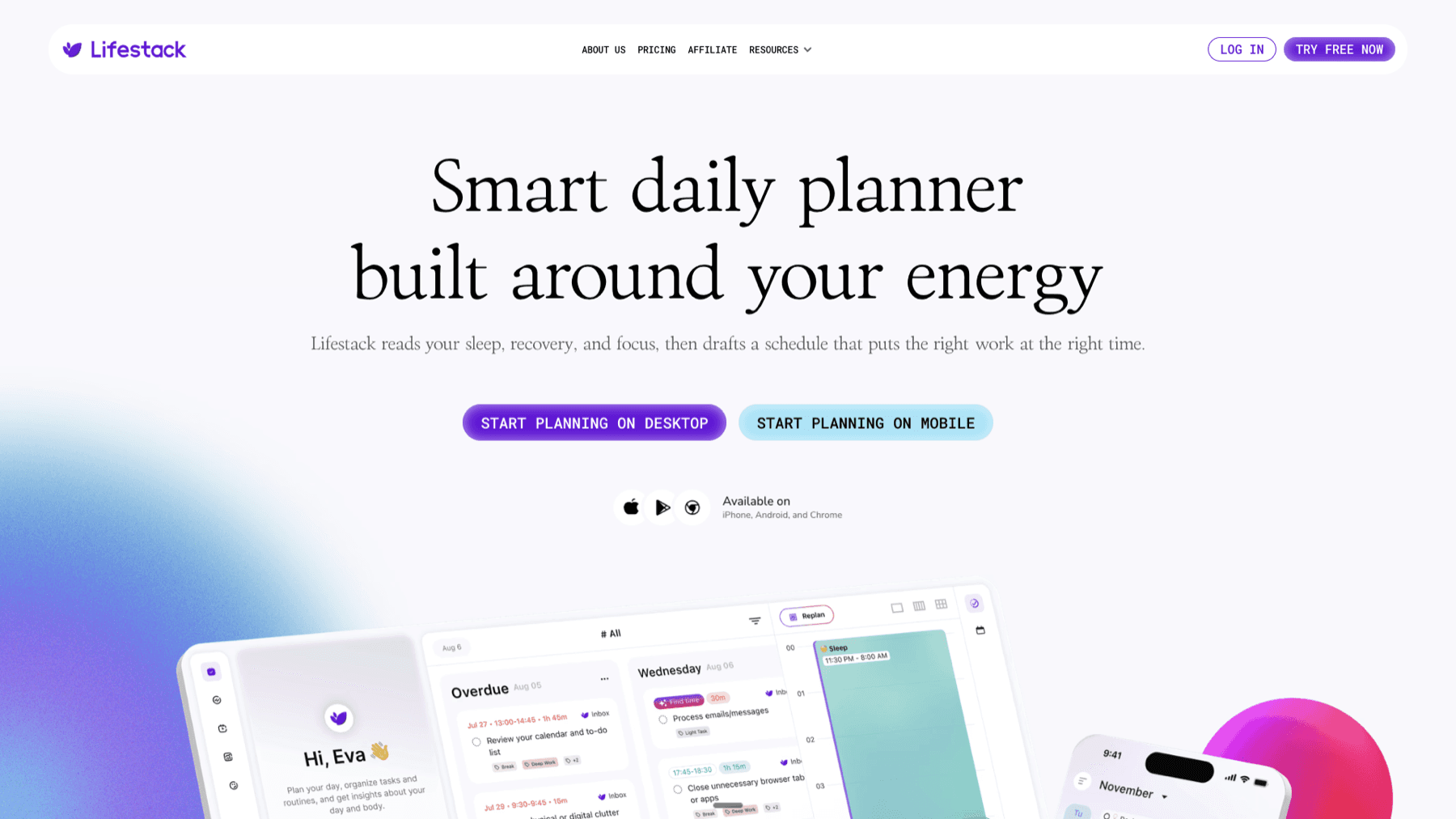
Lifestack makes this automatic by reading your sleep and recovery data from wearables like Oura Ring, Apple Watch, or WHOOP. On a high-recovery morning, it schedules demanding tasks early. On a low-recovery day, it adjusts expectations and redistributes the workload toward lighter tasks. The result is a daily schedule that actually fits your biology rather than fighting it.
Habit 4: Protect Blocks of Deep Work
Deep work is the focused, uninterrupted effort that produces the most valuable output. Writing, coding, strategic analysis, design thinking. It requires a minimum of 90 uninterrupted minutes to reach the cognitive state where the real work happens.
The habit here is treating deep work blocks like meetings you cannot miss. They get scheduled first. Everything else fills around them. If your calendar currently shows deep work fitting into whatever gaps are left after meetings, that is the problem. Flip the order.
Block two to three hours of deep work on your calendar every morning. Decline or push meetings that encroach on that window whenever possible. Over time, your colleagues learn the pattern and stop scheduling into it by default. Using a drag-and-drop calendar planner makes it easy to visualize and guard these blocks.
Habit 5: Set Boundaries Around Communication
Constant availability is a bad habit disguised as a virtue. Responding to every message within minutes signals responsiveness but destroys any possibility of sustained focus. It also trains your colleagues to expect immediate responses, which makes the boundary harder to set later.
A practical approach: check email and messages at two or three set windows during the day. Morning, midday, and late afternoon is a common rhythm. Outside those windows, notifications are off and you are not checking. This is one of the good workplace habits most likely to face pushback, but the resistance usually fades once colleagues see that response times are still reasonable, just not instantaneous.
If your role genuinely requires constant availability, define what that means explicitly. Real emergencies exist. Low-priority Slack messages framed as urgent do not. Drawing that line clearly protects your focus without creating real coverage gaps.
Habit 6: Take Structured Breaks
Skipping breaks to push through more work usually produces the opposite outcome. Decision quality drops, errors increase, and the last two hours of the day often undo progress from earlier. Breaks are not a reward for finishing work. They are part of how sustained work happens.
Structured breaks work better than spontaneous ones. The Pomodoro method (25 minutes of focus, 5 minutes of rest) is one option. A 90-minute focus block followed by a 15-minute break mirrors the brain's natural ultradian cycle more closely. The exact duration matters less than the regularity.
What you do during breaks also matters. A walk, stretching, or stepping away from all screens is more restorative than scrolling social media, which keeps the brain in a stimulated but unfocused state. If time blindness is a challenge for you, setting a timer to start and end breaks removes the guesswork entirely.
Habit 7: Build a Shutdown Ritual
Most knowledge workers do not have a clear end to their workday. Laptops stay open, notifications keep arriving, and the mental state of "work" persists through dinner and into the evening. This is not dedication. It is a failure to close the loop, and it degrades sleep, recovery, and the next day's performance.
A shutdown ritual is a repeatable sequence that signals to your brain that work is finished. It might be: close all open tabs, update your task list with what got done, write three priorities for tomorrow, close the laptop, say "shutdown complete" out loud. Cal Newport popularized this pattern in Deep Work, and the research on mental fatigue strongly supports it.
The key is that the ritual is consistent enough to become automatic. When your brain learns the sequence, it stops churning on unfinished work items in the background once the ritual is complete. People who build this habit consistently report better sleep and a meaningful reduction in evening anxiety about work.
Habit 8: Review Your Week Every Friday
The weekly review is the meta-habit that keeps all the others working together. Without it, small drift accumulates: priorities shift, commitments pile up, and the gap between what you planned to do and what you actually did widens invisibly over weeks.
A 20-minute Friday review asks three questions. What actually moved this week? What is still stuck and why? What is the one thing next week needs to accomplish? The answers realign your priorities before the week starts, not after it ends when the damage is done.
This habit also surfaces problems early. A project that slipped for one week gets caught on Friday. A pattern of the same tasks getting avoided every week points to something worth examining. Good task management combined with a weekly review gives you data about your own work patterns that no amount of ambition alone can match.
Best Tool for Building Good Workplace Habits
Tools work best when they make habits automatic rather than requiring extra willpower. Lifestack is built specifically around the habits that matter most here: energy-aware scheduling, daily planning, and connecting short-term tasks to longer-arc priorities.
It reads your wearable data to score your daily energy, then builds a schedule that matches your cognitive state to your task demands. On days when recovery data shows you are depleted, it suggests lighter work and moves deep focus blocks to better windows. On high-energy days, it surfaces your most important tasks early.
Unlike a generic calendar app, Lifestack gives you a daily planning layer that accounts for how you actually feel, not just when slots are open. Pricing starts at $7/month or $50/year, with a free trial on the annual plan.
FAQ
What are the most important good workplace habits to start with?
Start with the daily planning session and the shutdown ritual. These two bookends create structure at both ends of the workday and deliver visible results quickly. Once those are automatic, add single-tasking and deep work blocks. Do not try to change everything at once.
How long does it take to build a new workplace habit?
Research on habit formation suggests somewhere between 18 and 254 days depending on the person and the habit's complexity. The often-cited "21 days" is a myth. For most workplace habits, expect 6 to 8 weeks of consistent practice before the behavior starts to feel automatic rather than effortful.
Can good workplace habits help with ADHD at work?
Yes. Many of the habits in this list are especially valuable for people with ADHD time management challenges: the daily planning session externalizes priorities so they do not rely on working memory, the shutdown ritual closes open loops that otherwise continue demanding attention, and structured breaks work with the brain's natural rhythm rather than against it.
What if my workplace culture makes these habits hard to maintain?
Start with the habits that do not require your colleagues to change their behavior. Daily planning, shutdown rituals, single-tasking, and structured breaks are all personal habits you can build independently. Communication boundaries are the one area that involves others, and those work best when introduced gradually with clear framing about what you are protecting and why.
How is energy management different from time management?
Time management asks when you do something. Energy management asks whether you are in the right cognitive state to do it well. You can schedule a hard task at 9am and still produce poor work if your sleep was bad and your recovery score is low. Energy-based planning adds the missing variable that pure time management ignores.
Do I need a special app to build good workplace habits?
No. A notebook and a basic calendar can support all of these habits. Apps help by reducing friction and automating the parts that require tracking, like energy scoring or task prioritization. The best AI planner app for workplace habits is one you will actually use every day rather than the one with the most features.
Most advice about good workplace habits focuses on working harder. Get up earlier. Plan more. Move faster. But the people who sustain high performance over years do not work harder than everyone else. They work with better systems, and those systems become habits so ingrained that they stop requiring willpower to maintain.
The gap between a stressful workday and a focused one usually comes down to a handful of behaviors. Not personality, not talent. Behaviors. The good news is that behaviors can be changed. The challenging part is that changing them takes deliberate practice for long enough that the new pattern becomes automatic.
This guide covers 8 good workplace habits worth building. Each one is practical, specific, and backed by how high-performing people actually structure their days. Whether you are improving your organizational skills from scratch or refining a system that mostly works, these habits give you a clear starting point.
Key Takeaways
Good workplace habits work because they remove the daily decision of how to structure your time
Energy management matters as much as time management: scheduling hard work during low-energy windows is a silent productivity drain
A shutdown ritual and weekly review are two of the highest-ROI habits because they prevent problems rather than fixing them
Habit 1: Start Every Day With a Planning Session
One of the most common reasons workdays feel chaotic is that they start reactively. You open your laptop, check messages, respond to whatever feels urgent, and suddenly two hours are gone with nothing meaningful accomplished. A daily planning session breaks this pattern before it starts.
The session does not need to be long. Ten to fifteen minutes is enough. The goal is to identify your one to three most important tasks for the day, estimate realistic time for each, and block those tasks in your calendar before anything else fills the slots. You are setting the agenda instead of letting the agenda set itself.
The best daily planner apps support this by pulling together your calendar, tasks, and priorities in one view so the planning session takes minutes rather than an hour of gathering context. When your day has a plan, interruptions stay interruptions instead of becoming the entire day.
Habit 2: Single-Task to Protect Your Focus
Multitasking feels productive. The research says otherwise. Switching between tasks carries a cognitive cost every time, and that cost accumulates across a workday into something close to having lost two or three hours of productive thinking.
Single-tasking means working on one thing with full attention until it is done, or until a deliberate stopping point, before switching. It sounds obvious because it is obvious. The challenge is that email notifications, Slack pings, and low-priority interruptions make it structurally difficult to do in most work environments.
The fix is environmental as much as behavioral. Close other tabs. Put your phone face-down. Use app focus modes. Make distraction harder to reach than focus. Once the single-tasking habit is established, you will find that two hours of real focused work produces more output than four hours of fragmented switching.
Habit 3: Manage Your Energy, Not Just Your Hours
A calendar with twelve hours of tasks does not guarantee twelve hours of productive output. Most people have a cognitive peak window of three to five hours per day. Outside that window, the same work takes longer and produces worse results.
Energy-based planning matches your hardest tasks to your best hours. If you know your mornings are sharp and your early afternoons are flat, deep analytical work belongs in the morning. Email, meetings, and administrative tasks belong in the trough. This is not a radical insight, but very few people actually structure their calendar this way.
Lifestack makes this automatic by reading your sleep and recovery data from wearables like Oura Ring, Apple Watch, or WHOOP. On a high-recovery morning, it schedules demanding tasks early. On a low-recovery day, it adjusts expectations and redistributes the workload toward lighter tasks. The result is a daily schedule that actually fits your biology rather than fighting it.
Habit 4: Protect Blocks of Deep Work
Deep work is the focused, uninterrupted effort that produces the most valuable output. Writing, coding, strategic analysis, design thinking. It requires a minimum of 90 uninterrupted minutes to reach the cognitive state where the real work happens.
The habit here is treating deep work blocks like meetings you cannot miss. They get scheduled first. Everything else fills around them. If your calendar currently shows deep work fitting into whatever gaps are left after meetings, that is the problem. Flip the order.
Block two to three hours of deep work on your calendar every morning. Decline or push meetings that encroach on that window whenever possible. Over time, your colleagues learn the pattern and stop scheduling into it by default. Using a drag-and-drop calendar planner makes it easy to visualize and guard these blocks.
Habit 5: Set Boundaries Around Communication
Constant availability is a bad habit disguised as a virtue. Responding to every message within minutes signals responsiveness but destroys any possibility of sustained focus. It also trains your colleagues to expect immediate responses, which makes the boundary harder to set later.
A practical approach: check email and messages at two or three set windows during the day. Morning, midday, and late afternoon is a common rhythm. Outside those windows, notifications are off and you are not checking. This is one of the good workplace habits most likely to face pushback, but the resistance usually fades once colleagues see that response times are still reasonable, just not instantaneous.
If your role genuinely requires constant availability, define what that means explicitly. Real emergencies exist. Low-priority Slack messages framed as urgent do not. Drawing that line clearly protects your focus without creating real coverage gaps.
Habit 6: Take Structured Breaks
Skipping breaks to push through more work usually produces the opposite outcome. Decision quality drops, errors increase, and the last two hours of the day often undo progress from earlier. Breaks are not a reward for finishing work. They are part of how sustained work happens.
Structured breaks work better than spontaneous ones. The Pomodoro method (25 minutes of focus, 5 minutes of rest) is one option. A 90-minute focus block followed by a 15-minute break mirrors the brain's natural ultradian cycle more closely. The exact duration matters less than the regularity.
What you do during breaks also matters. A walk, stretching, or stepping away from all screens is more restorative than scrolling social media, which keeps the brain in a stimulated but unfocused state. If time blindness is a challenge for you, setting a timer to start and end breaks removes the guesswork entirely.
Habit 7: Build a Shutdown Ritual
Most knowledge workers do not have a clear end to their workday. Laptops stay open, notifications keep arriving, and the mental state of "work" persists through dinner and into the evening. This is not dedication. It is a failure to close the loop, and it degrades sleep, recovery, and the next day's performance.
A shutdown ritual is a repeatable sequence that signals to your brain that work is finished. It might be: close all open tabs, update your task list with what got done, write three priorities for tomorrow, close the laptop, say "shutdown complete" out loud. Cal Newport popularized this pattern in Deep Work, and the research on mental fatigue strongly supports it.
The key is that the ritual is consistent enough to become automatic. When your brain learns the sequence, it stops churning on unfinished work items in the background once the ritual is complete. People who build this habit consistently report better sleep and a meaningful reduction in evening anxiety about work.
Habit 8: Review Your Week Every Friday
The weekly review is the meta-habit that keeps all the others working together. Without it, small drift accumulates: priorities shift, commitments pile up, and the gap between what you planned to do and what you actually did widens invisibly over weeks.
A 20-minute Friday review asks three questions. What actually moved this week? What is still stuck and why? What is the one thing next week needs to accomplish? The answers realign your priorities before the week starts, not after it ends when the damage is done.
This habit also surfaces problems early. A project that slipped for one week gets caught on Friday. A pattern of the same tasks getting avoided every week points to something worth examining. Good task management combined with a weekly review gives you data about your own work patterns that no amount of ambition alone can match.
Best Tool for Building Good Workplace Habits
Tools work best when they make habits automatic rather than requiring extra willpower. Lifestack is built specifically around the habits that matter most here: energy-aware scheduling, daily planning, and connecting short-term tasks to longer-arc priorities.
It reads your wearable data to score your daily energy, then builds a schedule that matches your cognitive state to your task demands. On days when recovery data shows you are depleted, it suggests lighter work and moves deep focus blocks to better windows. On high-energy days, it surfaces your most important tasks early.
Unlike a generic calendar app, Lifestack gives you a daily planning layer that accounts for how you actually feel, not just when slots are open. Pricing starts at $7/month or $50/year, with a free trial on the annual plan.
FAQ
What are the most important good workplace habits to start with?
Start with the daily planning session and the shutdown ritual. These two bookends create structure at both ends of the workday and deliver visible results quickly. Once those are automatic, add single-tasking and deep work blocks. Do not try to change everything at once.
How long does it take to build a new workplace habit?
Research on habit formation suggests somewhere between 18 and 254 days depending on the person and the habit's complexity. The often-cited "21 days" is a myth. For most workplace habits, expect 6 to 8 weeks of consistent practice before the behavior starts to feel automatic rather than effortful.
Can good workplace habits help with ADHD at work?
Yes. Many of the habits in this list are especially valuable for people with ADHD time management challenges: the daily planning session externalizes priorities so they do not rely on working memory, the shutdown ritual closes open loops that otherwise continue demanding attention, and structured breaks work with the brain's natural rhythm rather than against it.
What if my workplace culture makes these habits hard to maintain?
Start with the habits that do not require your colleagues to change their behavior. Daily planning, shutdown rituals, single-tasking, and structured breaks are all personal habits you can build independently. Communication boundaries are the one area that involves others, and those work best when introduced gradually with clear framing about what you are protecting and why.
How is energy management different from time management?
Time management asks when you do something. Energy management asks whether you are in the right cognitive state to do it well. You can schedule a hard task at 9am and still produce poor work if your sleep was bad and your recovery score is low. Energy-based planning adds the missing variable that pure time management ignores.
Do I need a special app to build good workplace habits?
No. A notebook and a basic calendar can support all of these habits. Apps help by reducing friction and automating the parts that require tracking, like energy scoring or task prioritization. The best AI planner app for workplace habits is one you will actually use every day rather than the one with the most features.



FOLLOW ON
FOLLOW ON
FOLLOW ON


Copyright 2026 © Lifestack. All rights reserved
Copyright 2026 © Lifestack. All rights reserved

