
Book
Hyperfocus by Chris Bailey: Summary and Review
Hyperfocus by Chris Bailey: Summary and Review

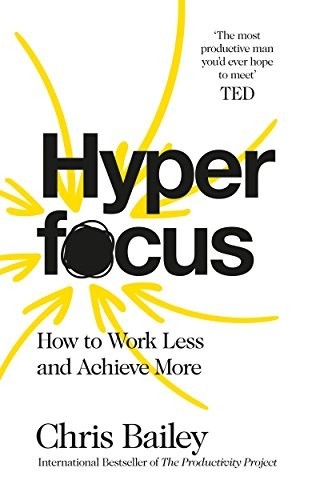
Most books about focus tell you to eliminate distraction. Chris Bailey's Hyperfocus takes a different angle: instead of just removing what pulls your attention away, it teaches you to deliberately place your attention where you want it. The book's central argument is that attention is the most valuable resource you manage at work, and that managing it intentionally is a learnable skill.
Bailey is the author of The Productivity Project and one of the more credible voices in the productivity space because he actually runs experiments on himself and cites research he's read rather than paraphrasing popular accounts. Hyperfocus is his most focused book (appropriately), and it's built around two modes of attention that he argues you need to alternate between: hyperfocus and scatterfocus.
If you've read Cal Newport's Deep Work and found it a bit austere, Bailey's approach is a practical complement. Less monastic, more modular.
Key Takeaways
Hyperfocus is intentional deep attention on one task. Scatterfocus is deliberate mind-wandering that produces creative connections. Both are necessary, and most people only value the first.
Your attentional space is finite. Every background task, notification, and open loop you're aware of is consuming part of it, even when you're not actively thinking about it.
The most important question you can ask yourself at the start of any work session: what is the most consequential thing I can give my full attention to right now?
What the Book Covers
The book is divided into two parts. Part one covers hyperfocus: how to enter a state of sustained, intentional attention; how long it actually takes to get there after an interruption; and how to choose what deserves that level of focus. Part two covers scatterfocus: the counterintuitive value of letting your mind wander intentionally, and the specific conditions under which this produces better creative thinking than grinding harder.
Bailey draws on a lot of the same research base as the neuroscience literature on attention (working memory limits, task-switching costs, the default mode network) but presents it accessibly. This is not a dense academic text. It reads quickly and the practical experiments scattered throughout give you something concrete to try rather than just concepts to understand.
Hyperfocus: What It Is and How to Enter It
Bailey defines hyperfocus as intentionally directing your full attention to one task until it's complete or until your session ends. That might sound obvious, but his point is that most people never actually do this. They work on a task while being vaguely aware of their email, their phone, the conversation happening nearby, and the 12 other things on their mental to-do list. None of those things are the task in front of them, but all of them are consuming attentional space.
He introduces the concept of "attentional space" as an analogy for working memory capacity. Imagine a desktop with a fixed surface area. Every open loop in your mind (things you meant to do, things you're worried about, background tasks) takes up space on that desktop. When the desktop is full of half-open windows, there's no room for the one thing you're trying to work on.
The four steps Bailey describes for entering hyperfocus: choose a single worthwhile object of focus, eliminate external distractions before you start, eliminate internal distractions (capture open loops to a trusted system), and keep returning your attention when it wanders. The last step is the practice. Your attention will wander. Returning it is the skill, not preventing the wander in the first place. For people wondering when to schedule deep work, Bailey's answer is: whenever your cognitive energy is highest, protected from the tasks that don't require focus at all.
The Productivity Sweet Spot
One of the more practically useful frameworks in the book is the productivity sweet spot matrix. Bailey maps tasks across two dimensions: how engaging they are and how consequential they are. The ideal hyperfocus target is a task that is both consequential and not so engaging that it pulls attention effortlessly (in that case you don't need to manage your attention, the task does it for you).
The tasks to watch for are those that are highly stimulating but low-consequence: social media, email, news feeds. These easily colonize your attentional space because they're designed to, but they produce very little in return. Bailey calls these "attractive distractions" and suggests treating them as deliberate breaks rather than work modes.
Hyperfocus versus ADHD hyperfocus
A note worth making: Bailey's "hyperfocus" is a chosen state of attention, not the same as hyperfocus in ADHD, which is typically involuntary and task-specific. Bailey's framework is about building a deliberate attention practice. ADHD hyperfocus tends to occur spontaneously around topics of intense interest, regardless of whether they're productive. The two concepts share a name and some surface similarity but are neurologically distinct.
Scatterfocus: Why Mind-Wandering Matters
The second half of the book is where Bailey distinguishes himself from most productivity writing. While everyone else is telling you to eliminate mind-wandering, Bailey argues that intentional mind-wandering is one of the most valuable cognitive modes you have access to. The brain's default mode network (the network active when you're not focused on an external task) is responsible for connecting ideas, planning, and self-referential thinking.
When you never let your mind wander, you shut down that network. You can maintain execution quality in the short term, but creative and strategic thinking suffers. This explains why good ideas tend to arrive in the shower, on a walk, or in that half-awake state before sleep. Those are the moments when the default mode network gets access.
Bailey's prescription is to schedule deliberate scatterfocus sessions: low-stimulation activities (walking without a podcast, a boring chore, a quiet sit) where your mind is free to associate. This isn't procrastination. It's the cognitive mode that produces the connections your focused work later executes.
For the science behind this, see our post on deep work trigger habits and neuroscience. The default mode network research is also what drives the recommendation for nature exposure in The Distracted Mind.
Practical Tools from the Book
The hourly awareness chime: Set a recurring reminder every hour to notice what your attention is on. Over a few days, this builds accurate self-knowledge about where your attention actually goes vs. where you intended it to go.
The intention ritual: Before each work session, write down one thing you intend to accomplish. This sets a top-down goal that makes it easier to return your attention when it drifts.
The distraction list: Keep a notepad next to your work. When a distraction thought arises ("I need to call back X", "I should check on Y"), write it down and return to the task. This offloads the open loop from working memory without losing it.
Scheduled scatterfocus: Build in at least one low-stimulation activity daily where your phone stays put. Walk, shower, commute without audio. Treat this as production time, not idle time.
How Hyperfocus Applies to Scheduling
Bailey's framework assumes you have control over when you do cognitively demanding work. That's often not fully true in practice, especially in jobs with meeting-heavy calendars. But it points to a real principle: your capacity for hyperfocus is not uniform across the day. It's tied to energy, not just time available.
This is exactly the problem Lifestack is designed to solve. The app learns your energy patterns across the day and auto-schedules tasks accordingly, placing work that requires hyperfocus when your attention is at its peak and lower-demand tasks when it isn't. That's the structural version of what Bailey recommends doing manually. See how energy-based scheduling works and how it connects to personal energy management principles.
For a broader set of tools to support focused work, see our list of work focusing tools and how to improve focus at work.
Frequently Asked Questions
What is Hyperfocus by Chris Bailey about?
Hyperfocus is a book about intentional attention management. It argues that your ability to direct and sustain attention is the most valuable productivity skill you have, and that managing it deliberately (both by entering deep focus states and by scheduling deliberate mind-wandering) produces better work and more creative thinking than grinding harder.
Is Hyperfocus better than Deep Work?
They complement each other rather than compete. Newport's Deep Work is more prescriptive about lifestyle design and the case for deep work as a career differentiator. Bailey's Hyperfocus is more practical about the moment-to-moment management of attention and explicitly covers the scatterfocus side, which Newport doesn't. Read both. Start with whichever framing feels more relevant to where you are right now.
What is scatterfocus and why does it matter?
Scatterfocus is Bailey's term for deliberate, unstructured mind-wandering. When you're not focused on an external task, your brain's default mode network activates, making connections between ideas, processing experiences, and generating insights. Most productivity advice tries to eliminate this state. Bailey argues you should schedule it intentionally instead.
How long should a hyperfocus session be?
Bailey doesn't prescribe a fixed duration. Research on attention suggests that sustained focus on a single task starts to degrade for most people after 45-90 minutes without a break. Bailey recommends experimenting to find your own peak focus window and protecting that window from low-value interruptions.
Does Chris Bailey use any apps or tools for hyperfocus?
Bailey is generally tool-agnostic in the book, but the principles he describes map well onto scheduling tools that protect your peak attention windows. Lifestack does this automatically by learning your energy patterns and placing cognitively demanding tasks at the right times. Paired with Bailey's intention ritual before each session, this gives you both structural protection and a clear focus target.
Most books about focus tell you to eliminate distraction. Chris Bailey's Hyperfocus takes a different angle: instead of just removing what pulls your attention away, it teaches you to deliberately place your attention where you want it. The book's central argument is that attention is the most valuable resource you manage at work, and that managing it intentionally is a learnable skill.
Bailey is the author of The Productivity Project and one of the more credible voices in the productivity space because he actually runs experiments on himself and cites research he's read rather than paraphrasing popular accounts. Hyperfocus is his most focused book (appropriately), and it's built around two modes of attention that he argues you need to alternate between: hyperfocus and scatterfocus.
If you've read Cal Newport's Deep Work and found it a bit austere, Bailey's approach is a practical complement. Less monastic, more modular.
Key Takeaways
Hyperfocus is intentional deep attention on one task. Scatterfocus is deliberate mind-wandering that produces creative connections. Both are necessary, and most people only value the first.
Your attentional space is finite. Every background task, notification, and open loop you're aware of is consuming part of it, even when you're not actively thinking about it.
The most important question you can ask yourself at the start of any work session: what is the most consequential thing I can give my full attention to right now?
What the Book Covers
The book is divided into two parts. Part one covers hyperfocus: how to enter a state of sustained, intentional attention; how long it actually takes to get there after an interruption; and how to choose what deserves that level of focus. Part two covers scatterfocus: the counterintuitive value of letting your mind wander intentionally, and the specific conditions under which this produces better creative thinking than grinding harder.
Bailey draws on a lot of the same research base as the neuroscience literature on attention (working memory limits, task-switching costs, the default mode network) but presents it accessibly. This is not a dense academic text. It reads quickly and the practical experiments scattered throughout give you something concrete to try rather than just concepts to understand.
Hyperfocus: What It Is and How to Enter It
Bailey defines hyperfocus as intentionally directing your full attention to one task until it's complete or until your session ends. That might sound obvious, but his point is that most people never actually do this. They work on a task while being vaguely aware of their email, their phone, the conversation happening nearby, and the 12 other things on their mental to-do list. None of those things are the task in front of them, but all of them are consuming attentional space.
He introduces the concept of "attentional space" as an analogy for working memory capacity. Imagine a desktop with a fixed surface area. Every open loop in your mind (things you meant to do, things you're worried about, background tasks) takes up space on that desktop. When the desktop is full of half-open windows, there's no room for the one thing you're trying to work on.
The four steps Bailey describes for entering hyperfocus: choose a single worthwhile object of focus, eliminate external distractions before you start, eliminate internal distractions (capture open loops to a trusted system), and keep returning your attention when it wanders. The last step is the practice. Your attention will wander. Returning it is the skill, not preventing the wander in the first place. For people wondering when to schedule deep work, Bailey's answer is: whenever your cognitive energy is highest, protected from the tasks that don't require focus at all.
The Productivity Sweet Spot
One of the more practically useful frameworks in the book is the productivity sweet spot matrix. Bailey maps tasks across two dimensions: how engaging they are and how consequential they are. The ideal hyperfocus target is a task that is both consequential and not so engaging that it pulls attention effortlessly (in that case you don't need to manage your attention, the task does it for you).
The tasks to watch for are those that are highly stimulating but low-consequence: social media, email, news feeds. These easily colonize your attentional space because they're designed to, but they produce very little in return. Bailey calls these "attractive distractions" and suggests treating them as deliberate breaks rather than work modes.
Hyperfocus versus ADHD hyperfocus
A note worth making: Bailey's "hyperfocus" is a chosen state of attention, not the same as hyperfocus in ADHD, which is typically involuntary and task-specific. Bailey's framework is about building a deliberate attention practice. ADHD hyperfocus tends to occur spontaneously around topics of intense interest, regardless of whether they're productive. The two concepts share a name and some surface similarity but are neurologically distinct.
Scatterfocus: Why Mind-Wandering Matters
The second half of the book is where Bailey distinguishes himself from most productivity writing. While everyone else is telling you to eliminate mind-wandering, Bailey argues that intentional mind-wandering is one of the most valuable cognitive modes you have access to. The brain's default mode network (the network active when you're not focused on an external task) is responsible for connecting ideas, planning, and self-referential thinking.
When you never let your mind wander, you shut down that network. You can maintain execution quality in the short term, but creative and strategic thinking suffers. This explains why good ideas tend to arrive in the shower, on a walk, or in that half-awake state before sleep. Those are the moments when the default mode network gets access.
Bailey's prescription is to schedule deliberate scatterfocus sessions: low-stimulation activities (walking without a podcast, a boring chore, a quiet sit) where your mind is free to associate. This isn't procrastination. It's the cognitive mode that produces the connections your focused work later executes.
For the science behind this, see our post on deep work trigger habits and neuroscience. The default mode network research is also what drives the recommendation for nature exposure in The Distracted Mind.
Practical Tools from the Book
The hourly awareness chime: Set a recurring reminder every hour to notice what your attention is on. Over a few days, this builds accurate self-knowledge about where your attention actually goes vs. where you intended it to go.
The intention ritual: Before each work session, write down one thing you intend to accomplish. This sets a top-down goal that makes it easier to return your attention when it drifts.
The distraction list: Keep a notepad next to your work. When a distraction thought arises ("I need to call back X", "I should check on Y"), write it down and return to the task. This offloads the open loop from working memory without losing it.
Scheduled scatterfocus: Build in at least one low-stimulation activity daily where your phone stays put. Walk, shower, commute without audio. Treat this as production time, not idle time.
How Hyperfocus Applies to Scheduling
Bailey's framework assumes you have control over when you do cognitively demanding work. That's often not fully true in practice, especially in jobs with meeting-heavy calendars. But it points to a real principle: your capacity for hyperfocus is not uniform across the day. It's tied to energy, not just time available.
This is exactly the problem Lifestack is designed to solve. The app learns your energy patterns across the day and auto-schedules tasks accordingly, placing work that requires hyperfocus when your attention is at its peak and lower-demand tasks when it isn't. That's the structural version of what Bailey recommends doing manually. See how energy-based scheduling works and how it connects to personal energy management principles.
For a broader set of tools to support focused work, see our list of work focusing tools and how to improve focus at work.
Frequently Asked Questions
What is Hyperfocus by Chris Bailey about?
Hyperfocus is a book about intentional attention management. It argues that your ability to direct and sustain attention is the most valuable productivity skill you have, and that managing it deliberately (both by entering deep focus states and by scheduling deliberate mind-wandering) produces better work and more creative thinking than grinding harder.
Is Hyperfocus better than Deep Work?
They complement each other rather than compete. Newport's Deep Work is more prescriptive about lifestyle design and the case for deep work as a career differentiator. Bailey's Hyperfocus is more practical about the moment-to-moment management of attention and explicitly covers the scatterfocus side, which Newport doesn't. Read both. Start with whichever framing feels more relevant to where you are right now.
What is scatterfocus and why does it matter?
Scatterfocus is Bailey's term for deliberate, unstructured mind-wandering. When you're not focused on an external task, your brain's default mode network activates, making connections between ideas, processing experiences, and generating insights. Most productivity advice tries to eliminate this state. Bailey argues you should schedule it intentionally instead.
How long should a hyperfocus session be?
Bailey doesn't prescribe a fixed duration. Research on attention suggests that sustained focus on a single task starts to degrade for most people after 45-90 minutes without a break. Bailey recommends experimenting to find your own peak focus window and protecting that window from low-value interruptions.
Does Chris Bailey use any apps or tools for hyperfocus?
Bailey is generally tool-agnostic in the book, but the principles he describes map well onto scheduling tools that protect your peak attention windows. Lifestack does this automatically by learning your energy patterns and placing cognitively demanding tasks at the right times. Paired with Bailey's intention ritual before each session, this gives you both structural protection and a clear focus target.



FOLLOW ON
FOLLOW ON
FOLLOW ON


Copyright 2026 © Lifestack. All rights reserved
Copyright 2026 © Lifestack. All rights reserved

