
Tips
Late Morning Chronotype: How to Optimize Your Day
Late Morning Chronotype: How to Optimize Your Day

Not everyone's best hours are at dawn. If you're at your sharpest between 9 and 11 AM and feel genuinely productive through midday, you likely have a late morning chronotype. You're not a night owl, but you're not an early bird either. You sit in the middle of the chronotype spectrum, and structuring your day around that specific window can change how much you get done.
Chronotypes are biologically driven. Your circadian rhythm, the roughly 24-hour internal clock that governs sleep timing, alertness peaks, hormone release, and body temperature cycles, is partly genetic. You can shift it within limits through behavior and light exposure, but your natural range is largely fixed. Fighting it costs energy. Working with it saves it.
The late morning chronotype is actually the most common type. Most adults naturally peak in cognitive performance between 9 AM and noon, which aligns reasonably well with conventional work schedules. But "reasonably well" isn't "optimally." Many late morning chronotypes still start meetings too early, schedule their most demanding work in the afternoon, and wonder why they feel like they're working harder than necessary.
This guide covers what defines the late morning chronotype, how it compares to early and evening types, and how to actually structure your day around it.
Key Takeaways
Late morning chronotypes typically peak in cognitive performance between 9 AM and noon, making that window the priority slot for deep and demanding work
Sleep timing matters as much as duration: going to bed between 10:30 PM and midnight and waking around 7-8 AM aligns naturally with a late morning chronotype
Scheduling your highest-priority work in your peak window, rather than filling it with meetings, is the most concrete change most late morning chronotypes can make
What Is a Late Morning Chronotype?
Your chronotype is the natural timing of your sleep-wake cycle and the alertness peaks that follow from it. Chronotype researcher Michael Breus classifies people into four main types: Lion (early riser), Bear (late morning / midday peak), Wolf (evening), and Dolphin (light sleeper / irregular). By this framework, the late morning chronotype corresponds most closely to the Bear type.
Bears make up roughly 55% of the population. They follow the solar cycle closely: they feel increasingly alert after waking around 7-8 AM, reach a cognitive peak in the late morning, experience a natural post-lunch dip in early afternoon, get a second wind in late afternoon, and begin winding down in the evening.
The "late morning" label distinguishes this type from the early morning chronotype (Lion), who peaks earlier, often by 8 AM. Late morning chronotypes need a brief warm-up period after waking before reaching full cognitive capacity. Trying to do complex analytical work at 6 AM rarely goes well for them, while the same work at 10 AM feels comparatively effortless.
Late Morning vs. Early Morning and Evening Types
The practical differences between chronotypes show up most clearly in when peak performance occurs and how sharply it's defined.
Early morning chronotypes (Lions) are genuinely at their best before most people are awake. They often have a sharper and earlier peak, sometimes by 7-9 AM, which means deep work needs to happen before noon or it doesn't happen at their best. They also tire earlier in the evening.
Late morning chronotypes have a later and somewhat broader peak window. Cognitive performance is high from roughly 9 to 11 or 12, and remains serviceable through early afternoon before the post-lunch dip hits. The post-lunch dip is real for almost everyone, but it's more pronounced for late morning types than early morning types. Evening chronotypes (Wolves) have their peak even later, often not fully sharp until afternoon or early evening.
Understanding where you fall shapes everything from when to schedule meetings to when to take breaks. Apps that track your circadian rhythm can help you identify your personal peak window with more precision than self-report alone.
How to Structure Your Day as a Late Morning Chronotype
Guard your 9-11 AM window. This is your most valuable cognitive real estate. Fill it with your hardest, most demanding work: writing, analysis, strategic planning, or anything that requires sustained focus. Don't let this window default to email, routine administrative tasks, or back-to-back meetings. Once it's gone, it doesn't come back that day.
Schedule meetings in mid-morning or early afternoon. Between 11 AM and 2 PM is generally fine for meetings. Your alertness is still reasonable, and you've already used your sharpest hours for the work that needs them. Avoid scheduling important meetings at 8 AM when you're still warming up, or at 3-4 PM when your energy is at its lowest.
Use the afternoon dip for low-demand tasks. The post-lunch dip (typically 1-3 PM) is physiologically normal and not a sign of poor focus habits. Use it for administrative work, routine emails, simple tasks, or a short walk. Fighting the dip with caffeine just delays the dip, it doesn't eliminate it. Energy-based planning works precisely by assigning task type to energy level rather than just filling calendar slots.
Take a second wind in late afternoon. Most late morning chronotypes experience a genuine recovery in alertness between 3:30 and 6 PM. This is a good secondary window for creative work, focused reading, or any tasks that require attention but not peak analytical performance.
Sleep Tips for Late Morning Chronotypes
Late morning chronotypes naturally fall asleep between 10:30 PM and midnight, and wake feeling rested between 7 and 8:30 AM. Trying to push that earlier to match an early riser's schedule often results in either struggling to fall asleep or waking with a sleep deficit. Both reduce performance the next morning.
If your schedule forces an earlier wake time (e.g., a 7 AM start), prioritize sleep consistency over sleep hour counts. Going to bed at the same time each night, including weekends, is the most reliable way to stabilize your circadian rhythm and get better sleep within the constraints you have. Resetting a drifted circadian rhythm typically takes 1-2 weeks of consistent timing.
Morning light exposure right after waking anchors the circadian rhythm earlier without requiring sleep schedule changes. Even 10-15 minutes of direct outdoor light shortly after waking shifts your internal clock slightly earlier over several days, which can move your peak performance window forward if needed.
A structured morning routine also helps late morning chronotypes reach their cognitive peak faster. A consistent wake time, hydration, movement, and limiting decision-making in the first 30 minutes all reduce the warm-up time before peak performance kicks in.
Exercise Timing for Late Morning Chronotypes
For late morning chronotypes, the best exercise window is typically between 7 and 9 AM, before the peak cognitive window starts. Morning exercise at this time doesn't compete with peak mental performance and provides an alertness boost that can sharpen the subsequent 9-11 AM work block.
Afternoon exercise (4-6 PM) is the secondary option. Body temperature, muscle function, and pain tolerance peak in mid-to-late afternoon for most people, which makes performance-oriented training slightly better in this window. The tradeoff is that late afternoon exercise competes with the second-wind work window for late morning chronotypes. Choose based on whether training performance or cognitive output matters more on a given day.
Avoid intense exercise immediately before your peak cognitive window. A hard workout at 8:30 AM followed by deep work at 9 AM leaves you physically depleted during your best mental hours, which undermines the whole alignment strategy.
Best Tool for Late Morning Chronotypes
Knowing your chronotype is the first step. Translating it into an actual schedule is where most people stop. An energy calendar makes your chronotype concrete by blocking your peak window for deep work and positioning lower-demand tasks in the dip periods, rather than leaving scheduling to whoever schedules meetings first.
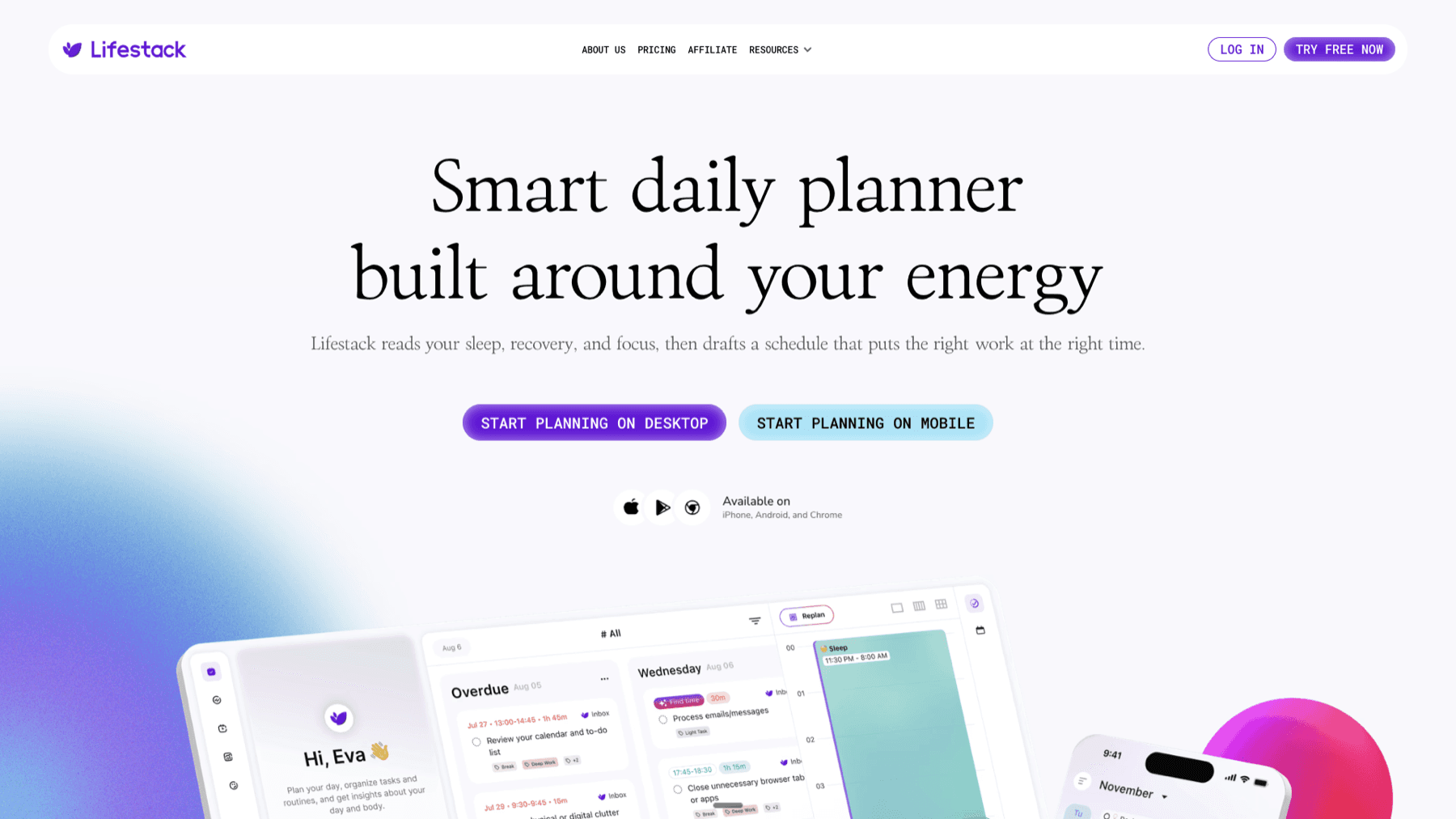
Lifestack connects with wearable health data to automatically identify your energy peaks and troughs each day and schedule your work around them. It knows when your actual high-energy window falls based on sleep quality and readiness data, not just your calendar preferences, which means your schedule adjusts on days when your sleep was poor rather than assuming you always peak at 9 AM. Pairing Oura Ring data with Lifestack gives you a particularly precise read on whether your chronotype alignment is working. Plans start at $7/month or $50/year, with a 7-day free trial on the annual plan.
FAQ
What does a late morning chronotype mean?
A late morning chronotype means your natural cognitive peak falls in the late morning, typically between 9 AM and noon. You're not a true early bird (who peaks at 6-8 AM) or a night owl (who peaks in the evening). You're the most common type, with an internal clock that follows the daylight cycle fairly closely but with a moderate, not extreme, morning bias.
Can you change your chronotype?
You can shift your chronotype by 30-60 minutes through consistent behavioral changes, primarily morning light exposure, consistent sleep timing, and exercise timing. A late morning chronotype can become a moderate morning type with sustained effort. You cannot, however, convert a late morning chronotype into a Lion (early riser) without significant ongoing effort that fights your biology.
What is the difference between morning and late morning chronotype?
The early morning (Lion) chronotype peaks before 9 AM and often rises before 6 AM without an alarm. The late morning chronotype peaks between 9 and 11 AM and naturally wakes around 7-8 AM. In practice, the early morning type performs better in true early-morning work and tires earlier in the evening. The late morning type has a later, somewhat broader peak that aligns better with conventional daytime work hours.
How do I know if I'm a late morning chronotype?
You likely have a late morning chronotype if you wake most naturally around 7-7:30 AM, feel mentally sharp by 9-10 AM, hit a noticeable energy dip after lunch, recover in late afternoon, and feel ready for sleep around 10:30 PM to midnight. If you feel sluggish until noon or need to stay up past 1 AM to feel truly awake, you're more of an evening type.
Is the late morning chronotype the most common?
Yes. The late morning / Bear type is the most prevalent chronotype, estimated at 55% of the general population. This makes it the biological norm that conventional work hours were roughly designed around, though those schedules still don't fully align with even the late morning type's optimal window.
Not everyone's best hours are at dawn. If you're at your sharpest between 9 and 11 AM and feel genuinely productive through midday, you likely have a late morning chronotype. You're not a night owl, but you're not an early bird either. You sit in the middle of the chronotype spectrum, and structuring your day around that specific window can change how much you get done.
Chronotypes are biologically driven. Your circadian rhythm, the roughly 24-hour internal clock that governs sleep timing, alertness peaks, hormone release, and body temperature cycles, is partly genetic. You can shift it within limits through behavior and light exposure, but your natural range is largely fixed. Fighting it costs energy. Working with it saves it.
The late morning chronotype is actually the most common type. Most adults naturally peak in cognitive performance between 9 AM and noon, which aligns reasonably well with conventional work schedules. But "reasonably well" isn't "optimally." Many late morning chronotypes still start meetings too early, schedule their most demanding work in the afternoon, and wonder why they feel like they're working harder than necessary.
This guide covers what defines the late morning chronotype, how it compares to early and evening types, and how to actually structure your day around it.
Key Takeaways
Late morning chronotypes typically peak in cognitive performance between 9 AM and noon, making that window the priority slot for deep and demanding work
Sleep timing matters as much as duration: going to bed between 10:30 PM and midnight and waking around 7-8 AM aligns naturally with a late morning chronotype
Scheduling your highest-priority work in your peak window, rather than filling it with meetings, is the most concrete change most late morning chronotypes can make
What Is a Late Morning Chronotype?
Your chronotype is the natural timing of your sleep-wake cycle and the alertness peaks that follow from it. Chronotype researcher Michael Breus classifies people into four main types: Lion (early riser), Bear (late morning / midday peak), Wolf (evening), and Dolphin (light sleeper / irregular). By this framework, the late morning chronotype corresponds most closely to the Bear type.
Bears make up roughly 55% of the population. They follow the solar cycle closely: they feel increasingly alert after waking around 7-8 AM, reach a cognitive peak in the late morning, experience a natural post-lunch dip in early afternoon, get a second wind in late afternoon, and begin winding down in the evening.
The "late morning" label distinguishes this type from the early morning chronotype (Lion), who peaks earlier, often by 8 AM. Late morning chronotypes need a brief warm-up period after waking before reaching full cognitive capacity. Trying to do complex analytical work at 6 AM rarely goes well for them, while the same work at 10 AM feels comparatively effortless.
Late Morning vs. Early Morning and Evening Types
The practical differences between chronotypes show up most clearly in when peak performance occurs and how sharply it's defined.
Early morning chronotypes (Lions) are genuinely at their best before most people are awake. They often have a sharper and earlier peak, sometimes by 7-9 AM, which means deep work needs to happen before noon or it doesn't happen at their best. They also tire earlier in the evening.
Late morning chronotypes have a later and somewhat broader peak window. Cognitive performance is high from roughly 9 to 11 or 12, and remains serviceable through early afternoon before the post-lunch dip hits. The post-lunch dip is real for almost everyone, but it's more pronounced for late morning types than early morning types. Evening chronotypes (Wolves) have their peak even later, often not fully sharp until afternoon or early evening.
Understanding where you fall shapes everything from when to schedule meetings to when to take breaks. Apps that track your circadian rhythm can help you identify your personal peak window with more precision than self-report alone.
How to Structure Your Day as a Late Morning Chronotype
Guard your 9-11 AM window. This is your most valuable cognitive real estate. Fill it with your hardest, most demanding work: writing, analysis, strategic planning, or anything that requires sustained focus. Don't let this window default to email, routine administrative tasks, or back-to-back meetings. Once it's gone, it doesn't come back that day.
Schedule meetings in mid-morning or early afternoon. Between 11 AM and 2 PM is generally fine for meetings. Your alertness is still reasonable, and you've already used your sharpest hours for the work that needs them. Avoid scheduling important meetings at 8 AM when you're still warming up, or at 3-4 PM when your energy is at its lowest.
Use the afternoon dip for low-demand tasks. The post-lunch dip (typically 1-3 PM) is physiologically normal and not a sign of poor focus habits. Use it for administrative work, routine emails, simple tasks, or a short walk. Fighting the dip with caffeine just delays the dip, it doesn't eliminate it. Energy-based planning works precisely by assigning task type to energy level rather than just filling calendar slots.
Take a second wind in late afternoon. Most late morning chronotypes experience a genuine recovery in alertness between 3:30 and 6 PM. This is a good secondary window for creative work, focused reading, or any tasks that require attention but not peak analytical performance.
Sleep Tips for Late Morning Chronotypes
Late morning chronotypes naturally fall asleep between 10:30 PM and midnight, and wake feeling rested between 7 and 8:30 AM. Trying to push that earlier to match an early riser's schedule often results in either struggling to fall asleep or waking with a sleep deficit. Both reduce performance the next morning.
If your schedule forces an earlier wake time (e.g., a 7 AM start), prioritize sleep consistency over sleep hour counts. Going to bed at the same time each night, including weekends, is the most reliable way to stabilize your circadian rhythm and get better sleep within the constraints you have. Resetting a drifted circadian rhythm typically takes 1-2 weeks of consistent timing.
Morning light exposure right after waking anchors the circadian rhythm earlier without requiring sleep schedule changes. Even 10-15 minutes of direct outdoor light shortly after waking shifts your internal clock slightly earlier over several days, which can move your peak performance window forward if needed.
A structured morning routine also helps late morning chronotypes reach their cognitive peak faster. A consistent wake time, hydration, movement, and limiting decision-making in the first 30 minutes all reduce the warm-up time before peak performance kicks in.
Exercise Timing for Late Morning Chronotypes
For late morning chronotypes, the best exercise window is typically between 7 and 9 AM, before the peak cognitive window starts. Morning exercise at this time doesn't compete with peak mental performance and provides an alertness boost that can sharpen the subsequent 9-11 AM work block.
Afternoon exercise (4-6 PM) is the secondary option. Body temperature, muscle function, and pain tolerance peak in mid-to-late afternoon for most people, which makes performance-oriented training slightly better in this window. The tradeoff is that late afternoon exercise competes with the second-wind work window for late morning chronotypes. Choose based on whether training performance or cognitive output matters more on a given day.
Avoid intense exercise immediately before your peak cognitive window. A hard workout at 8:30 AM followed by deep work at 9 AM leaves you physically depleted during your best mental hours, which undermines the whole alignment strategy.
Best Tool for Late Morning Chronotypes
Knowing your chronotype is the first step. Translating it into an actual schedule is where most people stop. An energy calendar makes your chronotype concrete by blocking your peak window for deep work and positioning lower-demand tasks in the dip periods, rather than leaving scheduling to whoever schedules meetings first.
Lifestack connects with wearable health data to automatically identify your energy peaks and troughs each day and schedule your work around them. It knows when your actual high-energy window falls based on sleep quality and readiness data, not just your calendar preferences, which means your schedule adjusts on days when your sleep was poor rather than assuming you always peak at 9 AM. Pairing Oura Ring data with Lifestack gives you a particularly precise read on whether your chronotype alignment is working. Plans start at $7/month or $50/year, with a 7-day free trial on the annual plan.
FAQ
What does a late morning chronotype mean?
A late morning chronotype means your natural cognitive peak falls in the late morning, typically between 9 AM and noon. You're not a true early bird (who peaks at 6-8 AM) or a night owl (who peaks in the evening). You're the most common type, with an internal clock that follows the daylight cycle fairly closely but with a moderate, not extreme, morning bias.
Can you change your chronotype?
You can shift your chronotype by 30-60 minutes through consistent behavioral changes, primarily morning light exposure, consistent sleep timing, and exercise timing. A late morning chronotype can become a moderate morning type with sustained effort. You cannot, however, convert a late morning chronotype into a Lion (early riser) without significant ongoing effort that fights your biology.
What is the difference between morning and late morning chronotype?
The early morning (Lion) chronotype peaks before 9 AM and often rises before 6 AM without an alarm. The late morning chronotype peaks between 9 and 11 AM and naturally wakes around 7-8 AM. In practice, the early morning type performs better in true early-morning work and tires earlier in the evening. The late morning type has a later, somewhat broader peak that aligns better with conventional daytime work hours.
How do I know if I'm a late morning chronotype?
You likely have a late morning chronotype if you wake most naturally around 7-7:30 AM, feel mentally sharp by 9-10 AM, hit a noticeable energy dip after lunch, recover in late afternoon, and feel ready for sleep around 10:30 PM to midnight. If you feel sluggish until noon or need to stay up past 1 AM to feel truly awake, you're more of an evening type.
Is the late morning chronotype the most common?
Yes. The late morning / Bear type is the most prevalent chronotype, estimated at 55% of the general population. This makes it the biological norm that conventional work hours were roughly designed around, though those schedules still don't fully align with even the late morning type's optimal window.



FOLLOW ON
FOLLOW ON
FOLLOW ON


Copyright 2026 © Lifestack. All rights reserved
Copyright 2026 © Lifestack. All rights reserved

