
Tips
Light Therapy for ADHD: Does It Work and How to Try It
Light Therapy for ADHD: Does It Work and How to Try It

Light therapy is one of the lesser-known tools for managing ADHD symptoms, particularly the sleep dysregulation, morning sluggishness, and circadian irregularity that make focus and task initiation harder than they need to be. The research is not as deep as it is for stimulant medication, but it is not negligible either, and the mechanism behind it makes biological sense given what we know about ADHD neuroscience.
This guide covers what light therapy actually does for ADHD, what the research shows, how to use it correctly, and how to combine it with other ADHD management strategies for a more complete approach to daily energy and focus.
Key Takeaways
Light therapy targets the circadian dysregulation common in ADHD by resetting your body's internal clock through timed morning light exposure
Research shows benefits for sleep quality, morning alertness, and mood in ADHD populations; evidence for direct focus improvement is promising but less established
10,000 lux light boxes used for 20 to 30 minutes within the first hour of waking produce the most consistent results in studies
Why ADHD and Circadian Rhythm Are Closely Connected
ADHD involves dysregulation across multiple systems, including the circadian clock. Studies consistently show that a majority of people with ADHD have delayed circadian phase: their internal clock runs later than average, making it biologically harder to fall asleep early, harder to wake up in the morning, and harder to reach peak alertness at the times when the conventional day demands it.
This is not laziness or a lifestyle choice. It is a physiological pattern: melatonin onset in ADHD populations typically occurs 90 minutes to 2 hours later than in neurotypical controls. The result is that people with ADHD are often asked to function at their biological equivalent of 5am when the rest of the world considers it 8am.
Light therapy directly targets this mechanism. Bright light exposure in the morning suppresses melatonin and advances the circadian clock, gradually shifting it earlier. Done consistently, it can move sleep onset and wake time forward by 30 to 90 minutes, which for ADHD users often means the difference between a functional morning and a lost one. The connection to ADHD morning routine problems is direct.
What the Research Actually Shows
The most cited study on light therapy and ADHD was conducted by Sandra Kooij and colleagues in the Netherlands, examining bright light therapy in adults with ADHD and delayed circadian phase. Results showed significant improvements in sleep onset timing, mood, and daytime alertness. Attention measures also improved, though the effect size was smaller than for circadian outcomes.
A 2016 pilot study found that morning bright light therapy reduced ADHD symptom severity ratings in adults, with improvements in attention and impulse control that persisted over the treatment period. The effect was independent of sleep improvements in some analyses, suggesting light therapy may have direct dopaminergic effects beyond just fixing the sleep schedule.
The dopamine connection matters here: light exposure activates the retinohypothalamic tract, which influences dopamine pathways in addition to circadian function. Dopamine dysregulation is central to ADHD, and anything that positively affects dopamine availability in relevant circuits is worth examining as an adjunct intervention.
How to Use Light Therapy for ADHD Correctly
Getting the protocol right matters significantly. Light therapy used at the wrong time or at insufficient intensity produces minimal benefit and can even disrupt sleep if done too late in the day.
Timing: Use your light box within the first 30 to 60 minutes of waking. This is the window where morning light has the strongest phase-advancing effect on the circadian clock. Later in the day, the effect diminishes and can shift in the wrong direction.
Intensity: 10,000 lux is the standard therapeutic dose. This is much brighter than ordinary indoor lighting, which typically runs 100 to 500 lux. Consumer light therapy lamps rated at 10,000 lux at the specified distance are what the research uses. Weaker devices produce weaker effects.
Distance: Most 10,000 lux devices require you to sit 16 to 24 inches away. The lux rating is distance-dependent: sitting farther away means receiving fewer lux than labeled. Follow the device's instructions on positioning.
Duration: 20 to 30 minutes is the standard session length for 10,000 lux devices. You do not need to stare directly at the light. Reading, eating breakfast, or working at a desk with the light to your side are all fine. The effect is mediated by light entering your eyes, not by looking directly at the source.
Consistency: Light therapy works by gradually shifting the circadian clock. One session produces a small effect. Three to four weeks of consistent morning use produces the full effect. Missing sessions slows progress.
Light Therapy vs Other ADHD Interventions
Light therapy is not a replacement for stimulant medication in people who benefit from it. The effect sizes for attention improvement are smaller than those for well-calibrated medication. It is best understood as an adjunct that addresses a specific dimension of ADHD, the circadian and sleep dysregulation component, that medication does not directly target.
People who find that their ADHD symptoms are notably worse in the morning, who have significant sleep onset delay, or who feel their focus improves dramatically later in the day are the most likely to see benefit from light therapy. These patterns suggest delayed circadian phase, which is exactly what morning light therapy corrects.
Light therapy has a strong evidence base for Seasonal Affective Disorder and good emerging evidence for non-seasonal depression. Given that depression and anxiety co-occur in ADHD at high rates, the mood benefits of light therapy are a relevant secondary effect for many people with ADHD. ADHD management strategies that address comorbid mood are often the most impactful overall.
When to Expect Results
Most people notice changes in morning alertness and sleep timing within one to two weeks of consistent use. Full circadian phase shifting takes three to four weeks. Subjective improvements in mood often appear in the first week. Attention and focus improvements, when they occur, typically follow the sleep improvements rather than preceding them.
If you see no change after four weeks of consistent 10,000 lux morning use at 20 to 30 minutes per session, either the circadian dysregulation component is not a major driver of your ADHD profile, or the protocol needs adjustment. A sleep medicine specialist or psychiatrist familiar with chronobiology can help evaluate this.
Seasonal variation is worth noting. Light therapy effects tend to be strongest in winter months when natural morning light is weak or absent. In summer, depending on your location, outdoor morning light may be sufficient to provide similar circadian benefits without a device. Circadian rhythm tracking can help you understand your personal patterns across seasons.
Combining Light Therapy with Structured Scheduling
Light therapy anchors your circadian clock. But a shifted circadian clock only produces better focus and energy if the rest of your day is structured to use those windows effectively. This is where scheduling and light therapy work together rather than in parallel.
For people with ADHD, the energy-aware scheduling approach that places demanding tasks in circadian peak windows and lighter work in the dips is the practical complement to light therapy's biological reset. When your morning light session shifts your alertness peak earlier, and your schedule is built to match that peak with your most important tasks, the combined effect is more useful than either intervention alone.
Best Tool for Building Structure Around Light Therapy: Lifestack
Lifestack is an AI-powered planner that learns your energy patterns and automatically schedules tasks into your peak cognitive windows. As light therapy gradually shifts your morning alertness earlier, Lifestack's scheduling adapts to that shift, keeping your most important work aligned with your best hours.
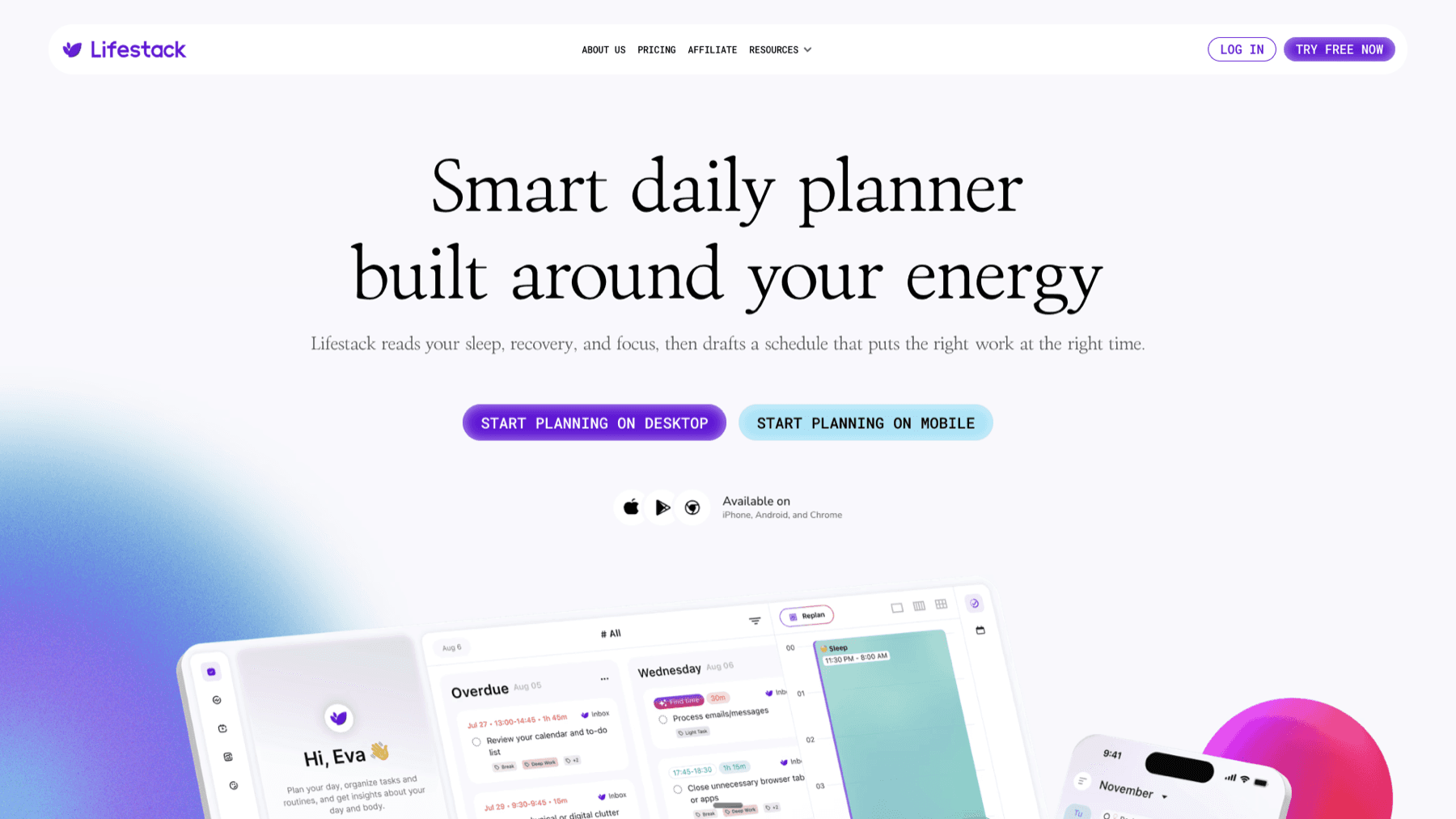
For ADHD specifically, the combination works on two levels. Light therapy addresses the biological root of morning dysregulation. Lifestack addresses the behavioral layer: once you have more morning energy available, it builds the structured plan that helps you use it. People with ADHD who want to improve focus often find that both the biology and the structure need to change for lasting improvement.
Lifestack integrates with Google Calendar and Apple Calendar and costs $9.99 per month or $49.99 per year, with a 7-day free trial on the annual plan.
FAQ
Does light therapy help ADHD?
Yes, particularly for the circadian dysregulation and sleep onset delay common in ADHD. Research shows improvements in sleep timing, morning alertness, and mood with consistent morning bright light therapy. Some studies also show attention improvements, though the effect sizes are smaller than for established ADHD medications. Light therapy is most effective as an adjunct to other ADHD management strategies, not as a standalone treatment.
What kind of light therapy is best for ADHD?
Morning bright light therapy using a 10,000 lux light box is the most researched and recommended approach. Full-spectrum LED light boxes are the standard. Dawn simulators, which gradually increase light intensity before your alarm, are a gentler alternative that some people find easier to incorporate. Blue light-blocking glasses at night are a complementary approach that reduces evening light exposure without adding morning light.
How long does light therapy take to work for ADHD?
Most people notice mood and alertness improvements within one to two weeks of consistent daily use. Full circadian phase shift takes three to four weeks. Attention benefits, when they occur, typically follow sleep improvements and may take the full four weeks to become consistent.
Can light therapy replace ADHD medication?
No. The evidence for light therapy's effect on core ADHD attention symptoms is considerably weaker than the evidence for stimulant medication. Light therapy addresses the circadian dysregulation component of ADHD specifically, which is a real and impactful dimension of the condition but is not the whole picture. It works best as an adjunct to other treatments, not a replacement.
When is the best time to do light therapy for ADHD?
Within the first 30 to 60 minutes of waking is the most effective window for advancing the circadian clock. The earlier in the morning, the stronger the phase-advancing effect. Avoid light therapy in the afternoon or evening: light exposure later in the day can shift the circadian clock later rather than earlier, which is the opposite of what most ADHD users need.
Can light therapy help with ADHD sleep problems?
Yes, and this is often the clearest benefit. ADHD-related sleep problems frequently involve delayed sleep onset, difficulty waking in the morning, and non-restorative sleep linked to circadian misalignment. Morning light therapy addresses all three by gradually advancing the circadian phase. Making yourself appropriately tired at the right time is much easier when your circadian clock is set correctly.
Light therapy is one of the lesser-known tools for managing ADHD symptoms, particularly the sleep dysregulation, morning sluggishness, and circadian irregularity that make focus and task initiation harder than they need to be. The research is not as deep as it is for stimulant medication, but it is not negligible either, and the mechanism behind it makes biological sense given what we know about ADHD neuroscience.
This guide covers what light therapy actually does for ADHD, what the research shows, how to use it correctly, and how to combine it with other ADHD management strategies for a more complete approach to daily energy and focus.
Key Takeaways
Light therapy targets the circadian dysregulation common in ADHD by resetting your body's internal clock through timed morning light exposure
Research shows benefits for sleep quality, morning alertness, and mood in ADHD populations; evidence for direct focus improvement is promising but less established
10,000 lux light boxes used for 20 to 30 minutes within the first hour of waking produce the most consistent results in studies
Why ADHD and Circadian Rhythm Are Closely Connected
ADHD involves dysregulation across multiple systems, including the circadian clock. Studies consistently show that a majority of people with ADHD have delayed circadian phase: their internal clock runs later than average, making it biologically harder to fall asleep early, harder to wake up in the morning, and harder to reach peak alertness at the times when the conventional day demands it.
This is not laziness or a lifestyle choice. It is a physiological pattern: melatonin onset in ADHD populations typically occurs 90 minutes to 2 hours later than in neurotypical controls. The result is that people with ADHD are often asked to function at their biological equivalent of 5am when the rest of the world considers it 8am.
Light therapy directly targets this mechanism. Bright light exposure in the morning suppresses melatonin and advances the circadian clock, gradually shifting it earlier. Done consistently, it can move sleep onset and wake time forward by 30 to 90 minutes, which for ADHD users often means the difference between a functional morning and a lost one. The connection to ADHD morning routine problems is direct.
What the Research Actually Shows
The most cited study on light therapy and ADHD was conducted by Sandra Kooij and colleagues in the Netherlands, examining bright light therapy in adults with ADHD and delayed circadian phase. Results showed significant improvements in sleep onset timing, mood, and daytime alertness. Attention measures also improved, though the effect size was smaller than for circadian outcomes.
A 2016 pilot study found that morning bright light therapy reduced ADHD symptom severity ratings in adults, with improvements in attention and impulse control that persisted over the treatment period. The effect was independent of sleep improvements in some analyses, suggesting light therapy may have direct dopaminergic effects beyond just fixing the sleep schedule.
The dopamine connection matters here: light exposure activates the retinohypothalamic tract, which influences dopamine pathways in addition to circadian function. Dopamine dysregulation is central to ADHD, and anything that positively affects dopamine availability in relevant circuits is worth examining as an adjunct intervention.
How to Use Light Therapy for ADHD Correctly
Getting the protocol right matters significantly. Light therapy used at the wrong time or at insufficient intensity produces minimal benefit and can even disrupt sleep if done too late in the day.
Timing: Use your light box within the first 30 to 60 minutes of waking. This is the window where morning light has the strongest phase-advancing effect on the circadian clock. Later in the day, the effect diminishes and can shift in the wrong direction.
Intensity: 10,000 lux is the standard therapeutic dose. This is much brighter than ordinary indoor lighting, which typically runs 100 to 500 lux. Consumer light therapy lamps rated at 10,000 lux at the specified distance are what the research uses. Weaker devices produce weaker effects.
Distance: Most 10,000 lux devices require you to sit 16 to 24 inches away. The lux rating is distance-dependent: sitting farther away means receiving fewer lux than labeled. Follow the device's instructions on positioning.
Duration: 20 to 30 minutes is the standard session length for 10,000 lux devices. You do not need to stare directly at the light. Reading, eating breakfast, or working at a desk with the light to your side are all fine. The effect is mediated by light entering your eyes, not by looking directly at the source.
Consistency: Light therapy works by gradually shifting the circadian clock. One session produces a small effect. Three to four weeks of consistent morning use produces the full effect. Missing sessions slows progress.
Light Therapy vs Other ADHD Interventions
Light therapy is not a replacement for stimulant medication in people who benefit from it. The effect sizes for attention improvement are smaller than those for well-calibrated medication. It is best understood as an adjunct that addresses a specific dimension of ADHD, the circadian and sleep dysregulation component, that medication does not directly target.
People who find that their ADHD symptoms are notably worse in the morning, who have significant sleep onset delay, or who feel their focus improves dramatically later in the day are the most likely to see benefit from light therapy. These patterns suggest delayed circadian phase, which is exactly what morning light therapy corrects.
Light therapy has a strong evidence base for Seasonal Affective Disorder and good emerging evidence for non-seasonal depression. Given that depression and anxiety co-occur in ADHD at high rates, the mood benefits of light therapy are a relevant secondary effect for many people with ADHD. ADHD management strategies that address comorbid mood are often the most impactful overall.
When to Expect Results
Most people notice changes in morning alertness and sleep timing within one to two weeks of consistent use. Full circadian phase shifting takes three to four weeks. Subjective improvements in mood often appear in the first week. Attention and focus improvements, when they occur, typically follow the sleep improvements rather than preceding them.
If you see no change after four weeks of consistent 10,000 lux morning use at 20 to 30 minutes per session, either the circadian dysregulation component is not a major driver of your ADHD profile, or the protocol needs adjustment. A sleep medicine specialist or psychiatrist familiar with chronobiology can help evaluate this.
Seasonal variation is worth noting. Light therapy effects tend to be strongest in winter months when natural morning light is weak or absent. In summer, depending on your location, outdoor morning light may be sufficient to provide similar circadian benefits without a device. Circadian rhythm tracking can help you understand your personal patterns across seasons.
Combining Light Therapy with Structured Scheduling
Light therapy anchors your circadian clock. But a shifted circadian clock only produces better focus and energy if the rest of your day is structured to use those windows effectively. This is where scheduling and light therapy work together rather than in parallel.
For people with ADHD, the energy-aware scheduling approach that places demanding tasks in circadian peak windows and lighter work in the dips is the practical complement to light therapy's biological reset. When your morning light session shifts your alertness peak earlier, and your schedule is built to match that peak with your most important tasks, the combined effect is more useful than either intervention alone.
Best Tool for Building Structure Around Light Therapy: Lifestack
Lifestack is an AI-powered planner that learns your energy patterns and automatically schedules tasks into your peak cognitive windows. As light therapy gradually shifts your morning alertness earlier, Lifestack's scheduling adapts to that shift, keeping your most important work aligned with your best hours.
For ADHD specifically, the combination works on two levels. Light therapy addresses the biological root of morning dysregulation. Lifestack addresses the behavioral layer: once you have more morning energy available, it builds the structured plan that helps you use it. People with ADHD who want to improve focus often find that both the biology and the structure need to change for lasting improvement.
Lifestack integrates with Google Calendar and Apple Calendar and costs $9.99 per month or $49.99 per year, with a 7-day free trial on the annual plan.
FAQ
Does light therapy help ADHD?
Yes, particularly for the circadian dysregulation and sleep onset delay common in ADHD. Research shows improvements in sleep timing, morning alertness, and mood with consistent morning bright light therapy. Some studies also show attention improvements, though the effect sizes are smaller than for established ADHD medications. Light therapy is most effective as an adjunct to other ADHD management strategies, not as a standalone treatment.
What kind of light therapy is best for ADHD?
Morning bright light therapy using a 10,000 lux light box is the most researched and recommended approach. Full-spectrum LED light boxes are the standard. Dawn simulators, which gradually increase light intensity before your alarm, are a gentler alternative that some people find easier to incorporate. Blue light-blocking glasses at night are a complementary approach that reduces evening light exposure without adding morning light.
How long does light therapy take to work for ADHD?
Most people notice mood and alertness improvements within one to two weeks of consistent daily use. Full circadian phase shift takes three to four weeks. Attention benefits, when they occur, typically follow sleep improvements and may take the full four weeks to become consistent.
Can light therapy replace ADHD medication?
No. The evidence for light therapy's effect on core ADHD attention symptoms is considerably weaker than the evidence for stimulant medication. Light therapy addresses the circadian dysregulation component of ADHD specifically, which is a real and impactful dimension of the condition but is not the whole picture. It works best as an adjunct to other treatments, not a replacement.
When is the best time to do light therapy for ADHD?
Within the first 30 to 60 minutes of waking is the most effective window for advancing the circadian clock. The earlier in the morning, the stronger the phase-advancing effect. Avoid light therapy in the afternoon or evening: light exposure later in the day can shift the circadian clock later rather than earlier, which is the opposite of what most ADHD users need.
Can light therapy help with ADHD sleep problems?
Yes, and this is often the clearest benefit. ADHD-related sleep problems frequently involve delayed sleep onset, difficulty waking in the morning, and non-restorative sleep linked to circadian misalignment. Morning light therapy addresses all three by gradually advancing the circadian phase. Making yourself appropriately tired at the right time is much easier when your circadian clock is set correctly.



FOLLOW ON
FOLLOW ON
FOLLOW ON


Copyright 2026 © Lifestack. All rights reserved
Copyright 2026 © Lifestack. All rights reserved

