
Tips
Restfulness: 7 Ways to Get More Restorative Sleep
Restfulness: 7 Ways to Get More Restorative Sleep

Most people measure sleep by duration. Eight hours in bed gets treated as the benchmark, and anything close feels like success. But the number of hours you spend horizontal is a poor measure of how well you actually recovered. Restfulness, the quality of sleep rather than its length, is what determines whether you wake up sharp or depleted.
Restful sleep means spending enough time in the deeper and more restorative stages of sleep, moving through sleep cycles without frequent interruption, and waking without the accumulated physical and cognitive debt that poor sleep creates. You can sleep eight hours and still have low restfulness if your sleep is fragmented, your environment is off, or your body cannot reach the deeper recovery stages it needs.
The good news is that restfulness is more changeable than most people assume. Most of the factors that degrade sleep quality are behavioral or environmental, which means they respond to deliberate adjustment. This guide covers seven evidence-based strategies for improving restfulness, starting with the ones that tend to make the biggest difference. For context on how sleep gives you energy, the connection runs through these deeper stages.
Key Takeaways
Restfulness refers to sleep quality, not duration. You can sleep eight hours and still wake unrestored if your sleep is fragmented or shallow
Consistent sleep and wake times, a cool dark bedroom, and a genuine wind-down routine produce the most reliable improvements in sleep quality
Tracking your sleep data makes it easier to identify which changes are actually helping and which are not
What Does Restfulness Actually Mean?
Restfulness is a measure of how restorative sleep was, not how long it lasted. A restful night is one where you moved through full sleep cycles, spent adequate time in slow-wave (deep) sleep and REM sleep, and were not frequently pulled out of those stages by pain, noise, temperature, or stress.
Wearable devices and sleep trackers often express this as a readiness score, recovery score, or sleep quality percentage. The exact calculation varies by device, but most weight time in deep sleep, sleep continuity (how often you woke), and how aligned your sleep was with your circadian rhythm. A score that is consistently lower than expected is a signal worth investigating rather than ignoring.
Poor restfulness has real costs. Low REM sleep impairs memory consolidation and emotional regulation. Low slow-wave sleep impairs physical recovery, hormone regulation, and immune function. Both affect mood, decision-making, and energy in ways that accumulate over days and weeks. The effects of a single restless night are mild. A consistent pattern of poor restfulness becomes a performance and health problem.
1. Keep Your Sleep Schedule Consistent
Your body's circadian rhythm is a timer. It regulates when you feel sleepy, when your core temperature drops, when melatonin rises, and when cortisol prepares you to wake up. When your sleep and wake times are consistent, this timer runs well. When they vary by more than an hour or two night to night, the system is always adjusting rather than running on schedule.
Social jet lag, the gap between your biological clock and your social schedule, is a significant driver of poor restfulness. People who sleep until noon on weekends and wake at 6 AM on weekdays are essentially shifting time zones twice a week. The result is Sunday night insomnia, Monday morning grogginess, and chronically reduced sleep quality through the week.
The fix is not exciting: pick a consistent wake time and hold it regardless of when you went to bed. The morning anchor is more important than the bedtime anchor because light exposure at a fixed time resets your circadian clock daily. A circadian rhythm app can help you understand your natural chronotype and set a schedule that fits it rather than fighting it.
2. Optimize Your Sleep Environment
Temperature is the most underrated environmental variable in sleep quality. Your core body temperature needs to drop by about one to two degrees Fahrenheit to initiate and maintain deep sleep. A bedroom that is too warm, above roughly 67 to 68 degrees Fahrenheit, actively impairs this process. Most sleep researchers recommend 65 to 68 degrees as the target range for most adults.
Darkness matters almost as much. Any light reaching the eyes at night signals the brain to reduce melatonin production, which delays sleep onset and reduces overall sleep quality. Blackout curtains, a sleep mask, or both make a measurable difference, particularly for people in urban environments or anyone with streetlights or device indicators in their bedroom.
Noise is the third major factor. Continuous noise is easier to sleep through than intermittent noise, because it is the unpredictable changes that trigger partial arousals. White noise machines work partly by masking the sudden sounds that would otherwise pull you out of lighter sleep stages. For people with partners or pets whose movement creates noise, this is particularly worth addressing.
3. Limit Caffeine and Alcohol
Caffeine has a half-life of around five to six hours in most people, which means that a 3 PM coffee still has roughly half its active dose in your system at 8 PM. For people who are slow caffeine metabolizers, the half-life can reach eight hours or more. The effect on sleep architecture is real even when you do not notice it in falling asleep: caffeine suppresses slow-wave sleep, reducing the restorative depth of sleep even when total duration appears normal.
Alcohol creates a different problem. It helps many people fall asleep faster, which makes it feel like a sleep aid. In the second half of the night, as the body metabolizes it, alcohol disrupts REM sleep and causes more frequent partial arousals. The result is sleep that looks adequate on a clock but scores poorly on any quality measure.
The practical guidance: cut caffeine by early afternoon, avoid alcohol within three hours of sleep, and pay attention to how each affects your sleep quality data if you track it. Individual responses vary enough that testing is more useful than following a fixed rule.
4. Build a Pre-Sleep Wind-Down Routine
The transition from full wakefulness to sleep is not a switch. It is a ramp. Your nervous system needs time to downshift from the arousal state that carries you through the day to the parasympathetic state in which deep sleep is possible. Most restfulness problems that people attribute to insomnia are actually a failure to allow this transition enough time and the right conditions.
A wind-down routine does not need to be elaborate. Thirty to sixty minutes of low-stimulation activity, without screens or high-cognitive-demand tasks, is enough for most people. Reading physical books, stretching, light journaling, and quiet conversation all work. The key is consistency. A night routine that happens at the same time each night becomes a behavioral cue that your nervous system learns to associate with sleep onset.
Blue light from screens delays melatonin onset, which is a real but often overstated effect. The bigger issue with screens before bed is cognitive arousal: checking email, social media, or news keeps the brain in a reactive, alert state that is the opposite of what sleep initiation requires.
5. Get the Right Amount of Exercise
Regular exercise is one of the most consistent predictors of good sleep quality in the research literature. People who exercise regularly spend more time in slow-wave sleep, fall asleep faster, and report higher sleep quality than sedentary individuals. Even moderate aerobic exercise at three to four times per week produces measurable improvements in restfulness within a few weeks.
Timing matters less than often claimed. The older guidance that exercise within three hours of sleep worsens sleep quality has been significantly revised. For most people, exercise timing has minimal effect on sleep. For some individuals who are particularly sensitive to cortisol, high-intensity exercise in the late evening does delay sleep onset, but this is not universal. Test it for yourself rather than assuming the worst.
The minimum effective dose for sleep benefits is lower than most people think. A thirty-minute walk, done consistently, is enough to produce meaningful improvements in sleep architecture for people who are currently sedentary. The benefits of walking extend well beyond the metabolic, particularly for people dealing with stress and restless sleep.
6. Address Stress Before You Lie Down
Mental arousal at bedtime, running through tomorrow's tasks, replaying conversations, or feeling anxious about sleep itself, keeps the brain in a state that is incompatible with sleep onset. The problem is not the stress itself but carrying it unprocessed into the bedroom.
A brain dump before bed, writing down everything on your mind without trying to solve it, reduces cognitive intrusion at sleep time by externalizing the mental load. The act of writing creates a sense of having handled something, even when nothing is actually resolved. Research on worry postponement shows that scheduling a specific time to deal with anxious thoughts reduces their intrusion at other times.
For people with ADHD sleep difficulties, racing thoughts and difficulty transitioning out of hyperfocus are common drivers of poor restfulness. The problem is often not sleep itself but the transition into it, which responds well to structured wind-down and task-offloading before bed.
7. Track Your Sleep Quality
You cannot improve what you cannot measure. Sleep tracking makes restfulness legible in a way that subjective reports cannot. You may feel you slept well on a night where your deep sleep was minimal, or feel groggy on a night where your data shows good quality sleep because of other factors like illness or allergies. Tracking creates a feedback loop that self-reporting alone cannot.
The best sleep tracking apps and wearables measure time in each sleep stage, sleep continuity, resting heart rate, heart rate variability, and respiratory rate. None of these are perfectly accurate compared to lab polysomnography, but they are accurate enough to identify trends and respond to changes over time.
The most useful thing sleep tracking reveals is which behaviors actually affect your data. The strategies in this guide are evidence-based, but individual responses vary. Tracking lets you identify which ones move the needle for you specifically, rather than following generic advice that may not apply.
Best Tool for Scheduling Around Your Restfulness
Improving your restfulness changes your nights. What happens with the next day depends on whether your schedule responds to the energy you actually have, not the energy you planned for.
Lifestack is a daily planner built around your real energy state. It reads data from wearables including Oura, Whoop, Garmin, Apple Watch, Fitbit, and Ultrahuman, then schedules tasks into your day based on when you are actually sharp. After a low-restfulness night, it does not front-load your calendar with work that requires deep focus. It adapts.
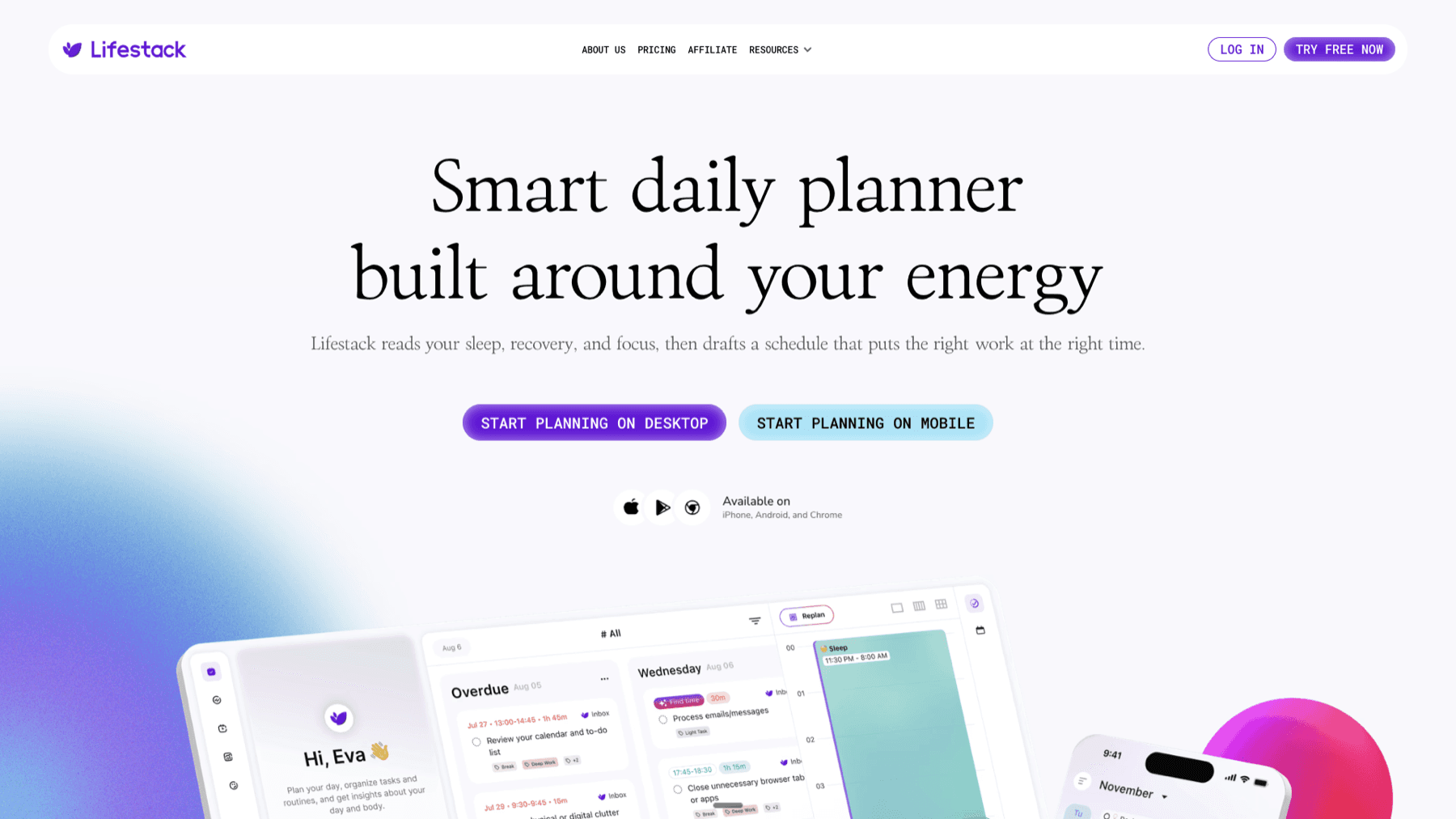
This is where personal energy management and restfulness connect directly. Better sleep produces higher energy ceilings. A planner that reads your energy level and schedules accordingly makes the most of whatever ceiling you have on a given day. Lifestack costs $7/month or $50/year, with a 7-day free trial on the annual plan.
Frequently Asked Questions
What does restfulness mean in sleep?
Restfulness refers to how restorative sleep was, not how long it lasted. Restful sleep involves adequate time in slow-wave (deep) sleep and REM sleep, few interruptions, and alignment with your circadian rhythm. A night of eight hours can score poorly on restfulness if sleep was fragmented or stayed in lighter stages throughout.
How do I know if I slept restfully?
The most reliable indicator is how you feel within an hour of waking, after grogginess clears. Feeling alert, able to concentrate, and in a stable mood suggests restful sleep. Persistent grogginess, poor concentration, or irritability that goes beyond a few minutes is a sign that sleep quality was low regardless of total hours. Wearable sleep trackers provide more objective signals through sleep stage data and continuity scores.
How many hours of sleep do I need for restfulness?
Most adults need seven to nine hours for adequate restfulness, but the right number varies by individual and changes across life stages. What matters more than hitting a fixed number is whether you are getting enough time in deep sleep and REM sleep. Some people achieve good restfulness in seven hours; others need eight and a half. Tracking your data over a few weeks gives you a more accurate personal target than applying any population average.
What causes poor restfulness even with enough sleep?
Common causes include an inconsistent sleep schedule, a bedroom that is too warm, alcohol or late caffeine, high stress or mental arousal at bedtime, sleep disorders like sleep apnea or restless legs, and certain medications. Poor restfulness despite adequate duration is worth investigating rather than attributing to normal variation.
Does exercise improve restfulness?
Yes. Regular aerobic exercise is one of the most consistently supported interventions for improving sleep quality in the research literature. It increases time in slow-wave sleep, reduces sleep onset time, and improves overall continuity. The benefits are available at moderate intensity and relatively low frequency. Three to four sessions of thirty minutes per week is enough to produce measurable improvements for most sedentary adults.
Can stress permanently damage sleep quality?
Chronic high stress is associated with persistently poor sleep quality, but the relationship is not permanent or irreversible. Stress-related sleep disruption responds to behavioral interventions including pre-sleep routines, journaling, cognitive behavioral therapy for insomnia (CBT-I), and stress management practices. The body's capacity for restful sleep is generally preserved even after periods of significant stress.
Most people measure sleep by duration. Eight hours in bed gets treated as the benchmark, and anything close feels like success. But the number of hours you spend horizontal is a poor measure of how well you actually recovered. Restfulness, the quality of sleep rather than its length, is what determines whether you wake up sharp or depleted.
Restful sleep means spending enough time in the deeper and more restorative stages of sleep, moving through sleep cycles without frequent interruption, and waking without the accumulated physical and cognitive debt that poor sleep creates. You can sleep eight hours and still have low restfulness if your sleep is fragmented, your environment is off, or your body cannot reach the deeper recovery stages it needs.
The good news is that restfulness is more changeable than most people assume. Most of the factors that degrade sleep quality are behavioral or environmental, which means they respond to deliberate adjustment. This guide covers seven evidence-based strategies for improving restfulness, starting with the ones that tend to make the biggest difference. For context on how sleep gives you energy, the connection runs through these deeper stages.
Key Takeaways
Restfulness refers to sleep quality, not duration. You can sleep eight hours and still wake unrestored if your sleep is fragmented or shallow
Consistent sleep and wake times, a cool dark bedroom, and a genuine wind-down routine produce the most reliable improvements in sleep quality
Tracking your sleep data makes it easier to identify which changes are actually helping and which are not
What Does Restfulness Actually Mean?
Restfulness is a measure of how restorative sleep was, not how long it lasted. A restful night is one where you moved through full sleep cycles, spent adequate time in slow-wave (deep) sleep and REM sleep, and were not frequently pulled out of those stages by pain, noise, temperature, or stress.
Wearable devices and sleep trackers often express this as a readiness score, recovery score, or sleep quality percentage. The exact calculation varies by device, but most weight time in deep sleep, sleep continuity (how often you woke), and how aligned your sleep was with your circadian rhythm. A score that is consistently lower than expected is a signal worth investigating rather than ignoring.
Poor restfulness has real costs. Low REM sleep impairs memory consolidation and emotional regulation. Low slow-wave sleep impairs physical recovery, hormone regulation, and immune function. Both affect mood, decision-making, and energy in ways that accumulate over days and weeks. The effects of a single restless night are mild. A consistent pattern of poor restfulness becomes a performance and health problem.
1. Keep Your Sleep Schedule Consistent
Your body's circadian rhythm is a timer. It regulates when you feel sleepy, when your core temperature drops, when melatonin rises, and when cortisol prepares you to wake up. When your sleep and wake times are consistent, this timer runs well. When they vary by more than an hour or two night to night, the system is always adjusting rather than running on schedule.
Social jet lag, the gap between your biological clock and your social schedule, is a significant driver of poor restfulness. People who sleep until noon on weekends and wake at 6 AM on weekdays are essentially shifting time zones twice a week. The result is Sunday night insomnia, Monday morning grogginess, and chronically reduced sleep quality through the week.
The fix is not exciting: pick a consistent wake time and hold it regardless of when you went to bed. The morning anchor is more important than the bedtime anchor because light exposure at a fixed time resets your circadian clock daily. A circadian rhythm app can help you understand your natural chronotype and set a schedule that fits it rather than fighting it.
2. Optimize Your Sleep Environment
Temperature is the most underrated environmental variable in sleep quality. Your core body temperature needs to drop by about one to two degrees Fahrenheit to initiate and maintain deep sleep. A bedroom that is too warm, above roughly 67 to 68 degrees Fahrenheit, actively impairs this process. Most sleep researchers recommend 65 to 68 degrees as the target range for most adults.
Darkness matters almost as much. Any light reaching the eyes at night signals the brain to reduce melatonin production, which delays sleep onset and reduces overall sleep quality. Blackout curtains, a sleep mask, or both make a measurable difference, particularly for people in urban environments or anyone with streetlights or device indicators in their bedroom.
Noise is the third major factor. Continuous noise is easier to sleep through than intermittent noise, because it is the unpredictable changes that trigger partial arousals. White noise machines work partly by masking the sudden sounds that would otherwise pull you out of lighter sleep stages. For people with partners or pets whose movement creates noise, this is particularly worth addressing.
3. Limit Caffeine and Alcohol
Caffeine has a half-life of around five to six hours in most people, which means that a 3 PM coffee still has roughly half its active dose in your system at 8 PM. For people who are slow caffeine metabolizers, the half-life can reach eight hours or more. The effect on sleep architecture is real even when you do not notice it in falling asleep: caffeine suppresses slow-wave sleep, reducing the restorative depth of sleep even when total duration appears normal.
Alcohol creates a different problem. It helps many people fall asleep faster, which makes it feel like a sleep aid. In the second half of the night, as the body metabolizes it, alcohol disrupts REM sleep and causes more frequent partial arousals. The result is sleep that looks adequate on a clock but scores poorly on any quality measure.
The practical guidance: cut caffeine by early afternoon, avoid alcohol within three hours of sleep, and pay attention to how each affects your sleep quality data if you track it. Individual responses vary enough that testing is more useful than following a fixed rule.
4. Build a Pre-Sleep Wind-Down Routine
The transition from full wakefulness to sleep is not a switch. It is a ramp. Your nervous system needs time to downshift from the arousal state that carries you through the day to the parasympathetic state in which deep sleep is possible. Most restfulness problems that people attribute to insomnia are actually a failure to allow this transition enough time and the right conditions.
A wind-down routine does not need to be elaborate. Thirty to sixty minutes of low-stimulation activity, without screens or high-cognitive-demand tasks, is enough for most people. Reading physical books, stretching, light journaling, and quiet conversation all work. The key is consistency. A night routine that happens at the same time each night becomes a behavioral cue that your nervous system learns to associate with sleep onset.
Blue light from screens delays melatonin onset, which is a real but often overstated effect. The bigger issue with screens before bed is cognitive arousal: checking email, social media, or news keeps the brain in a reactive, alert state that is the opposite of what sleep initiation requires.
5. Get the Right Amount of Exercise
Regular exercise is one of the most consistent predictors of good sleep quality in the research literature. People who exercise regularly spend more time in slow-wave sleep, fall asleep faster, and report higher sleep quality than sedentary individuals. Even moderate aerobic exercise at three to four times per week produces measurable improvements in restfulness within a few weeks.
Timing matters less than often claimed. The older guidance that exercise within three hours of sleep worsens sleep quality has been significantly revised. For most people, exercise timing has minimal effect on sleep. For some individuals who are particularly sensitive to cortisol, high-intensity exercise in the late evening does delay sleep onset, but this is not universal. Test it for yourself rather than assuming the worst.
The minimum effective dose for sleep benefits is lower than most people think. A thirty-minute walk, done consistently, is enough to produce meaningful improvements in sleep architecture for people who are currently sedentary. The benefits of walking extend well beyond the metabolic, particularly for people dealing with stress and restless sleep.
6. Address Stress Before You Lie Down
Mental arousal at bedtime, running through tomorrow's tasks, replaying conversations, or feeling anxious about sleep itself, keeps the brain in a state that is incompatible with sleep onset. The problem is not the stress itself but carrying it unprocessed into the bedroom.
A brain dump before bed, writing down everything on your mind without trying to solve it, reduces cognitive intrusion at sleep time by externalizing the mental load. The act of writing creates a sense of having handled something, even when nothing is actually resolved. Research on worry postponement shows that scheduling a specific time to deal with anxious thoughts reduces their intrusion at other times.
For people with ADHD sleep difficulties, racing thoughts and difficulty transitioning out of hyperfocus are common drivers of poor restfulness. The problem is often not sleep itself but the transition into it, which responds well to structured wind-down and task-offloading before bed.
7. Track Your Sleep Quality
You cannot improve what you cannot measure. Sleep tracking makes restfulness legible in a way that subjective reports cannot. You may feel you slept well on a night where your deep sleep was minimal, or feel groggy on a night where your data shows good quality sleep because of other factors like illness or allergies. Tracking creates a feedback loop that self-reporting alone cannot.
The best sleep tracking apps and wearables measure time in each sleep stage, sleep continuity, resting heart rate, heart rate variability, and respiratory rate. None of these are perfectly accurate compared to lab polysomnography, but they are accurate enough to identify trends and respond to changes over time.
The most useful thing sleep tracking reveals is which behaviors actually affect your data. The strategies in this guide are evidence-based, but individual responses vary. Tracking lets you identify which ones move the needle for you specifically, rather than following generic advice that may not apply.
Best Tool for Scheduling Around Your Restfulness
Improving your restfulness changes your nights. What happens with the next day depends on whether your schedule responds to the energy you actually have, not the energy you planned for.
Lifestack is a daily planner built around your real energy state. It reads data from wearables including Oura, Whoop, Garmin, Apple Watch, Fitbit, and Ultrahuman, then schedules tasks into your day based on when you are actually sharp. After a low-restfulness night, it does not front-load your calendar with work that requires deep focus. It adapts.
This is where personal energy management and restfulness connect directly. Better sleep produces higher energy ceilings. A planner that reads your energy level and schedules accordingly makes the most of whatever ceiling you have on a given day. Lifestack costs $7/month or $50/year, with a 7-day free trial on the annual plan.
Frequently Asked Questions
What does restfulness mean in sleep?
Restfulness refers to how restorative sleep was, not how long it lasted. Restful sleep involves adequate time in slow-wave (deep) sleep and REM sleep, few interruptions, and alignment with your circadian rhythm. A night of eight hours can score poorly on restfulness if sleep was fragmented or stayed in lighter stages throughout.
How do I know if I slept restfully?
The most reliable indicator is how you feel within an hour of waking, after grogginess clears. Feeling alert, able to concentrate, and in a stable mood suggests restful sleep. Persistent grogginess, poor concentration, or irritability that goes beyond a few minutes is a sign that sleep quality was low regardless of total hours. Wearable sleep trackers provide more objective signals through sleep stage data and continuity scores.
How many hours of sleep do I need for restfulness?
Most adults need seven to nine hours for adequate restfulness, but the right number varies by individual and changes across life stages. What matters more than hitting a fixed number is whether you are getting enough time in deep sleep and REM sleep. Some people achieve good restfulness in seven hours; others need eight and a half. Tracking your data over a few weeks gives you a more accurate personal target than applying any population average.
What causes poor restfulness even with enough sleep?
Common causes include an inconsistent sleep schedule, a bedroom that is too warm, alcohol or late caffeine, high stress or mental arousal at bedtime, sleep disorders like sleep apnea or restless legs, and certain medications. Poor restfulness despite adequate duration is worth investigating rather than attributing to normal variation.
Does exercise improve restfulness?
Yes. Regular aerobic exercise is one of the most consistently supported interventions for improving sleep quality in the research literature. It increases time in slow-wave sleep, reduces sleep onset time, and improves overall continuity. The benefits are available at moderate intensity and relatively low frequency. Three to four sessions of thirty minutes per week is enough to produce measurable improvements for most sedentary adults.
Can stress permanently damage sleep quality?
Chronic high stress is associated with persistently poor sleep quality, but the relationship is not permanent or irreversible. Stress-related sleep disruption responds to behavioral interventions including pre-sleep routines, journaling, cognitive behavioral therapy for insomnia (CBT-I), and stress management practices. The body's capacity for restful sleep is generally preserved even after periods of significant stress.



FOLLOW ON
FOLLOW ON
FOLLOW ON


Copyright 2026 © Lifestack. All rights reserved
Copyright 2026 © Lifestack. All rights reserved

