
Tips
Best Self-Improvement Books for Men in 2026
Best Self-Improvement Books for Men in 2026

Most self-improvement advice on the internet is shallow. You get a 60-second reel telling you to wake up at 5am, and somehow that's supposed to turn everything around. Books are different. The best ones force you to sit with an idea long enough to actually change how you see things. This list is those books.
The titles here were chosen because they cut across different dimensions of growth that men actually struggle with: building habits that stick, developing mental toughness, finding a sense of purpose, and doing focused work in a world that constantly pulls your attention apart. Together, they cover most of what you need.
We've also included a section on the best tool for putting what you read into practice, because a great book means nothing if it doesn't change what you do on Monday morning.
Key Takeaways
Atomic Habits by James Clear is the single most practical book on behavior change ever written, and it's the obvious starting point for anyone who wants to build better systems.
For mental toughness and discipline, Goggins and Aurelius are unmatched. Read one when you need fire, the other when you need clarity.
Purpose-driven work separates the people who hit burnout from those who don't. Frankl, Peterson, and Newport each approach this from a different angle, and all three are worth your time.
Quick Guide
Atomic Habits by James Clear: The gold standard for building good habits and breaking bad ones
Can't Hurt Me by David Goggins: Navy SEAL's raw memoir on extreme mental toughness
Meditations by Marcus Aurelius: Stoic philosophy from a Roman emperor's private journal
The 7 Habits of Highly Effective People by Stephen Covey: Timeless framework for personal and professional effectiveness
Man's Search for Meaning by Viktor Frankl: Finding purpose through extreme suffering and hardship
12 Rules for Life by Jordan Peterson: A clinical psychologist's framework for taking responsibility and building order
The Obstacle Is the Way by Ryan Holiday: Stoic approach to turning adversity into advantage
Deep Work by Cal Newport: The case for focused, distraction-free work as the key skill of our time
How We Selected These Books
We filtered for books that are actually read to completion, not just bought and shelved. That meant looking at reader completion rates, Goodreads ratings weighted by review volume, and consistent mentions across men's self-development communities over multiple years. We also required each book to offer something concrete: a system, a reframe, or a philosophy you can actually use.
No filler. No books included because they were trendy in a given year. Every title here has held up over time.
1. Atomic Habits by James Clear
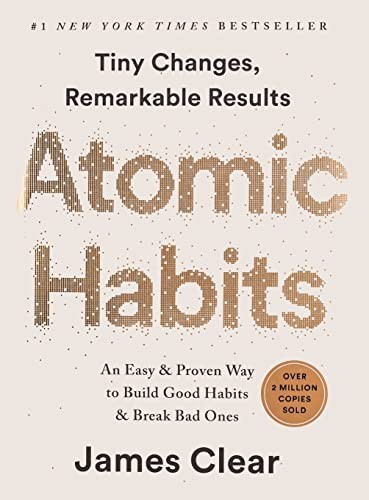
The most practical book on habit formation ever written.
James Clear spent years studying the science of behavior change and distilled it into one central insight: you don't rise to the level of your goals, you fall to the level of your systems. Atomic Habits is built on four laws of behavior change (make it obvious, make it attractive, make it easy, make it satisfying), and the practical advice in each chapter is dense enough that most people read it twice.
What sets it apart from similar books is that Clear never pretends willpower is the answer. The whole framework is about designing your environment so that the right behaviors are the path of least resistance. That shift in thinking changes how you approach everything from your morning routine to your workout schedule.
There's an existing Lifestack deep-dive on Atomic Habits worth reading alongside the book, which covers how to apply Clear's habit stacking method in your daily schedule.
Key Lessons
Small 1% improvements compound dramatically over time
Identity-based habits outlast motivation-based ones
The environment you design matters more than your intentions
Best for: Anyone who wants to build better routines and understands that motivation alone isn't a system.
2. Can't Hurt Me by David Goggins
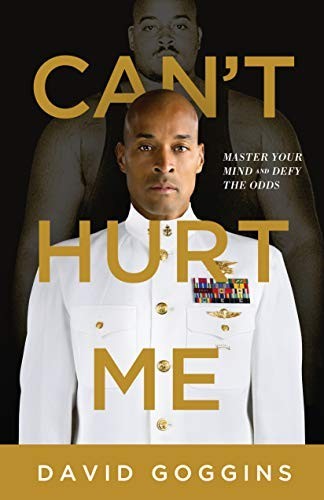
A former Navy SEAL's manual for breaking through mental limits.
David Goggins grew up in a violently abusive household, struggled with severe obesity, and failed his first attempt at Navy SEAL training. Then he became one of the most decorated special operations soldiers in U.S. history and completed some of the most grueling endurance events on the planet. Can't Hurt Me is the account of how he did it.
The book works as a memoir and a psychological blueprint at the same time. Goggins introduces concepts like the "40% rule" (when your mind says you're done, you're usually at 40% of your actual capacity) and the "accountability mirror" (brutally honest self-assessment without excuses). These aren't motivational platitudes. They come from a man who actually lived them under extreme duress, which is why they land differently than most self-help material.
Key Lessons
The mind quits long before the body does
Callusing your mind requires seeking out voluntary discomfort
Honest self-assessment, not self-compassion, is what drives real change
Best for: Men who need to reconnect with their capacity for hard work and stop negotiating with the comfortable version of themselves.
3. Meditations by Marcus Aurelius
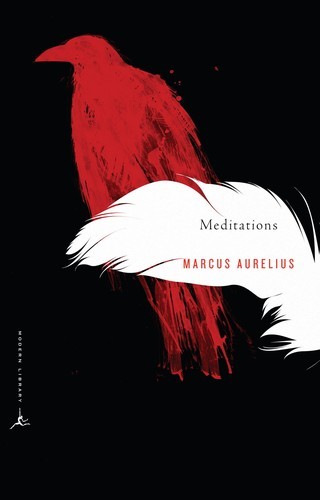
Private notes from a Roman emperor that became a timeless guide to clear thinking.
Marcus Aurelius ruled the Roman Empire at its height and wrote none of this for publication. Meditations is his personal journal, written to himself as a series of reminders about how to think and act. That context matters. This is a man with more power than nearly any human in history telling himself to stay humble, control his reactions, and focus on what he can influence. That's the actual point of Stoicism.
The Gregory Hays translation (Modern Library edition) is the most readable modern version. Aurelius writes in short, punchy observations rather than long philosophical arguments, which makes the book easy to pick up and put down. Many readers keep it on their desk and read one page a day.
Key Lessons
You control your judgments and responses, not external events
The obstacle in your path is the path
Virtue and duty matter more than comfort or recognition
Best for: Anyone who wants a daily check on their ego and a framework for staying grounded under pressure.
4. The 7 Habits of Highly Effective People by Stephen Covey
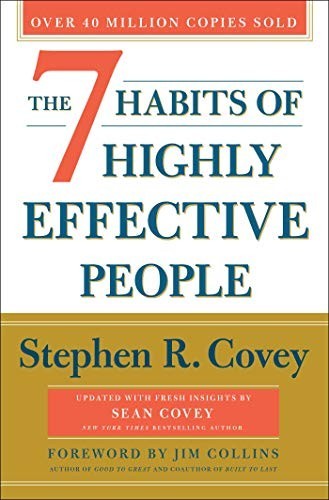
The foundational framework for personal effectiveness that still holds up 35 years later.
Published in 1989 and still selling millions of copies, Covey's book isn't a list of productivity tricks. It's a character-based model for effectiveness built around principles: be proactive, begin with the end in mind, put first things first, think win-win, seek to understand before being understood, synergize, and sharpen the saw. Each habit builds on the last in a deliberate sequence.
The reason this book aged well while most business books from the same era haven't is that Covey focused on principles rather than tactics. The tactics change. The principles don't. The full breakdown of Covey's 7 Habits on the Lifestack blog goes deeper on how each one applies to modern productivity.
Key Lessons
Effective people are proactive, not reactive
Most urgent things are not important, and most important things are not urgent
Relationships require an "emotional bank account" that you must actively maintain
Best for: Men in leadership roles or early in their careers who want a complete model for how to show up, not just a list of hacks.
5. Man's Search for Meaning by Viktor Frankl

A psychiatrist's account of surviving four Nazi concentration camps and what it revealed about human resilience.
Viktor Frankl spent years in Auschwitz and three other concentration camps. Man's Search for Meaning is his account of what he observed about who survived psychologically and who didn't. His central argument: people can endure almost any suffering if they have a reason for it. Suffering without meaning breaks people. Suffering in service of something larger does not.
At 154 pages, this is the shortest book on this list and one of the densest. Frankl developed Logotherapy (meaning-centered psychotherapy) from his observations, and the second half of the book explains the framework. The first half is the memoir, and it's some of the most quietly devastating writing you'll encounter.
Key Lessons
The primary human drive is not pleasure but the pursuit of meaning
You can choose your attitude toward any circumstance, even extreme suffering
A life without purpose collapses under ordinary stress
Best for: Men going through a difficult period who need a perspective shift, or anyone who wants to understand what actually drives sustained motivation.
6. 12 Rules for Life by Jordan Peterson

A clinical psychologist's guide to taking responsibility and building order from chaos.
Jordan Peterson's rules range from the literal ("stand up straight with your shoulders back") to the philosophical ("pursue what is meaningful, not what is expedient"). Each chapter starts with the rule and then expands into psychology, mythology, and clinical observation. The writing is dense and occasionally takes wide detours, but the core arguments are consistently worth the effort.
The book's central message is that personal responsibility is the foundation of everything else. You can't fix the world until you've addressed what's broken in your own room. That framing connected with a generation of young men who found a lot of self-help too soft on accountability, and it's why the book sold over 10 million copies.
Key Lessons
Order and discipline are prerequisites for freedom, not its opposites
Compare yourself to who you were yesterday, not to others
Taking responsibility is the starting point for any meaningful improvement
Best for: Men who are drifting and need a clear-eyed framework for getting their lives in order.
7. The Obstacle Is the Way by Ryan Holiday
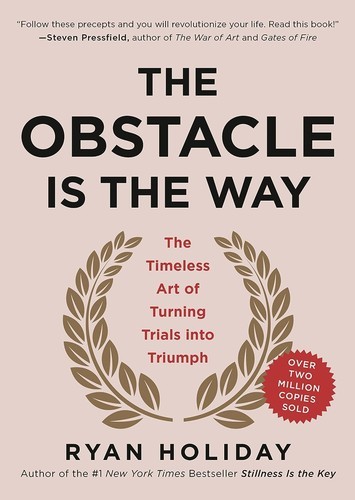
Stoic philosophy applied to real-world adversity, with examples from history's most effective people.
Ryan Holiday translated the core of Stoic philosophy into three words: perception, action, will. How you see a problem determines whether it defeats you or becomes your advantage. This book is built around historical case studies: Thomas Edison, Abraham Lincoln, Amelia Earhart, and dozens of others who turned serious setbacks into defining moments.
The format works because Holiday doesn't just explain the philosophy in the abstract. He shows it operating in high-stakes situations where the wrong mindset would have meant failure. It's a short book (200 pages), and most people finish it in two sittings. Many read it at least once a year.
Key Lessons
The thing in your way is often the thing that can move you forward
Action on what you can control prevents you from wasting energy on what you can't
Persistent will, not talent, is what determines long outcomes
Best for: Men dealing with a specific setback, career change, or period of stagnation who need a framework for converting it into forward momentum.
8. Deep Work by Cal Newport

The case that focused, cognitively demanding work is the most valuable skill in a distracted world.
Cal Newport argues that the ability to focus without distraction on cognitively demanding tasks (what he calls "deep work") is becoming both increasingly rare and increasingly valuable. Most people in knowledge-work environments spend their days in a state of constant shallow work: email, Slack, meetings, notifications. Newport makes the case that this is actively eroding the capacity for the kind of work that produces meaningful results.
The book has two parts. The first makes the argument. The second gives you the rules for implementing deep work in your schedule, including time-blocking, depth scheduling, and draining the shallows. The Lifestack breakdown of Cal Newport's Deep Work covers how to apply these rules practically, including how energy-based scheduling pairs with Newport's depth philosophy. We also have a dedicated post on Newport's slow productivity approach for a more recent take on his work.
Key Lessons
Shallow work expands to fill available time if you let it
Deep work requires scheduling, not just intention
Boredom tolerance is a prerequisite for concentration
Best for: Knowledge workers, engineers, writers, and anyone whose best work requires sustained uninterrupted focus.
Best App to Put These Books Into Practice
Reading is the input. Your calendar is the output. Most people finish a book feeling motivated and then return to the same schedule that produced the problems the book was supposed to fix. The missing layer is a planning system that makes it easy to actually do the things you learned.
Lifestack is an AI scheduling app built around energy-aware time blocking. You log your energy levels alongside your tasks, and the app learns when you do your best cognitive work, your best creative work, and when you're coasting. Then it auto-schedules your tasks accordingly, so your deep work blocks land when your focus is sharpest.
This connects directly to what Newport argues in Deep Work, what Clear describes in Atomic Habits (identity-based scheduling), and what Covey means by "first things first." Energy-based planning is what makes those principles operational rather than theoretical. Lifestack works on iOS and Android with a Chrome extension, and costs $7/month ($50/year). There's a 7-day free trial on the annual plan.
More on the approach: how energy-based scheduling works and personal energy management fundamentals.
Which Book Should You Start With?
If you want to build better habits: Start with Atomic Habits. Read our other productivity book picks after.
If you feel stuck or unmotivated: Start with Can't Hurt Me or Man's Search for Meaning, depending on whether you need fire or philosophy.
If you're drifting and need structure: Start with 12 Rules for Life or The 7 Habits.
If you want to do better work: Start with Deep Work. Then pair it with the best self-improvement apps to make the schedule real.
If you're facing a major setback: Start with The Obstacle Is the Way or Man's Search for Meaning.
If you want daily philosophy: Meditations works best as a daily read, one or two pages at a time.
Frequently Asked Questions
What is the best self-improvement book for men who hate self-help books?
Can't Hurt Me and Meditations are the two most-cited picks among men who say they dislike the genre. Goggins doesn't do positive thinking or vague advice. Marcus Aurelius wrote for himself, not an audience. Neither feels like a self-help book in the conventional sense.
How many self-improvement books should a man read per year?
Quality over quantity. One book read carefully, with notes and applied behavior change, is worth more than twelve books skimmed. Most of the men who talk about reading 50 books a year are retaining and applying almost nothing. Start with one book per month and focus on actually changing how you act, not just how you feel after reading.
Are self-improvement books for men different from general self-help books?
The best ones aren't. Atomic Habits and Deep Work aren't written "for men" but consistently rank highest among male readers because they're built around systems, evidence, and concrete action rather than emotion and affirmation. The books on this list work for anyone, but they tend to land strongly with men who want a framework rather than encouragement.
What's the best self-improvement book for men in their 20s?
Atomic Habits first, because the earlier you build the right systems the more they compound. Then Deep Work for anyone who wants their career to move faster than their peers'. After those two, read whatever connects with what you're actually struggling with.
Do audiobooks count, or should I read self-improvement books in print?
Audiobooks work for narrative-driven books like Can't Hurt Me and Man's Search for Meaning. They're less effective for books with dense frameworks like The 7 Habits or Atomic Habits, where you want to pause, take notes, and flip back. For those, print or e-book is better.
Is there a good app to help implement self-improvement book lessons?
Lifestack is the strongest option for translating reading into action. It auto-schedules your tasks based on your personal energy patterns, which directly applies the core insight from books like Deep Work and Atomic Habits: doing the right work at the right time matters as much as doing it at all. See also: best apps for self-improvement and self-improvement podcasts worth pairing with these books.
Most self-improvement advice on the internet is shallow. You get a 60-second reel telling you to wake up at 5am, and somehow that's supposed to turn everything around. Books are different. The best ones force you to sit with an idea long enough to actually change how you see things. This list is those books.
The titles here were chosen because they cut across different dimensions of growth that men actually struggle with: building habits that stick, developing mental toughness, finding a sense of purpose, and doing focused work in a world that constantly pulls your attention apart. Together, they cover most of what you need.
We've also included a section on the best tool for putting what you read into practice, because a great book means nothing if it doesn't change what you do on Monday morning.
Key Takeaways
Atomic Habits by James Clear is the single most practical book on behavior change ever written, and it's the obvious starting point for anyone who wants to build better systems.
For mental toughness and discipline, Goggins and Aurelius are unmatched. Read one when you need fire, the other when you need clarity.
Purpose-driven work separates the people who hit burnout from those who don't. Frankl, Peterson, and Newport each approach this from a different angle, and all three are worth your time.
Quick Guide
Atomic Habits by James Clear: The gold standard for building good habits and breaking bad ones
Can't Hurt Me by David Goggins: Navy SEAL's raw memoir on extreme mental toughness
Meditations by Marcus Aurelius: Stoic philosophy from a Roman emperor's private journal
The 7 Habits of Highly Effective People by Stephen Covey: Timeless framework for personal and professional effectiveness
Man's Search for Meaning by Viktor Frankl: Finding purpose through extreme suffering and hardship
12 Rules for Life by Jordan Peterson: A clinical psychologist's framework for taking responsibility and building order
The Obstacle Is the Way by Ryan Holiday: Stoic approach to turning adversity into advantage
Deep Work by Cal Newport: The case for focused, distraction-free work as the key skill of our time
How We Selected These Books
We filtered for books that are actually read to completion, not just bought and shelved. That meant looking at reader completion rates, Goodreads ratings weighted by review volume, and consistent mentions across men's self-development communities over multiple years. We also required each book to offer something concrete: a system, a reframe, or a philosophy you can actually use.
No filler. No books included because they were trendy in a given year. Every title here has held up over time.
1. Atomic Habits by James Clear
The most practical book on habit formation ever written.
James Clear spent years studying the science of behavior change and distilled it into one central insight: you don't rise to the level of your goals, you fall to the level of your systems. Atomic Habits is built on four laws of behavior change (make it obvious, make it attractive, make it easy, make it satisfying), and the practical advice in each chapter is dense enough that most people read it twice.
What sets it apart from similar books is that Clear never pretends willpower is the answer. The whole framework is about designing your environment so that the right behaviors are the path of least resistance. That shift in thinking changes how you approach everything from your morning routine to your workout schedule.
There's an existing Lifestack deep-dive on Atomic Habits worth reading alongside the book, which covers how to apply Clear's habit stacking method in your daily schedule.
Key Lessons
Small 1% improvements compound dramatically over time
Identity-based habits outlast motivation-based ones
The environment you design matters more than your intentions
Best for: Anyone who wants to build better routines and understands that motivation alone isn't a system.
2. Can't Hurt Me by David Goggins
A former Navy SEAL's manual for breaking through mental limits.
David Goggins grew up in a violently abusive household, struggled with severe obesity, and failed his first attempt at Navy SEAL training. Then he became one of the most decorated special operations soldiers in U.S. history and completed some of the most grueling endurance events on the planet. Can't Hurt Me is the account of how he did it.
The book works as a memoir and a psychological blueprint at the same time. Goggins introduces concepts like the "40% rule" (when your mind says you're done, you're usually at 40% of your actual capacity) and the "accountability mirror" (brutally honest self-assessment without excuses). These aren't motivational platitudes. They come from a man who actually lived them under extreme duress, which is why they land differently than most self-help material.
Key Lessons
The mind quits long before the body does
Callusing your mind requires seeking out voluntary discomfort
Honest self-assessment, not self-compassion, is what drives real change
Best for: Men who need to reconnect with their capacity for hard work and stop negotiating with the comfortable version of themselves.
3. Meditations by Marcus Aurelius
Private notes from a Roman emperor that became a timeless guide to clear thinking.
Marcus Aurelius ruled the Roman Empire at its height and wrote none of this for publication. Meditations is his personal journal, written to himself as a series of reminders about how to think and act. That context matters. This is a man with more power than nearly any human in history telling himself to stay humble, control his reactions, and focus on what he can influence. That's the actual point of Stoicism.
The Gregory Hays translation (Modern Library edition) is the most readable modern version. Aurelius writes in short, punchy observations rather than long philosophical arguments, which makes the book easy to pick up and put down. Many readers keep it on their desk and read one page a day.
Key Lessons
You control your judgments and responses, not external events
The obstacle in your path is the path
Virtue and duty matter more than comfort or recognition
Best for: Anyone who wants a daily check on their ego and a framework for staying grounded under pressure.
4. The 7 Habits of Highly Effective People by Stephen Covey
The foundational framework for personal effectiveness that still holds up 35 years later.
Published in 1989 and still selling millions of copies, Covey's book isn't a list of productivity tricks. It's a character-based model for effectiveness built around principles: be proactive, begin with the end in mind, put first things first, think win-win, seek to understand before being understood, synergize, and sharpen the saw. Each habit builds on the last in a deliberate sequence.
The reason this book aged well while most business books from the same era haven't is that Covey focused on principles rather than tactics. The tactics change. The principles don't. The full breakdown of Covey's 7 Habits on the Lifestack blog goes deeper on how each one applies to modern productivity.
Key Lessons
Effective people are proactive, not reactive
Most urgent things are not important, and most important things are not urgent
Relationships require an "emotional bank account" that you must actively maintain
Best for: Men in leadership roles or early in their careers who want a complete model for how to show up, not just a list of hacks.
5. Man's Search for Meaning by Viktor Frankl
A psychiatrist's account of surviving four Nazi concentration camps and what it revealed about human resilience.
Viktor Frankl spent years in Auschwitz and three other concentration camps. Man's Search for Meaning is his account of what he observed about who survived psychologically and who didn't. His central argument: people can endure almost any suffering if they have a reason for it. Suffering without meaning breaks people. Suffering in service of something larger does not.
At 154 pages, this is the shortest book on this list and one of the densest. Frankl developed Logotherapy (meaning-centered psychotherapy) from his observations, and the second half of the book explains the framework. The first half is the memoir, and it's some of the most quietly devastating writing you'll encounter.
Key Lessons
The primary human drive is not pleasure but the pursuit of meaning
You can choose your attitude toward any circumstance, even extreme suffering
A life without purpose collapses under ordinary stress
Best for: Men going through a difficult period who need a perspective shift, or anyone who wants to understand what actually drives sustained motivation.
6. 12 Rules for Life by Jordan Peterson
A clinical psychologist's guide to taking responsibility and building order from chaos.
Jordan Peterson's rules range from the literal ("stand up straight with your shoulders back") to the philosophical ("pursue what is meaningful, not what is expedient"). Each chapter starts with the rule and then expands into psychology, mythology, and clinical observation. The writing is dense and occasionally takes wide detours, but the core arguments are consistently worth the effort.
The book's central message is that personal responsibility is the foundation of everything else. You can't fix the world until you've addressed what's broken in your own room. That framing connected with a generation of young men who found a lot of self-help too soft on accountability, and it's why the book sold over 10 million copies.
Key Lessons
Order and discipline are prerequisites for freedom, not its opposites
Compare yourself to who you were yesterday, not to others
Taking responsibility is the starting point for any meaningful improvement
Best for: Men who are drifting and need a clear-eyed framework for getting their lives in order.
7. The Obstacle Is the Way by Ryan Holiday
Stoic philosophy applied to real-world adversity, with examples from history's most effective people.
Ryan Holiday translated the core of Stoic philosophy into three words: perception, action, will. How you see a problem determines whether it defeats you or becomes your advantage. This book is built around historical case studies: Thomas Edison, Abraham Lincoln, Amelia Earhart, and dozens of others who turned serious setbacks into defining moments.
The format works because Holiday doesn't just explain the philosophy in the abstract. He shows it operating in high-stakes situations where the wrong mindset would have meant failure. It's a short book (200 pages), and most people finish it in two sittings. Many read it at least once a year.
Key Lessons
The thing in your way is often the thing that can move you forward
Action on what you can control prevents you from wasting energy on what you can't
Persistent will, not talent, is what determines long outcomes
Best for: Men dealing with a specific setback, career change, or period of stagnation who need a framework for converting it into forward momentum.
8. Deep Work by Cal Newport
The case that focused, cognitively demanding work is the most valuable skill in a distracted world.
Cal Newport argues that the ability to focus without distraction on cognitively demanding tasks (what he calls "deep work") is becoming both increasingly rare and increasingly valuable. Most people in knowledge-work environments spend their days in a state of constant shallow work: email, Slack, meetings, notifications. Newport makes the case that this is actively eroding the capacity for the kind of work that produces meaningful results.
The book has two parts. The first makes the argument. The second gives you the rules for implementing deep work in your schedule, including time-blocking, depth scheduling, and draining the shallows. The Lifestack breakdown of Cal Newport's Deep Work covers how to apply these rules practically, including how energy-based scheduling pairs with Newport's depth philosophy. We also have a dedicated post on Newport's slow productivity approach for a more recent take on his work.
Key Lessons
Shallow work expands to fill available time if you let it
Deep work requires scheduling, not just intention
Boredom tolerance is a prerequisite for concentration
Best for: Knowledge workers, engineers, writers, and anyone whose best work requires sustained uninterrupted focus.
Best App to Put These Books Into Practice
Reading is the input. Your calendar is the output. Most people finish a book feeling motivated and then return to the same schedule that produced the problems the book was supposed to fix. The missing layer is a planning system that makes it easy to actually do the things you learned.
Lifestack is an AI scheduling app built around energy-aware time blocking. You log your energy levels alongside your tasks, and the app learns when you do your best cognitive work, your best creative work, and when you're coasting. Then it auto-schedules your tasks accordingly, so your deep work blocks land when your focus is sharpest.
This connects directly to what Newport argues in Deep Work, what Clear describes in Atomic Habits (identity-based scheduling), and what Covey means by "first things first." Energy-based planning is what makes those principles operational rather than theoretical. Lifestack works on iOS and Android with a Chrome extension, and costs $7/month ($50/year). There's a 7-day free trial on the annual plan.
More on the approach: how energy-based scheduling works and personal energy management fundamentals.
Which Book Should You Start With?
If you want to build better habits: Start with Atomic Habits. Read our other productivity book picks after.
If you feel stuck or unmotivated: Start with Can't Hurt Me or Man's Search for Meaning, depending on whether you need fire or philosophy.
If you're drifting and need structure: Start with 12 Rules for Life or The 7 Habits.
If you want to do better work: Start with Deep Work. Then pair it with the best self-improvement apps to make the schedule real.
If you're facing a major setback: Start with The Obstacle Is the Way or Man's Search for Meaning.
If you want daily philosophy: Meditations works best as a daily read, one or two pages at a time.
Frequently Asked Questions
What is the best self-improvement book for men who hate self-help books?
Can't Hurt Me and Meditations are the two most-cited picks among men who say they dislike the genre. Goggins doesn't do positive thinking or vague advice. Marcus Aurelius wrote for himself, not an audience. Neither feels like a self-help book in the conventional sense.
How many self-improvement books should a man read per year?
Quality over quantity. One book read carefully, with notes and applied behavior change, is worth more than twelve books skimmed. Most of the men who talk about reading 50 books a year are retaining and applying almost nothing. Start with one book per month and focus on actually changing how you act, not just how you feel after reading.
Are self-improvement books for men different from general self-help books?
The best ones aren't. Atomic Habits and Deep Work aren't written "for men" but consistently rank highest among male readers because they're built around systems, evidence, and concrete action rather than emotion and affirmation. The books on this list work for anyone, but they tend to land strongly with men who want a framework rather than encouragement.
What's the best self-improvement book for men in their 20s?
Atomic Habits first, because the earlier you build the right systems the more they compound. Then Deep Work for anyone who wants their career to move faster than their peers'. After those two, read whatever connects with what you're actually struggling with.
Do audiobooks count, or should I read self-improvement books in print?
Audiobooks work for narrative-driven books like Can't Hurt Me and Man's Search for Meaning. They're less effective for books with dense frameworks like The 7 Habits or Atomic Habits, where you want to pause, take notes, and flip back. For those, print or e-book is better.
Is there a good app to help implement self-improvement book lessons?
Lifestack is the strongest option for translating reading into action. It auto-schedules your tasks based on your personal energy patterns, which directly applies the core insight from books like Deep Work and Atomic Habits: doing the right work at the right time matters as much as doing it at all. See also: best apps for self-improvement and self-improvement podcasts worth pairing with these books.



FOLLOW ON
FOLLOW ON
FOLLOW ON


Copyright 2026 © Lifestack. All rights reserved
Copyright 2026 © Lifestack. All rights reserved

