
Tips
Short Sleeper Syndrome: What the Science Says
Short Sleeper Syndrome: What the Science Says

Every few years, a news story appears about someone who sleeps four hours a night, functions perfectly, and never feels tired. These stories typically imply that some people are just built differently and don't need as much sleep as the rest of us. The truth is more complicated, and considerably rarer than the stories suggest.
Short sleeper syndrome (SSS) is a real genetic condition, but it affects an estimated one to three percent of the population. Most people who believe they're natural short sleepers are actually chronically sleep deprived and have simply adapted to feeling that way. Understanding the difference matters, because the health consequences of the two are very different.
This guide covers what short sleeper syndrome actually is, how it's distinct from ordinary sleep deprivation, what the genetics look like, and how to figure out which category you're actually in.
Key Takeaways
True short sleeper syndrome is a rare genetic trait affecting roughly 1-3% of people
Most people who believe they're short sleepers are chronically sleep deprived and have adapted to it
Chronic short sleep carries serious long-term health risks even when it doesn't feel that way day to day
What Is Short Sleeper Syndrome?
Short sleeper syndrome is a naturally occurring condition where a person genuinely requires fewer hours of sleep to feel fully rested. True short sleepers consistently sleep six hours or fewer, wake up naturally without an alarm, feel completely restored, and maintain that pattern without any apparent cognitive or health consequences.
The key word is "genuinely." This isn't a choice or a skill. True SSS is hardwired into the person's biology. They don't drag through the afternoon. They don't need caffeine to function. They don't sleep in on weekends to catch up. They simply need less sleep and wake up feeling fine.
This is very different from what most self-identified short sleepers experience, which is a compressed sleep schedule driven by work, caregiving, or screen time, paired with the human capacity to adapt to chronic deprivation and stop noticing how impaired you've become. Whether 8 hours of sleep is enough varies by individual, but the range of genuine human sleep need is narrower than most people assume.
The Genetic Basis of True SSS
Researchers have identified several genetic mutations associated with short sleeper syndrome, primarily in genes involved in how the brain processes sleep signals. The DEC2 gene mutation was one of the first identified. Carriers of this mutation consistently sleep fewer hours than the general population without accumulating sleep debt or showing the cognitive decline associated with sleep restriction in non-carriers.
Subsequent research identified additional variants (NPSR1, mGluR1, β1-AR) that appear to produce similar effects through slightly different pathways. None of these mutations has been found in more than a tiny fraction of the population.
This genetic basis is important because it means SSS isn't something you develop through practice or willpower. If you don't carry the relevant mutations, training yourself to sleep less will not produce the same outcome. What it will produce is sleep debt and the health consequences that come with it.
True SSS vs. Chronic Sleep Deprivation
This distinction is the central diagnostic challenge, because the surface behavior looks identical. Both groups sleep short hours. The difference is in the consequences and in what happens on weekends, vacations, and during illness.
True short sleepers don't sleep significantly longer on weekends. They don't feel dramatically better after a long sleep. They don't get more ill than average or recover more slowly. Their performance on cognitive tasks doesn't improve measurably after extra sleep because they aren't carrying debt to repay.
Chronically sleep-deprived people do all of those things, even if they don't notice it clearly. Research consistently shows that people underestimate their own impairment under sleep restriction and overestimate their baseline performance. If you've been running on six hours for years, you may have genuinely forgotten what fully rested feels like. Sleep's relationship to energy is more direct than most people realize once they actually get enough of it.
Symptoms and How to Recognize It
True short sleeper syndrome presents as consistently sleeping four to six hours, waking spontaneously (not by alarm), feeling alert and energetic immediately upon waking, and maintaining that alertness throughout the entire day without afternoon fatigue, caffeine dependence, or the urge to nap. This pattern is stable across years and across situations where longer sleep is available.
Signs that point toward chronic deprivation rather than true SSS: needing an alarm to wake up, feeling groggy for an extended period after waking, hitting a wall in the afternoon, craving sleep on weekends or vacation, getting noticeably more sick than peers, or experiencing concentration and memory problems during the day.
If you're unsure which applies to you, two weeks of sleeping as much as your body wants (no alarm, low-stress schedule) can reveal your natural sleep need. Most chronically sleep-deprived people find they sleep significantly longer during this window before returning to a stable baseline that's often more than they'd been getting.
Health Implications of Short Sleep
For the small group with genuine SSS, the short sleep doesn't appear to carry the same health risks as externally imposed short sleep. The mutation that reduces their sleep need doesn't seem to shortcut the restorative processes that sleep provides; it appears to run those processes more efficiently in a shorter window.
For everyone else, chronic sleep restriction is associated with a substantial list of downstream effects: increased cardiovascular risk, impaired glucose metabolism, weakened immune function, higher rates of depression and anxiety, and accelerated cognitive decline over decades. These effects accumulate even when they're not felt acutely.
The tricky part is that sleep-deprived people often report feeling fine. The impairment is real but imperceptible to the person experiencing it, which makes it easy to rationalize continued short sleep as personal necessity rather than deficit. If you regularly feel low energy throughout the day, poor sleep quality is the first thing worth examining before looking for other explanations.
How to Figure Out Your Real Sleep Need
There's no definitive genetic test for SSS available to consumers, and the mutations associated with it are rare enough that a negative result from a consumer genetics test doesn't mean much. The most practical method remains behavioral: reset your schedule and see what your body actually does with unconstrained sleep time.
For two to three weeks, go to bed when tired, don't set an alarm (or set one only as a backup for truly unavoidable commitments), avoid alcohol in the evenings (which fragments sleep), and keep your sleep environment dark and cool. Most people stabilize at their natural sleep need after a week or so of catching up. That stabilized amount is closer to your true need than whatever you were getting before.
Tracking your patterns consistently also helps. Circadian rhythm apps can surface patterns about when you feel alert versus dragged, which feeds into understanding both your sleep need and how to schedule your day around your natural energy peaks. Resetting a disrupted circadian rhythm is sometimes the actual fix for people who assumed they were naturally short sleepers but had just shifted their rhythms out of alignment.
Best Tool for Sleep and Energy Management
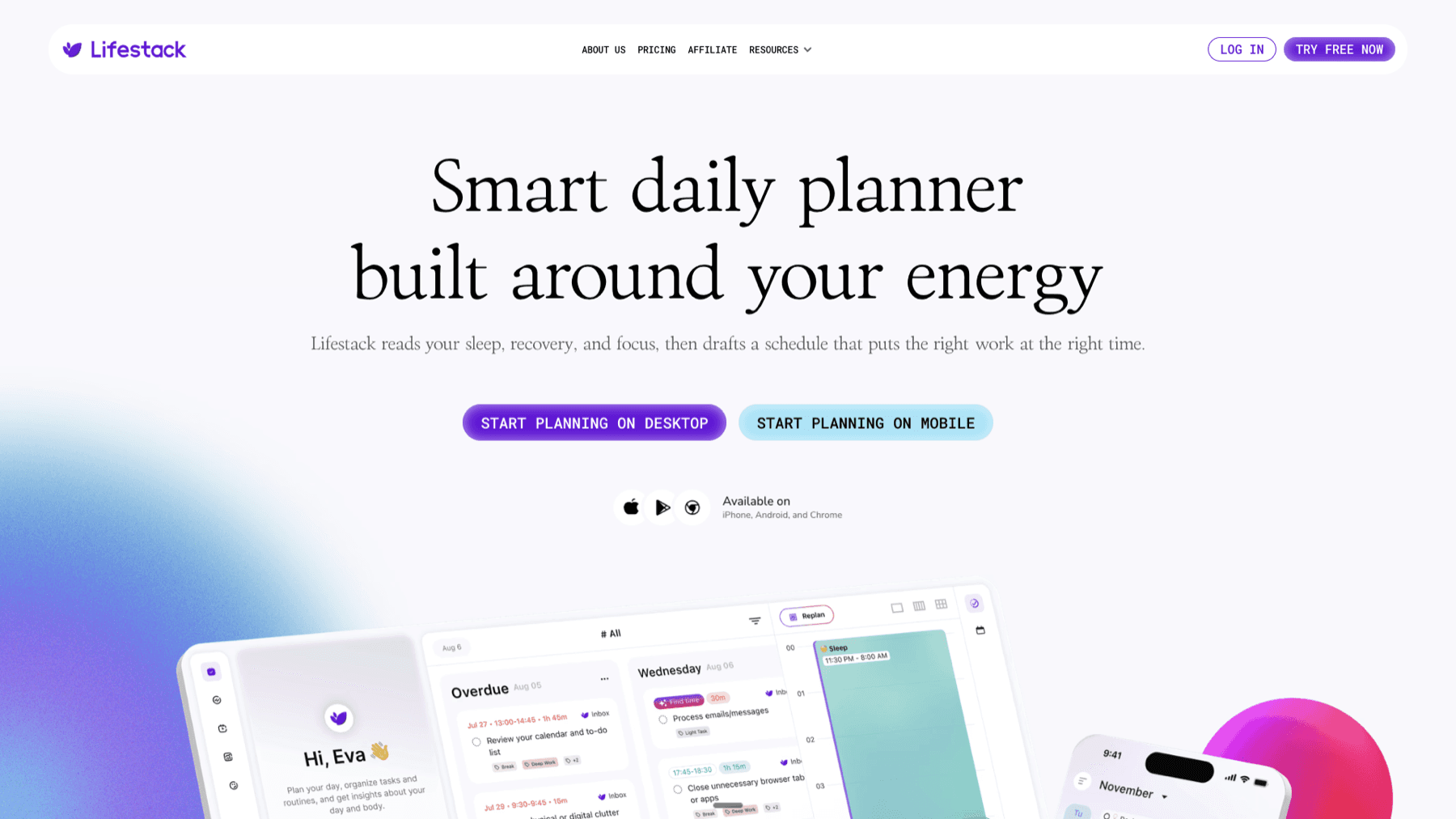
If you're working on improving your sleep patterns or managing energy on reduced sleep, Lifestack addresses the scheduling side of the equation. One of the most practical interventions for people with inconsistent energy is to stop scheduling demanding tasks randomly throughout the day and start scheduling them around actual energy levels.
Lifestack does this automatically. It learns when your energy peaks and troughs tend to fall and schedules your priority tasks into the windows when you're most likely to do them well. This matters whether you're a genuine short sleeper managing a compressed day, or a regular sleeper trying to get more out of the hours you have. Read more in the Lifestack introduction or see how the energy calendar approach applies in practice. Lifestack costs $7/month or $50/year, with a 7-day free trial on the annual plan.
FAQ
How rare is true short sleeper syndrome?
Estimates vary, but most researchers put the prevalence at roughly 1 to 3 percent of the population. It's significantly rarer than the number of people who identify as natural short sleepers, which suggests most self-identified short sleepers are functioning on habitual sleep deprivation rather than true SSS.
Can you develop short sleeper syndrome?
No. True SSS is genetic. You either carry the relevant mutations or you don't. You can train yourself to function on less sleep, but that's different: the underlying sleep debt accumulates even if you stop feeling it acutely.
Do short sleepers live longer?
True short sleepers don't appear to have shortened lifespans compared to normal sleepers, based on available research. This is different from habitually sleep-deprived people, who show higher rates of cardiovascular disease and other long-term health risks.
What should I do if I think I might have SSS?
The most practical first step is to test it: spend two weeks sleeping without constraints and see whether your body stabilizes at a short sleep schedule naturally. If you still only need four to six hours without feeling tired or impaired, that's more consistent with true SSS. If you start sleeping significantly longer, you were carrying debt. Discussing it with a sleep physician is the right move if you want a more formal evaluation.
Is it possible to need only 5 hours of sleep?
For true short sleepers, yes. For most people, no. Research on sleep restriction shows that the vast majority of people who sleep five hours show measurable cognitive impairment, even if they don't perceive it themselves. Five hours of sleep feeling fine is more often a sign of adaptation to deprivation than evidence of a genuine low sleep need.
Does caffeine help if you're a short sleeper?
True short sleepers often don't need caffeine because they wake up fully rested. If you find that you depend heavily on caffeine to function, it's more likely a sign of sleep debt than of SSS. How long caffeine stays in your system matters too, because late-day caffeine can cut into the sleep you're getting, compounding the deficit.
Every few years, a news story appears about someone who sleeps four hours a night, functions perfectly, and never feels tired. These stories typically imply that some people are just built differently and don't need as much sleep as the rest of us. The truth is more complicated, and considerably rarer than the stories suggest.
Short sleeper syndrome (SSS) is a real genetic condition, but it affects an estimated one to three percent of the population. Most people who believe they're natural short sleepers are actually chronically sleep deprived and have simply adapted to feeling that way. Understanding the difference matters, because the health consequences of the two are very different.
This guide covers what short sleeper syndrome actually is, how it's distinct from ordinary sleep deprivation, what the genetics look like, and how to figure out which category you're actually in.
Key Takeaways
True short sleeper syndrome is a rare genetic trait affecting roughly 1-3% of people
Most people who believe they're short sleepers are chronically sleep deprived and have adapted to it
Chronic short sleep carries serious long-term health risks even when it doesn't feel that way day to day
What Is Short Sleeper Syndrome?
Short sleeper syndrome is a naturally occurring condition where a person genuinely requires fewer hours of sleep to feel fully rested. True short sleepers consistently sleep six hours or fewer, wake up naturally without an alarm, feel completely restored, and maintain that pattern without any apparent cognitive or health consequences.
The key word is "genuinely." This isn't a choice or a skill. True SSS is hardwired into the person's biology. They don't drag through the afternoon. They don't need caffeine to function. They don't sleep in on weekends to catch up. They simply need less sleep and wake up feeling fine.
This is very different from what most self-identified short sleepers experience, which is a compressed sleep schedule driven by work, caregiving, or screen time, paired with the human capacity to adapt to chronic deprivation and stop noticing how impaired you've become. Whether 8 hours of sleep is enough varies by individual, but the range of genuine human sleep need is narrower than most people assume.
The Genetic Basis of True SSS
Researchers have identified several genetic mutations associated with short sleeper syndrome, primarily in genes involved in how the brain processes sleep signals. The DEC2 gene mutation was one of the first identified. Carriers of this mutation consistently sleep fewer hours than the general population without accumulating sleep debt or showing the cognitive decline associated with sleep restriction in non-carriers.
Subsequent research identified additional variants (NPSR1, mGluR1, β1-AR) that appear to produce similar effects through slightly different pathways. None of these mutations has been found in more than a tiny fraction of the population.
This genetic basis is important because it means SSS isn't something you develop through practice or willpower. If you don't carry the relevant mutations, training yourself to sleep less will not produce the same outcome. What it will produce is sleep debt and the health consequences that come with it.
True SSS vs. Chronic Sleep Deprivation
This distinction is the central diagnostic challenge, because the surface behavior looks identical. Both groups sleep short hours. The difference is in the consequences and in what happens on weekends, vacations, and during illness.
True short sleepers don't sleep significantly longer on weekends. They don't feel dramatically better after a long sleep. They don't get more ill than average or recover more slowly. Their performance on cognitive tasks doesn't improve measurably after extra sleep because they aren't carrying debt to repay.
Chronically sleep-deprived people do all of those things, even if they don't notice it clearly. Research consistently shows that people underestimate their own impairment under sleep restriction and overestimate their baseline performance. If you've been running on six hours for years, you may have genuinely forgotten what fully rested feels like. Sleep's relationship to energy is more direct than most people realize once they actually get enough of it.
Symptoms and How to Recognize It
True short sleeper syndrome presents as consistently sleeping four to six hours, waking spontaneously (not by alarm), feeling alert and energetic immediately upon waking, and maintaining that alertness throughout the entire day without afternoon fatigue, caffeine dependence, or the urge to nap. This pattern is stable across years and across situations where longer sleep is available.
Signs that point toward chronic deprivation rather than true SSS: needing an alarm to wake up, feeling groggy for an extended period after waking, hitting a wall in the afternoon, craving sleep on weekends or vacation, getting noticeably more sick than peers, or experiencing concentration and memory problems during the day.
If you're unsure which applies to you, two weeks of sleeping as much as your body wants (no alarm, low-stress schedule) can reveal your natural sleep need. Most chronically sleep-deprived people find they sleep significantly longer during this window before returning to a stable baseline that's often more than they'd been getting.
Health Implications of Short Sleep
For the small group with genuine SSS, the short sleep doesn't appear to carry the same health risks as externally imposed short sleep. The mutation that reduces their sleep need doesn't seem to shortcut the restorative processes that sleep provides; it appears to run those processes more efficiently in a shorter window.
For everyone else, chronic sleep restriction is associated with a substantial list of downstream effects: increased cardiovascular risk, impaired glucose metabolism, weakened immune function, higher rates of depression and anxiety, and accelerated cognitive decline over decades. These effects accumulate even when they're not felt acutely.
The tricky part is that sleep-deprived people often report feeling fine. The impairment is real but imperceptible to the person experiencing it, which makes it easy to rationalize continued short sleep as personal necessity rather than deficit. If you regularly feel low energy throughout the day, poor sleep quality is the first thing worth examining before looking for other explanations.
How to Figure Out Your Real Sleep Need
There's no definitive genetic test for SSS available to consumers, and the mutations associated with it are rare enough that a negative result from a consumer genetics test doesn't mean much. The most practical method remains behavioral: reset your schedule and see what your body actually does with unconstrained sleep time.
For two to three weeks, go to bed when tired, don't set an alarm (or set one only as a backup for truly unavoidable commitments), avoid alcohol in the evenings (which fragments sleep), and keep your sleep environment dark and cool. Most people stabilize at their natural sleep need after a week or so of catching up. That stabilized amount is closer to your true need than whatever you were getting before.
Tracking your patterns consistently also helps. Circadian rhythm apps can surface patterns about when you feel alert versus dragged, which feeds into understanding both your sleep need and how to schedule your day around your natural energy peaks. Resetting a disrupted circadian rhythm is sometimes the actual fix for people who assumed they were naturally short sleepers but had just shifted their rhythms out of alignment.
Best Tool for Sleep and Energy Management
If you're working on improving your sleep patterns or managing energy on reduced sleep, Lifestack addresses the scheduling side of the equation. One of the most practical interventions for people with inconsistent energy is to stop scheduling demanding tasks randomly throughout the day and start scheduling them around actual energy levels.
Lifestack does this automatically. It learns when your energy peaks and troughs tend to fall and schedules your priority tasks into the windows when you're most likely to do them well. This matters whether you're a genuine short sleeper managing a compressed day, or a regular sleeper trying to get more out of the hours you have. Read more in the Lifestack introduction or see how the energy calendar approach applies in practice. Lifestack costs $7/month or $50/year, with a 7-day free trial on the annual plan.
FAQ
How rare is true short sleeper syndrome?
Estimates vary, but most researchers put the prevalence at roughly 1 to 3 percent of the population. It's significantly rarer than the number of people who identify as natural short sleepers, which suggests most self-identified short sleepers are functioning on habitual sleep deprivation rather than true SSS.
Can you develop short sleeper syndrome?
No. True SSS is genetic. You either carry the relevant mutations or you don't. You can train yourself to function on less sleep, but that's different: the underlying sleep debt accumulates even if you stop feeling it acutely.
Do short sleepers live longer?
True short sleepers don't appear to have shortened lifespans compared to normal sleepers, based on available research. This is different from habitually sleep-deprived people, who show higher rates of cardiovascular disease and other long-term health risks.
What should I do if I think I might have SSS?
The most practical first step is to test it: spend two weeks sleeping without constraints and see whether your body stabilizes at a short sleep schedule naturally. If you still only need four to six hours without feeling tired or impaired, that's more consistent with true SSS. If you start sleeping significantly longer, you were carrying debt. Discussing it with a sleep physician is the right move if you want a more formal evaluation.
Is it possible to need only 5 hours of sleep?
For true short sleepers, yes. For most people, no. Research on sleep restriction shows that the vast majority of people who sleep five hours show measurable cognitive impairment, even if they don't perceive it themselves. Five hours of sleep feeling fine is more often a sign of adaptation to deprivation than evidence of a genuine low sleep need.
Does caffeine help if you're a short sleeper?
True short sleepers often don't need caffeine because they wake up fully rested. If you find that you depend heavily on caffeine to function, it's more likely a sign of sleep debt than of SSS. How long caffeine stays in your system matters too, because late-day caffeine can cut into the sleep you're getting, compounding the deficit.



FOLLOW ON
FOLLOW ON
FOLLOW ON


Copyright 2026 © Lifestack. All rights reserved
Copyright 2026 © Lifestack. All rights reserved

