
Tips
ShutEye Sleep Tracker: App Review and Verdict
ShutEye Sleep Tracker: App Review and Verdict

What Is ShutEye?
ShutEye is an iOS sleep app that combines sleep tracking with sleep sounds, smart alarms, snoring detection, and bedtime stories. It's positioned as an all-in-one sleep app: you use it to fall asleep (sounds and stories), to track what happens while you sleep (cycles, snoring, sleep talk recording), and to wake up at the right time (smart alarm that fires during light sleep).
The app is free to download. The free tier is limited. Most of the features that make it useful require a subscription: $9.99/month or $59.99/year. There are occasional promotional rates in the $19.99-$29.99 range for lifetime access. The app has a 4.8-star rating with over a million reviews in the App Store.
Key Takeaways
ShutEye's sleep sound library is excellent, one of the most varied and well-produced of any sleep app. If you're primarily looking for sleep sounds, it's a strong option even at the price.
The sleep tracking is phone-based, not wearable-based. This is a meaningful limitation: accuracy depends on your phone's position and how still you keep it through the night.
At $59.99/year, ShutEye is priced higher than some alternatives that offer wearable-integrated sleep data. The comparison worth making is against Sleep Cycle ($39.99/year) and the Apple Health app (free).
What ShutEye Tracks
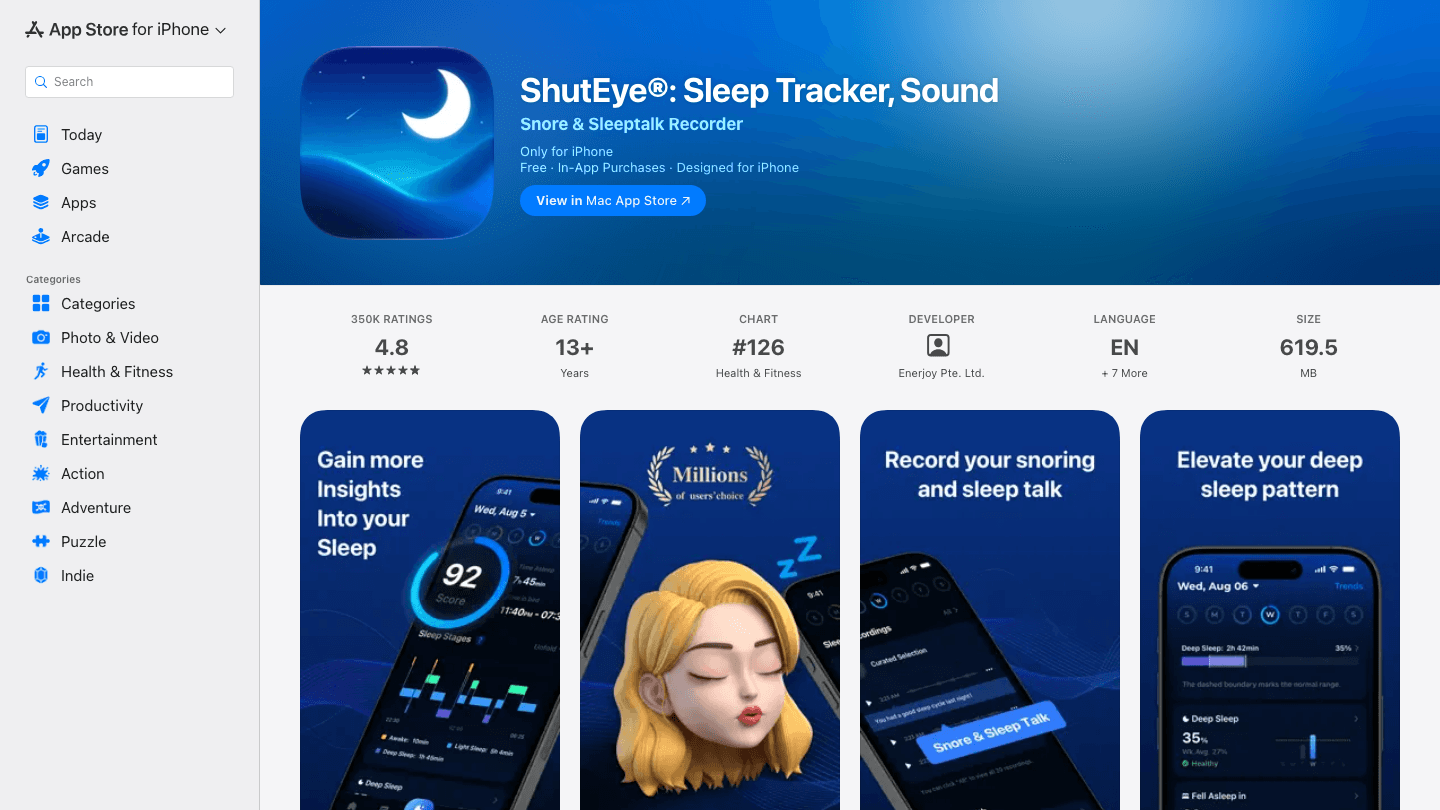
ShutEye uses your phone's microphone and accelerometer to track sleep. It analyzes sound patterns and movement to estimate which sleep stage you're in throughout the night. The morning summary shows:
Sleep stages: light, deep, and REM estimates with time spent in each
Sleep score: a composite rating for the night
Snoring analysis: detection, duration, and intensity of snoring episodes
Sleep talk recording: audio clips of sounds you made while sleeping
Heart rate: available if your phone is an Apple Watch companion or through Apple Health integration
The accuracy caveat is important. Phone-based sleep tracking estimates sleep stages from movement and sound rather than from physiological signals like heart rate and blood oxygen. This produces less precise sleep stage data than a wearable like a Fitbit or Apple Watch. For many users, the directional data (you slept about 6 hours, got some light and deep sleep, had one significant snoring episode at 2 AM) is useful even if the precise percentages aren't clinical-grade.
Sleep Sounds: The Strongest Feature
ShutEye's sound library is genuinely impressive. It includes dozens of ambient soundscapes, white noise variations, nature sounds, binaural beats, and original music composed specifically for sleep. The mixing feature lets you layer sounds, for example, rain on a window with distant thunder and a low fan hum, which some people find significantly more effective than any single sound alone.
The bedtime stories are professionally recorded and well-produced. They're genuinely calming rather than cheesy, which is harder to pull off than it sounds. For adults who struggle with racing thoughts at bedtime, a slow-paced story is often more effective than an alarm reminder to "relax." The story library is larger than most competitors, though Sleep Stories in Calm has more individual titles.
Smart Alarm
ShutEye's smart alarm monitors your movement and sound in a window before your target wake time (you set the window, typically 20-30 minutes). When it detects a period of light sleep within that window, it fires the alarm. The theory: waking from light sleep produces less grogginess than waking from deep sleep.
This feature works reasonably well for people whose schedules allow a 20-30 minute flexibility window. For people with hard wake-time requirements (a commute, a meeting, childcare), setting the window too wide risks waking up significantly earlier than needed. Keep it narrow, 10-15 minutes, if you have a firm daily start time.
ShutEye Pricing
Free: basic sound library and limited tracking history
Monthly: $9.99/month
Annual: $59.99/year ($5/month)
Lifetime: promotional pricing periodically available ($19.99-$33.99)
At $59.99/year, ShutEye costs more than Sleep Cycle ($39.99/year) and significantly more than using Apple Health's built-in sleep tracking (free if you have an Apple Watch). The app earns its price if you use both the sound and tracking features regularly. If you only want sleep sounds, there are cheaper standalone sound apps. If you only want sleep tracking, a wearable produces more accurate data for the same annual cost.
How It Compares to Alternatives
vs. Sleep Cycle: Sleep Cycle ($39.99/year) also uses phone-based tracking and a smart alarm. Its sound library is smaller, but its sleep analysis interface is cleaner and it has a longer track record. ShutEye wins on sounds and aesthetics; Sleep Cycle wins on price and interface clarity.
vs. Apple Health / Apple Watch: If you have an Apple Watch, Apple's free Sleep app tracks stages using the watch's sensors (more accurate than phone-based) and integrates with your health data. It doesn't have sounds or a sound library, so ShutEye still has a role as a companion sound app even for Apple Watch users.
vs. wearable sleep trackers: Our best smartwatch for sleep tracking roundup covers options like the Fitbit Sense 2 ($249.95) and Google Pixel Watch 4 ($349.99) that produce more accurate sleep stage data using body sensors. For users who prioritize data accuracy over convenience, a wearable plus free sound apps may beat ShutEye on value.
Who Should Use ShutEye
ShutEye makes the most sense for people who:
Struggle to fall asleep and want a strong sound library plus a simple tracker in one app
Don't own (or want to buy) a sleep-tracking wearable
Want directional sleep data without the full setup of a wearable ecosystem
Travel frequently and want a consistent sleep tool that doesn't depend on home infrastructure
It's a less strong fit for people who already have wearable sleep tracking (the phone-based data isn't more accurate), who only want one or the other feature (sounds or tracking), or who are very price-sensitive ($59.99/year is real money for phone-based tracking).
Pairing ShutEye with a Planning App
ShutEye tells you how you slept. What you do with that information the next morning is where most people leave value behind. A poor sleep efficiency score from ShutEye tells you something happened last night. Adjusting your day's schedule to account for it is the step most apps don't help with. Pairing ShutEye with a consistent night routine creates the full picture.
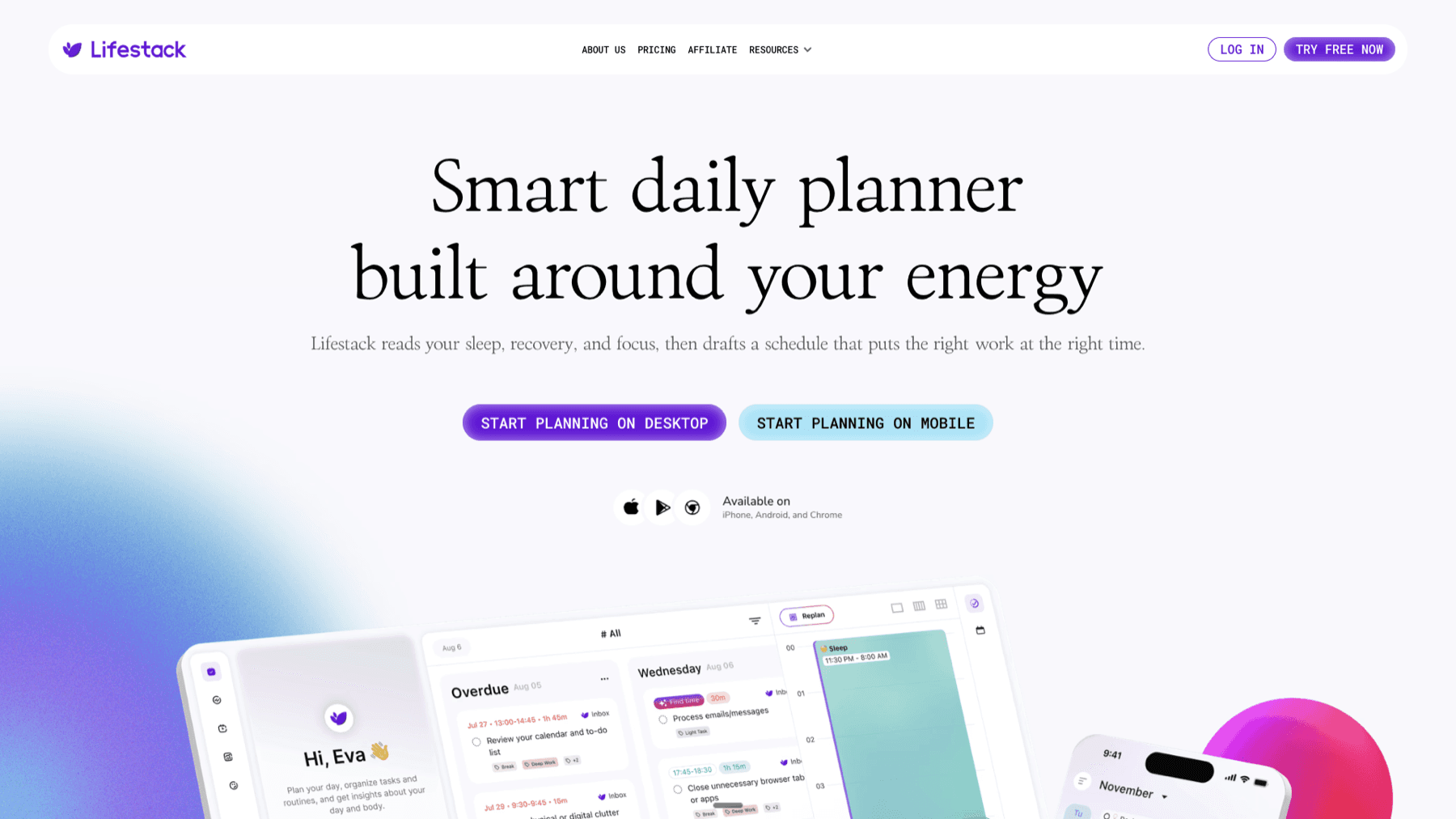
Lifestack is the planning layer that connects your energy-based scheduling to what ShutEye reveals. It for this. It's an AI scheduler that reads your energy levels and structures your day around them. After a ShutEye report shows you woke up twice and got less deep sleep than usual, Lifestack adjusts when your demanding tasks get scheduled. It's energy-based scheduling that turns sleep data into calendar action. Lifestack starts at $7/month or $50/year with a 7-day free trial.
FAQ
What is ShutEye sleep tracker?
ShutEye is an iOS sleep app that combines sleep tracking (using your phone's microphone and accelerometer), sleep sounds and ambient noise, smart alarm, snoring detection, and sleep talk recording. It's a freemium app: free to download with key features behind a subscription ($9.99/month or $59.99/year).
Is ShutEye sleep tracker accurate?
ShutEye uses phone-based tracking, which is less precise than wearable-based tracking that uses heart rate and blood oxygen sensors. It gives directional data on your sleep stages and snoring, but the precise percentages should be read as estimates rather than measurements. For clinical-grade accuracy, a dedicated sleep study or a wrist-based wearable with validated sensors is more reliable.
Is ShutEye free?
ShutEye is free to download with a limited feature set. The full experience, including detailed sleep analysis, the complete sound library, sleep talk recording, and extended tracking history, requires a subscription. Pricing is $9.99/month or $59.99/year. Lifetime deals appear occasionally.
What does ShutEye track while you sleep?
ShutEye tracks estimated sleep stages (light, deep, REM), snoring episodes with duration and intensity, sleep sounds and talk, and uses your phone's movement to detect waking periods. A sleep score is generated each morning. Heart rate data can be integrated through Apple Health if you use an Apple Watch.
How does ShutEye compare to Sleep Cycle?
Both apps use phone-based tracking and smart alarms. ShutEye has a significantly larger sound library and more polished audio content. Sleep Cycle ($39.99/year) is less expensive and has a cleaner data interface. If sleep sounds matter to you, ShutEye is the better choice. If you want the cheapest option focused purely on tracking, Sleep Cycle is more economical. For most accurate sleep data, a wearable sleep tracker beats both.
What Is ShutEye?
ShutEye is an iOS sleep app that combines sleep tracking with sleep sounds, smart alarms, snoring detection, and bedtime stories. It's positioned as an all-in-one sleep app: you use it to fall asleep (sounds and stories), to track what happens while you sleep (cycles, snoring, sleep talk recording), and to wake up at the right time (smart alarm that fires during light sleep).
The app is free to download. The free tier is limited. Most of the features that make it useful require a subscription: $9.99/month or $59.99/year. There are occasional promotional rates in the $19.99-$29.99 range for lifetime access. The app has a 4.8-star rating with over a million reviews in the App Store.
Key Takeaways
ShutEye's sleep sound library is excellent, one of the most varied and well-produced of any sleep app. If you're primarily looking for sleep sounds, it's a strong option even at the price.
The sleep tracking is phone-based, not wearable-based. This is a meaningful limitation: accuracy depends on your phone's position and how still you keep it through the night.
At $59.99/year, ShutEye is priced higher than some alternatives that offer wearable-integrated sleep data. The comparison worth making is against Sleep Cycle ($39.99/year) and the Apple Health app (free).
What ShutEye Tracks
ShutEye uses your phone's microphone and accelerometer to track sleep. It analyzes sound patterns and movement to estimate which sleep stage you're in throughout the night. The morning summary shows:
Sleep stages: light, deep, and REM estimates with time spent in each
Sleep score: a composite rating for the night
Snoring analysis: detection, duration, and intensity of snoring episodes
Sleep talk recording: audio clips of sounds you made while sleeping
Heart rate: available if your phone is an Apple Watch companion or through Apple Health integration
The accuracy caveat is important. Phone-based sleep tracking estimates sleep stages from movement and sound rather than from physiological signals like heart rate and blood oxygen. This produces less precise sleep stage data than a wearable like a Fitbit or Apple Watch. For many users, the directional data (you slept about 6 hours, got some light and deep sleep, had one significant snoring episode at 2 AM) is useful even if the precise percentages aren't clinical-grade.
Sleep Sounds: The Strongest Feature
ShutEye's sound library is genuinely impressive. It includes dozens of ambient soundscapes, white noise variations, nature sounds, binaural beats, and original music composed specifically for sleep. The mixing feature lets you layer sounds, for example, rain on a window with distant thunder and a low fan hum, which some people find significantly more effective than any single sound alone.
The bedtime stories are professionally recorded and well-produced. They're genuinely calming rather than cheesy, which is harder to pull off than it sounds. For adults who struggle with racing thoughts at bedtime, a slow-paced story is often more effective than an alarm reminder to "relax." The story library is larger than most competitors, though Sleep Stories in Calm has more individual titles.
Smart Alarm
ShutEye's smart alarm monitors your movement and sound in a window before your target wake time (you set the window, typically 20-30 minutes). When it detects a period of light sleep within that window, it fires the alarm. The theory: waking from light sleep produces less grogginess than waking from deep sleep.
This feature works reasonably well for people whose schedules allow a 20-30 minute flexibility window. For people with hard wake-time requirements (a commute, a meeting, childcare), setting the window too wide risks waking up significantly earlier than needed. Keep it narrow, 10-15 minutes, if you have a firm daily start time.
ShutEye Pricing
Free: basic sound library and limited tracking history
Monthly: $9.99/month
Annual: $59.99/year ($5/month)
Lifetime: promotional pricing periodically available ($19.99-$33.99)
At $59.99/year, ShutEye costs more than Sleep Cycle ($39.99/year) and significantly more than using Apple Health's built-in sleep tracking (free if you have an Apple Watch). The app earns its price if you use both the sound and tracking features regularly. If you only want sleep sounds, there are cheaper standalone sound apps. If you only want sleep tracking, a wearable produces more accurate data for the same annual cost.
How It Compares to Alternatives
vs. Sleep Cycle: Sleep Cycle ($39.99/year) also uses phone-based tracking and a smart alarm. Its sound library is smaller, but its sleep analysis interface is cleaner and it has a longer track record. ShutEye wins on sounds and aesthetics; Sleep Cycle wins on price and interface clarity.
vs. Apple Health / Apple Watch: If you have an Apple Watch, Apple's free Sleep app tracks stages using the watch's sensors (more accurate than phone-based) and integrates with your health data. It doesn't have sounds or a sound library, so ShutEye still has a role as a companion sound app even for Apple Watch users.
vs. wearable sleep trackers: Our best smartwatch for sleep tracking roundup covers options like the Fitbit Sense 2 ($249.95) and Google Pixel Watch 4 ($349.99) that produce more accurate sleep stage data using body sensors. For users who prioritize data accuracy over convenience, a wearable plus free sound apps may beat ShutEye on value.
Who Should Use ShutEye
ShutEye makes the most sense for people who:
Struggle to fall asleep and want a strong sound library plus a simple tracker in one app
Don't own (or want to buy) a sleep-tracking wearable
Want directional sleep data without the full setup of a wearable ecosystem
Travel frequently and want a consistent sleep tool that doesn't depend on home infrastructure
It's a less strong fit for people who already have wearable sleep tracking (the phone-based data isn't more accurate), who only want one or the other feature (sounds or tracking), or who are very price-sensitive ($59.99/year is real money for phone-based tracking).
Pairing ShutEye with a Planning App
ShutEye tells you how you slept. What you do with that information the next morning is where most people leave value behind. A poor sleep efficiency score from ShutEye tells you something happened last night. Adjusting your day's schedule to account for it is the step most apps don't help with. Pairing ShutEye with a consistent night routine creates the full picture.
Lifestack is the planning layer that connects your energy-based scheduling to what ShutEye reveals. It for this. It's an AI scheduler that reads your energy levels and structures your day around them. After a ShutEye report shows you woke up twice and got less deep sleep than usual, Lifestack adjusts when your demanding tasks get scheduled. It's energy-based scheduling that turns sleep data into calendar action. Lifestack starts at $7/month or $50/year with a 7-day free trial.
FAQ
What is ShutEye sleep tracker?
ShutEye is an iOS sleep app that combines sleep tracking (using your phone's microphone and accelerometer), sleep sounds and ambient noise, smart alarm, snoring detection, and sleep talk recording. It's a freemium app: free to download with key features behind a subscription ($9.99/month or $59.99/year).
Is ShutEye sleep tracker accurate?
ShutEye uses phone-based tracking, which is less precise than wearable-based tracking that uses heart rate and blood oxygen sensors. It gives directional data on your sleep stages and snoring, but the precise percentages should be read as estimates rather than measurements. For clinical-grade accuracy, a dedicated sleep study or a wrist-based wearable with validated sensors is more reliable.
Is ShutEye free?
ShutEye is free to download with a limited feature set. The full experience, including detailed sleep analysis, the complete sound library, sleep talk recording, and extended tracking history, requires a subscription. Pricing is $9.99/month or $59.99/year. Lifetime deals appear occasionally.
What does ShutEye track while you sleep?
ShutEye tracks estimated sleep stages (light, deep, REM), snoring episodes with duration and intensity, sleep sounds and talk, and uses your phone's movement to detect waking periods. A sleep score is generated each morning. Heart rate data can be integrated through Apple Health if you use an Apple Watch.
How does ShutEye compare to Sleep Cycle?
Both apps use phone-based tracking and smart alarms. ShutEye has a significantly larger sound library and more polished audio content. Sleep Cycle ($39.99/year) is less expensive and has a cleaner data interface. If sleep sounds matter to you, ShutEye is the better choice. If you want the cheapest option focused purely on tracking, Sleep Cycle is more economical. For most accurate sleep data, a wearable sleep tracker beats both.



FOLLOW ON
FOLLOW ON
FOLLOW ON


Copyright 2026 © Lifestack. All rights reserved
Copyright 2026 © Lifestack. All rights reserved

