
Tips
Sleep Efficiency: What It Is and How to Improve It
Sleep Efficiency: What It Is and How to Improve It

You slept eight hours. You still woke up exhausted. Sleep duration is only part of the picture. Sleep efficiency, the ratio of actual sleep time to time spent in bed, is often the more useful metric. You can spend nine hours in bed and get six hours of real sleep. That's 67% efficiency. It also explains a lot about why you feel the way you do when you wake up.
Sleep efficiency is used in clinical sleep medicine to assess insomnia and to evaluate whether interventions are working. It's now also the most common metric reported by consumer sleep trackers. Understanding what the number means, what drives it, and how to improve it gives you much more actionable information than a raw hours-slept figure.
Key Takeaways
Sleep efficiency is calculated as (total sleep time / total time in bed) x 100. Above 85% is generally considered good; above 90% is ideal.
The biggest drivers of low efficiency are fragmented sleep (waking frequently) and spending too long in bed before falling asleep.
The most effective intervention for chronically low sleep efficiency is sleep restriction therapy, which sounds counterintuitive but is well-supported by research.
How Sleep Efficiency Is Calculated
The formula is simple: divide your total sleep time by your total time in bed, then multiply by 100. If you were in bed for 8 hours but only asleep for 6.5 hours (accounting for time to fall asleep and mid-night awakenings), your sleep efficiency is 81.25%.
The two main sources of efficiency loss are sleep onset latency (how long it takes you to fall asleep after getting into bed) and wake after sleep onset (time spent awake during the night). Both can be measured by a sleep tracker, though consumer trackers have varying accuracy compared to clinical polysomnography.
Total sleep time is not the same as time in bed. This distinction is clinically important. Someone who spends 10 hours in bed but sleeps for 7 hours is managing sleep debt poorly by extending time in bed, which often makes efficiency worse over time.
What's a Good Sleep Efficiency Score?
Clinical sleep medicine generally uses 85% as the threshold for acceptable sleep efficiency. Below 85% is associated with subjective reports of poor sleep quality and, when chronic, with insomnia. Above 90% is considered ideal.
For context: healthy young adults typically achieve 88-95% efficiency. This naturally decreases with age as sleep becomes lighter and more fragmented. A 70-year-old with 80% efficiency may be experiencing normal age-related change rather than a disorder.
Consumer trackers vary in how they calculate and present efficiency. Some include the time spent falling asleep in the denominator; others don't. If you're tracking efficiency over time, consistency matters more than the absolute number. You're looking for trends, not exact values. The best sleep tracking apps will show you this trend clearly over weeks and months.
Why Sleep Efficiency Drops
The most common reasons for low sleep efficiency:
Extended time in bed relative to sleep need. If you spend 9 hours in bed but only need 7 hours of sleep, the extra 2 hours become time spent awake or in very light sleep.
Anxiety and hyperarousal. Difficulty falling asleep due to racing thoughts or physical tension is one of the most common causes of poor efficiency and is the primary driver of insomnia.
Poor sleep environment. Noise, light, and temperature all cause micro-arousals that add up to significant wake-after-sleep-onset time even when they don't fully wake you.
Alcohol and caffeine timing. Alcohol fragments sleep in the second half of the night despite making you drowsy initially. Late caffeine delays sleep onset.
Irregular sleep timing. Variable bedtimes and wake times disrupt circadian alignment and make it harder to fall and stay asleep at target times.
Sleep disorders like sleep apnea also dramatically reduce efficiency through constant micro-arousals. If your tracker shows consistently poor efficiency despite good habits, a sleep study is worth considering.
How to Improve Sleep Efficiency
Keep a consistent wake time. A fixed wake time is the single most reliable anchor for your circadian rhythm. Even on weekends. The sleep onset time can vary; the wake time should not. This builds sleep pressure at a predictable rate and makes it easier to fall asleep at your target bedtime.
Get out of bed if you've been awake for 20-30 minutes. Staying in bed while awake creates a learned association between bed and wakefulness. Getting up, doing something low-stimulation (reading in dim light, light stretching), and returning when sleepy breaks this association. This is a core principle of cognitive behavioral therapy for insomnia (CBT-I), which has the strongest evidence base of any insomnia treatment.
Build a real wind-down routine. Your brain needs a transition period. The wind-down routine for sleep doesn't need to be elaborate. A consistent 30-45 minute sequence of low-stimulation activities in dim light is enough for most people to reduce the time it takes to fall asleep. This directly improves efficiency by reducing sleep onset latency.
Match your time in bed to your actual sleep need. If you sleep 7 hours, don't spend 9 hours in bed. The extra 2 hours are spent awake, which teaches your nervous system that bed includes a lot of wakefulness. A tighter time-in-bed window, combined with a fixed wake time, builds sleep pressure that makes it easier to fall asleep quickly.
Optimize your sleep environment. Temperature is particularly important. The body drops core temperature to initiate sleep. A cool bedroom (around 65-68°F for most people) makes this easier and reduces night waking. Darkness and noise reduction address the other two main environmental causes of micro-arousals.
Addressing sleep hygiene factors is the first line of treatment before any intervention gets more complex. Many people see meaningful improvements in efficiency from consistent wake times and environment changes alone.
Sleep Efficiency vs. Sleep Duration: Which Matters More?
Both matter, but they measure different things. Duration tells you how much sleep you're getting. Efficiency tells you how restorative that time in bed actually is. High efficiency with adequate duration is the goal. High efficiency with insufficient duration still leaves you sleep-deprived. Low efficiency with long time in bed produces poor quality sleep despite appearing adequate on a duration-only metric.
The practical implication: someone sleeping 6 hours at 95% efficiency is getting higher-quality sleep than someone sleeping 8 hours at 70% efficiency, but both may be sleep-deprived for different reasons. The deep sleep percentage and REM proportion add additional layers to this picture that raw efficiency doesn't capture.
How to Track Your Sleep Efficiency
Consumer wearables (Oura Ring, Garmin, Apple Watch, Fitbit) all estimate sleep efficiency, though their accuracy varies. They're best used for tracking trends over time rather than exact nightly values. A week of consistently low efficiency tells you something real. A single low-efficiency night after an unusual day probably doesn't.
A sleep tracking system that pairs your wearable data with a sleep diary (noting bedtime, wake time, caffeine, alcohol, and subjective quality) is more diagnostic than either alone. The diary lets you correlate specific behaviors with efficiency changes, which makes interventions more targeted.
If you use an Oura Ring, its Readiness score integrates sleep efficiency, HRV, and resting heart rate into a daily indicator of recovery quality. It's one of the more reliable consumer signals for determining how to adjust your day's demands. The connection between sleep quality data and daily planning with Lifestack is worth exploring if you want to close that loop.
Best Tool for Planning Around Your Sleep Quality
Knowing your sleep efficiency score is most useful when it changes how you schedule your day. A night at 70% efficiency is different from a night at 92%, and your capacity for demanding cognitive work reflects that difference even if the hours slept are similar.
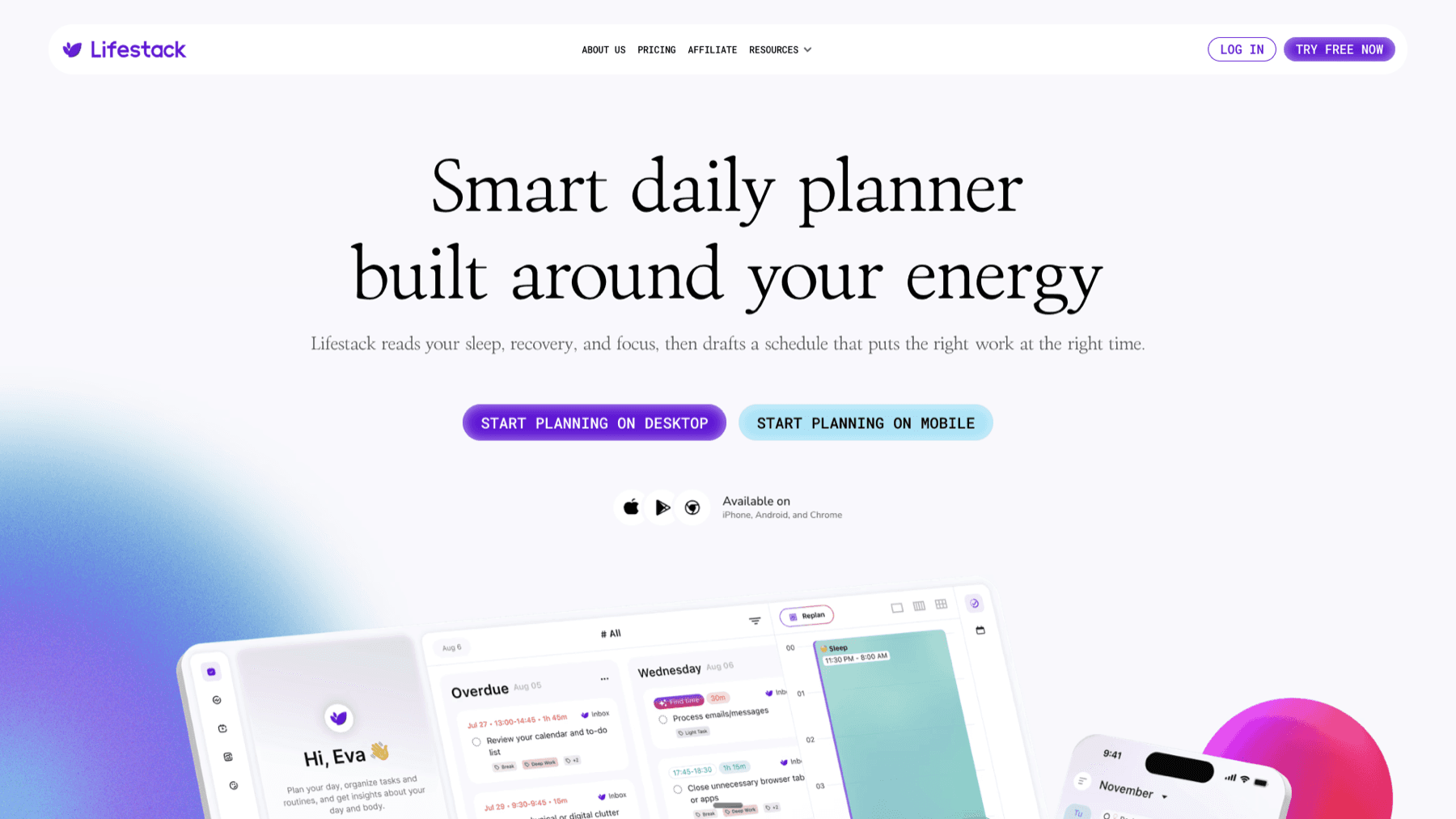
Lifestack is an AI planner built around energy-aware scheduling. For people who track sleep quality, this means placing your most demanding tasks during your actual high-energy windows rather than assuming consistent capacity throughout the day. On a low-efficiency night, Lifestack helps protect your limited cognitive windows for the work that genuinely requires them. The energy-based scheduling framework explains how this works in practice. Lifestack costs $7/month or $50/year, with a 7-day free trial on the annual plan. And for when low sleep efficiency starts affecting your daytime functioning, the guide on sleep deprivation and brain fog covers the downstream effects in detail.
Frequently Asked Questions
What is a good sleep efficiency percentage?
Above 85% is generally considered acceptable in clinical sleep medicine. Above 90% is ideal. Below 85% sustained over time is associated with insomnia and poor sleep quality. Natural sleep efficiency tends to decrease with age, so benchmarks are somewhat age-dependent.
How do I calculate my sleep efficiency?
Divide total sleep time by total time in bed, then multiply by 100. If you were in bed for 8 hours and slept for 7 of those hours, your efficiency is 87.5%. Consumer sleep trackers do this automatically, but you can also estimate manually using a sleep diary if you don't have a tracker.
What causes low sleep efficiency?
The main causes are spending too much time in bed relative to actual sleep need, difficulty falling asleep due to anxiety or arousal, frequent nighttime awakenings (from noise, temperature, alcohol, or sleep apnea), and irregular sleep-wake timing. Each has specific interventions; identifying which pattern applies to you makes improvement faster.
Can sleep trackers accurately measure sleep efficiency?
Consumer trackers correlate reasonably well with clinical polysomnography for sleep duration and gross stage proportions, but are less accurate for detecting short awakenings. They're reliable enough for tracking trends over time. Treat absolute nightly values as estimates rather than precise measurements. Consistency in using the same tracker matters for trend analysis.
Does going to bed later improve sleep efficiency?
Sometimes, intentionally. Sleep restriction therapy, a core component of CBT-I, involves temporarily restricting time in bed to build sleep pressure and improve efficiency. Going to bed later (while keeping wake time fixed) reduces the window for wakefulness and often produces more consolidated, efficient sleep. This is counterintuitive but well-supported by research. It should be done with guidance for people with significant insomnia.
Is 75% sleep efficiency bad?
Below 85% is generally poor, and 75% is low enough to cause noticeable daytime effects. A single night at 75% is less concerning than a sustained pattern. If your tracker shows consistently sub-85% efficiency for weeks, it's worth examining your sleep hygiene and bedtime routine, and consulting a sleep specialist if basic changes don't help within a few weeks. Improving deep sleep quality is often where the gains come from.
You slept eight hours. You still woke up exhausted. Sleep duration is only part of the picture. Sleep efficiency, the ratio of actual sleep time to time spent in bed, is often the more useful metric. You can spend nine hours in bed and get six hours of real sleep. That's 67% efficiency. It also explains a lot about why you feel the way you do when you wake up.
Sleep efficiency is used in clinical sleep medicine to assess insomnia and to evaluate whether interventions are working. It's now also the most common metric reported by consumer sleep trackers. Understanding what the number means, what drives it, and how to improve it gives you much more actionable information than a raw hours-slept figure.
Key Takeaways
Sleep efficiency is calculated as (total sleep time / total time in bed) x 100. Above 85% is generally considered good; above 90% is ideal.
The biggest drivers of low efficiency are fragmented sleep (waking frequently) and spending too long in bed before falling asleep.
The most effective intervention for chronically low sleep efficiency is sleep restriction therapy, which sounds counterintuitive but is well-supported by research.
How Sleep Efficiency Is Calculated
The formula is simple: divide your total sleep time by your total time in bed, then multiply by 100. If you were in bed for 8 hours but only asleep for 6.5 hours (accounting for time to fall asleep and mid-night awakenings), your sleep efficiency is 81.25%.
The two main sources of efficiency loss are sleep onset latency (how long it takes you to fall asleep after getting into bed) and wake after sleep onset (time spent awake during the night). Both can be measured by a sleep tracker, though consumer trackers have varying accuracy compared to clinical polysomnography.
Total sleep time is not the same as time in bed. This distinction is clinically important. Someone who spends 10 hours in bed but sleeps for 7 hours is managing sleep debt poorly by extending time in bed, which often makes efficiency worse over time.
What's a Good Sleep Efficiency Score?
Clinical sleep medicine generally uses 85% as the threshold for acceptable sleep efficiency. Below 85% is associated with subjective reports of poor sleep quality and, when chronic, with insomnia. Above 90% is considered ideal.
For context: healthy young adults typically achieve 88-95% efficiency. This naturally decreases with age as sleep becomes lighter and more fragmented. A 70-year-old with 80% efficiency may be experiencing normal age-related change rather than a disorder.
Consumer trackers vary in how they calculate and present efficiency. Some include the time spent falling asleep in the denominator; others don't. If you're tracking efficiency over time, consistency matters more than the absolute number. You're looking for trends, not exact values. The best sleep tracking apps will show you this trend clearly over weeks and months.
Why Sleep Efficiency Drops
The most common reasons for low sleep efficiency:
Extended time in bed relative to sleep need. If you spend 9 hours in bed but only need 7 hours of sleep, the extra 2 hours become time spent awake or in very light sleep.
Anxiety and hyperarousal. Difficulty falling asleep due to racing thoughts or physical tension is one of the most common causes of poor efficiency and is the primary driver of insomnia.
Poor sleep environment. Noise, light, and temperature all cause micro-arousals that add up to significant wake-after-sleep-onset time even when they don't fully wake you.
Alcohol and caffeine timing. Alcohol fragments sleep in the second half of the night despite making you drowsy initially. Late caffeine delays sleep onset.
Irregular sleep timing. Variable bedtimes and wake times disrupt circadian alignment and make it harder to fall and stay asleep at target times.
Sleep disorders like sleep apnea also dramatically reduce efficiency through constant micro-arousals. If your tracker shows consistently poor efficiency despite good habits, a sleep study is worth considering.
How to Improve Sleep Efficiency
Keep a consistent wake time. A fixed wake time is the single most reliable anchor for your circadian rhythm. Even on weekends. The sleep onset time can vary; the wake time should not. This builds sleep pressure at a predictable rate and makes it easier to fall asleep at your target bedtime.
Get out of bed if you've been awake for 20-30 minutes. Staying in bed while awake creates a learned association between bed and wakefulness. Getting up, doing something low-stimulation (reading in dim light, light stretching), and returning when sleepy breaks this association. This is a core principle of cognitive behavioral therapy for insomnia (CBT-I), which has the strongest evidence base of any insomnia treatment.
Build a real wind-down routine. Your brain needs a transition period. The wind-down routine for sleep doesn't need to be elaborate. A consistent 30-45 minute sequence of low-stimulation activities in dim light is enough for most people to reduce the time it takes to fall asleep. This directly improves efficiency by reducing sleep onset latency.
Match your time in bed to your actual sleep need. If you sleep 7 hours, don't spend 9 hours in bed. The extra 2 hours are spent awake, which teaches your nervous system that bed includes a lot of wakefulness. A tighter time-in-bed window, combined with a fixed wake time, builds sleep pressure that makes it easier to fall asleep quickly.
Optimize your sleep environment. Temperature is particularly important. The body drops core temperature to initiate sleep. A cool bedroom (around 65-68°F for most people) makes this easier and reduces night waking. Darkness and noise reduction address the other two main environmental causes of micro-arousals.
Addressing sleep hygiene factors is the first line of treatment before any intervention gets more complex. Many people see meaningful improvements in efficiency from consistent wake times and environment changes alone.
Sleep Efficiency vs. Sleep Duration: Which Matters More?
Both matter, but they measure different things. Duration tells you how much sleep you're getting. Efficiency tells you how restorative that time in bed actually is. High efficiency with adequate duration is the goal. High efficiency with insufficient duration still leaves you sleep-deprived. Low efficiency with long time in bed produces poor quality sleep despite appearing adequate on a duration-only metric.
The practical implication: someone sleeping 6 hours at 95% efficiency is getting higher-quality sleep than someone sleeping 8 hours at 70% efficiency, but both may be sleep-deprived for different reasons. The deep sleep percentage and REM proportion add additional layers to this picture that raw efficiency doesn't capture.
How to Track Your Sleep Efficiency
Consumer wearables (Oura Ring, Garmin, Apple Watch, Fitbit) all estimate sleep efficiency, though their accuracy varies. They're best used for tracking trends over time rather than exact nightly values. A week of consistently low efficiency tells you something real. A single low-efficiency night after an unusual day probably doesn't.
A sleep tracking system that pairs your wearable data with a sleep diary (noting bedtime, wake time, caffeine, alcohol, and subjective quality) is more diagnostic than either alone. The diary lets you correlate specific behaviors with efficiency changes, which makes interventions more targeted.
If you use an Oura Ring, its Readiness score integrates sleep efficiency, HRV, and resting heart rate into a daily indicator of recovery quality. It's one of the more reliable consumer signals for determining how to adjust your day's demands. The connection between sleep quality data and daily planning with Lifestack is worth exploring if you want to close that loop.
Best Tool for Planning Around Your Sleep Quality
Knowing your sleep efficiency score is most useful when it changes how you schedule your day. A night at 70% efficiency is different from a night at 92%, and your capacity for demanding cognitive work reflects that difference even if the hours slept are similar.
Lifestack is an AI planner built around energy-aware scheduling. For people who track sleep quality, this means placing your most demanding tasks during your actual high-energy windows rather than assuming consistent capacity throughout the day. On a low-efficiency night, Lifestack helps protect your limited cognitive windows for the work that genuinely requires them. The energy-based scheduling framework explains how this works in practice. Lifestack costs $7/month or $50/year, with a 7-day free trial on the annual plan. And for when low sleep efficiency starts affecting your daytime functioning, the guide on sleep deprivation and brain fog covers the downstream effects in detail.
Frequently Asked Questions
What is a good sleep efficiency percentage?
Above 85% is generally considered acceptable in clinical sleep medicine. Above 90% is ideal. Below 85% sustained over time is associated with insomnia and poor sleep quality. Natural sleep efficiency tends to decrease with age, so benchmarks are somewhat age-dependent.
How do I calculate my sleep efficiency?
Divide total sleep time by total time in bed, then multiply by 100. If you were in bed for 8 hours and slept for 7 of those hours, your efficiency is 87.5%. Consumer sleep trackers do this automatically, but you can also estimate manually using a sleep diary if you don't have a tracker.
What causes low sleep efficiency?
The main causes are spending too much time in bed relative to actual sleep need, difficulty falling asleep due to anxiety or arousal, frequent nighttime awakenings (from noise, temperature, alcohol, or sleep apnea), and irregular sleep-wake timing. Each has specific interventions; identifying which pattern applies to you makes improvement faster.
Can sleep trackers accurately measure sleep efficiency?
Consumer trackers correlate reasonably well with clinical polysomnography for sleep duration and gross stage proportions, but are less accurate for detecting short awakenings. They're reliable enough for tracking trends over time. Treat absolute nightly values as estimates rather than precise measurements. Consistency in using the same tracker matters for trend analysis.
Does going to bed later improve sleep efficiency?
Sometimes, intentionally. Sleep restriction therapy, a core component of CBT-I, involves temporarily restricting time in bed to build sleep pressure and improve efficiency. Going to bed later (while keeping wake time fixed) reduces the window for wakefulness and often produces more consolidated, efficient sleep. This is counterintuitive but well-supported by research. It should be done with guidance for people with significant insomnia.
Is 75% sleep efficiency bad?
Below 85% is generally poor, and 75% is low enough to cause noticeable daytime effects. A single night at 75% is less concerning than a sustained pattern. If your tracker shows consistently sub-85% efficiency for weeks, it's worth examining your sleep hygiene and bedtime routine, and consulting a sleep specialist if basic changes don't help within a few weeks. Improving deep sleep quality is often where the gains come from.



FOLLOW ON
FOLLOW ON
FOLLOW ON


Copyright 2026 © Lifestack. All rights reserved
Copyright 2026 © Lifestack. All rights reserved

