
Tips
Sleep Restriction: 6 Steps That Actually Fix Insomnia
Sleep Restriction: 6 Steps That Actually Fix Insomnia

You've tried the sleep hygiene advice. The chamomile tea, the screen curfew, the white noise machine. And you're still lying in bed for nine hours a night, sleeping for maybe five of them. That 40% gap between time in bed and actual sleep is exactly what sleep restriction therapy targets.
Sleep restriction is a core technique within CBT-I (Cognitive Behavioral Therapy for Insomnia) and has a success rate that puts prescription sleep aids to shame. Studies consistently show 70-80% of people with chronic insomnia see lasting improvement within four to six weeks. The idea sounds brutal at first: you deliberately cut your time in bed. But the logic is airtight, and the results are real.
This guide walks you through exactly how to implement it, what to expect week by week, and how to manage the inevitable fatigue during the first two weeks when the protocol is still building steam.
Key Takeaways
Sleep restriction works by building sleep pressure, not by forcing you to sleep longer
The method is more effective than most sleep medications for chronic insomnia, and the gains last
Temporary daytime fatigue in weeks one and two is expected (it means the protocol is working)
What Is Sleep Restriction Therapy?
Sleep restriction therapy limits the total time you spend in bed to match your actual average sleep duration. If you're sleeping five and a half hours but spending eight hours in bed, your sleep window becomes five and a half hours. You go to bed later. You get up at the same time every day.
Most people with insomnia do the opposite: they go to bed earlier, hoping to catch more sleep. Sleep restriction reverses that logic entirely. By compressing your sleep window, you build up adenosine (the chemical that drives sleep pressure) across the day, and you stop associating the bed with wakefulness, frustration, and midnight ceiling-staring.
This is not permanent sleep deprivation. You start with a compressed window and expand it gradually as your efficiency improves. Think of it as resetting your sleep system rather than punishing it. The goal is sleep that's deep, efficient, and consistent, not long and fragmented.
Why It Works: The Science of Sleep Pressure
Your brain runs on two overlapping systems. The circadian clock is your internal 24-hour rhythm, tied to light and temperature. The homeostatic sleep drive accumulates the longer you stay awake. When you have chronic insomnia, both systems get disrupted in ways that reinforce each other.
Spending hours awake in bed trains your brain to treat the bedroom as a stressful, alert place. Over time, the expectation of poor sleep becomes self-fulfilling. This is partly why melatonin supplements often fail for long-standing insomnia. They address the circadian clock but do nothing about the learned patterns and the chronically low sleep efficiency that's become the default.
Sleep restriction works by targeting sleep efficiency directly. It forces the homeostatic drive to rebuild, breaks the mental association between bed and wakefulness, and makes you genuinely tired at bedtime rather than just anxious about sleeping. Once your efficiency climbs above 85%, you begin adding time back in small increments.
Step 1: Calculate Your Sleep Efficiency
Before you set a sleep window, you need a baseline. Spend one week keeping a simple sleep diary. Record three numbers each morning: when you got into bed, when you estimate you fell asleep, and when you got out of bed for good.
From those numbers, calculate your average total sleep time (TST) and your average time in bed (TIB). Then apply this formula:
Sleep Efficiency = (TST divided by TIB) x 100
If you're sleeping 5.5 hours and spending 8.5 hours in bed, your efficiency is about 65%. Healthy sleep efficiency sits above 85%. That gap is what sleep restriction closes over the course of four to eight weeks.
Step 2: Set Your Sleep Window
Your starting sleep window equals your average TST from the diary, with a hard minimum of five and a half hours. Never go below that floor, regardless of what the diary shows. Going below five and a half hours introduces real safety risks, particularly for driving and sustained cognitive tasks.
Pick a fixed wake time first. This is your anchor. If you need to be up at 7:00 a.m. and your average TST is five and a half hours, your bedtime is 1:30 a.m. That's your entire allowed window. You do not go to bed before that time, even if you're exhausted at 10:00 p.m.
The wake time should align with your natural chronotype where possible, but the key constraint is consistency above everything else. A good energy calendar helps enormously during this phase. Mapping your actual energy patterns across the day lets you assign demanding work to your better hours and protect the hours around your new bedtime from stress and stimulation.
Step 3: Anchor Your Wake Time (No Matter What)
This is the hardest part. In the first week, you may lie awake until 2:00 a.m., finally feel sleepy, then have to get up at 7:00 a.m. regardless. That's not a failure. That's the protocol working exactly as designed.
The rigid wake time is what drives sleep pressure to accumulate day after day. If you sleep in to compensate on a bad night, you reset the pressure and the protocol stalls. Weekends are the biggest obstacle here. Treat Saturday and Sunday exactly the same as weekdays for the duration of the protocol.
If you wake in the middle of the night and can't return to sleep within 20 minutes, get out of bed. Read somewhere dim, do something quiet and unstimulating, and return only when you feel genuinely sleepy. Building a consistent morning routine during this period pulls the circadian anchor tighter and makes the early wake time feel less brutal after the first week or two.
Step 4: Track Your Efficiency and Expand Weekly
At the end of each week, recalculate your sleep efficiency using the same diary method. The expansion rules are:
Efficiency above 85% for the week: add 15-30 minutes to your sleep window by moving bedtime earlier
Efficiency between 80-85%: hold the same window for another week
Efficiency below 80%: reduce the window by 15 minutes
You repeat this cycle until your sleep window reaches your personal target (usually seven to eight hours) or you plateau at a point that feels restorative. Most people see real change within two to three weeks and hit their target in six to eight.
Circadian rhythm tracking apps and wearables like Oura or Whoop can help you see sleep efficiency automatically rather than estimating from a paper diary. Just be cautious about obsessing over the data, as that anxiety can work against you during sleep restriction.
Managing Daytime Fatigue During Sleep Restriction
Expect to feel tired in weeks one and two. This is the mechanism working. The fatigue builds the sleep pressure that fixes chronic insomnia. Fighting it with naps, extra caffeine after 2:00 p.m., or going to bed early cancels that pressure and stalls the protocol.
There are two exceptions to the no-nap rule: if your job involves driving, heavy machinery, or other high-stakes tasks, take a brief nap of 20 minutes or less before 3:00 p.m. Set an alarm. Do not let it run long enough to enter a full sleep cycle.
If you're struggling to feel tired enough at your new bedtime, light exposure is your best tool. Getting outside in the morning within an hour of waking sets your circadian clock and suppresses daytime melatonin. In the evening, dim screens and overhead lights starting 90 minutes before your sleep window. The guide on how to make yourself tired covers additional behavioral techniques that layer well with sleep restriction, including stimulus control and sleep drive stacking.
If you tend to wake early and can't return to sleep, the strategies in the guide on being a light sleeper cover targeted approaches for sleep maintenance that work alongside the sleep restriction protocol without interfering with it.
Best Tool to Support Sleep Restriction
Sleep restriction is precise work. Missing your wake time by 90 minutes or accidentally napping can set your progress back by several days. What helps most isn't willpower. It's a schedule that accounts for where your energy will actually be during the hardest parts of each day.
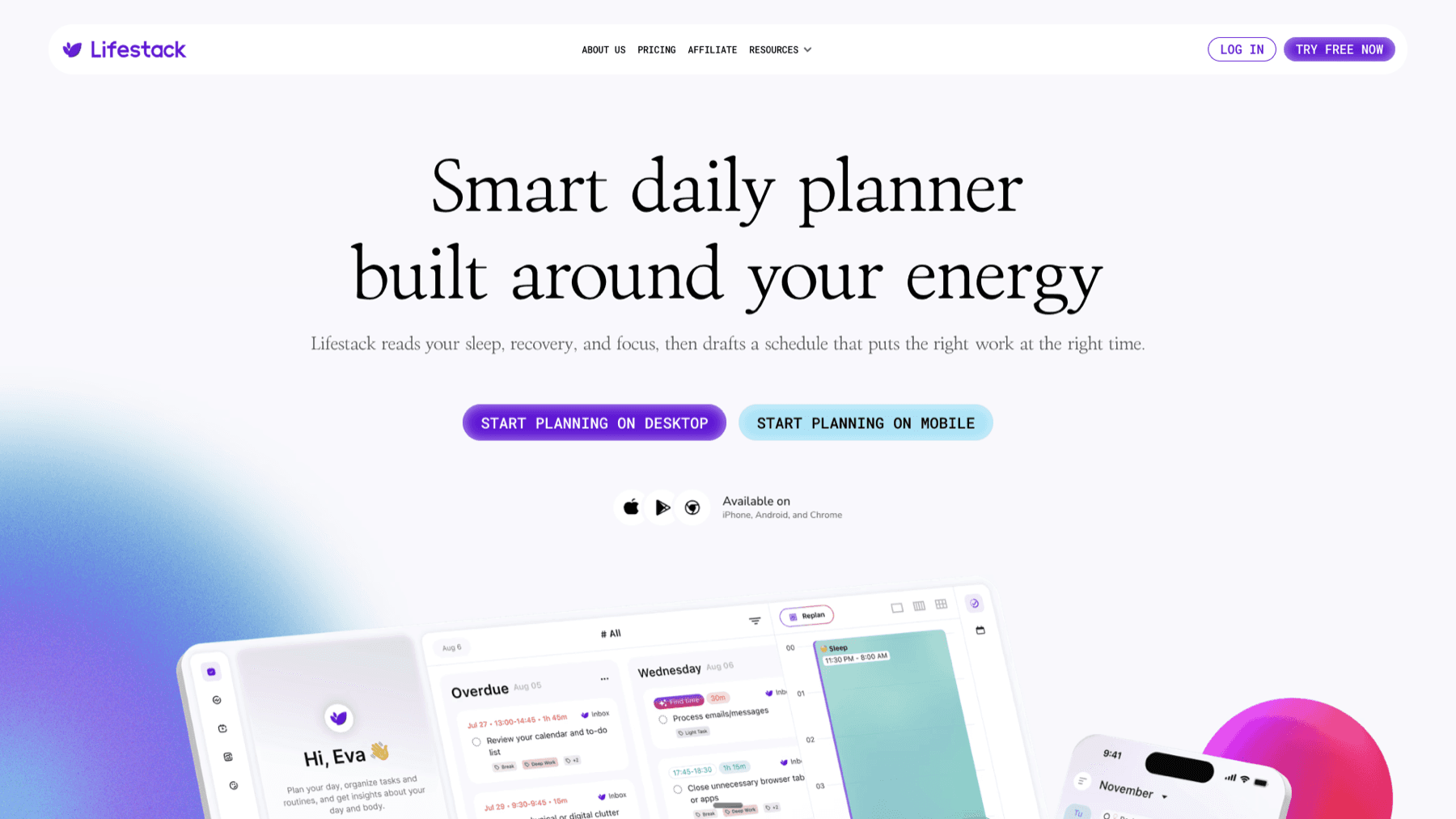
Lifestack schedules your day around your actual energy patterns rather than your intentions. During sleep restriction, when your energy is genuinely lower than normal, the app shifts cognitively demanding work to your peak hours and protects your lower-energy hours from meetings and high-stakes decisions. That means you're not fighting both sleep deprivation and a badly designed day at the same time.
Lifestack costs $9.99 per month or $49.99 per year (with a 7-day free trial on the annual plan). The lifetime plan is available at $120. It integrates with your existing calendar and tracks your energy data over time. As your sleep restriction protocol progresses and your sleep window expands, your energy baseline improves and the app reflects that in how it schedules the following weeks.
Frequently Asked Questions
Is sleep restriction therapy safe?
For most adults with chronic insomnia, yes. The main risk is increased daytime sleepiness during the first one to two weeks, which can affect driving and operating machinery. Sleep restriction is not recommended without clinical supervision for people with bipolar disorder, seizure disorders, or parasomnias like sleepwalking, since sleep deprivation can trigger episodes in those conditions.
How long does sleep restriction therapy take to work?
Most people notice significant improvement within two to three weeks and reach their sleep goal within six to eight weeks. Improvement typically shows up as falling asleep faster and fewer wake episodes before total sleep time actually increases.
Can I do sleep restriction on my own without a therapist?
Yes, and many people do successfully. The protocol is well-documented and the rules are clear. A therapist trained in CBT-I is helpful if you have comorbid anxiety or depression, or if the protocol stalls after eight weeks. Several online CBT-I programs are available and have strong research backing them.
What is the minimum sleep window allowed?
Five and a half hours. Going below that introduces real safety risks and sits outside the standard clinical protocol. If your sleep diary shows you're sleeping less than five and a half hours on average, you still start at five and a half hours and work up from there.
Does sleep restriction therapy work for sleep apnea?
Sleep restriction can address the insomnia component of sleep apnea, but it doesn't treat the apnea itself. If you have both conditions, treating the apnea with CPAP or another approach should come first. Treating sleep apnea alone often resolves insomnia, which is worth ruling out before committing to a full sleep restriction protocol.
You've tried the sleep hygiene advice. The chamomile tea, the screen curfew, the white noise machine. And you're still lying in bed for nine hours a night, sleeping for maybe five of them. That 40% gap between time in bed and actual sleep is exactly what sleep restriction therapy targets.
Sleep restriction is a core technique within CBT-I (Cognitive Behavioral Therapy for Insomnia) and has a success rate that puts prescription sleep aids to shame. Studies consistently show 70-80% of people with chronic insomnia see lasting improvement within four to six weeks. The idea sounds brutal at first: you deliberately cut your time in bed. But the logic is airtight, and the results are real.
This guide walks you through exactly how to implement it, what to expect week by week, and how to manage the inevitable fatigue during the first two weeks when the protocol is still building steam.
Key Takeaways
Sleep restriction works by building sleep pressure, not by forcing you to sleep longer
The method is more effective than most sleep medications for chronic insomnia, and the gains last
Temporary daytime fatigue in weeks one and two is expected (it means the protocol is working)
What Is Sleep Restriction Therapy?
Sleep restriction therapy limits the total time you spend in bed to match your actual average sleep duration. If you're sleeping five and a half hours but spending eight hours in bed, your sleep window becomes five and a half hours. You go to bed later. You get up at the same time every day.
Most people with insomnia do the opposite: they go to bed earlier, hoping to catch more sleep. Sleep restriction reverses that logic entirely. By compressing your sleep window, you build up adenosine (the chemical that drives sleep pressure) across the day, and you stop associating the bed with wakefulness, frustration, and midnight ceiling-staring.
This is not permanent sleep deprivation. You start with a compressed window and expand it gradually as your efficiency improves. Think of it as resetting your sleep system rather than punishing it. The goal is sleep that's deep, efficient, and consistent, not long and fragmented.
Why It Works: The Science of Sleep Pressure
Your brain runs on two overlapping systems. The circadian clock is your internal 24-hour rhythm, tied to light and temperature. The homeostatic sleep drive accumulates the longer you stay awake. When you have chronic insomnia, both systems get disrupted in ways that reinforce each other.
Spending hours awake in bed trains your brain to treat the bedroom as a stressful, alert place. Over time, the expectation of poor sleep becomes self-fulfilling. This is partly why melatonin supplements often fail for long-standing insomnia. They address the circadian clock but do nothing about the learned patterns and the chronically low sleep efficiency that's become the default.
Sleep restriction works by targeting sleep efficiency directly. It forces the homeostatic drive to rebuild, breaks the mental association between bed and wakefulness, and makes you genuinely tired at bedtime rather than just anxious about sleeping. Once your efficiency climbs above 85%, you begin adding time back in small increments.
Step 1: Calculate Your Sleep Efficiency
Before you set a sleep window, you need a baseline. Spend one week keeping a simple sleep diary. Record three numbers each morning: when you got into bed, when you estimate you fell asleep, and when you got out of bed for good.
From those numbers, calculate your average total sleep time (TST) and your average time in bed (TIB). Then apply this formula:
Sleep Efficiency = (TST divided by TIB) x 100
If you're sleeping 5.5 hours and spending 8.5 hours in bed, your efficiency is about 65%. Healthy sleep efficiency sits above 85%. That gap is what sleep restriction closes over the course of four to eight weeks.
Step 2: Set Your Sleep Window
Your starting sleep window equals your average TST from the diary, with a hard minimum of five and a half hours. Never go below that floor, regardless of what the diary shows. Going below five and a half hours introduces real safety risks, particularly for driving and sustained cognitive tasks.
Pick a fixed wake time first. This is your anchor. If you need to be up at 7:00 a.m. and your average TST is five and a half hours, your bedtime is 1:30 a.m. That's your entire allowed window. You do not go to bed before that time, even if you're exhausted at 10:00 p.m.
The wake time should align with your natural chronotype where possible, but the key constraint is consistency above everything else. A good energy calendar helps enormously during this phase. Mapping your actual energy patterns across the day lets you assign demanding work to your better hours and protect the hours around your new bedtime from stress and stimulation.
Step 3: Anchor Your Wake Time (No Matter What)
This is the hardest part. In the first week, you may lie awake until 2:00 a.m., finally feel sleepy, then have to get up at 7:00 a.m. regardless. That's not a failure. That's the protocol working exactly as designed.
The rigid wake time is what drives sleep pressure to accumulate day after day. If you sleep in to compensate on a bad night, you reset the pressure and the protocol stalls. Weekends are the biggest obstacle here. Treat Saturday and Sunday exactly the same as weekdays for the duration of the protocol.
If you wake in the middle of the night and can't return to sleep within 20 minutes, get out of bed. Read somewhere dim, do something quiet and unstimulating, and return only when you feel genuinely sleepy. Building a consistent morning routine during this period pulls the circadian anchor tighter and makes the early wake time feel less brutal after the first week or two.
Step 4: Track Your Efficiency and Expand Weekly
At the end of each week, recalculate your sleep efficiency using the same diary method. The expansion rules are:
Efficiency above 85% for the week: add 15-30 minutes to your sleep window by moving bedtime earlier
Efficiency between 80-85%: hold the same window for another week
Efficiency below 80%: reduce the window by 15 minutes
You repeat this cycle until your sleep window reaches your personal target (usually seven to eight hours) or you plateau at a point that feels restorative. Most people see real change within two to three weeks and hit their target in six to eight.
Circadian rhythm tracking apps and wearables like Oura or Whoop can help you see sleep efficiency automatically rather than estimating from a paper diary. Just be cautious about obsessing over the data, as that anxiety can work against you during sleep restriction.
Managing Daytime Fatigue During Sleep Restriction
Expect to feel tired in weeks one and two. This is the mechanism working. The fatigue builds the sleep pressure that fixes chronic insomnia. Fighting it with naps, extra caffeine after 2:00 p.m., or going to bed early cancels that pressure and stalls the protocol.
There are two exceptions to the no-nap rule: if your job involves driving, heavy machinery, or other high-stakes tasks, take a brief nap of 20 minutes or less before 3:00 p.m. Set an alarm. Do not let it run long enough to enter a full sleep cycle.
If you're struggling to feel tired enough at your new bedtime, light exposure is your best tool. Getting outside in the morning within an hour of waking sets your circadian clock and suppresses daytime melatonin. In the evening, dim screens and overhead lights starting 90 minutes before your sleep window. The guide on how to make yourself tired covers additional behavioral techniques that layer well with sleep restriction, including stimulus control and sleep drive stacking.
If you tend to wake early and can't return to sleep, the strategies in the guide on being a light sleeper cover targeted approaches for sleep maintenance that work alongside the sleep restriction protocol without interfering with it.
Best Tool to Support Sleep Restriction
Sleep restriction is precise work. Missing your wake time by 90 minutes or accidentally napping can set your progress back by several days. What helps most isn't willpower. It's a schedule that accounts for where your energy will actually be during the hardest parts of each day.
Lifestack schedules your day around your actual energy patterns rather than your intentions. During sleep restriction, when your energy is genuinely lower than normal, the app shifts cognitively demanding work to your peak hours and protects your lower-energy hours from meetings and high-stakes decisions. That means you're not fighting both sleep deprivation and a badly designed day at the same time.
Lifestack costs $9.99 per month or $49.99 per year (with a 7-day free trial on the annual plan). The lifetime plan is available at $120. It integrates with your existing calendar and tracks your energy data over time. As your sleep restriction protocol progresses and your sleep window expands, your energy baseline improves and the app reflects that in how it schedules the following weeks.
Frequently Asked Questions
Is sleep restriction therapy safe?
For most adults with chronic insomnia, yes. The main risk is increased daytime sleepiness during the first one to two weeks, which can affect driving and operating machinery. Sleep restriction is not recommended without clinical supervision for people with bipolar disorder, seizure disorders, or parasomnias like sleepwalking, since sleep deprivation can trigger episodes in those conditions.
How long does sleep restriction therapy take to work?
Most people notice significant improvement within two to three weeks and reach their sleep goal within six to eight weeks. Improvement typically shows up as falling asleep faster and fewer wake episodes before total sleep time actually increases.
Can I do sleep restriction on my own without a therapist?
Yes, and many people do successfully. The protocol is well-documented and the rules are clear. A therapist trained in CBT-I is helpful if you have comorbid anxiety or depression, or if the protocol stalls after eight weeks. Several online CBT-I programs are available and have strong research backing them.
What is the minimum sleep window allowed?
Five and a half hours. Going below that introduces real safety risks and sits outside the standard clinical protocol. If your sleep diary shows you're sleeping less than five and a half hours on average, you still start at five and a half hours and work up from there.
Does sleep restriction therapy work for sleep apnea?
Sleep restriction can address the insomnia component of sleep apnea, but it doesn't treat the apnea itself. If you have both conditions, treating the apnea with CPAP or another approach should come first. Treating sleep apnea alone often resolves insomnia, which is worth ruling out before committing to a full sleep restriction protocol.



FOLLOW ON
FOLLOW ON
FOLLOW ON


Copyright 2026 © Lifestack. All rights reserved
Copyright 2026 © Lifestack. All rights reserved

