
Tips
Why You Feel More Energized With Less Sleep: 7 Reasons
Why You Feel More Energized With Less Sleep: 7 Reasons

You slept five hours instead of eight. You wake up expecting to feel terrible, and instead you feel surprisingly sharp, alert, almost wired. This happens to enough people often enough that there are Reddit threads dedicated to it. It's counterintuitive, it can feel like good news, and it is almost certainly not.
The feeling is real. The explanation is neurochemical, not physiological. Your body is not running better on less sleep; it is running on a different fuel mix that happens to feel like energy in the short term and creates deficits that compound over time. Understanding what's actually happening makes it easier to stop interpreting the signal as permission to sleep less.
Here are seven reasons you might feel more energized after sleeping less than usual, and what each one tells you about what your body is actually doing.
Key Takeaways
Feeling alert after short sleep is usually a stress hormone response, not evidence that you need less sleep than average
The cognitive impairments from sleep deprivation often outpace subjective awareness of them; you feel fine but perform worse
A few of the reasons (circadian alignment, paying off sleep debt) reflect genuine improvements worth building on
First: Why Feeling Fine Doesn't Mean You Are Fine
Decades of sleep research have documented a consistent finding: sleep-deprived people reliably underestimate how impaired they are. In lab studies, subjects kept awake for extended periods report feeling only "slightly sleepy" while their cognitive testing shows performance equivalent to legal intoxication.
The brain's ability to assess its own function degrades under sleep deprivation before the brain itself degrades. This means the felt sense of "I'm actually fine on five hours" is itself a symptom of sleep deprivation, not evidence against it. Knowing this doesn't eliminate the experience but changes how to interpret it.
Reason 1: Cortisol and Adrenaline Are Spiking
Sleep deprivation triggers a stress response. The body interprets insufficient sleep as a threat and responds by releasing cortisol and adrenaline, both of which create feelings of alertness, heightened focus, and suppressed hunger. This is biologically similar to what happens in genuine emergency situations, where the body temporarily overrides fatigue to handle an acute threat.
The problem is that this is a borrowed state. The cortisol spike that makes you feel alert also suppresses immune function, raises blood pressure, and increases inflammatory markers. The energy is real but the cost is deferred, showing up as accumulated health risk and worsening fatigue in subsequent days if the sleep debt isn't paid.
Reason 2: Dopamine Levels Are Temporarily Higher
Sleep deprivation increases dopamine receptor sensitivity and, in some research, dopamine availability in the brain's reward circuits. Dopamine is the neurotransmitter associated with motivation, reward anticipation, and the sense of engagement. This helps explain why a night of poor sleep sometimes produces a feeling of being unusually "on" or productive early in the day.
The same mechanism is implicated in the manic phases of bipolar disorder, where reduced sleep produces feelings of increased energy and capacity. For most people, it's a much milder version of the same neurochemical dynamic. The dopamine effect tends to fade by afternoon of the same day, and the subsequent crash is often severe.
Reason 3: You've Avoided Sleep Inertia
Sleep inertia is the grogginess that follows waking, particularly when waking during a deep sleep stage. It can last anywhere from a few minutes to 30-45 minutes and significantly impairs cognitive performance and subjective alertness during that window.
If you wake after five hours and happen to be at the end of a sleep cycle rather than the middle of one, you may experience significantly less sleep inertia than you would after waking from a deeper stage eight hours in. This timing effect can make a short sleep feel more refreshing than a full night that ended at the wrong point in the cycle. It's not evidence of not needing more sleep; it's timing.
Reason 4: Your Circadian Rhythm Is Better Aligned
If you normally go to bed too late and sleep through your natural wake time, you may regularly wake during a circadian low point, which produces fatigue regardless of total sleep time. On nights when you sleep fewer hours but wake at a more circadian-appropriate time, you may feel more alert even with less total sleep.
This is one of the genuine improvements in the list rather than a false positive. If this pattern repeats, it's worth investigating whether your sleep schedule is chronobiologically misaligned. A circadian rhythm tracking app can help identify where your natural energy peaks and troughs sit relative to when you're currently sleeping and waking.
Reason 5: Caffeine Timing Is Working in Your Favor
On normal sleep days, you may be consuming caffeine at a suboptimal time relative to your adenosine cycle. On short-sleep days, the pattern shifts. You might consume caffeine earlier, in a higher dose, or at a point when adenosine has been building for fewer hours and is therefore more receptive to blockade.
The result can be a subjectively better response to caffeine than usual, which registers as "I feel good today despite sleeping less." What's actually happening is more efficient adenosine blockade, not better recovery. The caffeine is masking fatigue that will return once it wears off.
Reason 6: You Recently Paid Off Sleep Debt
If the night before your five-hour night you slept nine or ten hours, you may have partially paid off accumulated sleep debt. The five-hour night following an unusually long recovery sleep can feel fine because you're drawing on a more replenished baseline rather than an already-depleted one.
This is one of the more confusing patterns for people who track their sleep, because the short sleep feels better than the long sleep that preceded it. The long sleep did the recovery work; the short sleep is the easy night that followed it. On a longer timeline, the sleep debt will return if the short nights continue.
Reason 7: Your Body Has Adapted, Not Recovered
Chronic short sleepers often report feeling fine because they have genuinely adapted to their level of impairment. They are no longer experiencing acute sleep deprivation; they are experiencing chronic sleep deprivation that has become their baseline. The felt sense of energy is relative to their new normal, not to what full recovery would produce.
This adaptation is documented in research: people who are chronically sleep-restricted lose the ability to accurately report how impaired they are, because the impaired state has become familiar. Cognitive testing reveals ongoing deficits even when subjective reports suggest feeling "fine." The way to test this is to spend a week sleeping eight to nine hours and compare performance on cognitive tasks and emotional regulation. Many chronic short sleepers are surprised by the difference.
What to Do With This Information
Understanding why you feel energized on less sleep doesn't mean ignoring the signal. It means reading it correctly. The stress hormone response in Reason 1 is worth taking seriously as chronic stress, not as permission to sleep four hours. The circadian alignment effect in Reason 4 is worth acting on by shifting your sleep timing.
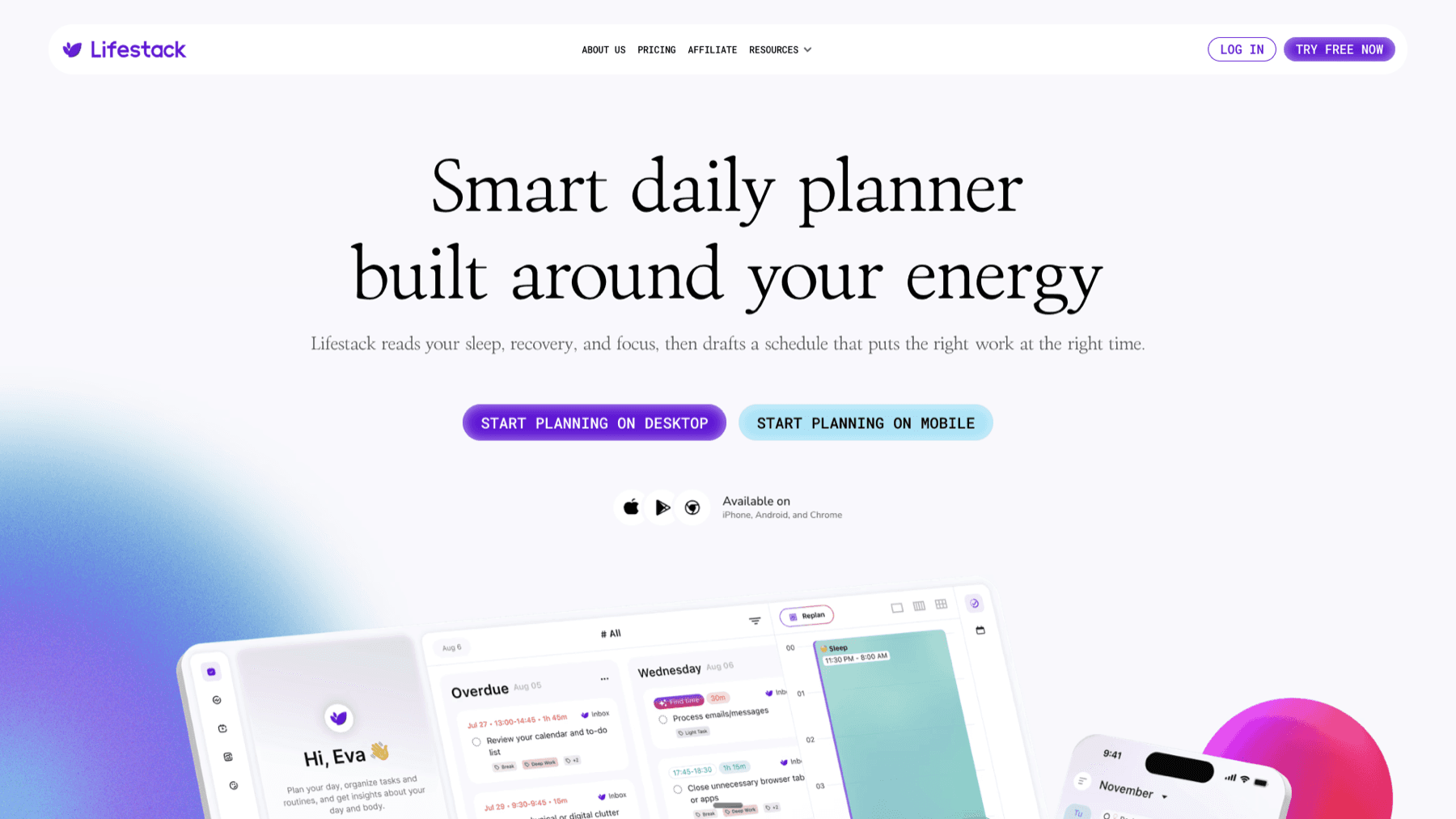
One practical step is tracking your actual performance and energy across days rather than just your felt sense in the morning. Lifestack tracks energy patterns over time and can reveal when your "energized" days after short sleep correlate with performance declines in the afternoon. An honest energy calendar often shows a different picture than the morning feeling suggests.
If you want to make yourself genuinely tired at bedtime rather than relying on accumulated sleep debt, behavioral approaches work better than supplements. Consistent wake times, morning light exposure, and avoiding screens in the hour before bed are the highest-impact interventions. If melatonin hasn't been helping you fall asleep, the issue is often timing rather than dose: melatonin works on circadian signaling, not sedation, and the timing window is narrow. And if you're struggling with the quality of sleep you do get, the guide on being a light sleeper covers stimulus control and sleep architecture techniques that improve sleep efficiency without requiring more hours.
Frequently Asked Questions
Is it possible to genuinely need less than eight hours of sleep?
Yes, but it's rare. Researchers estimate that true short sleep syndrome, a genetic variant that allows people to function well on six or fewer hours without cognitive impairment, affects only about 1-3% of the population. It's identifiable through genetic testing. For everyone else, the belief that they can function well on less sleep is almost always either adaptation to impairment or the short-term stress hormone effect described in this article.
Why do I feel groggy after sleeping eight hours but alert after sleeping six?
Most likely explanation: your eight-hour sleep ends at a poor point in your sleep cycle (often during deep slow-wave sleep), producing significant sleep inertia. Your six-hour sleep ends at the end of a lighter cycle with minimal sleep inertia. You can test this by experimenting with earlier or later wake times to find where your natural cycle end points sit. Alarm clocks that track movement and wake you during light sleep phases can also reduce this effect.
Does the energy from sleep deprivation go away on its own?
The stress hormone spike typically peaks in the morning and fades by early afternoon, often producing a significant energy crash in the 2-4 p.m. window. If you're experiencing the dopamine effect (Reason 2), it may last longer but still fades well before the end of a normal workday. Neither effect produces sustained energy across a full day.
Can I train myself to sleep less?
You can train yourself to function while impaired, which is what most short sleepers have done. Actual reduction of sleep need through deliberate training has no strong research support. The interventions that improve sleep efficiency (sleeping the same hours but getting more deep and REM sleep per hour in bed) are real and worth pursuing, but they don't reduce the total hours you need; they improve the quality of the hours you get.
Why do I feel better on no sleep than on four hours?
This is a well-documented phenomenon related to sleep stage disruption. Four hours of sleep often ends during a deep sleep stage, producing heavy sleep inertia and groggy awakening. No sleep keeps cortisol and adrenaline high, producing the stimulant-like effect described in Reason 1. The four-hour group is impaired in both ways: sleep-deprived and in sleep inertia. The no-sleep group is just sleep-deprived. Neither is a good option.
You slept five hours instead of eight. You wake up expecting to feel terrible, and instead you feel surprisingly sharp, alert, almost wired. This happens to enough people often enough that there are Reddit threads dedicated to it. It's counterintuitive, it can feel like good news, and it is almost certainly not.
The feeling is real. The explanation is neurochemical, not physiological. Your body is not running better on less sleep; it is running on a different fuel mix that happens to feel like energy in the short term and creates deficits that compound over time. Understanding what's actually happening makes it easier to stop interpreting the signal as permission to sleep less.
Here are seven reasons you might feel more energized after sleeping less than usual, and what each one tells you about what your body is actually doing.
Key Takeaways
Feeling alert after short sleep is usually a stress hormone response, not evidence that you need less sleep than average
The cognitive impairments from sleep deprivation often outpace subjective awareness of them; you feel fine but perform worse
A few of the reasons (circadian alignment, paying off sleep debt) reflect genuine improvements worth building on
First: Why Feeling Fine Doesn't Mean You Are Fine
Decades of sleep research have documented a consistent finding: sleep-deprived people reliably underestimate how impaired they are. In lab studies, subjects kept awake for extended periods report feeling only "slightly sleepy" while their cognitive testing shows performance equivalent to legal intoxication.
The brain's ability to assess its own function degrades under sleep deprivation before the brain itself degrades. This means the felt sense of "I'm actually fine on five hours" is itself a symptom of sleep deprivation, not evidence against it. Knowing this doesn't eliminate the experience but changes how to interpret it.
Reason 1: Cortisol and Adrenaline Are Spiking
Sleep deprivation triggers a stress response. The body interprets insufficient sleep as a threat and responds by releasing cortisol and adrenaline, both of which create feelings of alertness, heightened focus, and suppressed hunger. This is biologically similar to what happens in genuine emergency situations, where the body temporarily overrides fatigue to handle an acute threat.
The problem is that this is a borrowed state. The cortisol spike that makes you feel alert also suppresses immune function, raises blood pressure, and increases inflammatory markers. The energy is real but the cost is deferred, showing up as accumulated health risk and worsening fatigue in subsequent days if the sleep debt isn't paid.
Reason 2: Dopamine Levels Are Temporarily Higher
Sleep deprivation increases dopamine receptor sensitivity and, in some research, dopamine availability in the brain's reward circuits. Dopamine is the neurotransmitter associated with motivation, reward anticipation, and the sense of engagement. This helps explain why a night of poor sleep sometimes produces a feeling of being unusually "on" or productive early in the day.
The same mechanism is implicated in the manic phases of bipolar disorder, where reduced sleep produces feelings of increased energy and capacity. For most people, it's a much milder version of the same neurochemical dynamic. The dopamine effect tends to fade by afternoon of the same day, and the subsequent crash is often severe.
Reason 3: You've Avoided Sleep Inertia
Sleep inertia is the grogginess that follows waking, particularly when waking during a deep sleep stage. It can last anywhere from a few minutes to 30-45 minutes and significantly impairs cognitive performance and subjective alertness during that window.
If you wake after five hours and happen to be at the end of a sleep cycle rather than the middle of one, you may experience significantly less sleep inertia than you would after waking from a deeper stage eight hours in. This timing effect can make a short sleep feel more refreshing than a full night that ended at the wrong point in the cycle. It's not evidence of not needing more sleep; it's timing.
Reason 4: Your Circadian Rhythm Is Better Aligned
If you normally go to bed too late and sleep through your natural wake time, you may regularly wake during a circadian low point, which produces fatigue regardless of total sleep time. On nights when you sleep fewer hours but wake at a more circadian-appropriate time, you may feel more alert even with less total sleep.
This is one of the genuine improvements in the list rather than a false positive. If this pattern repeats, it's worth investigating whether your sleep schedule is chronobiologically misaligned. A circadian rhythm tracking app can help identify where your natural energy peaks and troughs sit relative to when you're currently sleeping and waking.
Reason 5: Caffeine Timing Is Working in Your Favor
On normal sleep days, you may be consuming caffeine at a suboptimal time relative to your adenosine cycle. On short-sleep days, the pattern shifts. You might consume caffeine earlier, in a higher dose, or at a point when adenosine has been building for fewer hours and is therefore more receptive to blockade.
The result can be a subjectively better response to caffeine than usual, which registers as "I feel good today despite sleeping less." What's actually happening is more efficient adenosine blockade, not better recovery. The caffeine is masking fatigue that will return once it wears off.
Reason 6: You Recently Paid Off Sleep Debt
If the night before your five-hour night you slept nine or ten hours, you may have partially paid off accumulated sleep debt. The five-hour night following an unusually long recovery sleep can feel fine because you're drawing on a more replenished baseline rather than an already-depleted one.
This is one of the more confusing patterns for people who track their sleep, because the short sleep feels better than the long sleep that preceded it. The long sleep did the recovery work; the short sleep is the easy night that followed it. On a longer timeline, the sleep debt will return if the short nights continue.
Reason 7: Your Body Has Adapted, Not Recovered
Chronic short sleepers often report feeling fine because they have genuinely adapted to their level of impairment. They are no longer experiencing acute sleep deprivation; they are experiencing chronic sleep deprivation that has become their baseline. The felt sense of energy is relative to their new normal, not to what full recovery would produce.
This adaptation is documented in research: people who are chronically sleep-restricted lose the ability to accurately report how impaired they are, because the impaired state has become familiar. Cognitive testing reveals ongoing deficits even when subjective reports suggest feeling "fine." The way to test this is to spend a week sleeping eight to nine hours and compare performance on cognitive tasks and emotional regulation. Many chronic short sleepers are surprised by the difference.
What to Do With This Information
Understanding why you feel energized on less sleep doesn't mean ignoring the signal. It means reading it correctly. The stress hormone response in Reason 1 is worth taking seriously as chronic stress, not as permission to sleep four hours. The circadian alignment effect in Reason 4 is worth acting on by shifting your sleep timing.
One practical step is tracking your actual performance and energy across days rather than just your felt sense in the morning. Lifestack tracks energy patterns over time and can reveal when your "energized" days after short sleep correlate with performance declines in the afternoon. An honest energy calendar often shows a different picture than the morning feeling suggests.
If you want to make yourself genuinely tired at bedtime rather than relying on accumulated sleep debt, behavioral approaches work better than supplements. Consistent wake times, morning light exposure, and avoiding screens in the hour before bed are the highest-impact interventions. If melatonin hasn't been helping you fall asleep, the issue is often timing rather than dose: melatonin works on circadian signaling, not sedation, and the timing window is narrow. And if you're struggling with the quality of sleep you do get, the guide on being a light sleeper covers stimulus control and sleep architecture techniques that improve sleep efficiency without requiring more hours.
Frequently Asked Questions
Is it possible to genuinely need less than eight hours of sleep?
Yes, but it's rare. Researchers estimate that true short sleep syndrome, a genetic variant that allows people to function well on six or fewer hours without cognitive impairment, affects only about 1-3% of the population. It's identifiable through genetic testing. For everyone else, the belief that they can function well on less sleep is almost always either adaptation to impairment or the short-term stress hormone effect described in this article.
Why do I feel groggy after sleeping eight hours but alert after sleeping six?
Most likely explanation: your eight-hour sleep ends at a poor point in your sleep cycle (often during deep slow-wave sleep), producing significant sleep inertia. Your six-hour sleep ends at the end of a lighter cycle with minimal sleep inertia. You can test this by experimenting with earlier or later wake times to find where your natural cycle end points sit. Alarm clocks that track movement and wake you during light sleep phases can also reduce this effect.
Does the energy from sleep deprivation go away on its own?
The stress hormone spike typically peaks in the morning and fades by early afternoon, often producing a significant energy crash in the 2-4 p.m. window. If you're experiencing the dopamine effect (Reason 2), it may last longer but still fades well before the end of a normal workday. Neither effect produces sustained energy across a full day.
Can I train myself to sleep less?
You can train yourself to function while impaired, which is what most short sleepers have done. Actual reduction of sleep need through deliberate training has no strong research support. The interventions that improve sleep efficiency (sleeping the same hours but getting more deep and REM sleep per hour in bed) are real and worth pursuing, but they don't reduce the total hours you need; they improve the quality of the hours you get.
Why do I feel better on no sleep than on four hours?
This is a well-documented phenomenon related to sleep stage disruption. Four hours of sleep often ends during a deep sleep stage, producing heavy sleep inertia and groggy awakening. No sleep keeps cortisol and adrenaline high, producing the stimulant-like effect described in Reason 1. The four-hour group is impaired in both ways: sleep-deprived and in sleep inertia. The no-sleep group is just sleep-deprived. Neither is a good option.



FOLLOW ON
FOLLOW ON
FOLLOW ON


Copyright 2026 © Lifestack. All rights reserved
Copyright 2026 © Lifestack. All rights reserved

