
Tips
6 Hours of Sleep a Night: Is It Actually Enough?
6 Hours of Sleep a Night: Is It Actually Enough?

Six hours of sleep sounds like a reasonable compromise. You stay productive late, wake up early, and still get a solid block of rest. Many high-performing people claim to run fine on six. The problem: the research on this is not ambiguous. For roughly 97 percent of the adult population, six hours is not enough sleep, and the cognitive decline it causes is largely invisible to the person experiencing it.
This is what makes chronic six-hour sleep unusual among health problems. With most deficits, you feel bad. With sleep restriction, your brain adapts to feeling impaired as normal. Studies have shown that people sleeping six hours a night rate their own alertness as perfectly adequate while performing at the cognitive level of someone who has been awake for 24 hours straight.
Here is what the science actually shows, who the exceptions are, and what you can do to protect your cognitive performance if six hours is genuinely your ceiling right now.
Key Takeaways
Most adults need 7 to 9 hours; six hours per night creates cumulative sleep debt with measurable cognitive effects within days
The short sleeper gene (DEC2) is real but affects roughly 1 to 3 percent of the population; most people who claim to thrive on six hours are adapted to impairment, not immune to it
Sleep quality and schedule timing can partially offset quantity shortfalls; energy-aware planning reduces the cognitive load that worsens sleep debt effects
What Science Says About 6 Hours of Sleep
The National Sleep Foundation and American Academy of Sleep Medicine both recommend 7 to 9 hours for adults. This is not a conservative estimate. It is derived from decades of sleep restriction studies where participants were held to specific sleep windows and measured across cognitive, metabolic, immunological, and cardiovascular markers.
A landmark 2003 study at the University of Pennsylvania by David Dinges placed adults in 6-hour, 8-hour, or total sleep deprivation groups for two weeks. The 6-hour group degraded consistently across every cognitive measure tested: reaction time, working memory, sustained attention, and logical reasoning. By day 14, their performance was comparable to the 24-hour total deprivation group, while they reported no subjective sense of being impaired.
The UK Biobank study, which tracked over 500,000 participants, found that sleeping under 7 hours was associated with increased all-cause mortality, cardiovascular disease, type 2 diabetes, and cognitive decline. The association holds after controlling for known confounders, which makes it hard to dismiss as correlation alone.
What Happens to Your Brain on 6 Hours
Sleep is when your brain consolidates memory, clears metabolic waste via the glymphatic system, and restores the prefrontal cortex function needed for executive thinking. Six hours compresses or eliminates the later REM cycles, which is when emotional regulation and memory consolidation are most active.
Concrete effects that appear within 72 hours of six-hour sleep restriction include: slower reaction times, reduced working memory capacity, impaired emotional regulation (higher irritability, lower frustration tolerance), reduced creativity and lateral thinking, and poorer performance on tasks that require clearing brain fog and sustained attention.
The glymphatic clearance problem is worth understanding specifically. During deep sleep, your brain's glymphatic system flushes out metabolic waste including amyloid beta, the protein associated with Alzheimer's disease. Chronic six-hour sleep reduces this clearance. Long-term studies have found higher amyloid accumulation in people who habitually sleep under seven hours, though the causal direction is still being studied.
Why You Think 6 Hours Is Enough (The Adaptation Trap)
The most counterintuitive finding in sleep restriction research is that the people most impaired by it feel fine. After three to five days of six-hour sleep, subjective sleepiness ratings stabilize. People report that they have adjusted. Performance measures continue declining.
This disconnect is why sleeping under recommended hours is easy to rationalize. You are not falling asleep at your desk. You are not stumbling through conversations. You are just subtly slower, less creative, less emotionally stable, and more prone to poor decisions than you would be at seven or eight hours. The impairment is invisible to you while being visible to others and measurable on tests.
The adaptation is not physiological recovery. It is your brain recalibrating its baseline expectation of what "normal" feels like.
The Short Sleeper Exception
A genuine short sleeper is someone who thrives on six hours or fewer with no cognitive deficit, no compensation napping, no performance decline on extended testing, and no deterioration over years. These individuals carry a mutation in the DEC2 gene, identified by researchers at UCSF in 2009, that alters their sleep architecture so they extract more restorative value per hour.
The population prevalence is estimated at 1 to 3 percent. This means that for every hundred people who believe they are natural short sleepers, roughly ninety-seven to ninety-nine are adapted to impairment rather than genetically immune to it. There is no self-administered test for the DEC2 mutation. The clinical tell is that true short sleepers have always, since childhood, naturally woken after six hours feeling completely restored, with no sleep debt and no performance deficit on objective measures.
If you started sleeping six hours because of work pressure or life demands in adulthood, you are almost certainly not in this group.
How to Maximize Sleep Quality When Quantity Is Constrained
If six hours is your current ceiling for external reasons, quality becomes more important. Restorative sleep depends more on consistent timing and sleep architecture than raw duration.
The highest-impact changes for sleep quality are: consistent wake time (more important than consistent bedtime for circadian anchoring), cool room temperature (65 to 68 degrees Fahrenheit is the most frequently cited range), limiting alcohol within three hours of sleep (alcohol sedates but suppresses REM, reducing sleep quality significantly), and avoiding blue light in the 90 minutes before bed.
Caffeine timing matters more than most people realize. Caffeine has a half-life of five to seven hours in most adults, meaning a 3pm coffee still has half its stimulant effect at 9pm. For six-hour sleepers, a hard caffeine cutoff at 1pm preserves more of the sleep quality in those six hours than later cutoffs, even if the late coffee does not feel like it is affecting sleep.
The Role of Your Daily Schedule in Sleep Quality
One underappreciated driver of poor sleep quality among six-hour sleepers is cognitive overload at bedtime. When your day was chaotic, underplanned, or filled with decisions that spilled into the evening, you arrive at bed with an active mental task list. This raises cortisol, delays sleep onset, and reduces deep sleep time in the hours you do have.
This is the connection between daytime scheduling and nighttime sleep quality. A day where your tasks were planned, prioritized, and matched to your energy levels produces less cognitive residue at bedtime. A day where you improvised through a pile of unfinished business produces the opposite: an overactivated brain at exactly the moment you need it to disengage.
Energy-aware scheduling addresses this by building your day around your natural cognitive peaks and troughs rather than arbitrary time slots. When your most demanding work happens in your sharpest windows and your evenings wind down naturally from a completed day, sleep quality improves even if total hours stay the same.
Best Tool for Improving Sleep with a Tight Schedule: Lifestack
Lifestack is an AI-powered daily planner built around energy-aware scheduling. It learns your energy patterns and automatically places your tasks into the time slots where you are most likely to execute them, protecting your peak-focus hours and creating natural daily closure that reduces the cognitive activation that delays sleep onset.
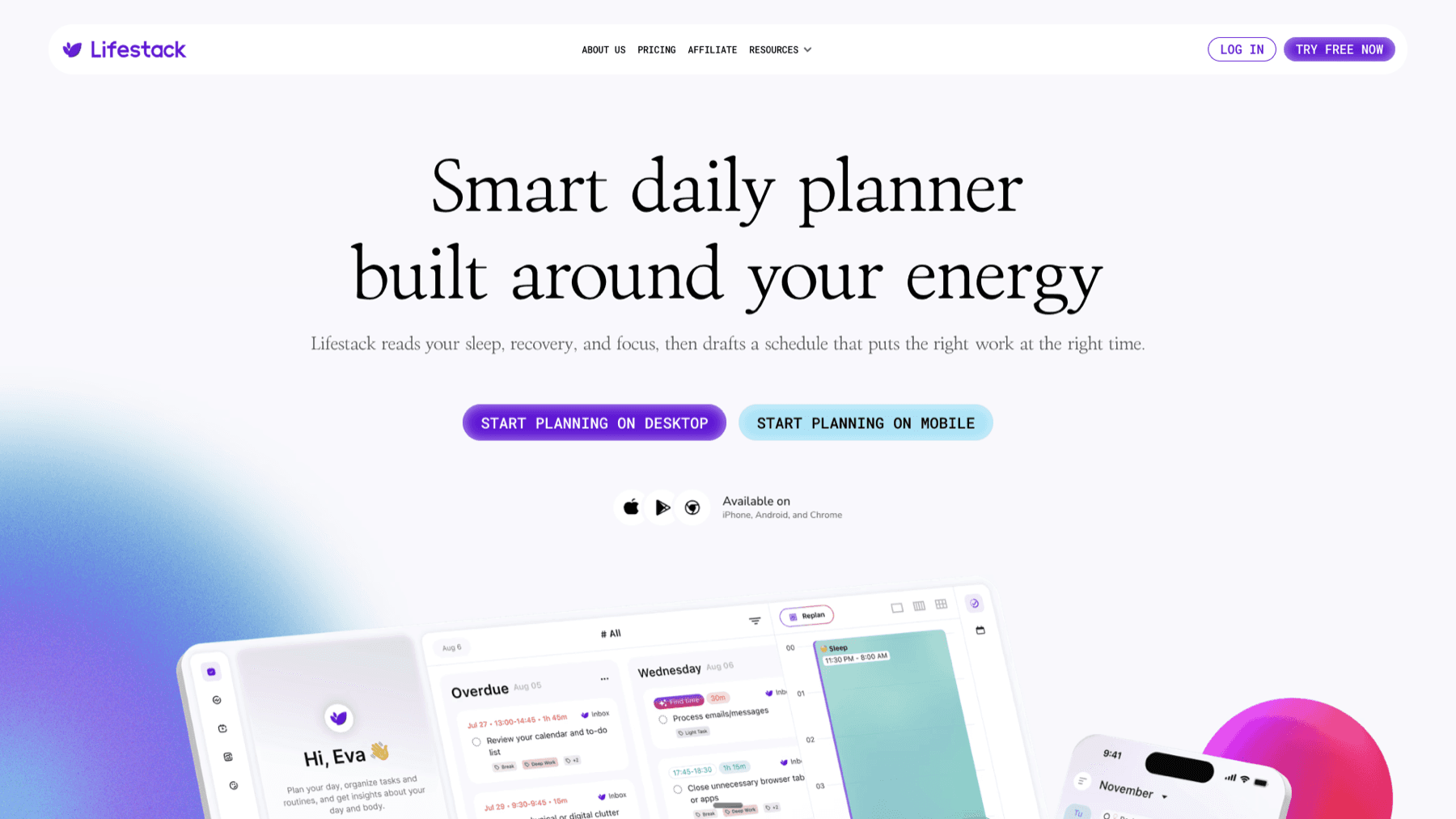
For people who are already sleeping six hours and cannot add more time, Lifestack addresses the quality layer: fewer open loops at bedtime, better task completion during the day, and a schedule that works with your circadian rhythm rather than against it. It connects with Google Calendar and Apple Calendar, making it easy to integrate without rebuilding your system from scratch.
Lifestack costs $9.99 per month or $49.99 per year, with a 7-day free trial on the annual plan.
Warning Signs Your 6 Hours Is Not Enough
The following are signals that your six-hour sleep is causing measurable impairment, even if you feel adapted to it:
You need an alarm to wake up (natural awakening after adequate sleep does not require forced interruption)
You fall asleep within five minutes of sitting still in a meeting or on transport
You rely on caffeine to feel functional, not just alert
Your mood and irritability vary significantly day to day without obvious cause
You sleep significantly longer on weekends or whenever the schedule allows (social jet lag)
You notice brain fog symptoms regularly in afternoons even with adequate nutrition and hydration
Three or more of these consistently present is a strong indicator that six hours is not your personal optimal, regardless of how normal it feels.
FAQ
Is 6 hours of sleep enough for adults?
For approximately 97 to 99 percent of adults, no. Most adults need 7 to 9 hours for full cognitive and physiological restoration. Six hours per night creates cumulative sleep debt within days, with measurable declines in reaction time, working memory, emotional regulation, and metabolic function. The rare exception is the DEC2 short sleeper mutation, which affects roughly 1 to 3 percent of the population.
Can you function on 6 hours of sleep long-term?
You can adapt to functioning on six hours in the sense that it stops feeling abnormal. You cannot adapt physiologically in the sense that performance recovers. Research shows that after a week of six-hour sleep, cognitive performance stabilizes at a degraded level while subjective alertness normalizes. The feeling of being fine is not evidence of actually being fine.
What are the long-term effects of 6 hours of sleep?
Chronic six-hour sleep is associated with increased risk of cardiovascular disease, type 2 diabetes, obesity, impaired immune function, and faster cognitive aging. The glymphatic clearance reduction from insufficient deep sleep is also linked in observational studies to higher amyloid accumulation in the brain over time.
How do I know if I am a natural short sleeper?
True short sleepers wake naturally and completely refreshed after six hours or fewer without an alarm, without sleep debt, and without performance decline on any objective measure, consistently since childhood. If your six-hour sleep pattern emerged from adult life pressure, you are almost certainly not a genetic short sleeper. A sleep medicine physician can help evaluate this with objective testing if you want certainty.
Is 6 hours of sleep better than none?
Yes, significantly. Total sleep deprivation causes acute and severe cognitive and physiological impairment. Six hours, even with its shortfalls, provides restorative value. The comparison matters when deciding between a very late night and a shortened sleep window: six hours is substantially better than zero.
How can I improve my sleep quality on 6 hours?
Consistent wake time anchors your circadian rhythm more effectively than a consistent bedtime. Cool room temperature, alcohol-free evenings, a hard caffeine cutoff in early afternoon, and low cognitive load at bedtime all improve sleep architecture within the six-hour window. Structured morning routines that create daily consistency also stabilize circadian timing, which improves sleep quality over time.
Six hours of sleep sounds like a reasonable compromise. You stay productive late, wake up early, and still get a solid block of rest. Many high-performing people claim to run fine on six. The problem: the research on this is not ambiguous. For roughly 97 percent of the adult population, six hours is not enough sleep, and the cognitive decline it causes is largely invisible to the person experiencing it.
This is what makes chronic six-hour sleep unusual among health problems. With most deficits, you feel bad. With sleep restriction, your brain adapts to feeling impaired as normal. Studies have shown that people sleeping six hours a night rate their own alertness as perfectly adequate while performing at the cognitive level of someone who has been awake for 24 hours straight.
Here is what the science actually shows, who the exceptions are, and what you can do to protect your cognitive performance if six hours is genuinely your ceiling right now.
Key Takeaways
Most adults need 7 to 9 hours; six hours per night creates cumulative sleep debt with measurable cognitive effects within days
The short sleeper gene (DEC2) is real but affects roughly 1 to 3 percent of the population; most people who claim to thrive on six hours are adapted to impairment, not immune to it
Sleep quality and schedule timing can partially offset quantity shortfalls; energy-aware planning reduces the cognitive load that worsens sleep debt effects
What Science Says About 6 Hours of Sleep
The National Sleep Foundation and American Academy of Sleep Medicine both recommend 7 to 9 hours for adults. This is not a conservative estimate. It is derived from decades of sleep restriction studies where participants were held to specific sleep windows and measured across cognitive, metabolic, immunological, and cardiovascular markers.
A landmark 2003 study at the University of Pennsylvania by David Dinges placed adults in 6-hour, 8-hour, or total sleep deprivation groups for two weeks. The 6-hour group degraded consistently across every cognitive measure tested: reaction time, working memory, sustained attention, and logical reasoning. By day 14, their performance was comparable to the 24-hour total deprivation group, while they reported no subjective sense of being impaired.
The UK Biobank study, which tracked over 500,000 participants, found that sleeping under 7 hours was associated with increased all-cause mortality, cardiovascular disease, type 2 diabetes, and cognitive decline. The association holds after controlling for known confounders, which makes it hard to dismiss as correlation alone.
What Happens to Your Brain on 6 Hours
Sleep is when your brain consolidates memory, clears metabolic waste via the glymphatic system, and restores the prefrontal cortex function needed for executive thinking. Six hours compresses or eliminates the later REM cycles, which is when emotional regulation and memory consolidation are most active.
Concrete effects that appear within 72 hours of six-hour sleep restriction include: slower reaction times, reduced working memory capacity, impaired emotional regulation (higher irritability, lower frustration tolerance), reduced creativity and lateral thinking, and poorer performance on tasks that require clearing brain fog and sustained attention.
The glymphatic clearance problem is worth understanding specifically. During deep sleep, your brain's glymphatic system flushes out metabolic waste including amyloid beta, the protein associated with Alzheimer's disease. Chronic six-hour sleep reduces this clearance. Long-term studies have found higher amyloid accumulation in people who habitually sleep under seven hours, though the causal direction is still being studied.
Why You Think 6 Hours Is Enough (The Adaptation Trap)
The most counterintuitive finding in sleep restriction research is that the people most impaired by it feel fine. After three to five days of six-hour sleep, subjective sleepiness ratings stabilize. People report that they have adjusted. Performance measures continue declining.
This disconnect is why sleeping under recommended hours is easy to rationalize. You are not falling asleep at your desk. You are not stumbling through conversations. You are just subtly slower, less creative, less emotionally stable, and more prone to poor decisions than you would be at seven or eight hours. The impairment is invisible to you while being visible to others and measurable on tests.
The adaptation is not physiological recovery. It is your brain recalibrating its baseline expectation of what "normal" feels like.
The Short Sleeper Exception
A genuine short sleeper is someone who thrives on six hours or fewer with no cognitive deficit, no compensation napping, no performance decline on extended testing, and no deterioration over years. These individuals carry a mutation in the DEC2 gene, identified by researchers at UCSF in 2009, that alters their sleep architecture so they extract more restorative value per hour.
The population prevalence is estimated at 1 to 3 percent. This means that for every hundred people who believe they are natural short sleepers, roughly ninety-seven to ninety-nine are adapted to impairment rather than genetically immune to it. There is no self-administered test for the DEC2 mutation. The clinical tell is that true short sleepers have always, since childhood, naturally woken after six hours feeling completely restored, with no sleep debt and no performance deficit on objective measures.
If you started sleeping six hours because of work pressure or life demands in adulthood, you are almost certainly not in this group.
How to Maximize Sleep Quality When Quantity Is Constrained
If six hours is your current ceiling for external reasons, quality becomes more important. Restorative sleep depends more on consistent timing and sleep architecture than raw duration.
The highest-impact changes for sleep quality are: consistent wake time (more important than consistent bedtime for circadian anchoring), cool room temperature (65 to 68 degrees Fahrenheit is the most frequently cited range), limiting alcohol within three hours of sleep (alcohol sedates but suppresses REM, reducing sleep quality significantly), and avoiding blue light in the 90 minutes before bed.
Caffeine timing matters more than most people realize. Caffeine has a half-life of five to seven hours in most adults, meaning a 3pm coffee still has half its stimulant effect at 9pm. For six-hour sleepers, a hard caffeine cutoff at 1pm preserves more of the sleep quality in those six hours than later cutoffs, even if the late coffee does not feel like it is affecting sleep.
The Role of Your Daily Schedule in Sleep Quality
One underappreciated driver of poor sleep quality among six-hour sleepers is cognitive overload at bedtime. When your day was chaotic, underplanned, or filled with decisions that spilled into the evening, you arrive at bed with an active mental task list. This raises cortisol, delays sleep onset, and reduces deep sleep time in the hours you do have.
This is the connection between daytime scheduling and nighttime sleep quality. A day where your tasks were planned, prioritized, and matched to your energy levels produces less cognitive residue at bedtime. A day where you improvised through a pile of unfinished business produces the opposite: an overactivated brain at exactly the moment you need it to disengage.
Energy-aware scheduling addresses this by building your day around your natural cognitive peaks and troughs rather than arbitrary time slots. When your most demanding work happens in your sharpest windows and your evenings wind down naturally from a completed day, sleep quality improves even if total hours stay the same.
Best Tool for Improving Sleep with a Tight Schedule: Lifestack
Lifestack is an AI-powered daily planner built around energy-aware scheduling. It learns your energy patterns and automatically places your tasks into the time slots where you are most likely to execute them, protecting your peak-focus hours and creating natural daily closure that reduces the cognitive activation that delays sleep onset.
For people who are already sleeping six hours and cannot add more time, Lifestack addresses the quality layer: fewer open loops at bedtime, better task completion during the day, and a schedule that works with your circadian rhythm rather than against it. It connects with Google Calendar and Apple Calendar, making it easy to integrate without rebuilding your system from scratch.
Lifestack costs $9.99 per month or $49.99 per year, with a 7-day free trial on the annual plan.
Warning Signs Your 6 Hours Is Not Enough
The following are signals that your six-hour sleep is causing measurable impairment, even if you feel adapted to it:
You need an alarm to wake up (natural awakening after adequate sleep does not require forced interruption)
You fall asleep within five minutes of sitting still in a meeting or on transport
You rely on caffeine to feel functional, not just alert
Your mood and irritability vary significantly day to day without obvious cause
You sleep significantly longer on weekends or whenever the schedule allows (social jet lag)
You notice brain fog symptoms regularly in afternoons even with adequate nutrition and hydration
Three or more of these consistently present is a strong indicator that six hours is not your personal optimal, regardless of how normal it feels.
FAQ
Is 6 hours of sleep enough for adults?
For approximately 97 to 99 percent of adults, no. Most adults need 7 to 9 hours for full cognitive and physiological restoration. Six hours per night creates cumulative sleep debt within days, with measurable declines in reaction time, working memory, emotional regulation, and metabolic function. The rare exception is the DEC2 short sleeper mutation, which affects roughly 1 to 3 percent of the population.
Can you function on 6 hours of sleep long-term?
You can adapt to functioning on six hours in the sense that it stops feeling abnormal. You cannot adapt physiologically in the sense that performance recovers. Research shows that after a week of six-hour sleep, cognitive performance stabilizes at a degraded level while subjective alertness normalizes. The feeling of being fine is not evidence of actually being fine.
What are the long-term effects of 6 hours of sleep?
Chronic six-hour sleep is associated with increased risk of cardiovascular disease, type 2 diabetes, obesity, impaired immune function, and faster cognitive aging. The glymphatic clearance reduction from insufficient deep sleep is also linked in observational studies to higher amyloid accumulation in the brain over time.
How do I know if I am a natural short sleeper?
True short sleepers wake naturally and completely refreshed after six hours or fewer without an alarm, without sleep debt, and without performance decline on any objective measure, consistently since childhood. If your six-hour sleep pattern emerged from adult life pressure, you are almost certainly not a genetic short sleeper. A sleep medicine physician can help evaluate this with objective testing if you want certainty.
Is 6 hours of sleep better than none?
Yes, significantly. Total sleep deprivation causes acute and severe cognitive and physiological impairment. Six hours, even with its shortfalls, provides restorative value. The comparison matters when deciding between a very late night and a shortened sleep window: six hours is substantially better than zero.
How can I improve my sleep quality on 6 hours?
Consistent wake time anchors your circadian rhythm more effectively than a consistent bedtime. Cool room temperature, alcohol-free evenings, a hard caffeine cutoff in early afternoon, and low cognitive load at bedtime all improve sleep architecture within the six-hour window. Structured morning routines that create daily consistency also stabilize circadian timing, which improves sleep quality over time.



FOLLOW ON
FOLLOW ON
FOLLOW ON


Copyright 2026 © Lifestack. All rights reserved
Copyright 2026 © Lifestack. All rights reserved

