
Device
Acer FreeSense Ring vs Oura Ring
Acer FreeSense Ring vs Oura Ring

Smart rings had one dominant name for years. Oura built a category and made the Oura Ring the default answer whenever someone asked about passive health tracking. Then Acer arrived with the FreeSense Ring and changed the conversation with one move: no subscription required.
The FreeSense Ring launched at $199 to $250 with all features unlocked from day one. The Oura Ring 4 costs $349 to $499 upfront plus $5.99 per month to access the sleep staging, readiness scores, and trend data that most people buy the ring for. Over three years, that subscription adds up to $215 on top of the hardware cost.
That pricing gap is the central question in this comparison. Whether Oura's platform and accuracy justify the ongoing cost depends on what you actually need from a smart ring.
Key Takeaways
The Acer FreeSense Ring costs significantly less up front and has no monthly subscription, making it the clear choice for budget-conscious buyers who want basic health tracking.
The Oura Ring 4 has longer battery life (8 days vs 4), a more established health platform, and deeper analytics that have been validated by years of user data and independent studies.
For serious athletes and sleep-focused users who want the most actionable data, Oura still justifies the premium. For casual trackers, FreeSense is a compelling alternative.
Quick Verdict
Acer FreeSense Ring: Best for budget buyers, casual health trackers, and anyone who refuses to pay a monthly subscription for wearable data.
Oura Ring 4: Best for serious health optimizers, athletes tracking recovery, and anyone willing to pay for deeper analytics and a longer battery window.
Acer FreeSense Ring Overview
The FreeSense Ring is Acer's first entry into the smart ring market, and it is more capable than the price suggests. At 2 to 3 grams (lighter than the Oura Ring's 4 to 6 grams), it disappears on your finger more completely than most ring-form health trackers. Available in sizes 7 to 13 in black or rose gold titanium alloy.
What it tracks: Heart rate, HRV, SpO2, sleep stages (awake, light, deep, REM), step count, active calories, and temperature. This covers the core health metrics that the majority of smart ring buyers actually use.
Battery life: 4 days. That is half the Oura Ring's 8-day window, which means more frequent charging. The FreeSense charges via a proprietary dock.
Pricing: $199 to $250 depending on size and retailer. No monthly subscription. All app features included in the purchase price indefinitely.
Limitations: Shorter battery, newer platform with less longitudinal data, no menstrual cycle tracking (which Oura includes), and a shorter track record for software reliability and accuracy validation.
Oura Ring 4 Overview
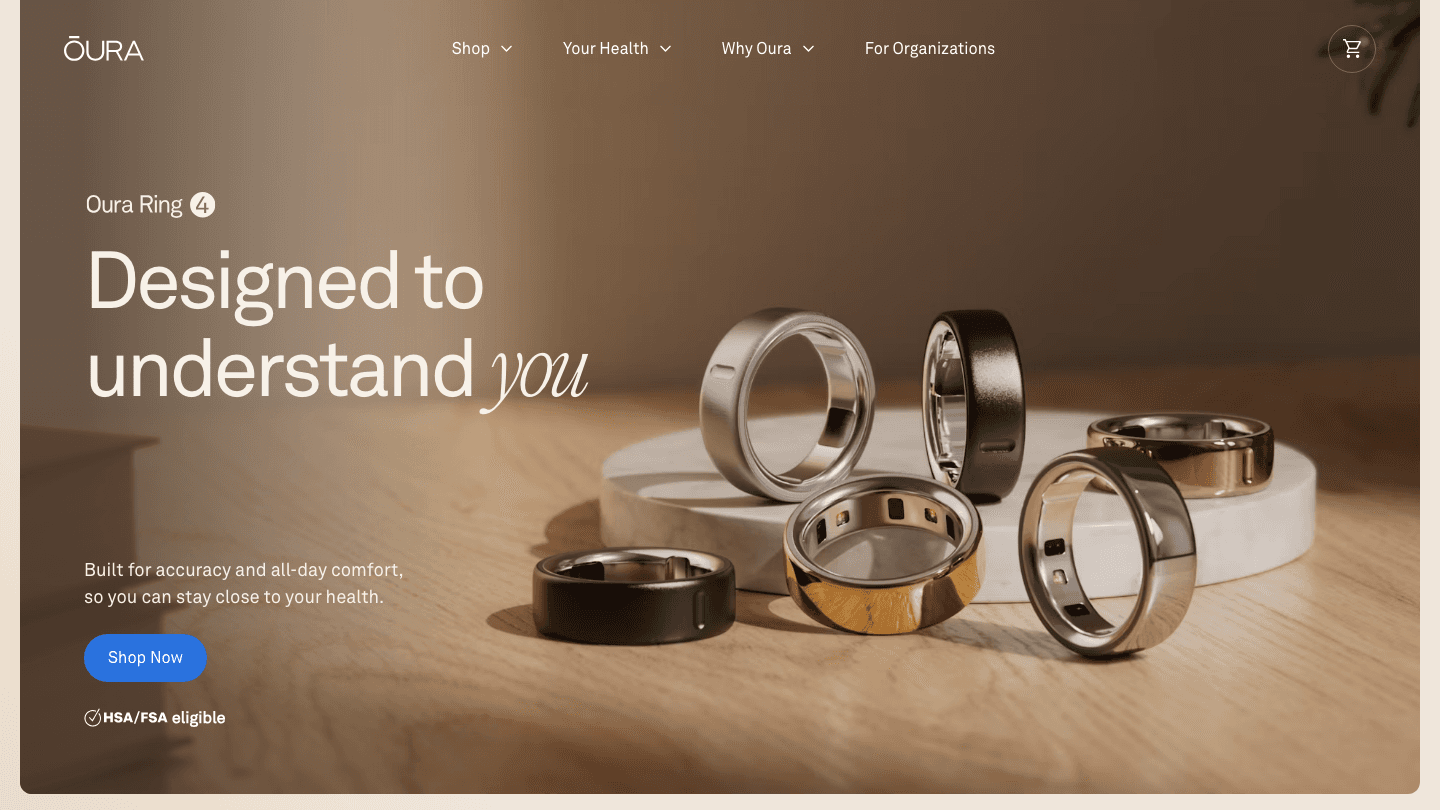
The Oura Ring 4 is the fourth generation of the ring that made sleep tracking in a ring format credible. The platform has years of independent research behind it, including studies comparing its sleep staging accuracy to clinical polysomnography. The ring form factor was validated at scale before Acer, Samsung, and other entrants arrived.
What it tracks: Heart rate, HRV, SpO2, skin temperature, sleep stages, readiness score, activity, stress, menstrual cycle insights, and cardiovascular age. The analytics layer is notably deeper than what most competitors offer, particularly on readiness and recovery scoring.
Battery life: Up to 8 days, charging in roughly 20 minutes. The 8-day window means once-weekly charging for most users, which is meaningfully more convenient than a 4-day cycle.
Pricing: $349 (Heritage) to $499 (Horizon) upfront, plus $5.99/month membership for full feature access. Without the membership, you see only real-time heart rate and step count. Sleep staging, readiness scores, and trend data all require the subscription.
Limitations: The subscription model is a real ongoing cost. Some users report the readiness score can feel inconsistent when sleep data is borderline. No screen and no GPS, same as FreeSense.
Head-to-Head Comparison
Price (hardware): FreeSense $199-250 vs Oura $349-499. FreeSense wins.
Ongoing cost: FreeSense $0/month vs Oura $5.99/month ($71.88/year). FreeSense wins decisively over a multi-year ownership horizon.
Battery life: FreeSense 4 days vs Oura 8 days. Oura wins.
Weight: FreeSense 2-3g vs Oura 4-6g. FreeSense wins.
Sleep tracking depth: Both track stages. Oura's platform has more research validation and longer-term trend analysis. Oura wins.
HRV tracking: Both include nightly HRV. For serious HRV analysis, Oura's baseline system and trend visualization are more developed. Oura wins.
Women's health features: FreeSense has none. Oura includes menstrual cycle tracking and hormone-aware insights. Oura wins for this use case.
App maturity: Oura's app has years of development and a large research community. FreeSense is newer and the platform is still maturing. Oura wins.
3-year total cost: FreeSense $199-250 total. Oura $349-499 + $215 subscription = $564-714 total. FreeSense wins on total cost of ownership.
Which Should You Choose?
Choose the Acer FreeSense Ring if: You want passive health tracking without a subscription, you are new to smart rings and unsure about the format, your budget is under $250, or you prioritize lightness and do not need the deepest analytics platform.
Choose the Oura Ring 4 if: You are a serious athlete or sleep optimizer who wants actionable readiness scores and validated data, you want menstrual cycle tracking, you can commit to the subscription, or you need the 8-day battery window to avoid frequent charging.
For users who are considering both for the first time, this breakdown of smart rings for sleep tracking covers how ring-form devices compare to wrist-based trackers for the specific use case of sleep staging accuracy.
Using Your Ring Data to Plan Better Days
Both rings generate recovery data. Acting on it effectively is a separate problem that neither ring's app fully solves.
A high readiness score from Oura or a strong recovery reading from FreeSense tells you your body is primed for effort. What it does not do is tell you how to fit that insight into a calendar with meetings, deadlines, and competing demands.
Lifestack fills that gap. Its energy-based scheduling maps tasks and training to the windows when you are genuinely sharp. On high-readiness days, your hardest work lands in peak windows. On recovery days, the schedule reflects your lower capacity rather than ignoring it. For Oura users specifically, the best apps to use with Oura Ring covers how Lifestack and other tools extend what the ring's data can do. Lifestack starts at $7/month or $50/year with a 7-day free trial on the annual plan.
Smart ring alternatives to Oura covers the broader category if you want to compare other options beyond the FreeSense Ring before committing.
Frequently Asked Questions
Does the Acer FreeSense Ring have a subscription?
No. All features in the Acer FreeSense Ring app are included with the hardware purchase. There is no monthly fee required to access sleep staging, HRV data, or health trend analysis.
How accurate is the Acer FreeSense Ring vs Oura Ring?
Oura Ring has years of published research comparing its sleep staging to clinical standards. The FreeSense Ring is newer and does not have the same validation record yet. Both use optical photoplethysmography sensors, so the hardware approach is similar. For accuracy-critical use cases, Oura's track record is more established.
Which smart ring has the longest battery life?
The Oura Ring 4 at 8 days is significantly longer than the Acer FreeSense Ring at 4 days. If you want to charge less frequently, Oura has a clear advantage.
Is Oura Ring worth the subscription?
For serious health and fitness optimization, yes. The readiness scores, sleep staging depth, menstrual cycle tracking, and long-term trend analysis are genuinely useful for people who act on health data. For casual trackers who mainly want to see step count and sleep hours, the subscription is harder to justify at $5.99/month.
How does the Acer FreeSense Ring compare to Oura Ring for sleep tracking?
Both track awake, light, deep, and REM sleep stages. Oura's sleep analysis is more detailed with its sleep score, sleep contributors breakdown (timing, efficiency, restfulness, latency), and longitudinal trends. The FreeSense provides basic stage tracking which covers what most casual users need.
Smart rings had one dominant name for years. Oura built a category and made the Oura Ring the default answer whenever someone asked about passive health tracking. Then Acer arrived with the FreeSense Ring and changed the conversation with one move: no subscription required.
The FreeSense Ring launched at $199 to $250 with all features unlocked from day one. The Oura Ring 4 costs $349 to $499 upfront plus $5.99 per month to access the sleep staging, readiness scores, and trend data that most people buy the ring for. Over three years, that subscription adds up to $215 on top of the hardware cost.
That pricing gap is the central question in this comparison. Whether Oura's platform and accuracy justify the ongoing cost depends on what you actually need from a smart ring.
Key Takeaways
The Acer FreeSense Ring costs significantly less up front and has no monthly subscription, making it the clear choice for budget-conscious buyers who want basic health tracking.
The Oura Ring 4 has longer battery life (8 days vs 4), a more established health platform, and deeper analytics that have been validated by years of user data and independent studies.
For serious athletes and sleep-focused users who want the most actionable data, Oura still justifies the premium. For casual trackers, FreeSense is a compelling alternative.
Quick Verdict
Acer FreeSense Ring: Best for budget buyers, casual health trackers, and anyone who refuses to pay a monthly subscription for wearable data.
Oura Ring 4: Best for serious health optimizers, athletes tracking recovery, and anyone willing to pay for deeper analytics and a longer battery window.
Acer FreeSense Ring Overview
The FreeSense Ring is Acer's first entry into the smart ring market, and it is more capable than the price suggests. At 2 to 3 grams (lighter than the Oura Ring's 4 to 6 grams), it disappears on your finger more completely than most ring-form health trackers. Available in sizes 7 to 13 in black or rose gold titanium alloy.
What it tracks: Heart rate, HRV, SpO2, sleep stages (awake, light, deep, REM), step count, active calories, and temperature. This covers the core health metrics that the majority of smart ring buyers actually use.
Battery life: 4 days. That is half the Oura Ring's 8-day window, which means more frequent charging. The FreeSense charges via a proprietary dock.
Pricing: $199 to $250 depending on size and retailer. No monthly subscription. All app features included in the purchase price indefinitely.
Limitations: Shorter battery, newer platform with less longitudinal data, no menstrual cycle tracking (which Oura includes), and a shorter track record for software reliability and accuracy validation.
Oura Ring 4 Overview
The Oura Ring 4 is the fourth generation of the ring that made sleep tracking in a ring format credible. The platform has years of independent research behind it, including studies comparing its sleep staging accuracy to clinical polysomnography. The ring form factor was validated at scale before Acer, Samsung, and other entrants arrived.
What it tracks: Heart rate, HRV, SpO2, skin temperature, sleep stages, readiness score, activity, stress, menstrual cycle insights, and cardiovascular age. The analytics layer is notably deeper than what most competitors offer, particularly on readiness and recovery scoring.
Battery life: Up to 8 days, charging in roughly 20 minutes. The 8-day window means once-weekly charging for most users, which is meaningfully more convenient than a 4-day cycle.
Pricing: $349 (Heritage) to $499 (Horizon) upfront, plus $5.99/month membership for full feature access. Without the membership, you see only real-time heart rate and step count. Sleep staging, readiness scores, and trend data all require the subscription.
Limitations: The subscription model is a real ongoing cost. Some users report the readiness score can feel inconsistent when sleep data is borderline. No screen and no GPS, same as FreeSense.
Head-to-Head Comparison
Price (hardware): FreeSense $199-250 vs Oura $349-499. FreeSense wins.
Ongoing cost: FreeSense $0/month vs Oura $5.99/month ($71.88/year). FreeSense wins decisively over a multi-year ownership horizon.
Battery life: FreeSense 4 days vs Oura 8 days. Oura wins.
Weight: FreeSense 2-3g vs Oura 4-6g. FreeSense wins.
Sleep tracking depth: Both track stages. Oura's platform has more research validation and longer-term trend analysis. Oura wins.
HRV tracking: Both include nightly HRV. For serious HRV analysis, Oura's baseline system and trend visualization are more developed. Oura wins.
Women's health features: FreeSense has none. Oura includes menstrual cycle tracking and hormone-aware insights. Oura wins for this use case.
App maturity: Oura's app has years of development and a large research community. FreeSense is newer and the platform is still maturing. Oura wins.
3-year total cost: FreeSense $199-250 total. Oura $349-499 + $215 subscription = $564-714 total. FreeSense wins on total cost of ownership.
Which Should You Choose?
Choose the Acer FreeSense Ring if: You want passive health tracking without a subscription, you are new to smart rings and unsure about the format, your budget is under $250, or you prioritize lightness and do not need the deepest analytics platform.
Choose the Oura Ring 4 if: You are a serious athlete or sleep optimizer who wants actionable readiness scores and validated data, you want menstrual cycle tracking, you can commit to the subscription, or you need the 8-day battery window to avoid frequent charging.
For users who are considering both for the first time, this breakdown of smart rings for sleep tracking covers how ring-form devices compare to wrist-based trackers for the specific use case of sleep staging accuracy.
Using Your Ring Data to Plan Better Days
Both rings generate recovery data. Acting on it effectively is a separate problem that neither ring's app fully solves.
A high readiness score from Oura or a strong recovery reading from FreeSense tells you your body is primed for effort. What it does not do is tell you how to fit that insight into a calendar with meetings, deadlines, and competing demands.
Lifestack fills that gap. Its energy-based scheduling maps tasks and training to the windows when you are genuinely sharp. On high-readiness days, your hardest work lands in peak windows. On recovery days, the schedule reflects your lower capacity rather than ignoring it. For Oura users specifically, the best apps to use with Oura Ring covers how Lifestack and other tools extend what the ring's data can do. Lifestack starts at $7/month or $50/year with a 7-day free trial on the annual plan.
Smart ring alternatives to Oura covers the broader category if you want to compare other options beyond the FreeSense Ring before committing.
Frequently Asked Questions
Does the Acer FreeSense Ring have a subscription?
No. All features in the Acer FreeSense Ring app are included with the hardware purchase. There is no monthly fee required to access sleep staging, HRV data, or health trend analysis.
How accurate is the Acer FreeSense Ring vs Oura Ring?
Oura Ring has years of published research comparing its sleep staging to clinical standards. The FreeSense Ring is newer and does not have the same validation record yet. Both use optical photoplethysmography sensors, so the hardware approach is similar. For accuracy-critical use cases, Oura's track record is more established.
Which smart ring has the longest battery life?
The Oura Ring 4 at 8 days is significantly longer than the Acer FreeSense Ring at 4 days. If you want to charge less frequently, Oura has a clear advantage.
Is Oura Ring worth the subscription?
For serious health and fitness optimization, yes. The readiness scores, sleep staging depth, menstrual cycle tracking, and long-term trend analysis are genuinely useful for people who act on health data. For casual trackers who mainly want to see step count and sleep hours, the subscription is harder to justify at $5.99/month.
How does the Acer FreeSense Ring compare to Oura Ring for sleep tracking?
Both track awake, light, deep, and REM sleep stages. Oura's sleep analysis is more detailed with its sleep score, sleep contributors breakdown (timing, efficiency, restfulness, latency), and longitudinal trends. The FreeSense provides basic stage tracking which covers what most casual users need.



FOLLOW ON
FOLLOW ON
FOLLOW ON


Copyright 2026 © Lifestack. All rights reserved
Copyright 2026 © Lifestack. All rights reserved

