
Tips
ADHD Study Tips: 8 Strategies That Work
ADHD Study Tips: 8 Strategies That Work

Studying with ADHD is not a discipline problem. The standard advice, sit down and focus, read it again until it sticks, just push through, assumes a brain that can sustain attention on demand. ADHD brains cannot do that reliably, but they can study effectively when the approach matches how they actually work rather than how they are supposed to work.
The strategies below are grounded in what we know about ADHD and learning: working memory deficits, difficulty with sustained attention, time blindness, and vulnerability to task paralysis. Each one addresses a specific failure mode rather than just urging more effort. Some require tools. Most require only a shift in approach.
These strategies apply to students at any level, from high school through graduate programs, and to adults studying for certifications, licensing exams, or professional development. The underlying mechanics of ADHD do not change much by age or context.
Key Takeaways
Short, timed study sessions work better than marathon blocks for ADHD brains
Scheduling study sessions during your natural energy peaks removes one layer of the starting problem
Active recall, retrieving information from memory rather than reviewing it, produces stronger retention for most ADHD learners
1. Break Study Sessions Into Timed Intervals
Long, open-ended study blocks are one of the worst formats for ADHD. Without a defined end point, the session feels infinite, which makes starting harder and staying on task harder once you have started. Timed intervals solve both problems by giving the session a visible structure.
The Pomodoro technique is the most common approach: 25 minutes of focused work, then a 5-minute break, cycling through four rounds before a longer 20-minute break. For ADHD, the interval length matters less than the principle. Some people do better with 15-minute intervals. Others can sustain 40 minutes. The key is that the break is real, not a "maybe I'll keep going if I'm in the zone" pause. Knowing a break is guaranteed makes it easier to stay in the interval.
Use a visible timer rather than a phone alarm. A timer you can see (a cube timer, a large digital display, or a browser tab) keeps the end point in your peripheral awareness and reduces the urge to check whether the time is almost up.
2. Schedule Study Sessions Around Your Energy Peaks
The time you study matters as much as how you study. ADHD brains are especially sensitive to energy state. Attempting demanding material during a low-energy window produces frustration and poor retention, while the same material in a high-energy window may click quickly. Most people schedule study sessions around calendar availability rather than cognitive state, which means hard work often lands at exactly the wrong time.
Pay attention to when you are genuinely sharp. For many people this is mid-morning. For others it is late afternoon or after exercise. Once you have a rough sense of your pattern, protect those windows for the hardest material and move review, organization, and lighter tasks to the low-energy periods.
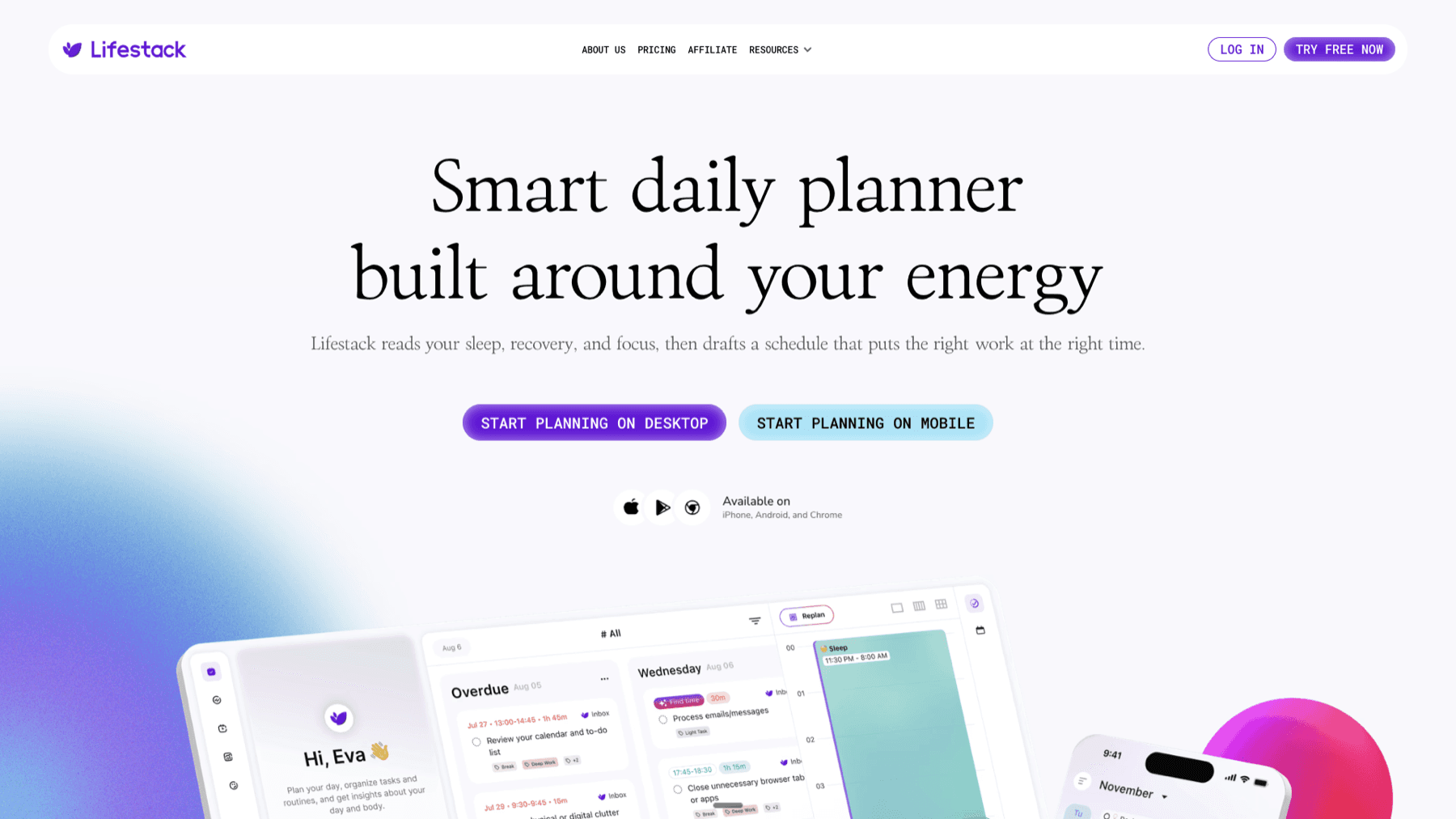
Lifestack makes this systematic. It reads data from wearables (Oura, Whoop, Garmin, Apple Watch, Fitbit) or accepts manual energy ratings, then schedules your tasks into calendar slots that match the cognitive demand. Hard study sessions go in your peak windows automatically. This is particularly useful for ADHD students who struggle to translate good intentions into a workable daily structure. See the Lifestack overview for how it works.
3. Use Active Recall Instead of Re-Reading
Re-reading is the most common study method and one of the least effective for long-term retention. It feels productive because the material becomes familiar, but familiarity is not the same as knowing. Active recall, forcing yourself to retrieve information from memory before checking the source, produces much stronger retention and is a better match for how ADHD brains process information.
In practice: close the textbook and write down everything you can remember about the topic. Answer practice questions before reviewing. Use flashcards with the answer hidden. Explain the concept out loud as if teaching it. The struggle to retrieve is the learning. Getting it wrong and then seeing the right answer is more effective than reading the right answer passively.
Spaced repetition systems like Anki automate the scheduling of active recall, surfacing cards just before you would otherwise forget them. For content-heavy courses where memorization is required, this approach beats reviewing notes by a wide margin.
4. Counter Task Paralysis With a Micro-Start
ADHD task paralysis is not laziness. It is a failure of task initiation driven by the size or ambiguity of the work ahead. "Study for the exam" is too large to begin. The brain stalls trying to figure out where to enter.
The micro-start is a specific, trivially small first action: "open the textbook to chapter 7." That is the only task. Once the book is open, the next step is usually obvious and the paralysis dissolves. The principle is that starting is the hard part, not continuing. Make the starting action so small it feels almost stupid to avoid it.
If you have trouble even identifying the micro-start, use a task-decomposition tool like Goblin Tools. You enter "study for the biology exam" and it generates a list of specific sub-tasks: "find your notes from last Tuesday," "make a list of topics covered in chapters 4 and 5," and so on. Each one is small enough to start.
5. Use Intentional Background Sound
Silence is not the ideal study environment for many people with ADHD. Silence makes every ambient noise a distraction, and the absence of stimulation can itself drive the brain to seek input. Intentional background sound fills that gap without competing for attention.
Brown noise is the most commonly cited option for ADHD: a low rumble similar to heavy rain or a running engine that masks environmental sounds without carrying melody or rhythm. Binaural beats, lo-fi music without lyrics, and ambient soundscapes (coffee shop noise, rain, white noise) all work for different people. The goal is consistent, non-distracting stimulation that keeps the brain at the right arousal level for the task.
Experiment with different types across a few sessions to find what works for you. Lyrics almost always compete with reading and writing tasks. Instrumental music with tempo variation can be helpful or distracting depending on the person.
6. Make Time Visible
ADHD time blindness means time passes differently when you are absorbed in something, and not always in the direction you want. A study session that felt like 20 minutes was 90. Or you spent an hour on one section and ran out of time for three others. Clocks on walls are easy to ignore. Timers that count down in your visual field are not.
Time-tracking tools that display elapsed time as a visible bar, cube timers that show the remaining time by how much colored face is showing, and large digital countdowns all work better than a phone notification for ADHD. The visual cue is processed automatically rather than requiring you to choose to check the time.
For longer study blocks with multiple sections, set a separate timer for each section rather than one timer for the whole block. This prevents the common pattern where you spend 80% of your time on the first topic because nothing prompted a transition.
7. Use Body Doubling
Body doubling is one of the most consistently effective ADHD productivity techniques: working in the physical or virtual presence of another person without necessarily interacting with them. The mechanism is not accountability in the usual sense. It is that another person's presence regulates arousal and reduces the pull of distractions in ways that are hard to achieve alone.
In-person options include library study rooms, coffee shops, and study groups where everyone works on their own material in the same space. For remote access, Focusmate offers virtual co-working sessions where you book a 25 or 50-minute slot with a stranger, state your goal, and work in silent parallel video. ADHD productivity hacks consistently surface body doubling as one of the highest-return interventions for people who struggle to study alone.
8. Build a Pre-Study Ritual
ADHD brains struggle to shift between states on command. Going from scrolling or conversation directly to focused study requires a transition that the brain often resists. A short, consistent pre-study ritual helps by signaling the shift and reducing the cognitive cost of starting.
The ritual should be brief and consistent: the same three to five actions every time you sit down to study. Examples: make tea, put on headphones, open the timer, close unrelated tabs. The content matters less than the consistency. After enough repetitions, the ritual itself becomes a cue that focused work follows. This is the same logic behind ADHD morning routines that make the first hour of the day automatic rather than a series of effortful decisions.
Best Tool for ADHD Studying: Lifestack
Most ADHD study problems are not study technique problems. They are scheduling and energy-management problems. You can know every technique above and still fail to use them consistently if your study sessions keep landing during low-energy windows or getting squeezed out by other commitments.
Lifestack addresses this at the structural level. It reads wearable data or manual energy ratings, then builds a daily schedule that puts cognitively demanding tasks, including study sessions, in the windows where your brain is actually able to do that work. For students with ADHD, the practical effect is that study blocks appear in the calendar at times when starting is less of a fight.
Pricing: $7/month or $50/year (7-day free trial on the annual plan). Available on iOS, Android, and Chrome extension.
FAQ
How do you study effectively with ADHD?
Effective ADHD studying means structuring the environment and the session to work with how your brain actually functions. Short timed intervals prevent attention from drifting. Scheduling sessions during energy peaks reduces the starting resistance. Active recall produces stronger retention than passive review. Body doubling maintains arousal and reduces distraction. No single technique fixes everything, but combining two or three of these produces reliably better results than trying to push through unstructured study blocks.
What is the best study method for ADHD?
Active recall combined with spaced repetition is the most evidence-supported study method for ADHD. It forces the brain to engage rather than passively absorb, produces stronger long-term retention, and works well in short intervals. For new material, timed Pomodoro intervals reduce the overwhelm of long study blocks. For review, flashcard-based spaced repetition apps like Anki are more effective than re-reading notes.
How long should an ADHD student study at a time?
Most ADHD students do better with study intervals between 15 and 30 minutes followed by a genuine break. The standard Pomodoro interval of 25 minutes works for many people. The important principle is that the end time is fixed and visible before the session starts. Open-ended study blocks make starting harder and make it easier to lose the thread once you have started. Experiment with interval length to find what matches your attention span; longer is not automatically better.
Why is it so hard for people with ADHD to study?
Several ADHD-related challenges make studying hard. Task initiation difficulties mean getting started takes disproportionate effort. Working memory limitations make it harder to hold information while processing new material. Time blindness makes it difficult to track how long you have been studying or how much time is left. Emotional avoidance of difficult material or fear of failure can cause task paralysis before a session even begins. These are neurological challenges, not motivational ones, which is why effort-based approaches alone rarely solve them.
What environment is best for studying with ADHD?
The best study environment for ADHD is one with controlled, consistent stimulation rather than either complete silence or unpredictable noise. Intentional background sound (brown noise, lo-fi music without lyrics, ambient soundscapes) works better than silence for many ADHD brains. A dedicated study space, separate from where you sleep or relax, helps with the mental shift into focus mode. If you work at home, body doubling via a virtual co-working session can replicate the focusing effect of a library or coffee shop.
Does Lifestack help with ADHD studying?
Yes, specifically for the scheduling and energy-management side of the problem. Lifestack reads wearable or manually entered energy data and schedules your tasks, including study sessions, during the windows where your cognitive capacity is highest. For ADHD students who know what to study but consistently schedule it at the wrong time or let it get bumped by lower-priority tasks, this addresses the structural cause rather than the surface symptom. See the ADHD student planner guide for more on building a study system that accounts for ADHD.
Studying with ADHD is not a discipline problem. The standard advice, sit down and focus, read it again until it sticks, just push through, assumes a brain that can sustain attention on demand. ADHD brains cannot do that reliably, but they can study effectively when the approach matches how they actually work rather than how they are supposed to work.
The strategies below are grounded in what we know about ADHD and learning: working memory deficits, difficulty with sustained attention, time blindness, and vulnerability to task paralysis. Each one addresses a specific failure mode rather than just urging more effort. Some require tools. Most require only a shift in approach.
These strategies apply to students at any level, from high school through graduate programs, and to adults studying for certifications, licensing exams, or professional development. The underlying mechanics of ADHD do not change much by age or context.
Key Takeaways
Short, timed study sessions work better than marathon blocks for ADHD brains
Scheduling study sessions during your natural energy peaks removes one layer of the starting problem
Active recall, retrieving information from memory rather than reviewing it, produces stronger retention for most ADHD learners
1. Break Study Sessions Into Timed Intervals
Long, open-ended study blocks are one of the worst formats for ADHD. Without a defined end point, the session feels infinite, which makes starting harder and staying on task harder once you have started. Timed intervals solve both problems by giving the session a visible structure.
The Pomodoro technique is the most common approach: 25 minutes of focused work, then a 5-minute break, cycling through four rounds before a longer 20-minute break. For ADHD, the interval length matters less than the principle. Some people do better with 15-minute intervals. Others can sustain 40 minutes. The key is that the break is real, not a "maybe I'll keep going if I'm in the zone" pause. Knowing a break is guaranteed makes it easier to stay in the interval.
Use a visible timer rather than a phone alarm. A timer you can see (a cube timer, a large digital display, or a browser tab) keeps the end point in your peripheral awareness and reduces the urge to check whether the time is almost up.
2. Schedule Study Sessions Around Your Energy Peaks
The time you study matters as much as how you study. ADHD brains are especially sensitive to energy state. Attempting demanding material during a low-energy window produces frustration and poor retention, while the same material in a high-energy window may click quickly. Most people schedule study sessions around calendar availability rather than cognitive state, which means hard work often lands at exactly the wrong time.
Pay attention to when you are genuinely sharp. For many people this is mid-morning. For others it is late afternoon or after exercise. Once you have a rough sense of your pattern, protect those windows for the hardest material and move review, organization, and lighter tasks to the low-energy periods.
Lifestack makes this systematic. It reads data from wearables (Oura, Whoop, Garmin, Apple Watch, Fitbit) or accepts manual energy ratings, then schedules your tasks into calendar slots that match the cognitive demand. Hard study sessions go in your peak windows automatically. This is particularly useful for ADHD students who struggle to translate good intentions into a workable daily structure. See the Lifestack overview for how it works.
3. Use Active Recall Instead of Re-Reading
Re-reading is the most common study method and one of the least effective for long-term retention. It feels productive because the material becomes familiar, but familiarity is not the same as knowing. Active recall, forcing yourself to retrieve information from memory before checking the source, produces much stronger retention and is a better match for how ADHD brains process information.
In practice: close the textbook and write down everything you can remember about the topic. Answer practice questions before reviewing. Use flashcards with the answer hidden. Explain the concept out loud as if teaching it. The struggle to retrieve is the learning. Getting it wrong and then seeing the right answer is more effective than reading the right answer passively.
Spaced repetition systems like Anki automate the scheduling of active recall, surfacing cards just before you would otherwise forget them. For content-heavy courses where memorization is required, this approach beats reviewing notes by a wide margin.
4. Counter Task Paralysis With a Micro-Start
ADHD task paralysis is not laziness. It is a failure of task initiation driven by the size or ambiguity of the work ahead. "Study for the exam" is too large to begin. The brain stalls trying to figure out where to enter.
The micro-start is a specific, trivially small first action: "open the textbook to chapter 7." That is the only task. Once the book is open, the next step is usually obvious and the paralysis dissolves. The principle is that starting is the hard part, not continuing. Make the starting action so small it feels almost stupid to avoid it.
If you have trouble even identifying the micro-start, use a task-decomposition tool like Goblin Tools. You enter "study for the biology exam" and it generates a list of specific sub-tasks: "find your notes from last Tuesday," "make a list of topics covered in chapters 4 and 5," and so on. Each one is small enough to start.
5. Use Intentional Background Sound
Silence is not the ideal study environment for many people with ADHD. Silence makes every ambient noise a distraction, and the absence of stimulation can itself drive the brain to seek input. Intentional background sound fills that gap without competing for attention.
Brown noise is the most commonly cited option for ADHD: a low rumble similar to heavy rain or a running engine that masks environmental sounds without carrying melody or rhythm. Binaural beats, lo-fi music without lyrics, and ambient soundscapes (coffee shop noise, rain, white noise) all work for different people. The goal is consistent, non-distracting stimulation that keeps the brain at the right arousal level for the task.
Experiment with different types across a few sessions to find what works for you. Lyrics almost always compete with reading and writing tasks. Instrumental music with tempo variation can be helpful or distracting depending on the person.
6. Make Time Visible
ADHD time blindness means time passes differently when you are absorbed in something, and not always in the direction you want. A study session that felt like 20 minutes was 90. Or you spent an hour on one section and ran out of time for three others. Clocks on walls are easy to ignore. Timers that count down in your visual field are not.
Time-tracking tools that display elapsed time as a visible bar, cube timers that show the remaining time by how much colored face is showing, and large digital countdowns all work better than a phone notification for ADHD. The visual cue is processed automatically rather than requiring you to choose to check the time.
For longer study blocks with multiple sections, set a separate timer for each section rather than one timer for the whole block. This prevents the common pattern where you spend 80% of your time on the first topic because nothing prompted a transition.
7. Use Body Doubling
Body doubling is one of the most consistently effective ADHD productivity techniques: working in the physical or virtual presence of another person without necessarily interacting with them. The mechanism is not accountability in the usual sense. It is that another person's presence regulates arousal and reduces the pull of distractions in ways that are hard to achieve alone.
In-person options include library study rooms, coffee shops, and study groups where everyone works on their own material in the same space. For remote access, Focusmate offers virtual co-working sessions where you book a 25 or 50-minute slot with a stranger, state your goal, and work in silent parallel video. ADHD productivity hacks consistently surface body doubling as one of the highest-return interventions for people who struggle to study alone.
8. Build a Pre-Study Ritual
ADHD brains struggle to shift between states on command. Going from scrolling or conversation directly to focused study requires a transition that the brain often resists. A short, consistent pre-study ritual helps by signaling the shift and reducing the cognitive cost of starting.
The ritual should be brief and consistent: the same three to five actions every time you sit down to study. Examples: make tea, put on headphones, open the timer, close unrelated tabs. The content matters less than the consistency. After enough repetitions, the ritual itself becomes a cue that focused work follows. This is the same logic behind ADHD morning routines that make the first hour of the day automatic rather than a series of effortful decisions.
Best Tool for ADHD Studying: Lifestack
Most ADHD study problems are not study technique problems. They are scheduling and energy-management problems. You can know every technique above and still fail to use them consistently if your study sessions keep landing during low-energy windows or getting squeezed out by other commitments.
Lifestack addresses this at the structural level. It reads wearable data or manual energy ratings, then builds a daily schedule that puts cognitively demanding tasks, including study sessions, in the windows where your brain is actually able to do that work. For students with ADHD, the practical effect is that study blocks appear in the calendar at times when starting is less of a fight.
Pricing: $7/month or $50/year (7-day free trial on the annual plan). Available on iOS, Android, and Chrome extension.
FAQ
How do you study effectively with ADHD?
Effective ADHD studying means structuring the environment and the session to work with how your brain actually functions. Short timed intervals prevent attention from drifting. Scheduling sessions during energy peaks reduces the starting resistance. Active recall produces stronger retention than passive review. Body doubling maintains arousal and reduces distraction. No single technique fixes everything, but combining two or three of these produces reliably better results than trying to push through unstructured study blocks.
What is the best study method for ADHD?
Active recall combined with spaced repetition is the most evidence-supported study method for ADHD. It forces the brain to engage rather than passively absorb, produces stronger long-term retention, and works well in short intervals. For new material, timed Pomodoro intervals reduce the overwhelm of long study blocks. For review, flashcard-based spaced repetition apps like Anki are more effective than re-reading notes.
How long should an ADHD student study at a time?
Most ADHD students do better with study intervals between 15 and 30 minutes followed by a genuine break. The standard Pomodoro interval of 25 minutes works for many people. The important principle is that the end time is fixed and visible before the session starts. Open-ended study blocks make starting harder and make it easier to lose the thread once you have started. Experiment with interval length to find what matches your attention span; longer is not automatically better.
Why is it so hard for people with ADHD to study?
Several ADHD-related challenges make studying hard. Task initiation difficulties mean getting started takes disproportionate effort. Working memory limitations make it harder to hold information while processing new material. Time blindness makes it difficult to track how long you have been studying or how much time is left. Emotional avoidance of difficult material or fear of failure can cause task paralysis before a session even begins. These are neurological challenges, not motivational ones, which is why effort-based approaches alone rarely solve them.
What environment is best for studying with ADHD?
The best study environment for ADHD is one with controlled, consistent stimulation rather than either complete silence or unpredictable noise. Intentional background sound (brown noise, lo-fi music without lyrics, ambient soundscapes) works better than silence for many ADHD brains. A dedicated study space, separate from where you sleep or relax, helps with the mental shift into focus mode. If you work at home, body doubling via a virtual co-working session can replicate the focusing effect of a library or coffee shop.
Does Lifestack help with ADHD studying?
Yes, specifically for the scheduling and energy-management side of the problem. Lifestack reads wearable or manually entered energy data and schedules your tasks, including study sessions, during the windows where your cognitive capacity is highest. For ADHD students who know what to study but consistently schedule it at the wrong time or let it get bumped by lower-priority tasks, this addresses the structural cause rather than the surface symptom. See the ADHD student planner guide for more on building a study system that accounts for ADHD.



FOLLOW ON
FOLLOW ON
FOLLOW ON


Copyright 2026 © Lifestack. All rights reserved
Copyright 2026 © Lifestack. All rights reserved

