
App
Best Apps to Help With Anxiety in 2026
Best Apps to Help With Anxiety in 2026

Anxiety apps have gotten better, and they've also gotten more crowded. The App Store has hundreds of options ranging from evidence-based CBT tools developed with clinical input to ambient sound generators with wellness branding layered on top. Finding apps that actually help requires knowing what kind of anxiety you're trying to manage and what approach fits your life.
The apps that work for most people fall into a few categories: tools that reduce cognitive load and overwhelm (scheduling and organization), guided meditation and breathing (for acute stress and daily practice), AI-based conversational support (for CBT techniques on demand), and apps with a large free content library for people who want options without a subscription commitment. We looked at all of these to find what's worth your time in 2026.
Key Takeaways
Anxiety driven by disorganization and task overwhelm responds well to structure and scheduling tools, not just meditation. Addressing the source matters as much as managing the symptoms.
Headspace and Calm are the best guided-meditation choices for different reasons: Headspace is better for building a daily habit with a structured program, Calm is more flexible and better for sleep.
Insight Timer is the best free option for people who want meditation and anxiety content without a subscription, with a library larger than any paid competitor.
Quick Guide: Best Apps to Help With Anxiety
1. Lifestack: AI scheduler that reduces overwhelm-driven anxiety by organizing your day around your actual capacity
2. Headspace: Structured daily meditation with dedicated anxiety and stress programs
3. Calm: Flexible meditation, sleep stories, and breathing exercises for daily and nighttime anxiety
4. Insight Timer: Largest free meditation library, with guided sessions specifically for anxiety and stress
5. Woebot: AI-powered chatbot using CBT techniques to address anxious thoughts in real time
How We Evaluated These Apps
Evidence base (is the approach backed by clinical research?)
Free tier quality (how useful is the app without paying?)
Daily usability (does it fit into a real routine?)
Acute vs chronic anxiety support (good for panic moments vs. long-term management)
ADHD-friendliness (low decision overhead, short sessions, flexible structure)
1. Lifestack
Best app for anxiety driven by overwhelm, disorganization, or unpredictable schedules

A significant portion of chronic anxiety stems not from abstract worry but from concrete overwhelm: too many tasks, unclear priorities, and the nagging sense that something important is being missed. No amount of meditation resolves this if the underlying disorganization remains. Lifestack addresses anxiety at the source by reading your calendar, task list, and wearable recovery data, then building a daily schedule that matches your cognitive load to your actual capacity.
For people with ADHD, whose anxiety often coexists with executive dysfunction, this approach is particularly effective: instead of maintaining constant mental vigilance about what needs to happen and when, Lifestack holds the schedule so you don't have to. The anxiety that comes from not trusting yourself to keep track of things decreases when an AI is actively managing the plan. See also our guide to ADHD and social anxiety for how executive function and anxiety interact.
What Works: Energy-aware task scheduling based on wearable recovery data, task prioritization that reduces decision fatigue, daily plan adjustment when capacity is low
Limitations: Not a meditation or CBT tool; addresses organizational anxiety, not generalized anxiety disorder or panic; subscription required
Pricing: $7/month or $50/year (7-day free trial on annual plan)
Best for: People whose anxiety is driven by task overwhelm, disorganization, or the stress of an unmanageable schedule
2. Headspace
Best structured meditation app for building a consistent anxiety management practice

Headspace is the most structured of the major meditation apps, with guided courses that progress systematically rather than dropping users into a library and expecting them to self-direct. The Anxiety course, for example, follows a specific sequence teaching mindfulness-based techniques for relating to anxious thoughts rather than fighting them. The SOS sessions (1-3 minute breathing and grounding exercises) are available for acute moments of stress when a 20-minute meditation isn't realistic.
Headspace was acquired by Sword Health in 2026, but the app continues operating with its existing content and subscription model. The addition of expert-led meditations and therapy integration through the acquisition may expand what's available on the platform over time.
What Works: Structured anxiety and stress courses, beginner-friendly progressions, SOS sessions for acute stress, content for sleep, focus, and exercise
Limitations: Most meaningful content is behind the paywall; the free tier is limited; the course structure can feel constraining if you want to explore freely
Pricing: Free basics; $69.99/year for full access
Best for: People who want to build a daily meditation habit with a structured program, not just access to a library
3. Calm
Best flexible meditation app for daily anxiety and nighttime worry
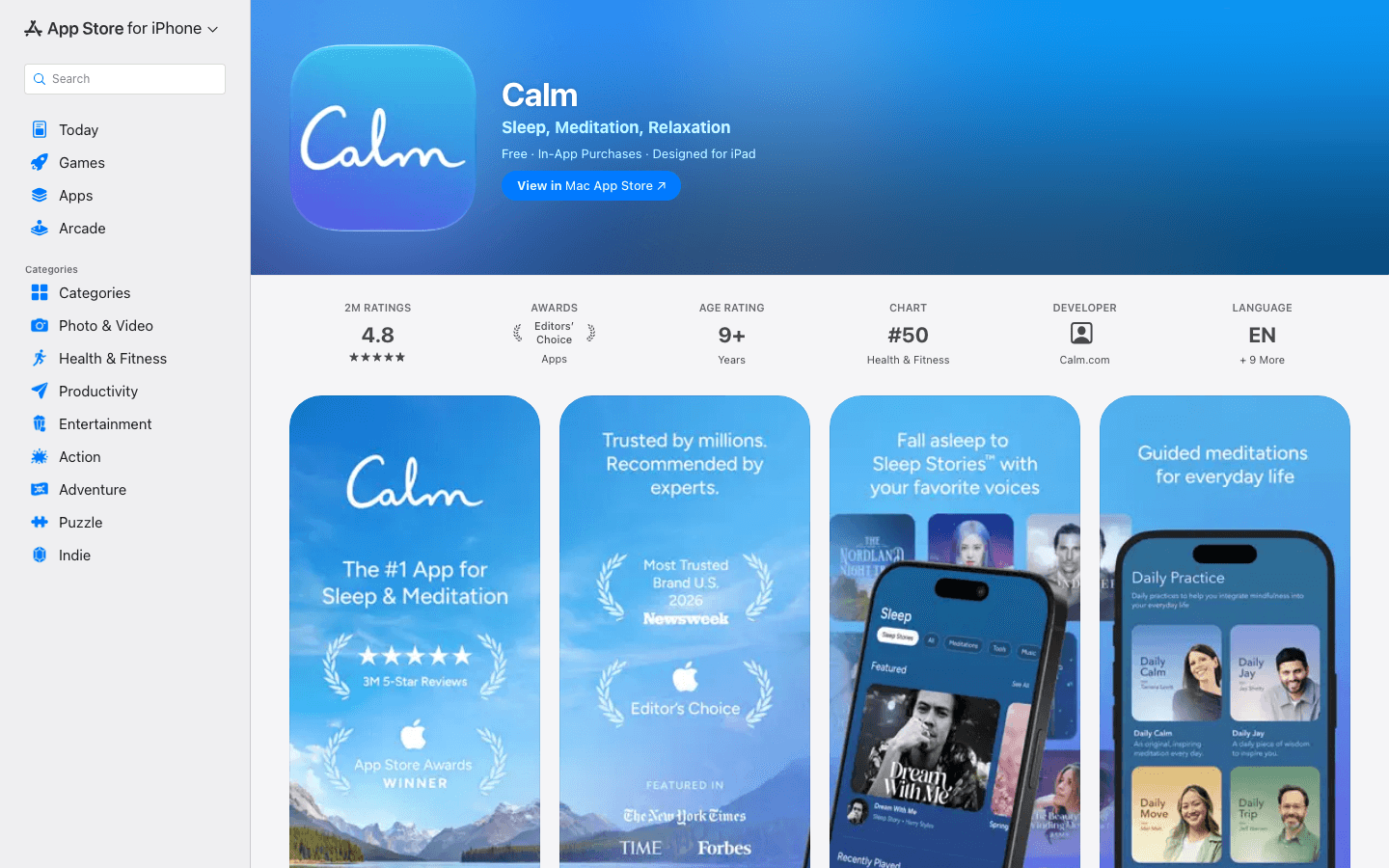
Calm is less structured than Headspace and more expansive in its content offering. The sleep stories, daily meditations, breathing exercises, and music playlists create a toolkit rather than a course. This works better for people who already know what kind of support they need and want to access it quickly rather than following a prescribed program.
The breathing exercise tools in Calm are among the most accessible in any app: simple visual guides for box breathing, 4-7-8 breathing, and other techniques that work for acute anxiety in under 5 minutes. For nighttime anxiety and worry, the sleep stories (narrated content designed to redirect attention away from racing thoughts) are particularly effective and are among the app's most-used features.
What Works: Sleep stories for nighttime anxiety, breathing exercises, flexible daily meditation options, music for focus and calm, daily Calm meditation with fresh content
Limitations: Less structured than Headspace for building a specific anxiety management program; most content requires a subscription; some users find the content breadth overwhelming
Pricing: Free basics; $69.99/year for full access
Best for: People who want flexible daily meditation and sleep support, particularly for nighttime anxiety and racing thoughts before bed
4. Insight Timer
Best free app for anxiety meditation with the largest content library available
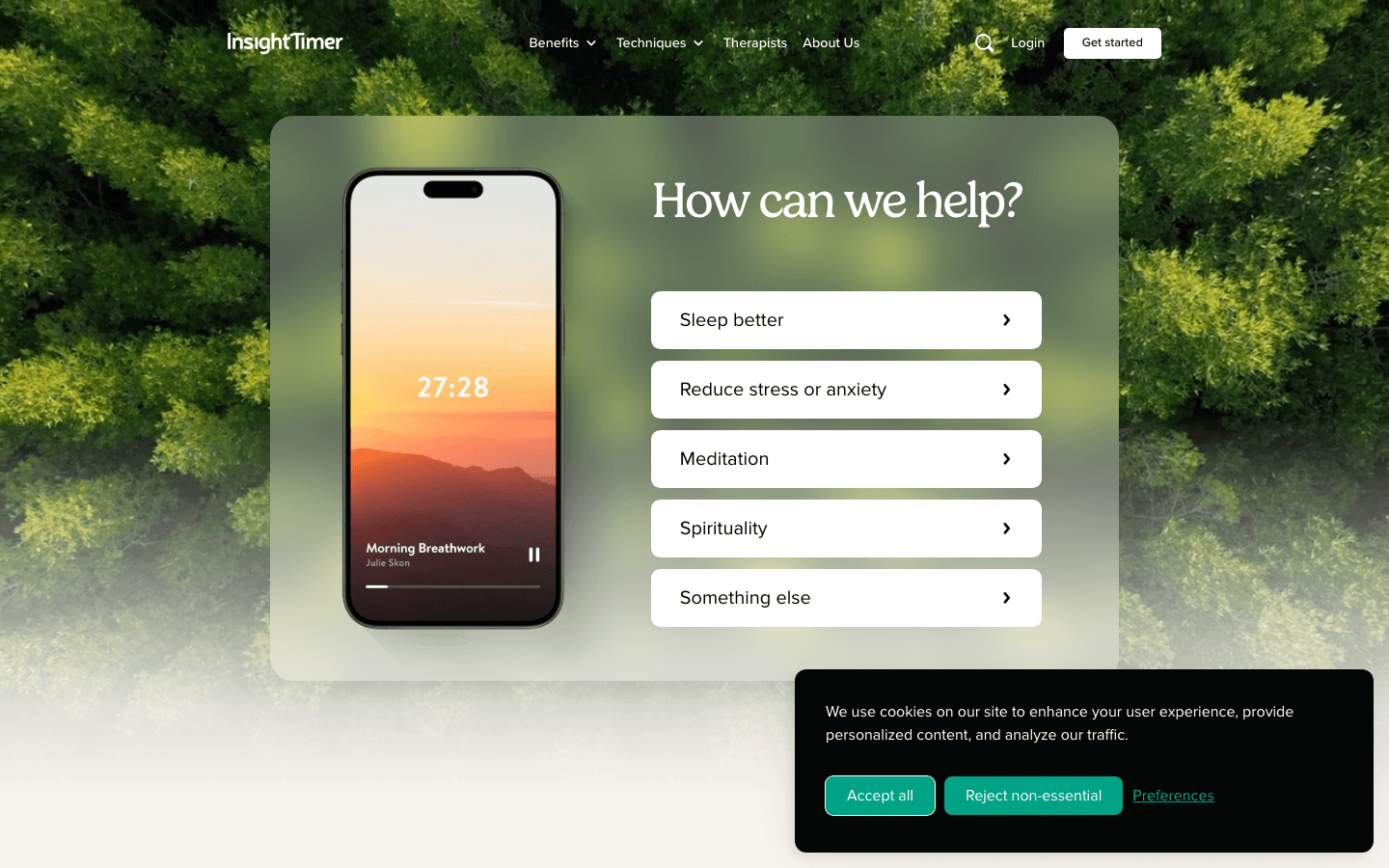
Insight Timer has a free tier that outperforms the paid tiers of most meditation apps by volume: over 100,000 free guided meditations from more than 15,000 teachers. Searching specifically for anxiety, stress, or panic produces dozens of options at any session length, from 2 minutes to an hour. For people who want access to diverse approaches and teachers without committing to a subscription, there is no better option.
The quality varies more than on Headspace or Calm, since any qualified teacher can submit content. But the filter tools work well, and the rating system helps surface what users have found most effective. The paid tier adds structured courses, but most people who try Insight Timer find the free content sufficient for their anxiety management needs. Our sleep tracker roundup covers how meditation apps like Insight Timer fit alongside wearable sleep monitoring.
What Works: Enormous free library, search by specific need (anxiety, panic, sleep, stress), timer feature for unguided meditation, community features
Limitations: Content quality is inconsistent; no structured progressive program in the free tier; the volume of options can be overwhelming for people who want someone to tell them exactly what to do
Pricing: Free with core library; Plus at $9.99/month or $59.99/year for courses and offline downloads
Best for: People who want maximum free content for anxiety and sleep, or who want to explore different meditation styles without committing to one platform's approach
5. Woebot
Best AI-powered app for addressing anxious thoughts using CBT techniques
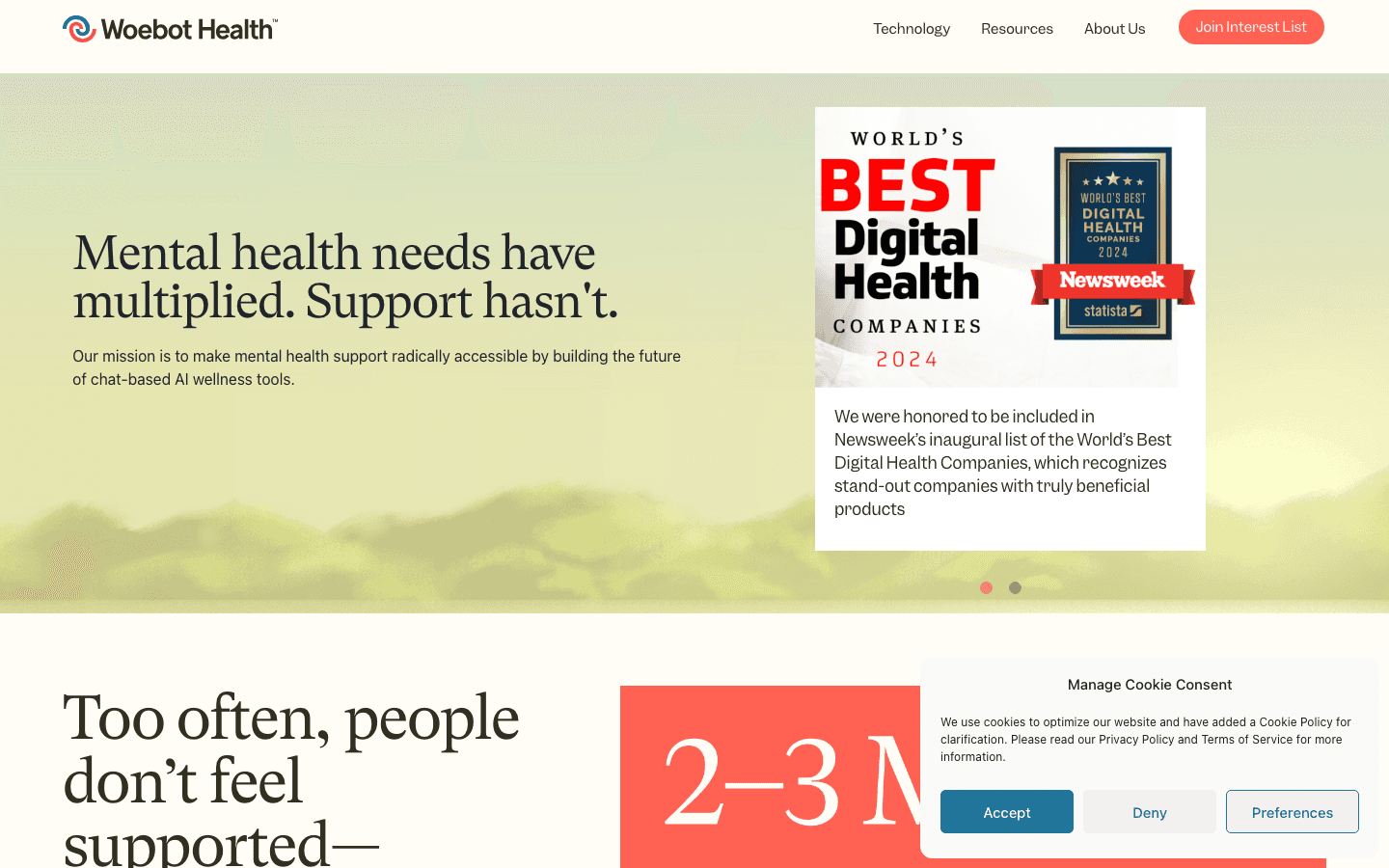
Woebot is a conversational AI built specifically around cognitive behavioral therapy (CBT) techniques for managing anxiety, low mood, and stress. Unlike meditation apps, Woebot engages you in a dialogue: it asks what's on your mind, walks you through identifying cognitive distortions (like catastrophizing, all-or-nothing thinking, or mind reading), and helps you develop a more balanced perspective.
The evidence base is stronger than most apps in this category. Woebot has published peer-reviewed research demonstrating effectiveness for depression and anxiety in college students, and the CBT framework it uses is one of the most empirically supported interventions for anxiety disorders. It works best as a between-session tool rather than a replacement for therapy. For people on waiting lists for therapy, or who can't afford consistent sessions, Woebot provides structured CBT support that is genuinely better than apps with vaguer "wellness" frameworks.
What Works: Evidence-based CBT techniques, conversational format that reduces the barrier to starting, mood tracking, exercises for specific cognitive patterns, available 24/7
Limitations: Not a replacement for therapy; limited ability to handle crisis situations; the chatbot format is not for everyone; pricing has varied as the product has evolved
Pricing: Free to download; check current pricing on the app as plans vary by region and offering
Best for: People who want structured CBT techniques on demand, particularly those who understand cognitive distortions and want guided practice between therapy sessions
Which Anxiety App Is Right for You?
Use Lifestack if: Your anxiety is primarily driven by task overwhelm, unclear priorities, or the stress of not trusting your schedule to capture everything important
Use Headspace if: You want to build a structured daily meditation practice with a program that teaches specific anxiety management techniques step by step
Use Calm if: You want flexible meditation and sleep support without a prescribed course, especially if nighttime anxiety or racing thoughts are your main concern
Use Insight Timer if: You want the largest free library of guided meditations for anxiety and want to explore different approaches before committing to a subscription
Use Woebot if: You want to work through anxious thoughts using CBT techniques and prefer a conversational format to passive listening
For anxiety connected to ADHD, see our guide to best mobile apps for ADHD. For work-related stress and burnout, our work-life balance apps guide covers tools that address the source rather than only the symptoms. And our post on whether dehydration causes anxiety covers some underappreciated physical contributors to daily anxiety.
Frequently Asked Questions
Can apps actually help with anxiety?
Yes, for mild to moderate anxiety, certain apps have solid evidence behind them. CBT-based tools like Woebot have published peer-reviewed research. Mindfulness-based apps like Headspace and Calm have been studied in clinical contexts and show benefits for stress reduction and anxiety symptom reduction in non-clinical populations. Apps are not a replacement for therapy when anxiety is severe, persistent, or significantly impairs functioning.
What's the best free anxiety app?
Insight Timer offers the most content for free, with tens of thousands of guided meditations for anxiety, stress, and sleep at no cost. Woebot's basic CBT conversations are also free in most markets. Headspace and Calm both have limited free tiers, but the meaningful content requires a subscription.
Is Headspace good for anxiety?
Yes, particularly for people who want a structured approach. Headspace has dedicated anxiety and stress courses that teach mindfulness-based cognitive approaches in a progressive sequence. The SOS sessions are also genuinely useful for acute anxiety moments. The acquisition by Sword Health hasn't changed the core product as of late 2026.
How is Woebot different from other anxiety apps?
Woebot is a conversational CBT tool rather than a meditation or relaxation app. While Headspace and Calm help you feel calmer in the moment, Woebot works on the cognitive patterns that produce anxiety by helping you identify and challenge distorted thinking. The two approaches are complementary rather than competing, which is why many people use a meditation app for daily practice and Woebot for working through specific anxious thought patterns.
When should I see a therapist instead of using an app?
If your anxiety is significantly affecting daily functioning (work, relationships, physical health), is accompanied by panic attacks, has been persistent for months without improvement, or involves trauma, apps are not sufficient on their own. Apps are most useful as daily maintenance tools, between-session support alongside therapy, or as a first step for mild anxiety. A psychiatrist or psychologist can make that call with more information than an app can provide.
Anxiety apps have gotten better, and they've also gotten more crowded. The App Store has hundreds of options ranging from evidence-based CBT tools developed with clinical input to ambient sound generators with wellness branding layered on top. Finding apps that actually help requires knowing what kind of anxiety you're trying to manage and what approach fits your life.
The apps that work for most people fall into a few categories: tools that reduce cognitive load and overwhelm (scheduling and organization), guided meditation and breathing (for acute stress and daily practice), AI-based conversational support (for CBT techniques on demand), and apps with a large free content library for people who want options without a subscription commitment. We looked at all of these to find what's worth your time in 2026.
Key Takeaways
Anxiety driven by disorganization and task overwhelm responds well to structure and scheduling tools, not just meditation. Addressing the source matters as much as managing the symptoms.
Headspace and Calm are the best guided-meditation choices for different reasons: Headspace is better for building a daily habit with a structured program, Calm is more flexible and better for sleep.
Insight Timer is the best free option for people who want meditation and anxiety content without a subscription, with a library larger than any paid competitor.
Quick Guide: Best Apps to Help With Anxiety
1. Lifestack: AI scheduler that reduces overwhelm-driven anxiety by organizing your day around your actual capacity
2. Headspace: Structured daily meditation with dedicated anxiety and stress programs
3. Calm: Flexible meditation, sleep stories, and breathing exercises for daily and nighttime anxiety
4. Insight Timer: Largest free meditation library, with guided sessions specifically for anxiety and stress
5. Woebot: AI-powered chatbot using CBT techniques to address anxious thoughts in real time
How We Evaluated These Apps
Evidence base (is the approach backed by clinical research?)
Free tier quality (how useful is the app without paying?)
Daily usability (does it fit into a real routine?)
Acute vs chronic anxiety support (good for panic moments vs. long-term management)
ADHD-friendliness (low decision overhead, short sessions, flexible structure)
1. Lifestack
Best app for anxiety driven by overwhelm, disorganization, or unpredictable schedules
A significant portion of chronic anxiety stems not from abstract worry but from concrete overwhelm: too many tasks, unclear priorities, and the nagging sense that something important is being missed. No amount of meditation resolves this if the underlying disorganization remains. Lifestack addresses anxiety at the source by reading your calendar, task list, and wearable recovery data, then building a daily schedule that matches your cognitive load to your actual capacity.
For people with ADHD, whose anxiety often coexists with executive dysfunction, this approach is particularly effective: instead of maintaining constant mental vigilance about what needs to happen and when, Lifestack holds the schedule so you don't have to. The anxiety that comes from not trusting yourself to keep track of things decreases when an AI is actively managing the plan. See also our guide to ADHD and social anxiety for how executive function and anxiety interact.
What Works: Energy-aware task scheduling based on wearable recovery data, task prioritization that reduces decision fatigue, daily plan adjustment when capacity is low
Limitations: Not a meditation or CBT tool; addresses organizational anxiety, not generalized anxiety disorder or panic; subscription required
Pricing: $7/month or $50/year (7-day free trial on annual plan)
Best for: People whose anxiety is driven by task overwhelm, disorganization, or the stress of an unmanageable schedule
2. Headspace
Best structured meditation app for building a consistent anxiety management practice
Headspace is the most structured of the major meditation apps, with guided courses that progress systematically rather than dropping users into a library and expecting them to self-direct. The Anxiety course, for example, follows a specific sequence teaching mindfulness-based techniques for relating to anxious thoughts rather than fighting them. The SOS sessions (1-3 minute breathing and grounding exercises) are available for acute moments of stress when a 20-minute meditation isn't realistic.
Headspace was acquired by Sword Health in 2026, but the app continues operating with its existing content and subscription model. The addition of expert-led meditations and therapy integration through the acquisition may expand what's available on the platform over time.
What Works: Structured anxiety and stress courses, beginner-friendly progressions, SOS sessions for acute stress, content for sleep, focus, and exercise
Limitations: Most meaningful content is behind the paywall; the free tier is limited; the course structure can feel constraining if you want to explore freely
Pricing: Free basics; $69.99/year for full access
Best for: People who want to build a daily meditation habit with a structured program, not just access to a library
3. Calm
Best flexible meditation app for daily anxiety and nighttime worry
Calm is less structured than Headspace and more expansive in its content offering. The sleep stories, daily meditations, breathing exercises, and music playlists create a toolkit rather than a course. This works better for people who already know what kind of support they need and want to access it quickly rather than following a prescribed program.
The breathing exercise tools in Calm are among the most accessible in any app: simple visual guides for box breathing, 4-7-8 breathing, and other techniques that work for acute anxiety in under 5 minutes. For nighttime anxiety and worry, the sleep stories (narrated content designed to redirect attention away from racing thoughts) are particularly effective and are among the app's most-used features.
What Works: Sleep stories for nighttime anxiety, breathing exercises, flexible daily meditation options, music for focus and calm, daily Calm meditation with fresh content
Limitations: Less structured than Headspace for building a specific anxiety management program; most content requires a subscription; some users find the content breadth overwhelming
Pricing: Free basics; $69.99/year for full access
Best for: People who want flexible daily meditation and sleep support, particularly for nighttime anxiety and racing thoughts before bed
4. Insight Timer
Best free app for anxiety meditation with the largest content library available
Insight Timer has a free tier that outperforms the paid tiers of most meditation apps by volume: over 100,000 free guided meditations from more than 15,000 teachers. Searching specifically for anxiety, stress, or panic produces dozens of options at any session length, from 2 minutes to an hour. For people who want access to diverse approaches and teachers without committing to a subscription, there is no better option.
The quality varies more than on Headspace or Calm, since any qualified teacher can submit content. But the filter tools work well, and the rating system helps surface what users have found most effective. The paid tier adds structured courses, but most people who try Insight Timer find the free content sufficient for their anxiety management needs. Our sleep tracker roundup covers how meditation apps like Insight Timer fit alongside wearable sleep monitoring.
What Works: Enormous free library, search by specific need (anxiety, panic, sleep, stress), timer feature for unguided meditation, community features
Limitations: Content quality is inconsistent; no structured progressive program in the free tier; the volume of options can be overwhelming for people who want someone to tell them exactly what to do
Pricing: Free with core library; Plus at $9.99/month or $59.99/year for courses and offline downloads
Best for: People who want maximum free content for anxiety and sleep, or who want to explore different meditation styles without committing to one platform's approach
5. Woebot
Best AI-powered app for addressing anxious thoughts using CBT techniques
Woebot is a conversational AI built specifically around cognitive behavioral therapy (CBT) techniques for managing anxiety, low mood, and stress. Unlike meditation apps, Woebot engages you in a dialogue: it asks what's on your mind, walks you through identifying cognitive distortions (like catastrophizing, all-or-nothing thinking, or mind reading), and helps you develop a more balanced perspective.
The evidence base is stronger than most apps in this category. Woebot has published peer-reviewed research demonstrating effectiveness for depression and anxiety in college students, and the CBT framework it uses is one of the most empirically supported interventions for anxiety disorders. It works best as a between-session tool rather than a replacement for therapy. For people on waiting lists for therapy, or who can't afford consistent sessions, Woebot provides structured CBT support that is genuinely better than apps with vaguer "wellness" frameworks.
What Works: Evidence-based CBT techniques, conversational format that reduces the barrier to starting, mood tracking, exercises for specific cognitive patterns, available 24/7
Limitations: Not a replacement for therapy; limited ability to handle crisis situations; the chatbot format is not for everyone; pricing has varied as the product has evolved
Pricing: Free to download; check current pricing on the app as plans vary by region and offering
Best for: People who want structured CBT techniques on demand, particularly those who understand cognitive distortions and want guided practice between therapy sessions
Which Anxiety App Is Right for You?
Use Lifestack if: Your anxiety is primarily driven by task overwhelm, unclear priorities, or the stress of not trusting your schedule to capture everything important
Use Headspace if: You want to build a structured daily meditation practice with a program that teaches specific anxiety management techniques step by step
Use Calm if: You want flexible meditation and sleep support without a prescribed course, especially if nighttime anxiety or racing thoughts are your main concern
Use Insight Timer if: You want the largest free library of guided meditations for anxiety and want to explore different approaches before committing to a subscription
Use Woebot if: You want to work through anxious thoughts using CBT techniques and prefer a conversational format to passive listening
For anxiety connected to ADHD, see our guide to best mobile apps for ADHD. For work-related stress and burnout, our work-life balance apps guide covers tools that address the source rather than only the symptoms. And our post on whether dehydration causes anxiety covers some underappreciated physical contributors to daily anxiety.
Frequently Asked Questions
Can apps actually help with anxiety?
Yes, for mild to moderate anxiety, certain apps have solid evidence behind them. CBT-based tools like Woebot have published peer-reviewed research. Mindfulness-based apps like Headspace and Calm have been studied in clinical contexts and show benefits for stress reduction and anxiety symptom reduction in non-clinical populations. Apps are not a replacement for therapy when anxiety is severe, persistent, or significantly impairs functioning.
What's the best free anxiety app?
Insight Timer offers the most content for free, with tens of thousands of guided meditations for anxiety, stress, and sleep at no cost. Woebot's basic CBT conversations are also free in most markets. Headspace and Calm both have limited free tiers, but the meaningful content requires a subscription.
Is Headspace good for anxiety?
Yes, particularly for people who want a structured approach. Headspace has dedicated anxiety and stress courses that teach mindfulness-based cognitive approaches in a progressive sequence. The SOS sessions are also genuinely useful for acute anxiety moments. The acquisition by Sword Health hasn't changed the core product as of late 2026.
How is Woebot different from other anxiety apps?
Woebot is a conversational CBT tool rather than a meditation or relaxation app. While Headspace and Calm help you feel calmer in the moment, Woebot works on the cognitive patterns that produce anxiety by helping you identify and challenge distorted thinking. The two approaches are complementary rather than competing, which is why many people use a meditation app for daily practice and Woebot for working through specific anxious thought patterns.
When should I see a therapist instead of using an app?
If your anxiety is significantly affecting daily functioning (work, relationships, physical health), is accompanied by panic attacks, has been persistent for months without improvement, or involves trauma, apps are not sufficient on their own. Apps are most useful as daily maintenance tools, between-session support alongside therapy, or as a first step for mild anxiety. A psychiatrist or psychologist can make that call with more information than an app can provide.



FOLLOW ON
FOLLOW ON
FOLLOW ON


Copyright 2026 © Lifestack. All rights reserved
Copyright 2026 © Lifestack. All rights reserved

