
App
Bevel App Review: Is It Worth $14.99/Month?
Bevel App Review: Is It Worth $14.99/Month?

Bevel launched in 2023 as a wearable data aggregator. It has since grown into one of the most actively developed AI health coaching apps on iOS, reaching over 100,000 daily active users and raising a $10M Series A from General Catalyst in late 2025. The version most people are downloading now, Bevel 3.0, is a different product from the one early reviewers covered.
The core idea: Bevel pulls data from your Apple Watch, Apple Health, and other connected sources and turns it into a single health picture. Recovery score. Sleep score. Strain score. Stress score. Nutrition score. Then its AI coaching layer tells you what to do about it. The question is whether that combination is worth $14.99 per month for the Pro features, and whether the free tier is good enough to stand on its own.
We spent time with both tiers. Here is what we found.
Key Takeaways
Bevel's free tier is a real product with Recovery, Sleep, Strain, and Stress scoring at no cost
Pro unlocks AI coaching, Biological Age, and Health Records at $14.99/month or $99.99/year
Bevel tells you what your body did; tools like Lifestack tell you what to do about it from a scheduling perspective
What Bevel Does
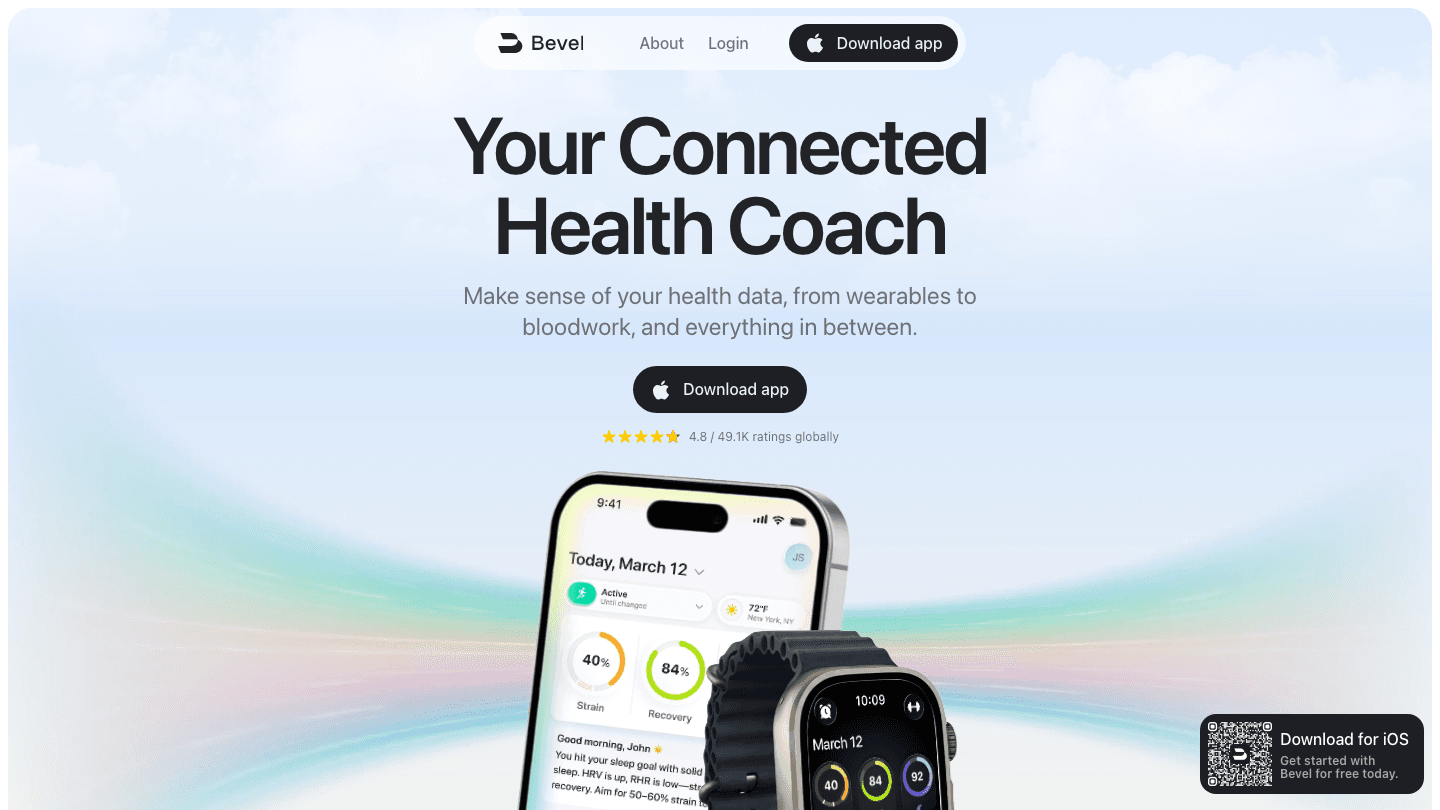
Bevel aggregates health data from your Apple Watch and Apple Health into a unified dashboard. Each morning you get five scores: Recovery (how ready your body is for effort), Sleep (quality and duration), Strain (workload from the previous day), Stress (HRV and physiological markers), and Nutrition (logged food and glucose if you track it). Together they form a complete picture of where your body is on any given day.
Version 3.0, released in April 2026, added proactive AI check-ins that reach out to you rather than waiting for you to open the app. Bevel Intelligence now maintains a memory of your patterns and goals, can generate personalized training plans, and connects your daily scores to longer-term trends. This is the feature that most separates Bevel from a basic sleep tracker or fitness ring dashboard.
Bevel Free vs Pro
The free tier includes all five health scores, basic trend tracking, and a general summary of each day. This is not a stripped-down demo. You can use it indefinitely and get genuine value from the scoring data without paying anything.
Pro adds the AI coaching layer (Bevel Intelligence), Biological Age tracking, and Health Records integration. For data-oriented users who want to understand not just their scores but what to do to change them, Pro is where the real value lives. The AI coaching quality varies by use case: users who engage with check-ins consistently report more relevant recommendations over time.
Free: Recovery, Sleep, Strain, Stress, Nutrition scores; basic trends
Pro: AI coaching, Biological Age, Health Records, personalized training plans
Price: $14.99/month or $99.99/year ($8.33/month effective)
What Works Well
The free tier is genuinely good, which is not something you can say about most health apps. Most treat their free version as a funnel for paid conversion and gate anything useful behind a paywall. Bevel's core scoring works at no cost.
Multi-wearable support is also a real differentiator. Most recovery apps tie you to one ecosystem. Bevel connects across devices, which matters for anyone who splits their health tracking across an Apple Watch, a Whoop band, or a glucose monitor.
The proactive check-in model in 3.0 solves a real engagement problem with health apps: most only surface information when you go looking for it. Bevel reaching out when it notices a pattern is more in line with how an actual coach would work.
What Needs Work
Bevel is iOS only. If you use Android, it is not available to you.
At $14.99 per month, the Pro tier is one of the more expensive health apps in its category. The AI coaching layer needs consistent engagement to get better at your patterns. Users who check in daily for two to three weeks report much more relevant guidance than people who open the app occasionally.
Bevel tells you what your body did and how you are recovering. It does not schedule your day around that information. If your recovery score is low, Bevel will tell you to take it easy. But it does not automatically move your demanding tasks to a later window or protect your peak-focus hours from meetings. That gap is where a tool like energy-aware scheduling becomes important.
Best Alternatives to Bevel
If Bevel does not fit your needs or you want to complement it with a scheduling layer, these are the strongest alternatives.
1. Lifestack: Energy-Aware AI Scheduling
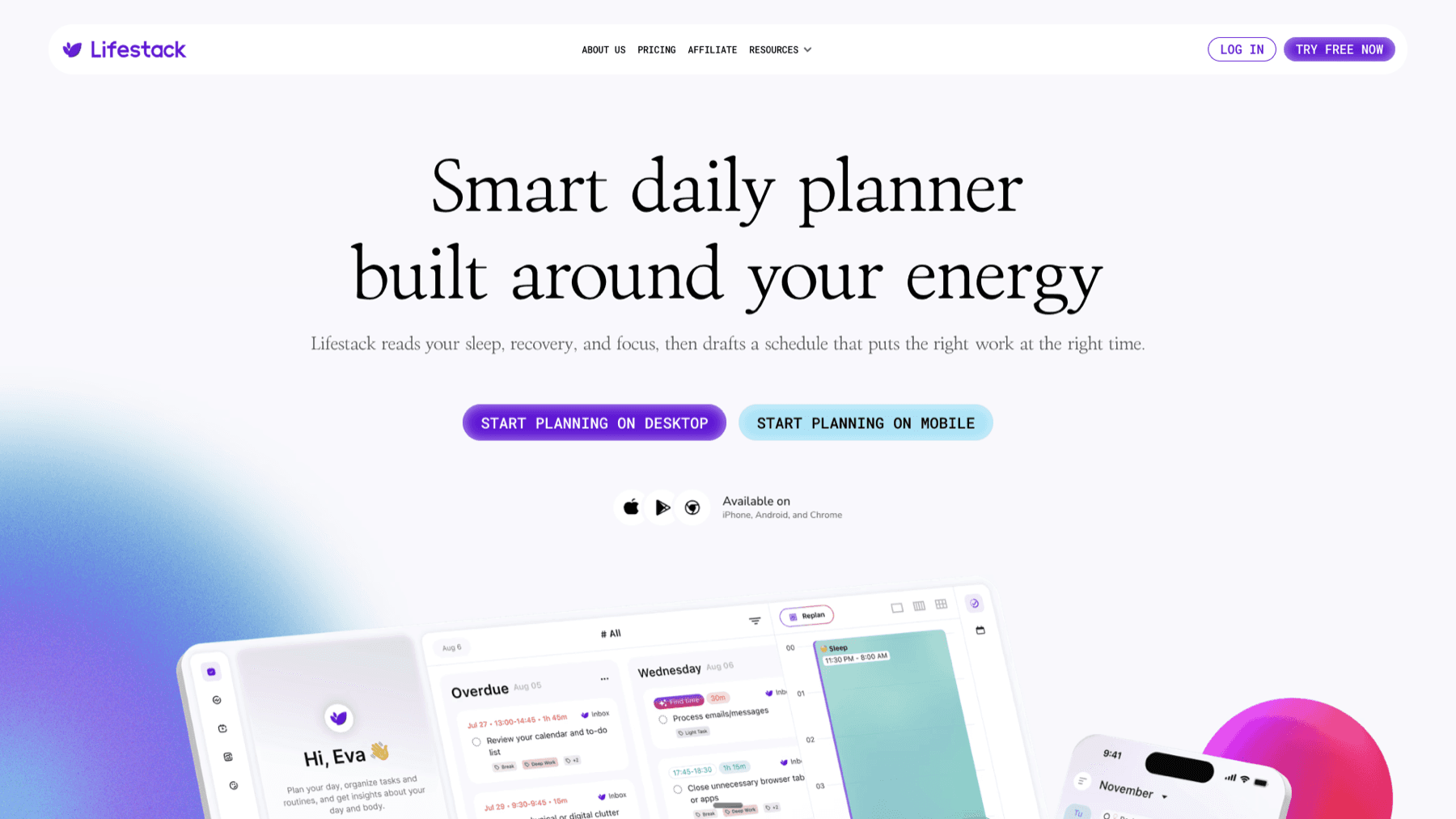
Lifestack solves the problem that Bevel leaves open: turning health data into an actual daily schedule. Where Bevel surfaces recovery and energy scores, Lifestack takes your energy patterns and builds a real calendar around them. High-demand tasks go in your peak windows. Recovery or admin work fills the low-energy slots. When your day changes, the schedule updates automatically.
For people with ADHD or irregular energy patterns, this matters a lot. Knowing your recovery score is low is one thing. Having your schedule automatically adjusted so you are not fighting biology all day is another. Lifestack integrates with Google Calendar and Apple Calendar, so there is no app-switching or manual planning on top of what Bevel already tracks.
The two tools work well together: Bevel for understanding your physiological state, Lifestack for acting on it. Used alone, Lifestack is also the stronger tool for daily planning for ADHD and variable-energy users who want their schedule to reflect how they actually feel.
Pricing: $9.99/month or $49.99/year; 7-day free trial on annual plan
2. Athlytic
Athlytic is a recovery-focused Apple Watch coach that covers similar ground to Bevel's recovery and strain scoring. It is less feature-rich than Bevel 3.0 but has a strong reputation for clean data presentation and Apple Watch integration. If you primarily want recovery coaching without AI check-ins or health records, Athlytic is a simpler alternative.
3. WHOOP
WHOOP is the hardware-first alternative. The WHOOP band tracks recovery, sleep, and strain with sensors purpose-built for the task rather than relying on a general-purpose Apple Watch. The coaching is built into the hardware ecosystem. It is more expensive overall (hardware plus subscription), but serious athletes often prefer its strain and HRV data quality.
Final Verdict
Bevel earns its 4.8-star App Store rating. The free tier is a real product. The Pro tier at $99.99 per year is competitive if you actually engage with the AI coaching daily. The multi-wearable support and proactive check-ins in 3.0 make it one of the better-built health AI apps available on iOS.
The limitation: Bevel is a diagnostic tool, not a planning tool. It tells you what happened and what your body needs. Acting on that information, particularly structuring your morning and day around your recovery state, still requires a scheduling layer like Lifestack to complete the loop.
FAQ
Is the Bevel app free?
Yes. Bevel's core features, including Recovery, Sleep, Strain, Stress, and Nutrition scoring, are free. The company committed in late 2025 that features free today stay free. The paid Pro tier ($14.99/month or $99.99/year) adds AI coaching (Bevel Intelligence), Biological Age, and Health Records.
What is Bevel Pro and is it worth it?
Bevel Pro unlocks the AI coaching layer, which generates personalized recommendations, proactive check-ins, and training plans based on your ongoing health data. It is worth it for users who engage with the AI daily and want guidance that evolves over time. Casual users who mainly want to see their scores can use the free tier indefinitely.
Does Bevel work on Android?
No. Bevel is currently iOS only. Android users should look at alternatives like AI health apps on Android that offer similar scoring and coaching functionality.
How does Bevel compare to WHOOP?
WHOOP requires dedicated hardware (a wrist band) while Bevel works with your existing Apple Watch. WHOOP's strain and HRV data is considered more precise because the hardware is optimized for biometric sensing. Bevel wins on flexibility and cost for people already in the Apple ecosystem.
What does Bevel's recovery score mean?
Bevel's recovery score combines HRV, resting heart rate, sleep quality, and previous day strain to estimate how ready your body is for physical or cognitive effort. A high score means your nervous system has recovered well. A low score suggests a lighter day will yield better results. The score is most useful when tracked over time to understand your personal patterns.
Can Bevel help with ADHD?
Bevel surfaces recovery and energy data that is relevant for ADHD focus and energy management. Knowing when your HRV is low or your strain is high can explain why a particular day felt harder. The limitation is that Bevel does not build a schedule around this data. Pairing it with Lifestack, which schedules tasks into your peak-energy windows automatically, creates a more complete system for ADHD energy management.
Bevel launched in 2023 as a wearable data aggregator. It has since grown into one of the most actively developed AI health coaching apps on iOS, reaching over 100,000 daily active users and raising a $10M Series A from General Catalyst in late 2025. The version most people are downloading now, Bevel 3.0, is a different product from the one early reviewers covered.
The core idea: Bevel pulls data from your Apple Watch, Apple Health, and other connected sources and turns it into a single health picture. Recovery score. Sleep score. Strain score. Stress score. Nutrition score. Then its AI coaching layer tells you what to do about it. The question is whether that combination is worth $14.99 per month for the Pro features, and whether the free tier is good enough to stand on its own.
We spent time with both tiers. Here is what we found.
Key Takeaways
Bevel's free tier is a real product with Recovery, Sleep, Strain, and Stress scoring at no cost
Pro unlocks AI coaching, Biological Age, and Health Records at $14.99/month or $99.99/year
Bevel tells you what your body did; tools like Lifestack tell you what to do about it from a scheduling perspective
What Bevel Does
Bevel aggregates health data from your Apple Watch and Apple Health into a unified dashboard. Each morning you get five scores: Recovery (how ready your body is for effort), Sleep (quality and duration), Strain (workload from the previous day), Stress (HRV and physiological markers), and Nutrition (logged food and glucose if you track it). Together they form a complete picture of where your body is on any given day.
Version 3.0, released in April 2026, added proactive AI check-ins that reach out to you rather than waiting for you to open the app. Bevel Intelligence now maintains a memory of your patterns and goals, can generate personalized training plans, and connects your daily scores to longer-term trends. This is the feature that most separates Bevel from a basic sleep tracker or fitness ring dashboard.
Bevel Free vs Pro
The free tier includes all five health scores, basic trend tracking, and a general summary of each day. This is not a stripped-down demo. You can use it indefinitely and get genuine value from the scoring data without paying anything.
Pro adds the AI coaching layer (Bevel Intelligence), Biological Age tracking, and Health Records integration. For data-oriented users who want to understand not just their scores but what to do to change them, Pro is where the real value lives. The AI coaching quality varies by use case: users who engage with check-ins consistently report more relevant recommendations over time.
Free: Recovery, Sleep, Strain, Stress, Nutrition scores; basic trends
Pro: AI coaching, Biological Age, Health Records, personalized training plans
Price: $14.99/month or $99.99/year ($8.33/month effective)
What Works Well
The free tier is genuinely good, which is not something you can say about most health apps. Most treat their free version as a funnel for paid conversion and gate anything useful behind a paywall. Bevel's core scoring works at no cost.
Multi-wearable support is also a real differentiator. Most recovery apps tie you to one ecosystem. Bevel connects across devices, which matters for anyone who splits their health tracking across an Apple Watch, a Whoop band, or a glucose monitor.
The proactive check-in model in 3.0 solves a real engagement problem with health apps: most only surface information when you go looking for it. Bevel reaching out when it notices a pattern is more in line with how an actual coach would work.
What Needs Work
Bevel is iOS only. If you use Android, it is not available to you.
At $14.99 per month, the Pro tier is one of the more expensive health apps in its category. The AI coaching layer needs consistent engagement to get better at your patterns. Users who check in daily for two to three weeks report much more relevant guidance than people who open the app occasionally.
Bevel tells you what your body did and how you are recovering. It does not schedule your day around that information. If your recovery score is low, Bevel will tell you to take it easy. But it does not automatically move your demanding tasks to a later window or protect your peak-focus hours from meetings. That gap is where a tool like energy-aware scheduling becomes important.
Best Alternatives to Bevel
If Bevel does not fit your needs or you want to complement it with a scheduling layer, these are the strongest alternatives.
1. Lifestack: Energy-Aware AI Scheduling
Lifestack solves the problem that Bevel leaves open: turning health data into an actual daily schedule. Where Bevel surfaces recovery and energy scores, Lifestack takes your energy patterns and builds a real calendar around them. High-demand tasks go in your peak windows. Recovery or admin work fills the low-energy slots. When your day changes, the schedule updates automatically.
For people with ADHD or irregular energy patterns, this matters a lot. Knowing your recovery score is low is one thing. Having your schedule automatically adjusted so you are not fighting biology all day is another. Lifestack integrates with Google Calendar and Apple Calendar, so there is no app-switching or manual planning on top of what Bevel already tracks.
The two tools work well together: Bevel for understanding your physiological state, Lifestack for acting on it. Used alone, Lifestack is also the stronger tool for daily planning for ADHD and variable-energy users who want their schedule to reflect how they actually feel.
Pricing: $9.99/month or $49.99/year; 7-day free trial on annual plan
2. Athlytic
Athlytic is a recovery-focused Apple Watch coach that covers similar ground to Bevel's recovery and strain scoring. It is less feature-rich than Bevel 3.0 but has a strong reputation for clean data presentation and Apple Watch integration. If you primarily want recovery coaching without AI check-ins or health records, Athlytic is a simpler alternative.
3. WHOOP
WHOOP is the hardware-first alternative. The WHOOP band tracks recovery, sleep, and strain with sensors purpose-built for the task rather than relying on a general-purpose Apple Watch. The coaching is built into the hardware ecosystem. It is more expensive overall (hardware plus subscription), but serious athletes often prefer its strain and HRV data quality.
Final Verdict
Bevel earns its 4.8-star App Store rating. The free tier is a real product. The Pro tier at $99.99 per year is competitive if you actually engage with the AI coaching daily. The multi-wearable support and proactive check-ins in 3.0 make it one of the better-built health AI apps available on iOS.
The limitation: Bevel is a diagnostic tool, not a planning tool. It tells you what happened and what your body needs. Acting on that information, particularly structuring your morning and day around your recovery state, still requires a scheduling layer like Lifestack to complete the loop.
FAQ
Is the Bevel app free?
Yes. Bevel's core features, including Recovery, Sleep, Strain, Stress, and Nutrition scoring, are free. The company committed in late 2025 that features free today stay free. The paid Pro tier ($14.99/month or $99.99/year) adds AI coaching (Bevel Intelligence), Biological Age, and Health Records.
What is Bevel Pro and is it worth it?
Bevel Pro unlocks the AI coaching layer, which generates personalized recommendations, proactive check-ins, and training plans based on your ongoing health data. It is worth it for users who engage with the AI daily and want guidance that evolves over time. Casual users who mainly want to see their scores can use the free tier indefinitely.
Does Bevel work on Android?
No. Bevel is currently iOS only. Android users should look at alternatives like AI health apps on Android that offer similar scoring and coaching functionality.
How does Bevel compare to WHOOP?
WHOOP requires dedicated hardware (a wrist band) while Bevel works with your existing Apple Watch. WHOOP's strain and HRV data is considered more precise because the hardware is optimized for biometric sensing. Bevel wins on flexibility and cost for people already in the Apple ecosystem.
What does Bevel's recovery score mean?
Bevel's recovery score combines HRV, resting heart rate, sleep quality, and previous day strain to estimate how ready your body is for physical or cognitive effort. A high score means your nervous system has recovered well. A low score suggests a lighter day will yield better results. The score is most useful when tracked over time to understand your personal patterns.
Can Bevel help with ADHD?
Bevel surfaces recovery and energy data that is relevant for ADHD focus and energy management. Knowing when your HRV is low or your strain is high can explain why a particular day felt harder. The limitation is that Bevel does not build a schedule around this data. Pairing it with Lifestack, which schedules tasks into your peak-energy windows automatically, creates a more complete system for ADHD energy management.



FOLLOW ON
FOLLOW ON
FOLLOW ON


Copyright 2026 © Lifestack. All rights reserved
Copyright 2026 © Lifestack. All rights reserved

