
Tips
Caffeine Nap: How It Works and How to Take One
Caffeine Nap: How It Works and How to Take One

A caffeine nap sounds like a contradiction. You drink coffee - a stimulant - and then immediately lie down and fall asleep. Yet it consistently outperforms both a coffee alone and a nap alone in research measuring alertness, reaction time, and error rates. The reason is specific and well-understood once you know what caffeine and sleep are both doing to the same brain chemical.
This guide covers the exact science, the protocol that makes it work, the scenarios where it's most useful, and the ones where it backfires.
Key Takeaways
A caffeine nap works because caffeine takes 20-30 minutes to reach the brain, and during that window, sleep clears adenosine from the same receptors caffeine will occupy. The two effects combine rather than compete.
The protocol is simple: drink 100-150mg of caffeine (roughly one espresso or small coffee), lie down immediately, and sleep for 20 minutes. Set an alarm before you close your eyes.
Do not take caffeine naps after 2-3 PM unless you work nights. The caffeine half-life extends alertness into the evening and disrupts sleep quality.
What Is a Caffeine Nap?
A caffeine nap (also called a coffee nap or nappuccino) involves drinking a caffeinated beverage and immediately taking a 20-minute nap. The key word is immediately: you drink the coffee and then lie down right away, before the caffeine has time to work.
This is the opposite of what most people do. Most people drink coffee when they feel tired and wait for it to work. The caffeine nap uses the waiting period productively by sleeping through it. The 20-minute nap window is also important: it is long enough to get meaningful rest but short enough that you wake up before entering deep sleep, which would cause grogginess rather than restored alertness.
The technique became well-known through a 1997 study by Loughborough University sleep researchers, who found that people who took caffeine naps before a driving simulation made significantly fewer errors than those who only drank coffee or only napped. Subsequent studies in military, healthcare, and workplace settings confirmed the effect.
The Science: Why Caffeine and Napping Work Together
To understand why a caffeine nap works, you need to understand adenosine. Adenosine is a byproduct of neural activity that accumulates in your brain throughout the day. The more adenosine builds up, the sleepier you feel. Sleep clears adenosine. This is why you feel refreshed after sleeping and foggy when you haven't slept enough.
Caffeine works not by giving you energy but by blocking adenosine receptors. Caffeine's molecular structure is close enough to adenosine's that it fits into the same receptor sites without activating them. When caffeine occupies those receptors, adenosine cannot bind to them, and you don't feel the sleepiness signal. The adenosine is still there; caffeine is just preventing you from feeling it.
Here is where the caffeine nap gets interesting. After you drink coffee, it takes roughly 20 to 30 minutes for caffeine to absorb through your gut and reach your bloodstream and brain in meaningful concentrations. During that window, if you sleep, your brain naturally clears some of the accumulated adenosine. When you wake up, two things happen simultaneously: the nap has reduced adenosine levels, and the caffeine has now arrived to block what remains. The clearance and the blockade stack rather than compete. This is why the combination outperforms either alone.
How to Take a Caffeine Nap: The Protocol
Choose your caffeine source: A single espresso, small drip coffee, or caffeine pill in the 100-150mg range. This is roughly the caffeine in a standard 8oz coffee. Going higher increases the risk of feeling wired rather than refreshed when you wake.
Drink it quickly: Sip the coffee over 5 minutes or less. The goal is to start the absorption clock as close to when you lie down as possible.
Lie down immediately: Don't check your phone or start another task. Put your head down as soon as you finish the coffee.
Set a 20-minute alarm: Do this before you start drinking. 20 minutes is the sweet spot. Under 10 minutes doesn't give you enough rest. Over 30 minutes risks entering deeper sleep stages, which causes sleep inertia (the groggy, disoriented feeling of waking from deep sleep).
Don't worry if you don't fully sleep: Even lying still with your eyes closed produces some adenosine clearance. You don't need to achieve deep sleep for the technique to work. Many people who say they "can't nap" still benefit from a caffeine rest period.
Give it 5 minutes after waking: You may feel slightly groggy immediately after the alarm. Sit up, drink water, get moving. Full alertness typically kicks in within 5 to 10 minutes as the caffeine comes online.
Benefits of Caffeine Naps
Research consistently shows caffeine naps improve performance on tasks requiring sustained attention, reaction speed, and working memory. The effect is most pronounced when you are already somewhat sleep-deprived, which is when you need it most.
Better than coffee alone: Coffee without the nap blocks adenosine but doesn't clear it. When the caffeine wears off, adenosine rebounds. A caffeine nap reduces that rebound.
Better than a nap alone: Sleep without caffeine improves alertness, but the benefit curve is slower. Caffeine accelerates the transition from sleep to full alertness, which is particularly useful when you have limited time.
Improved mood: Caffeine increases dopamine availability, and naps clear cortisol-related fatigue. The combination produces a better mood improvement than either alone in most studies.
Lower sleep inertia: Counterintuitively, waking up from a caffeine nap typically involves less grogginess than waking from a nap without caffeine. The arriving caffeine smooths the transition back to wakefulness.
For people exploring the caffeine and alertness relationship further, our post on why caffeine sometimes makes you sleepy with ADHD covers how individual dopamine responses change the expected caffeine effect.
When Not to Take a Caffeine Nap
The caffeine nap has real limitations, and pushing past them backfires.
After 2-3 PM for normal sleepers: Caffeine has a half-life of roughly 5 to 7 hours. An afternoon caffeine nap means caffeine is still active in your system at 10 PM or later, reducing sleep quality even if you don't feel alert. Poor nighttime sleep leads to more adenosine the next day - the opposite of the goal.
If you have anxiety or caffeine sensitivity: For people who experience anxiety, jitteriness, or heart palpitations with caffeine, the nap does not eliminate those effects. The adenosine receptor blocking still happens; you just feel it differently.
As a substitute for adequate sleep: A caffeine nap is a performance tool for managing normal daytime fatigue, not a workaround for chronic sleep deprivation. If you're sleeping 5 hours a night and relying on caffeine naps to function, the caffeine nap is masking a problem rather than solving it.
Before tasks requiring fine motor precision: Some people experience brief, mild tremors as caffeine comes online. This is not a problem for most tasks but is relevant if your work requires steady hands.
Building a Better Energy System Around Caffeine Naps
A caffeine nap is a tactical tool. It works best within a broader system that knows when your energy is high, when it is low, and what kind of work belongs in each window. Most people use caffeine reactively, reaching for it when they crash rather than placing it where it will do the most good. The same applies to naps.
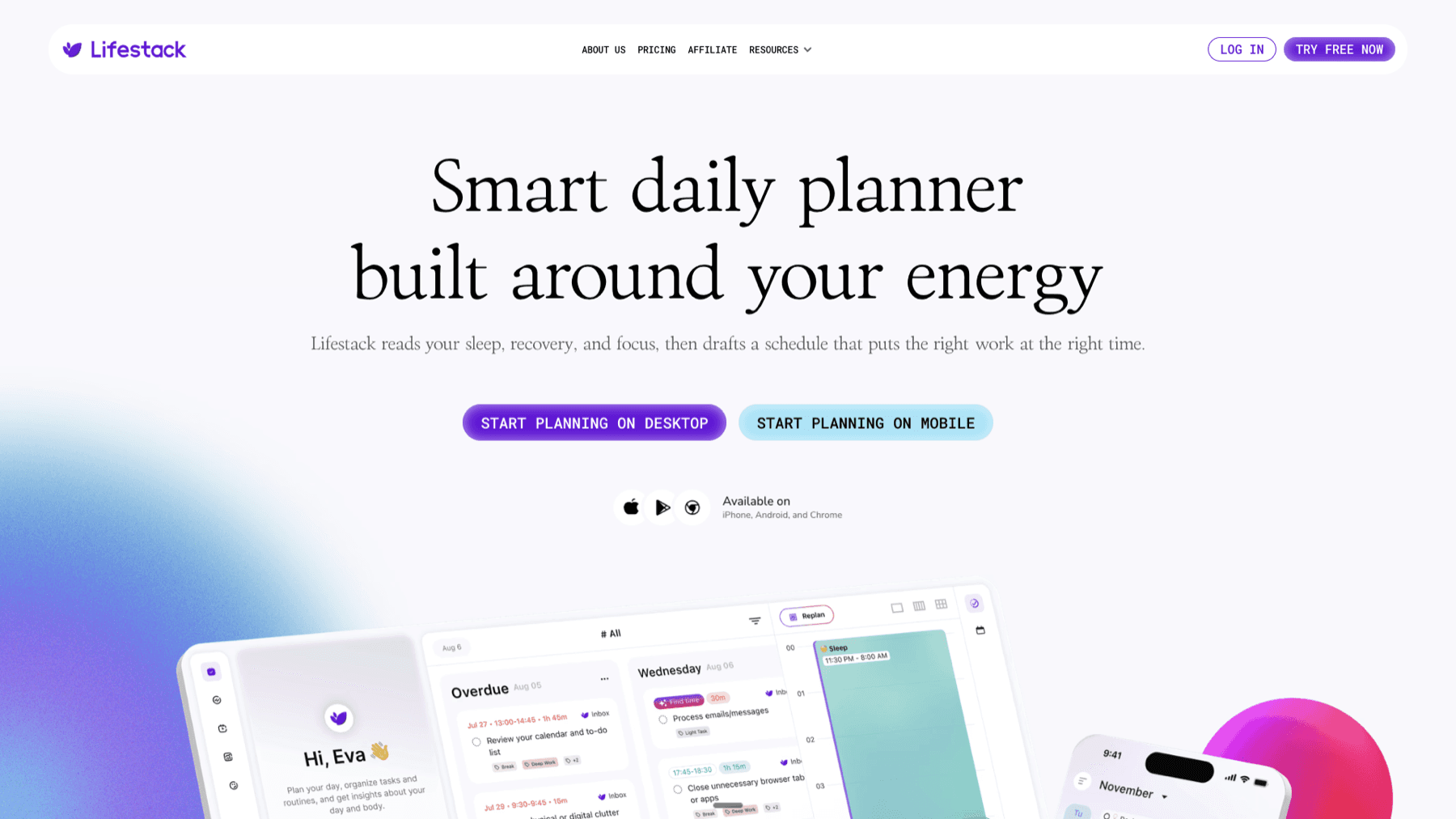
Lifestack is an AI scheduler that builds your daily plan around your energy levels. It asks how you're feeling at the start of each day and places high-focus tasks in your peak windows while lighter work fills lower-energy periods. If you know your afternoon energy typically drops between 1 and 3 PM, that is when a caffeine nap belongs in your schedule - before demanding afternoon work, not during it.
Lifestack cannot tell you when to drink coffee, but it can build a schedule that makes the caffeine nap window obvious: protect 1:00 to 1:30 PM as a rest block, schedule your hardest work at 2:00 PM when the caffeine and nap effects peak, and fill the lower-energy morning slot with admin and email. Pairing this with a time blocking template makes the structure repeatable without rebuilding it each day. This kind of deliberate energy architecture is more effective than random caffeine use. It works alongside circadian rhythm apps that track your energy patterns and can help identify your best nap window. For ADHD users managing variable energy and focus, see our guide on how to focus with ADHD and our roundup of health coaching apps that include scheduling tools.
Lifestack costs $7/month or $50/year with a 7-day free trial.
Frequently Asked Questions
Does a caffeine nap actually work?
Yes. Multiple peer-reviewed studies confirm that caffeine naps outperform either coffee or a nap alone on measures of sustained attention, reaction time, and error rates. The effect relies on specific timing: caffeine must be consumed immediately before the nap, not after waking, so that it arrives in the brain simultaneously with the alertness benefits of sleep.
How much caffeine should I use for a caffeine nap?
100 to 150mg is the range used in most research. This is roughly one espresso shot (60-80mg) or a small drip coffee (80-100mg). Going above 200mg increases the risk of anxiety and disrupts the nap itself by making it harder to fall asleep before the caffeine activates.
What if I can't fall asleep during the nap?
You do not need to fully sleep to benefit. Even resting quietly with your eyes closed for 20 minutes reduces muscle tension and produces some adenosine clearance. Many habitual caffeine nappers report never reaching sleep and still feeling substantially more alert after the rest period. The goal is a low-stimulation, eyes-closed rest, not necessarily verified sleep.
Can you take a caffeine nap every day?
Habitually, yes. Many people build a post-lunch caffeine nap into their daily routine. The main risk is caffeine tolerance building over time, which reduces the effectiveness of the caffeine component. Taking occasional caffeine-free days or weeks helps maintain sensitivity. The nap portion has no meaningful downside if limited to 20 minutes and not too late in the day.
Is a caffeine nap the same as a power nap?
A power nap is any brief sleep session of 10 to 30 minutes taken to improve alertness. A caffeine nap is a specific type of power nap that combines caffeine consumption with the rest period. All caffeine naps are power naps; not all power naps are caffeine naps. The caffeine addition makes the technique more effective than a plain power nap for most people.
A caffeine nap sounds like a contradiction. You drink coffee - a stimulant - and then immediately lie down and fall asleep. Yet it consistently outperforms both a coffee alone and a nap alone in research measuring alertness, reaction time, and error rates. The reason is specific and well-understood once you know what caffeine and sleep are both doing to the same brain chemical.
This guide covers the exact science, the protocol that makes it work, the scenarios where it's most useful, and the ones where it backfires.
Key Takeaways
A caffeine nap works because caffeine takes 20-30 minutes to reach the brain, and during that window, sleep clears adenosine from the same receptors caffeine will occupy. The two effects combine rather than compete.
The protocol is simple: drink 100-150mg of caffeine (roughly one espresso or small coffee), lie down immediately, and sleep for 20 minutes. Set an alarm before you close your eyes.
Do not take caffeine naps after 2-3 PM unless you work nights. The caffeine half-life extends alertness into the evening and disrupts sleep quality.
What Is a Caffeine Nap?
A caffeine nap (also called a coffee nap or nappuccino) involves drinking a caffeinated beverage and immediately taking a 20-minute nap. The key word is immediately: you drink the coffee and then lie down right away, before the caffeine has time to work.
This is the opposite of what most people do. Most people drink coffee when they feel tired and wait for it to work. The caffeine nap uses the waiting period productively by sleeping through it. The 20-minute nap window is also important: it is long enough to get meaningful rest but short enough that you wake up before entering deep sleep, which would cause grogginess rather than restored alertness.
The technique became well-known through a 1997 study by Loughborough University sleep researchers, who found that people who took caffeine naps before a driving simulation made significantly fewer errors than those who only drank coffee or only napped. Subsequent studies in military, healthcare, and workplace settings confirmed the effect.
The Science: Why Caffeine and Napping Work Together
To understand why a caffeine nap works, you need to understand adenosine. Adenosine is a byproduct of neural activity that accumulates in your brain throughout the day. The more adenosine builds up, the sleepier you feel. Sleep clears adenosine. This is why you feel refreshed after sleeping and foggy when you haven't slept enough.
Caffeine works not by giving you energy but by blocking adenosine receptors. Caffeine's molecular structure is close enough to adenosine's that it fits into the same receptor sites without activating them. When caffeine occupies those receptors, adenosine cannot bind to them, and you don't feel the sleepiness signal. The adenosine is still there; caffeine is just preventing you from feeling it.
Here is where the caffeine nap gets interesting. After you drink coffee, it takes roughly 20 to 30 minutes for caffeine to absorb through your gut and reach your bloodstream and brain in meaningful concentrations. During that window, if you sleep, your brain naturally clears some of the accumulated adenosine. When you wake up, two things happen simultaneously: the nap has reduced adenosine levels, and the caffeine has now arrived to block what remains. The clearance and the blockade stack rather than compete. This is why the combination outperforms either alone.
How to Take a Caffeine Nap: The Protocol
Choose your caffeine source: A single espresso, small drip coffee, or caffeine pill in the 100-150mg range. This is roughly the caffeine in a standard 8oz coffee. Going higher increases the risk of feeling wired rather than refreshed when you wake.
Drink it quickly: Sip the coffee over 5 minutes or less. The goal is to start the absorption clock as close to when you lie down as possible.
Lie down immediately: Don't check your phone or start another task. Put your head down as soon as you finish the coffee.
Set a 20-minute alarm: Do this before you start drinking. 20 minutes is the sweet spot. Under 10 minutes doesn't give you enough rest. Over 30 minutes risks entering deeper sleep stages, which causes sleep inertia (the groggy, disoriented feeling of waking from deep sleep).
Don't worry if you don't fully sleep: Even lying still with your eyes closed produces some adenosine clearance. You don't need to achieve deep sleep for the technique to work. Many people who say they "can't nap" still benefit from a caffeine rest period.
Give it 5 minutes after waking: You may feel slightly groggy immediately after the alarm. Sit up, drink water, get moving. Full alertness typically kicks in within 5 to 10 minutes as the caffeine comes online.
Benefits of Caffeine Naps
Research consistently shows caffeine naps improve performance on tasks requiring sustained attention, reaction speed, and working memory. The effect is most pronounced when you are already somewhat sleep-deprived, which is when you need it most.
Better than coffee alone: Coffee without the nap blocks adenosine but doesn't clear it. When the caffeine wears off, adenosine rebounds. A caffeine nap reduces that rebound.
Better than a nap alone: Sleep without caffeine improves alertness, but the benefit curve is slower. Caffeine accelerates the transition from sleep to full alertness, which is particularly useful when you have limited time.
Improved mood: Caffeine increases dopamine availability, and naps clear cortisol-related fatigue. The combination produces a better mood improvement than either alone in most studies.
Lower sleep inertia: Counterintuitively, waking up from a caffeine nap typically involves less grogginess than waking from a nap without caffeine. The arriving caffeine smooths the transition back to wakefulness.
For people exploring the caffeine and alertness relationship further, our post on why caffeine sometimes makes you sleepy with ADHD covers how individual dopamine responses change the expected caffeine effect.
When Not to Take a Caffeine Nap
The caffeine nap has real limitations, and pushing past them backfires.
After 2-3 PM for normal sleepers: Caffeine has a half-life of roughly 5 to 7 hours. An afternoon caffeine nap means caffeine is still active in your system at 10 PM or later, reducing sleep quality even if you don't feel alert. Poor nighttime sleep leads to more adenosine the next day - the opposite of the goal.
If you have anxiety or caffeine sensitivity: For people who experience anxiety, jitteriness, or heart palpitations with caffeine, the nap does not eliminate those effects. The adenosine receptor blocking still happens; you just feel it differently.
As a substitute for adequate sleep: A caffeine nap is a performance tool for managing normal daytime fatigue, not a workaround for chronic sleep deprivation. If you're sleeping 5 hours a night and relying on caffeine naps to function, the caffeine nap is masking a problem rather than solving it.
Before tasks requiring fine motor precision: Some people experience brief, mild tremors as caffeine comes online. This is not a problem for most tasks but is relevant if your work requires steady hands.
Building a Better Energy System Around Caffeine Naps
A caffeine nap is a tactical tool. It works best within a broader system that knows when your energy is high, when it is low, and what kind of work belongs in each window. Most people use caffeine reactively, reaching for it when they crash rather than placing it where it will do the most good. The same applies to naps.
Lifestack is an AI scheduler that builds your daily plan around your energy levels. It asks how you're feeling at the start of each day and places high-focus tasks in your peak windows while lighter work fills lower-energy periods. If you know your afternoon energy typically drops between 1 and 3 PM, that is when a caffeine nap belongs in your schedule - before demanding afternoon work, not during it.
Lifestack cannot tell you when to drink coffee, but it can build a schedule that makes the caffeine nap window obvious: protect 1:00 to 1:30 PM as a rest block, schedule your hardest work at 2:00 PM when the caffeine and nap effects peak, and fill the lower-energy morning slot with admin and email. Pairing this with a time blocking template makes the structure repeatable without rebuilding it each day. This kind of deliberate energy architecture is more effective than random caffeine use. It works alongside circadian rhythm apps that track your energy patterns and can help identify your best nap window. For ADHD users managing variable energy and focus, see our guide on how to focus with ADHD and our roundup of health coaching apps that include scheduling tools.
Lifestack costs $7/month or $50/year with a 7-day free trial.
Frequently Asked Questions
Does a caffeine nap actually work?
Yes. Multiple peer-reviewed studies confirm that caffeine naps outperform either coffee or a nap alone on measures of sustained attention, reaction time, and error rates. The effect relies on specific timing: caffeine must be consumed immediately before the nap, not after waking, so that it arrives in the brain simultaneously with the alertness benefits of sleep.
How much caffeine should I use for a caffeine nap?
100 to 150mg is the range used in most research. This is roughly one espresso shot (60-80mg) or a small drip coffee (80-100mg). Going above 200mg increases the risk of anxiety and disrupts the nap itself by making it harder to fall asleep before the caffeine activates.
What if I can't fall asleep during the nap?
You do not need to fully sleep to benefit. Even resting quietly with your eyes closed for 20 minutes reduces muscle tension and produces some adenosine clearance. Many habitual caffeine nappers report never reaching sleep and still feeling substantially more alert after the rest period. The goal is a low-stimulation, eyes-closed rest, not necessarily verified sleep.
Can you take a caffeine nap every day?
Habitually, yes. Many people build a post-lunch caffeine nap into their daily routine. The main risk is caffeine tolerance building over time, which reduces the effectiveness of the caffeine component. Taking occasional caffeine-free days or weeks helps maintain sensitivity. The nap portion has no meaningful downside if limited to 20 minutes and not too late in the day.
Is a caffeine nap the same as a power nap?
A power nap is any brief sleep session of 10 to 30 minutes taken to improve alertness. A caffeine nap is a specific type of power nap that combines caffeine consumption with the rest period. All caffeine naps are power naps; not all power naps are caffeine naps. The caffeine addition makes the technique more effective than a plain power nap for most people.



FOLLOW ON
FOLLOW ON
FOLLOW ON


Copyright 2026 © Lifestack. All rights reserved
Copyright 2026 © Lifestack. All rights reserved

