
Device
COROS Heart Rate Monitor Review: Is It Worth $89?
COROS Heart Rate Monitor Review: Is It Worth $89?

Wrist-based heart rate tracking has a reliability problem that most athletes know well. Push into a hard interval and the number on your watch lags by 10, sometimes 20 seconds. By the time it catches up, the effort is over. Arm-worn optical monitors sit closer to a major artery and generally read faster and more steadily. The question is whether COROS has built one worth buying at $89.
COROS is best known for GPS running and triathlon watches. The COROS PACE 4 remains one of the best-value GPS watches on the market, and their long-running rivalry with Garmin has produced some genuinely excellent hardware. The COROS Heart Rate Monitor is a different kind of product: a standalone arm band that pairs to any Bluetooth device, whether that's a COROS watch, a Garmin, a Wahoo bike computer, or your phone.
At 19 grams and with a 38-hour battery, it looks good on paper. But accuracy claims for optical sensors require real-world verification, and there are trade-offs at this price point worth knowing before you buy.
We tested the COROS Heart Rate Monitor across steady runs, interval sessions, and long bike rides. Here is what we found.
Key Takeaways
Arm placement delivers noticeably more consistent readings than wrist-based tracking during high-intensity intervals
38-hour battery life is best in class for an optical arm band and eliminates the gel-and-electrode hassle of chest straps
No ANT+ and no HRV measurement are real limitations for cyclists and recovery-focused athletes
What Is the COROS Heart Rate Monitor?
The COROS Heart Rate Monitor is an upper-arm optical sensor, not a watch or fitness tracker. It does exactly one thing: broadcast your heart rate via Bluetooth to up to three paired devices simultaneously. It has no display, no onboard storage, and no GPS. If your watch or app stops recording, the data is gone.
The sensor module houses five LEDs and four photodetectors, arranged in a multi-channel pattern that allows it to triangulate blood flow more accurately than the single-channel optical sensors found in most budget wrist trackers. The module snaps into a fabric armband made from polyester, nylon, and spandex. The band is fully removable for washing, which is a practical advantage over competitors with fixed, sealed designs.
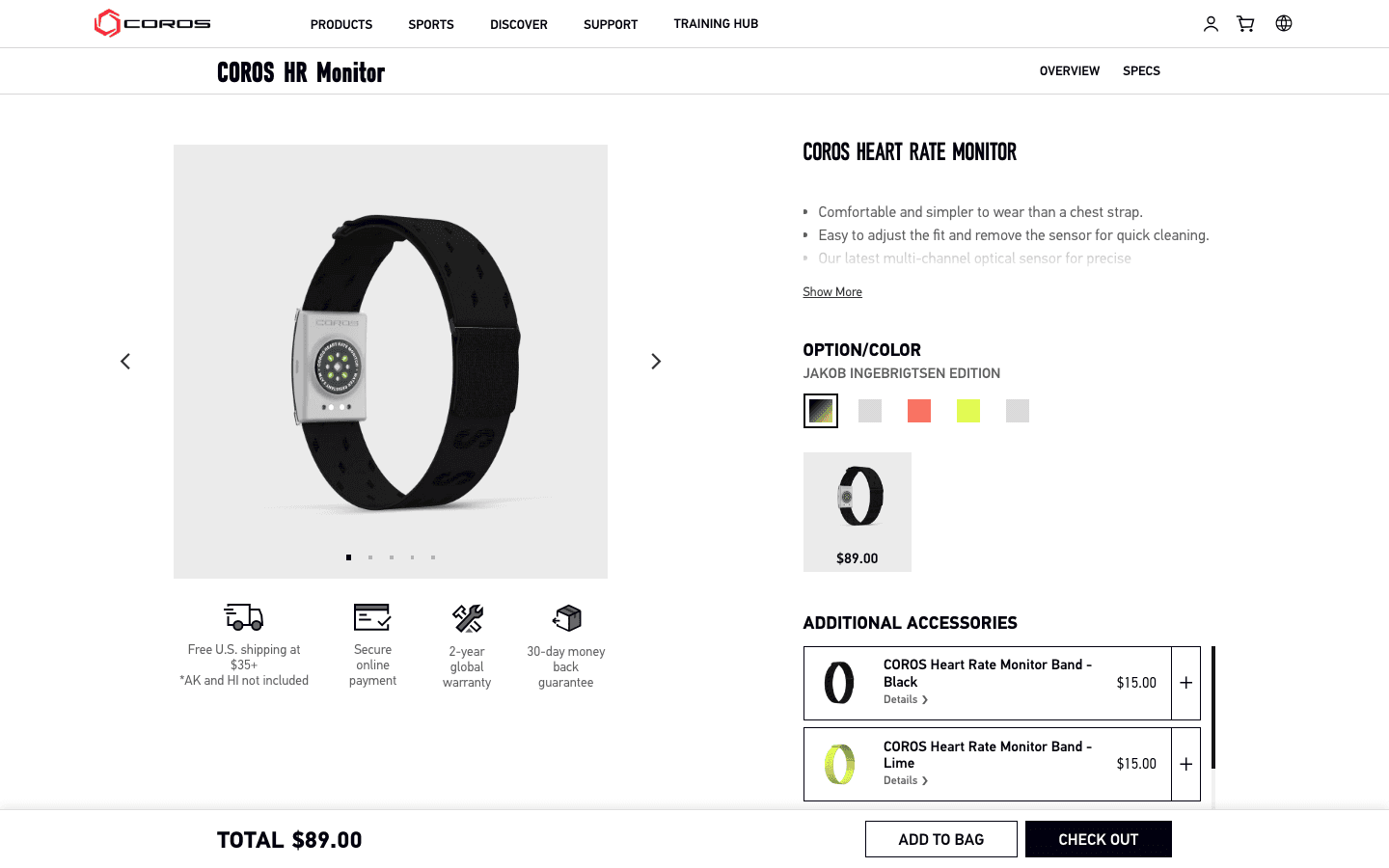
It comes in two sizes. Standard fits arm circumferences of 18 to 32 cm, and Large fits 24 to 43 cm. Color options include the Jakob Ingebrigtsen Edition in black, grey, orange, and lime green. The band replacement costs $15 if yours wears out.
Design and Comfort
Nineteen grams on your upper arm is barely there. After a few minutes of running you genuinely stop noticing it. The velcro closure stays secure through sweat and movement without tightening uncomfortably over a long effort. Compared to silicone chest straps, which require wetting the electrodes and can cause skin irritation after two or three hours, the COROS band is far friendlier for daily training.
On efforts under two hours, the fabric stayed comfortable. A few reviewers noted some chafing on marathon-length runs when the band absorbed significant sweat. That's not unusual for arm bands at any price point, and the fix is to position it slightly higher or lower depending on where your arm flexes most.
The sensor's auto wear detection kicks in within a few seconds of putting it on, pairing automatically with remembered devices. There are no buttons to press. This sounds minor, but for pre-race mornings when you're managing gear and nerves simultaneously, it matters.
Accuracy and Performance
The arm beats the wrist. That is the fundamental truth of optical heart rate monitoring. The brachial artery runs along the inner arm and provides a stronger, more stable signal than the radial artery at the wrist, particularly when your hands are cold or gripping handlebars. The COROS Heart Rate Monitor puts the sensor in a better anatomical position from the start.
In steady-state running at moderate intensities, the COROS read within one to two beats per minute of a Polar chest strap across multiple tests. That is excellent. The gap widens slightly during rapid intensity changes, typical for optical sensors, where a 5 to 10 second lag appears before the number catches up. Dedicated chest straps like the Polar H9 and H10 remain more accurate for intervals because they measure electrical heart activity rather than blood flow.
Cold weather performance stood out. Wrist trackers frequently struggle when temperatures drop below 50 degrees Fahrenheit because peripheral vasoconstriction reduces blood flow at the wrist. The arm is less affected by this, and the COROS readings remained stable in testing at temperatures where wrist-based monitors produced garbage data.
Battery Life
Thirty-eight hours of continuous active use is genuinely exceptional. For context, the Polar OH1+ manages 12 hours, and the Wahoo TICKR FIT tops out around 30 hours. The COROS battery would outlast any single training block without needing a charge. The 80-day standby figure is less useful in practice since you will be charging it between sessions anyway, but it means forgetting to charge after one workout will not leave you with a dead device on race morning.
The one inconvenience is the proprietary magnetic USB cable. If you lose it you are looking at a COROS-specific replacement, not a standard USB-C. Keep track of the cable.
Connectivity and Compatibility
The COROS Heart Rate Monitor connects via Bluetooth only. It does not support ANT+. For cyclists, this is a significant omission. Most cycling power meters, indoor trainers, and bike computers use ANT+ as their primary protocol, and some older Garmin devices do too. If your training setup relies heavily on ANT+, this is a dealbreaker. Check your devices before purchasing.
For the Bluetooth ecosystem, compatibility is broad. It pairs reliably with COROS watches, Garmin devices that accept Bluetooth sensors, Apple Watch, Wahoo Elemnt computers, Zwift, TrainerRoad, Polar Flow, Nike Run Club, and Adidas Running. The three simultaneous Bluetooth connections mean you can broadcast to your watch, phone, and a bike computer at the same time without switching pairings between activities.
If you own a COROS watch, the pairing experience is the smoothest. The COROS PACE 4 recognizes the HRM automatically and displays a clean live heart rate field during recording. Non-COROS pairings work fine but require manual sensor search in your device settings the first time.
HRV: The One Thing It Does Not Do
Heart rate variability has become a central metric for serious athletes monitoring recovery. The COROS Heart Rate Monitor does not measure HRV. It broadcasts real-time heart rate only. If you want dedicated HRV tracking, you will need a chest strap with RR-interval recording (such as the Polar H10) or a wearable with overnight HRV monitoring like an Oura Ring or WHOOP.
Understanding what your HRV numbers mean and how to respond to them is worth studying if you are not already. But for athletes who simply want accurate real-time heart rate during training without the complexity of HRV analysis, the COROS handles the job well.
Pricing and Value
The COROS Heart Rate Monitor retails for $89. Replacement bands are $15. COROS includes a 2-year global warranty and a 30-day money-back guarantee, which is more generous than most competitors in this category.
For comparison: the Wahoo TICKR FIT is around $80 but tops out at 30 hours of battery. The Polar OH1+ is similarly priced but limited to 12 hours. The Garmin HRM-Pro is around $130 and adds ANT+, HRV, and running dynamics, but requires a Garmin ecosystem to unlock most of those features. At $89 with 38 hours of battery, the COROS sits in a reasonable position if Bluetooth-only connectivity suits your setup.
The Missing Piece: Planning Around Your Training Data
A heart rate monitor tells you how your body performed. What it cannot do is help you plan the rest of your day around that effort. If you just ran a hard interval session with your heart rate pegged at 175 for thirty minutes, your afternoon meetings and evening commitments probably should not look the same as a rest day. That is where Lifestack comes in.
Lifestack is an AI-powered planner that schedules your tasks and calendar around your energy levels. It connects your health data and automatically moves demanding work away from your low-energy windows. Pair it with consistent heart rate training data and you can build a daily schedule that respects recovery as seriously as your training plan does. The annual plan is $50 per year with a 7-day free trial. Read more about building a sustainable wellness routine that actually sticks.
Should You Buy the COROS Heart Rate Monitor?
Buy it if you train mostly with Bluetooth devices, want a sensor that outperforms wrist tracking without the mess of a chest strap, and value long battery life above all else. Runners, open-water swimmers who want pre- and post-swim data, and cyclists in a Bluetooth ecosystem will find it genuinely useful. The 38-hour battery means you can use it daily for a week between charges.
Skip it if your cycling setup depends on ANT+, if HRV is a core metric in your training (get the Polar H10 instead), or if you are an endurance athlete who needs chest-strap-level precision during maximal intervals. The optical sensor is good but not perfect at peak intensities. You can also compare other screenless trackers if you are exploring options beyond arm bands.
For most recreational athletes and fitness-focused runners, $89 for an accurate, comfortable, all-day arm band with exceptional battery life is a fair trade. It does what it says on the box.
Frequently Asked Questions
Does the COROS Heart Rate Monitor work with Garmin watches?
Yes. The COROS Heart Rate Monitor connects to Garmin watches and devices that accept Bluetooth heart rate sensors. It does not use ANT+, so older Garmin devices that only support ANT+ will not pair. If your Garmin supports Bluetooth sensors, the COROS will work with it.
Does the COROS Heart Rate Monitor have ANT+?
No. The COROS Heart Rate Monitor is Bluetooth-only and does not support ANT+. This is one of its primary limitations for cyclists who rely on ANT+ bike computers and indoor trainers.
Is the COROS Heart Rate Monitor waterproof?
It is rated 3 ATM, meaning it handles sweat and rain without issue. It is not suitable for swimming. The sensor should not be submerged. If you need a monitor for open-water or pool swimming, look at chest straps with higher water ratings.
How accurate is the COROS Heart Rate Monitor compared to a chest strap?
At steady efforts it reads within one to two beats per minute of a reference chest strap, which is excellent for an optical sensor. During rapid intensity changes, like sprint intervals, a short lag of 5 to 10 seconds is typical. For precision interval training, dedicated electrical sensors like the Polar H10 are still more accurate. For general aerobic training, the COROS is close enough for meaningful data.
Does the COROS Heart Rate Monitor track HRV?
No. The device transmits real-time heart rate only and does not record RR intervals or calculate HRV. For HRV tracking, you need a chest strap with RR interval support or a recovery wearable like WHOOP or Oura Ring.
Can I use the COROS Heart Rate Monitor with non-COROS watches?
Yes. The COROS Heart Rate Monitor pairs with any Bluetooth-compatible fitness device, including Garmin, Apple Watch, Polar, and Wahoo. The pairing experience is smoothest with COROS watches but works reliably across brands.
Wrist-based heart rate tracking has a reliability problem that most athletes know well. Push into a hard interval and the number on your watch lags by 10, sometimes 20 seconds. By the time it catches up, the effort is over. Arm-worn optical monitors sit closer to a major artery and generally read faster and more steadily. The question is whether COROS has built one worth buying at $89.
COROS is best known for GPS running and triathlon watches. The COROS PACE 4 remains one of the best-value GPS watches on the market, and their long-running rivalry with Garmin has produced some genuinely excellent hardware. The COROS Heart Rate Monitor is a different kind of product: a standalone arm band that pairs to any Bluetooth device, whether that's a COROS watch, a Garmin, a Wahoo bike computer, or your phone.
At 19 grams and with a 38-hour battery, it looks good on paper. But accuracy claims for optical sensors require real-world verification, and there are trade-offs at this price point worth knowing before you buy.
We tested the COROS Heart Rate Monitor across steady runs, interval sessions, and long bike rides. Here is what we found.
Key Takeaways
Arm placement delivers noticeably more consistent readings than wrist-based tracking during high-intensity intervals
38-hour battery life is best in class for an optical arm band and eliminates the gel-and-electrode hassle of chest straps
No ANT+ and no HRV measurement are real limitations for cyclists and recovery-focused athletes
What Is the COROS Heart Rate Monitor?
The COROS Heart Rate Monitor is an upper-arm optical sensor, not a watch or fitness tracker. It does exactly one thing: broadcast your heart rate via Bluetooth to up to three paired devices simultaneously. It has no display, no onboard storage, and no GPS. If your watch or app stops recording, the data is gone.
The sensor module houses five LEDs and four photodetectors, arranged in a multi-channel pattern that allows it to triangulate blood flow more accurately than the single-channel optical sensors found in most budget wrist trackers. The module snaps into a fabric armband made from polyester, nylon, and spandex. The band is fully removable for washing, which is a practical advantage over competitors with fixed, sealed designs.
It comes in two sizes. Standard fits arm circumferences of 18 to 32 cm, and Large fits 24 to 43 cm. Color options include the Jakob Ingebrigtsen Edition in black, grey, orange, and lime green. The band replacement costs $15 if yours wears out.
Design and Comfort
Nineteen grams on your upper arm is barely there. After a few minutes of running you genuinely stop noticing it. The velcro closure stays secure through sweat and movement without tightening uncomfortably over a long effort. Compared to silicone chest straps, which require wetting the electrodes and can cause skin irritation after two or three hours, the COROS band is far friendlier for daily training.
On efforts under two hours, the fabric stayed comfortable. A few reviewers noted some chafing on marathon-length runs when the band absorbed significant sweat. That's not unusual for arm bands at any price point, and the fix is to position it slightly higher or lower depending on where your arm flexes most.
The sensor's auto wear detection kicks in within a few seconds of putting it on, pairing automatically with remembered devices. There are no buttons to press. This sounds minor, but for pre-race mornings when you're managing gear and nerves simultaneously, it matters.
Accuracy and Performance
The arm beats the wrist. That is the fundamental truth of optical heart rate monitoring. The brachial artery runs along the inner arm and provides a stronger, more stable signal than the radial artery at the wrist, particularly when your hands are cold or gripping handlebars. The COROS Heart Rate Monitor puts the sensor in a better anatomical position from the start.
In steady-state running at moderate intensities, the COROS read within one to two beats per minute of a Polar chest strap across multiple tests. That is excellent. The gap widens slightly during rapid intensity changes, typical for optical sensors, where a 5 to 10 second lag appears before the number catches up. Dedicated chest straps like the Polar H9 and H10 remain more accurate for intervals because they measure electrical heart activity rather than blood flow.
Cold weather performance stood out. Wrist trackers frequently struggle when temperatures drop below 50 degrees Fahrenheit because peripheral vasoconstriction reduces blood flow at the wrist. The arm is less affected by this, and the COROS readings remained stable in testing at temperatures where wrist-based monitors produced garbage data.
Battery Life
Thirty-eight hours of continuous active use is genuinely exceptional. For context, the Polar OH1+ manages 12 hours, and the Wahoo TICKR FIT tops out around 30 hours. The COROS battery would outlast any single training block without needing a charge. The 80-day standby figure is less useful in practice since you will be charging it between sessions anyway, but it means forgetting to charge after one workout will not leave you with a dead device on race morning.
The one inconvenience is the proprietary magnetic USB cable. If you lose it you are looking at a COROS-specific replacement, not a standard USB-C. Keep track of the cable.
Connectivity and Compatibility
The COROS Heart Rate Monitor connects via Bluetooth only. It does not support ANT+. For cyclists, this is a significant omission. Most cycling power meters, indoor trainers, and bike computers use ANT+ as their primary protocol, and some older Garmin devices do too. If your training setup relies heavily on ANT+, this is a dealbreaker. Check your devices before purchasing.
For the Bluetooth ecosystem, compatibility is broad. It pairs reliably with COROS watches, Garmin devices that accept Bluetooth sensors, Apple Watch, Wahoo Elemnt computers, Zwift, TrainerRoad, Polar Flow, Nike Run Club, and Adidas Running. The three simultaneous Bluetooth connections mean you can broadcast to your watch, phone, and a bike computer at the same time without switching pairings between activities.
If you own a COROS watch, the pairing experience is the smoothest. The COROS PACE 4 recognizes the HRM automatically and displays a clean live heart rate field during recording. Non-COROS pairings work fine but require manual sensor search in your device settings the first time.
HRV: The One Thing It Does Not Do
Heart rate variability has become a central metric for serious athletes monitoring recovery. The COROS Heart Rate Monitor does not measure HRV. It broadcasts real-time heart rate only. If you want dedicated HRV tracking, you will need a chest strap with RR-interval recording (such as the Polar H10) or a wearable with overnight HRV monitoring like an Oura Ring or WHOOP.
Understanding what your HRV numbers mean and how to respond to them is worth studying if you are not already. But for athletes who simply want accurate real-time heart rate during training without the complexity of HRV analysis, the COROS handles the job well.
Pricing and Value
The COROS Heart Rate Monitor retails for $89. Replacement bands are $15. COROS includes a 2-year global warranty and a 30-day money-back guarantee, which is more generous than most competitors in this category.
For comparison: the Wahoo TICKR FIT is around $80 but tops out at 30 hours of battery. The Polar OH1+ is similarly priced but limited to 12 hours. The Garmin HRM-Pro is around $130 and adds ANT+, HRV, and running dynamics, but requires a Garmin ecosystem to unlock most of those features. At $89 with 38 hours of battery, the COROS sits in a reasonable position if Bluetooth-only connectivity suits your setup.
The Missing Piece: Planning Around Your Training Data
A heart rate monitor tells you how your body performed. What it cannot do is help you plan the rest of your day around that effort. If you just ran a hard interval session with your heart rate pegged at 175 for thirty minutes, your afternoon meetings and evening commitments probably should not look the same as a rest day. That is where Lifestack comes in.
Lifestack is an AI-powered planner that schedules your tasks and calendar around your energy levels. It connects your health data and automatically moves demanding work away from your low-energy windows. Pair it with consistent heart rate training data and you can build a daily schedule that respects recovery as seriously as your training plan does. The annual plan is $50 per year with a 7-day free trial. Read more about building a sustainable wellness routine that actually sticks.
Should You Buy the COROS Heart Rate Monitor?
Buy it if you train mostly with Bluetooth devices, want a sensor that outperforms wrist tracking without the mess of a chest strap, and value long battery life above all else. Runners, open-water swimmers who want pre- and post-swim data, and cyclists in a Bluetooth ecosystem will find it genuinely useful. The 38-hour battery means you can use it daily for a week between charges.
Skip it if your cycling setup depends on ANT+, if HRV is a core metric in your training (get the Polar H10 instead), or if you are an endurance athlete who needs chest-strap-level precision during maximal intervals. The optical sensor is good but not perfect at peak intensities. You can also compare other screenless trackers if you are exploring options beyond arm bands.
For most recreational athletes and fitness-focused runners, $89 for an accurate, comfortable, all-day arm band with exceptional battery life is a fair trade. It does what it says on the box.
Frequently Asked Questions
Does the COROS Heart Rate Monitor work with Garmin watches?
Yes. The COROS Heart Rate Monitor connects to Garmin watches and devices that accept Bluetooth heart rate sensors. It does not use ANT+, so older Garmin devices that only support ANT+ will not pair. If your Garmin supports Bluetooth sensors, the COROS will work with it.
Does the COROS Heart Rate Monitor have ANT+?
No. The COROS Heart Rate Monitor is Bluetooth-only and does not support ANT+. This is one of its primary limitations for cyclists who rely on ANT+ bike computers and indoor trainers.
Is the COROS Heart Rate Monitor waterproof?
It is rated 3 ATM, meaning it handles sweat and rain without issue. It is not suitable for swimming. The sensor should not be submerged. If you need a monitor for open-water or pool swimming, look at chest straps with higher water ratings.
How accurate is the COROS Heart Rate Monitor compared to a chest strap?
At steady efforts it reads within one to two beats per minute of a reference chest strap, which is excellent for an optical sensor. During rapid intensity changes, like sprint intervals, a short lag of 5 to 10 seconds is typical. For precision interval training, dedicated electrical sensors like the Polar H10 are still more accurate. For general aerobic training, the COROS is close enough for meaningful data.
Does the COROS Heart Rate Monitor track HRV?
No. The device transmits real-time heart rate only and does not record RR intervals or calculate HRV. For HRV tracking, you need a chest strap with RR interval support or a recovery wearable like WHOOP or Oura Ring.
Can I use the COROS Heart Rate Monitor with non-COROS watches?
Yes. The COROS Heart Rate Monitor pairs with any Bluetooth-compatible fitness device, including Garmin, Apple Watch, Polar, and Wahoo. The pairing experience is smoothest with COROS watches but works reliably across brands.



FOLLOW ON
FOLLOW ON
FOLLOW ON


Copyright 2026 © Lifestack. All rights reserved
Copyright 2026 © Lifestack. All rights reserved

