
Device
COROS PACE 4 Review: Best Value GPS Watch?
COROS PACE 4 Review: Best Value GPS Watch?

Who Is the COROS PACE 4 For?
The COROS PACE 4 launched in November 2025 at $249 and immediately set a new bar for what a budget GPS running watch can do. At 32 grams with a nylon band, it is one of the lightest GPS watches on the market. It pairs that weight with an AMOLED display and 41 hours of GPS battery life, specs you would normally see on watches costing $100 to $150 more.
This is not a smartwatch. There is no contactless payment, no third-party app store, and no streaming music. COROS builds for athletes who want precise training data and nothing that drains battery or adds weight. If that sounds like you, the PACE 4 is worth a close look.
We tested it over several weeks across road runs, trail sessions, and daily use. Here is what held up and where the trade-offs are.
Key Takeaways
At $249, the COROS PACE 4 delivers AMOLED display quality and GPS accuracy that rivals watches costing $350 to $400.
The 41-hour GPS battery life is exceptional for a watch this light and thin.
It is a pure athlete's tool. No contactless pay, no app store, no music streaming.
Design and Build Quality
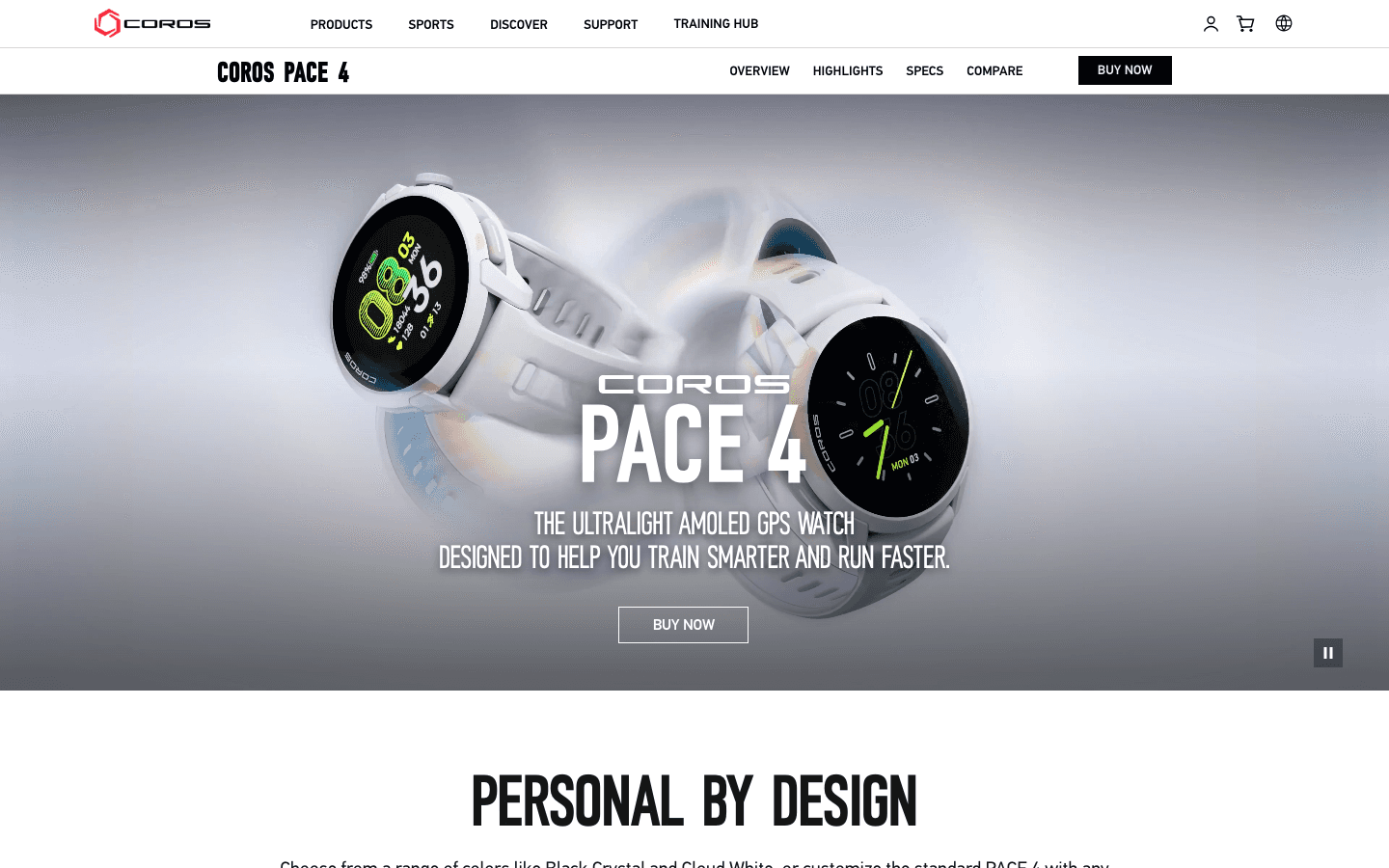
The PACE 4 measures 43.4mm across and 11.8mm thick. That thickness is surprisingly svelte for a watch with an AMOLED panel and multi-band GPS inside. The nylon band version weighs 32 grams on your wrist, which is lighter than most running earbuds.
The case is polycarbonate with a mineral glass screen. It feels purposeful rather than premium. COROS is not trying to compete with the Garmin Fenix or Polar Grit on materials. What the plastic case trades in feel it makes up for in weight savings and price.
The watch is rated 5 ATM, meaning it handles swimming and showering without issue. The band comes in multiple colorways including Black Crystal and Cloud White. A silicone band option adds 8 grams if you prefer a more traditional feel during humid conditions.
Display
COROS made a real upgrade here. The 1.2-inch AMOLED display shows 164% higher resolution than the PACE 3. In direct sunlight, the screen holds up well. Colors are vivid, text is sharp, and the always-on mode remains readable without hammering battery.
The interface uses a single side button plus touchscreen. Navigation is clean and fast. Data fields during a run are configurable with up to 6 fields per screen. The touch sensitivity is good enough that you can swipe through screens mid-run with a sweaty finger, though the button is more reliable in downpour conditions.
GPS Accuracy and Performance
COROS added dual-frequency GPS (L1+L5) to the PACE 4. In open-sky conditions on road runs, the tracking is precise. Distance readings consistently matched measured course lengths to within about 0.05 miles per 5-mile run.
In urban canyons and on tree-covered trails, dual-frequency made a visible difference compared to single-band watches. Tracks stayed on the road rather than cutting through buildings, and mile-pace fluctuations were reduced. The watch supports all major satellite systems: GPS, GLONASS, Galileo, BeiDou, and QZSS.
Signal acquisition from cold start took under 30 seconds in most tests. If you use the COROS app regularly, the watch downloads predicted satellite data via the phone, and cold starts drop to 5 to 10 seconds.
Battery Life
COROS claims 41 hours in GPS mode. Real-world testing matched that closely, coming in around 38 to 41 hours depending on whether all-systems or dual-frequency GPS was active (dual-frequency draws slightly more).
Daily use with GPS off and heart rate monitoring active lasted 19 days on a charge. That is class-leading at this price. The Garmin Forerunner 265 at a similar price point gets about 13 hours of GPS and 13 days daily use. The PACE 4's battery advantage is significant for ultramarathon runners, but it matters for everyday athletes too since charging is less frequent.
USB-C charging is fast, bringing the watch from empty to 80% in about an hour.
Health and Recovery Tracking
The PACE 4 tracks heart rate continuously, sleep stages, HRV (heart rate variability), and menstrual cycle. The redesigned HR sensor uses larger LEDs and improved algorithms compared to the PACE 3, and accuracy during moderate-intensity runs was solid.
COROS provides a daily readiness score based on HRV and sleep data. It does not push you into a recovery protocol or block hard training sessions, but the data is there if you want to inform your own decisions. For a deeper look at how wearable data can shape your schedule, see our wearable comparison guide.
One gap: there is no skin temperature sensor, which limits some of the baseline illness-detection features you get on Oura Ring or Garmin Fenix. But for running-focused athletes, the metrics that matter (HRV, sleep quality, resting heart rate) are all present.
Training Features
COROS has built out its training intelligence significantly. The PACE 4 includes a race predictor that estimates your finish time at various distances based on recent workouts. There is also a personalized marathon plan builder and a virtual pacer that adjusts your target pace based on current conditions.
Structured workout creation is done in the COROS app or Training Hub (the web platform). You can build interval sessions with specific heart rate or pace targets and push them to the watch. The watch guides you through each segment with vibration alerts and clear on-screen prompts.
Navigation uses breadcrumb trail routing rather than full topo maps. You can load a GPX course onto the watch and follow it, with turn-by-turn vibration cues. It is not as visual as the mapping on a Garmin Fenix, but it covers 95% of use cases for trail and road runners. The PACE 4 also added topographic map support as of the latest firmware update.
COROS App and Integrations
The COROS app is clean and data-rich. Syncing is fast. Post-run analysis shows pace, heart rate, elevation, and a route map. Training load trends are visible over rolling 42-day windows.
Third-party integrations include Strava, TrainingPeaks, Wikiloc, and RidewithGPS. The COROS app does not sync natively to Apple Health or Google Health, which is a limitation if you use a platform like Garmin-connected apps that pull from health aggregators. See our related guide on getting the most from fitness wearables for workflow tips that apply here too.
Plan Smarter Training with Lifestack
The COROS PACE 4 gives you the data. What you do with it on your calendar is the next problem to solve.

Lifestack is a daily planner that schedules your work and workouts around your energy levels rather than just clock time. When your HRV trends low after a hard week, Lifestack shifts high-output tasks to later in the day and keeps your morning lighter. When recovery metrics look good, it puts your hardest cognitive work first.
The result is a schedule that reflects your actual capacity, not an idealized version of it. Athletes using COROS data to track training load can build that same logic into their work calendar with an energy-aware planning approach. Lifestack costs $10/month or $50/year, with a 7-day free trial on the annual plan.
Who Should Buy the COROS PACE 4?
Serious runners on a budget: The $249 price delivers specs that cost $350 to $400 elsewhere. Hard to beat.
Ultra and long-course athletes: 41-hour GPS battery means you can race an ultra and log the whole thing without carrying a backup watch.
Anyone upgrading from a basic GPS watch: The jump from single-band GPS to dual-frequency tracking makes a noticeable difference in accuracy on trails and in cities.
Not for you if: You want Apple Pay, music streaming, a third-party app store, or deep Apple Health/Google Health integration. The Apple Watch Ultra or Garmin Venu series cover those needs, as covered in our Apple Watch productivity guide.
Frequently Asked Questions
How much does the COROS PACE 4 cost?
The COROS PACE 4 is priced at $249 USD, GBP 229, or EUR 269 at launch. It is available directly from coros.com and at major running retailers.
Does the COROS PACE 4 have maps?
Yes. The PACE 4 supports breadcrumb navigation and, with the latest firmware, topographic maps. It is not as visual as the turn-by-turn street maps on a Garmin Fenix, but it covers route following and GPX import for trail and road running.
How does the COROS PACE 4 compare to Garmin Forerunner 265?
Both are AMOLED GPS watches in the same price bracket. The PACE 4 has significantly better battery life (41 vs. 13 GPS hours) and is lighter (32g vs. 49g). The Forerunner 265 has better ecosystem integration with Garmin Connect, Garmin Pay, and a broader third-party app library. For pure running performance, the PACE 4 holds its own.
Does the COROS PACE 4 sync with Strava?
Yes. The COROS app has a native Strava integration that auto-uploads completed activities. It also syncs with TrainingPeaks, RidewithGPS, and Wikiloc.
Is the COROS PACE 4 good for beginners?
It can be, but the interface and feature depth are really built for athletes who want to use the data. If you are just starting to run and want a simple step counter and GPS tracker, a basic Garmin Forerunner 55 or Fitbit Charge 6 might be a better starting point. The PACE 4 rewards users who dig into training load, HRV, and structured workouts. See our habit tracker guide for building the kind of routine that gets more out of wearable data.
Does the COROS PACE 4 have contactless payment?
No. COROS does not include NFC or contactless payment on the PACE 4. This is a deliberate trade-off to keep weight low and battery life high. If NFC pay is a must-have, look at the Apple Watch SE or Garmin Venu 3 instead.
Who Is the COROS PACE 4 For?
The COROS PACE 4 launched in November 2025 at $249 and immediately set a new bar for what a budget GPS running watch can do. At 32 grams with a nylon band, it is one of the lightest GPS watches on the market. It pairs that weight with an AMOLED display and 41 hours of GPS battery life, specs you would normally see on watches costing $100 to $150 more.
This is not a smartwatch. There is no contactless payment, no third-party app store, and no streaming music. COROS builds for athletes who want precise training data and nothing that drains battery or adds weight. If that sounds like you, the PACE 4 is worth a close look.
We tested it over several weeks across road runs, trail sessions, and daily use. Here is what held up and where the trade-offs are.
Key Takeaways
At $249, the COROS PACE 4 delivers AMOLED display quality and GPS accuracy that rivals watches costing $350 to $400.
The 41-hour GPS battery life is exceptional for a watch this light and thin.
It is a pure athlete's tool. No contactless pay, no app store, no music streaming.
Design and Build Quality
The PACE 4 measures 43.4mm across and 11.8mm thick. That thickness is surprisingly svelte for a watch with an AMOLED panel and multi-band GPS inside. The nylon band version weighs 32 grams on your wrist, which is lighter than most running earbuds.
The case is polycarbonate with a mineral glass screen. It feels purposeful rather than premium. COROS is not trying to compete with the Garmin Fenix or Polar Grit on materials. What the plastic case trades in feel it makes up for in weight savings and price.
The watch is rated 5 ATM, meaning it handles swimming and showering without issue. The band comes in multiple colorways including Black Crystal and Cloud White. A silicone band option adds 8 grams if you prefer a more traditional feel during humid conditions.
Display
COROS made a real upgrade here. The 1.2-inch AMOLED display shows 164% higher resolution than the PACE 3. In direct sunlight, the screen holds up well. Colors are vivid, text is sharp, and the always-on mode remains readable without hammering battery.
The interface uses a single side button plus touchscreen. Navigation is clean and fast. Data fields during a run are configurable with up to 6 fields per screen. The touch sensitivity is good enough that you can swipe through screens mid-run with a sweaty finger, though the button is more reliable in downpour conditions.
GPS Accuracy and Performance
COROS added dual-frequency GPS (L1+L5) to the PACE 4. In open-sky conditions on road runs, the tracking is precise. Distance readings consistently matched measured course lengths to within about 0.05 miles per 5-mile run.
In urban canyons and on tree-covered trails, dual-frequency made a visible difference compared to single-band watches. Tracks stayed on the road rather than cutting through buildings, and mile-pace fluctuations were reduced. The watch supports all major satellite systems: GPS, GLONASS, Galileo, BeiDou, and QZSS.
Signal acquisition from cold start took under 30 seconds in most tests. If you use the COROS app regularly, the watch downloads predicted satellite data via the phone, and cold starts drop to 5 to 10 seconds.
Battery Life
COROS claims 41 hours in GPS mode. Real-world testing matched that closely, coming in around 38 to 41 hours depending on whether all-systems or dual-frequency GPS was active (dual-frequency draws slightly more).
Daily use with GPS off and heart rate monitoring active lasted 19 days on a charge. That is class-leading at this price. The Garmin Forerunner 265 at a similar price point gets about 13 hours of GPS and 13 days daily use. The PACE 4's battery advantage is significant for ultramarathon runners, but it matters for everyday athletes too since charging is less frequent.
USB-C charging is fast, bringing the watch from empty to 80% in about an hour.
Health and Recovery Tracking
The PACE 4 tracks heart rate continuously, sleep stages, HRV (heart rate variability), and menstrual cycle. The redesigned HR sensor uses larger LEDs and improved algorithms compared to the PACE 3, and accuracy during moderate-intensity runs was solid.
COROS provides a daily readiness score based on HRV and sleep data. It does not push you into a recovery protocol or block hard training sessions, but the data is there if you want to inform your own decisions. For a deeper look at how wearable data can shape your schedule, see our wearable comparison guide.
One gap: there is no skin temperature sensor, which limits some of the baseline illness-detection features you get on Oura Ring or Garmin Fenix. But for running-focused athletes, the metrics that matter (HRV, sleep quality, resting heart rate) are all present.
Training Features
COROS has built out its training intelligence significantly. The PACE 4 includes a race predictor that estimates your finish time at various distances based on recent workouts. There is also a personalized marathon plan builder and a virtual pacer that adjusts your target pace based on current conditions.
Structured workout creation is done in the COROS app or Training Hub (the web platform). You can build interval sessions with specific heart rate or pace targets and push them to the watch. The watch guides you through each segment with vibration alerts and clear on-screen prompts.
Navigation uses breadcrumb trail routing rather than full topo maps. You can load a GPX course onto the watch and follow it, with turn-by-turn vibration cues. It is not as visual as the mapping on a Garmin Fenix, but it covers 95% of use cases for trail and road runners. The PACE 4 also added topographic map support as of the latest firmware update.
COROS App and Integrations
The COROS app is clean and data-rich. Syncing is fast. Post-run analysis shows pace, heart rate, elevation, and a route map. Training load trends are visible over rolling 42-day windows.
Third-party integrations include Strava, TrainingPeaks, Wikiloc, and RidewithGPS. The COROS app does not sync natively to Apple Health or Google Health, which is a limitation if you use a platform like Garmin-connected apps that pull from health aggregators. See our related guide on getting the most from fitness wearables for workflow tips that apply here too.
Plan Smarter Training with Lifestack
The COROS PACE 4 gives you the data. What you do with it on your calendar is the next problem to solve.
Lifestack is a daily planner that schedules your work and workouts around your energy levels rather than just clock time. When your HRV trends low after a hard week, Lifestack shifts high-output tasks to later in the day and keeps your morning lighter. When recovery metrics look good, it puts your hardest cognitive work first.
The result is a schedule that reflects your actual capacity, not an idealized version of it. Athletes using COROS data to track training load can build that same logic into their work calendar with an energy-aware planning approach. Lifestack costs $10/month or $50/year, with a 7-day free trial on the annual plan.
Who Should Buy the COROS PACE 4?
Serious runners on a budget: The $249 price delivers specs that cost $350 to $400 elsewhere. Hard to beat.
Ultra and long-course athletes: 41-hour GPS battery means you can race an ultra and log the whole thing without carrying a backup watch.
Anyone upgrading from a basic GPS watch: The jump from single-band GPS to dual-frequency tracking makes a noticeable difference in accuracy on trails and in cities.
Not for you if: You want Apple Pay, music streaming, a third-party app store, or deep Apple Health/Google Health integration. The Apple Watch Ultra or Garmin Venu series cover those needs, as covered in our Apple Watch productivity guide.
Frequently Asked Questions
How much does the COROS PACE 4 cost?
The COROS PACE 4 is priced at $249 USD, GBP 229, or EUR 269 at launch. It is available directly from coros.com and at major running retailers.
Does the COROS PACE 4 have maps?
Yes. The PACE 4 supports breadcrumb navigation and, with the latest firmware, topographic maps. It is not as visual as the turn-by-turn street maps on a Garmin Fenix, but it covers route following and GPX import for trail and road running.
How does the COROS PACE 4 compare to Garmin Forerunner 265?
Both are AMOLED GPS watches in the same price bracket. The PACE 4 has significantly better battery life (41 vs. 13 GPS hours) and is lighter (32g vs. 49g). The Forerunner 265 has better ecosystem integration with Garmin Connect, Garmin Pay, and a broader third-party app library. For pure running performance, the PACE 4 holds its own.
Does the COROS PACE 4 sync with Strava?
Yes. The COROS app has a native Strava integration that auto-uploads completed activities. It also syncs with TrainingPeaks, RidewithGPS, and Wikiloc.
Is the COROS PACE 4 good for beginners?
It can be, but the interface and feature depth are really built for athletes who want to use the data. If you are just starting to run and want a simple step counter and GPS tracker, a basic Garmin Forerunner 55 or Fitbit Charge 6 might be a better starting point. The PACE 4 rewards users who dig into training load, HRV, and structured workouts. See our habit tracker guide for building the kind of routine that gets more out of wearable data.
Does the COROS PACE 4 have contactless payment?
No. COROS does not include NFC or contactless payment on the PACE 4. This is a deliberate trade-off to keep weight low and battery life high. If NFC pay is a must-have, look at the Apple Watch SE or Garmin Venu 3 instead.



FOLLOW ON
FOLLOW ON
FOLLOW ON


Copyright 2026 © Lifestack. All rights reserved
Copyright 2026 © Lifestack. All rights reserved

