
Device
COROS Watch: Which Model Should You Buy in 2026?
COROS Watch: Which Model Should You Buy in 2026?

COROS built its reputation making GPS watches that prioritized battery life and training accuracy over smartwatch features. While Garmin was loading up its watches with music storage and contactless payments, COROS was asking a different question: what does a dedicated athlete actually need? The answer they landed on was precise GPS, long battery life, a light chassis, and a clean training platform. That bet has paid off.
Today the COROS lineup spans five distinct watches, from a $199 entry-level runner to a $699 ultra-endurance beast. Each targets a different type of athlete, and the differences matter. Picking the wrong model means paying for features you will never use, or skimping on the ones that matter most to your training.
This guide covers every current COROS watch, compares their key specs side by side, and tells you which one to buy based on what you actually do. Prices are current as of October 2026.
Key Takeaways
The COROS PACE 4 at $249 is the best all-round GPS running watch at its price point in 2026 for most athletes
Battery life is COROS's biggest differentiator: even the entry-level PACE 3 gets 38 hours of GPS tracking
The new PACE 4 Pro at $449 brings flagship-level brightness and speaker features without the bulk of the APEX or VERTIX line
COROS Watch Lineup at a Glance
COROS PACE 3 ($199) - Entry-level GPS running watch with 38h GPS battery
COROS PACE 4 ($249) - AMOLED upgrade with voice control and 41h GPS
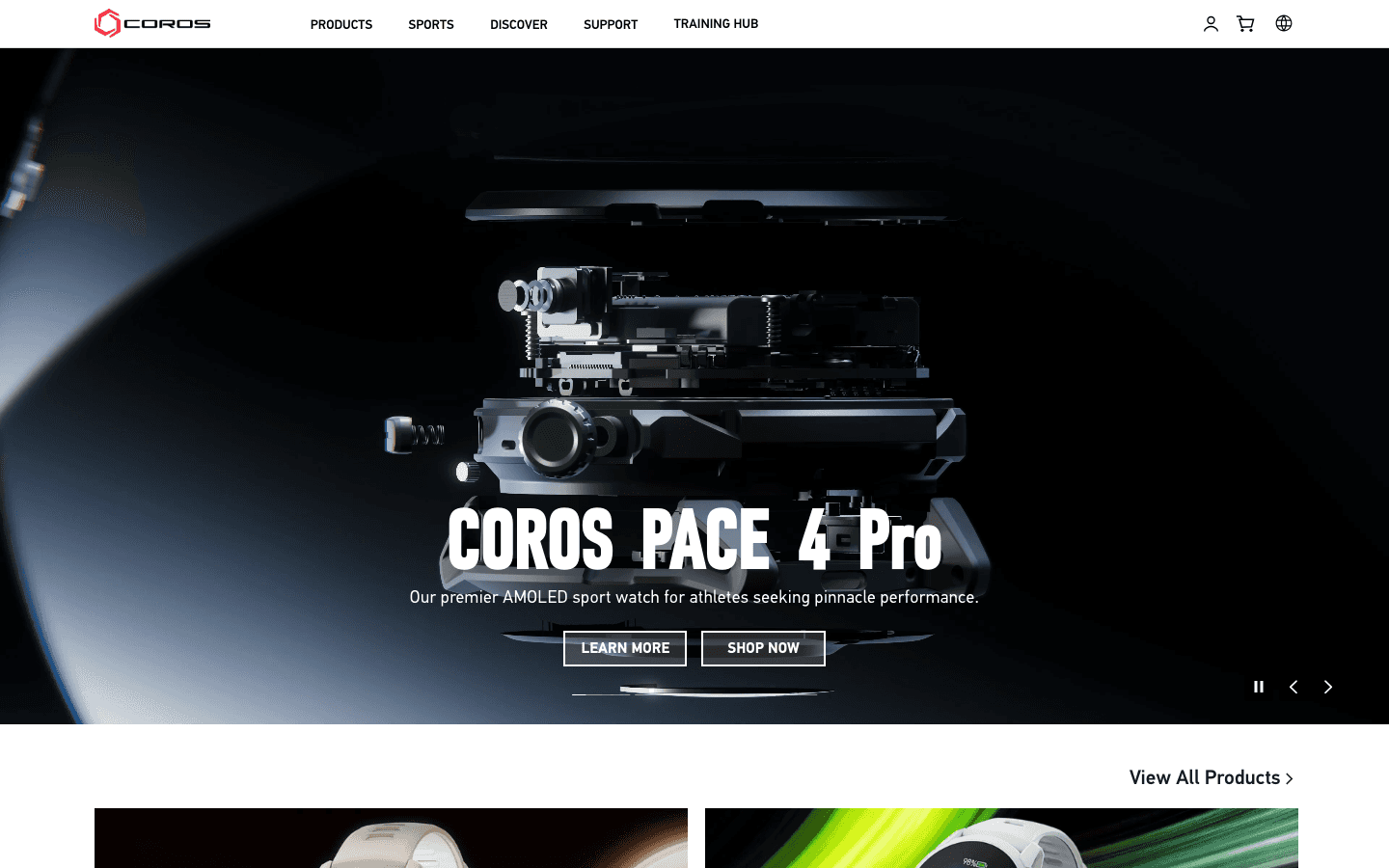
COROS PACE 4 Pro ($449) - New flagship runner with 3,500-nit AMOLED, titanium, and speaker
COROS APEX 4 ($429-479) - Trail and adventure watch with sapphire glass and extreme battery
COROS VERTIX 2S ($699) - Ultra-endurance expedition watch with 118h GPS
COROS PACE 3: The Budget-Friendly Starter
At $199, the PACE 3 is the entry point into the COROS ecosystem. It is still a capable GPS watch by any objective measure: dual-frequency GPS for accurate tracking in tree cover and urban canyons, 38 hours of GPS battery life, a 30-gram body, and a training platform that matches much more expensive watches.
What you give up at this price is the display. The PACE 3 uses an LCD screen that looks dated next to the AMOLED panels on newer models. Colors are muted, and readability in direct sunlight is adequate but not impressive. For athletes training by feel or following structured workouts where they glance at data fields rather than admiring the display, none of that matters much.
Best for: first-time GPS watch buyers, triathletes on a budget, runners who want accurate training data without spending more than needed.
COROS PACE 4: The Best All-Rounder
This is the watch most runners should buy. The PACE 4 ($249) brings a bright AMOLED display, voice control, a digital crown interface, and 41 hours of GPS battery into a 32-gram body. The jump from the PACE 3 costs $50 and buys a meaningfully better experience every single day you wear it. The full COROS PACE 4 review covers it in depth, but the short version is: this watch punches well above its price.
The PACE 4 supports dual-frequency GPS, heart rate monitoring, sleep tracking, HRV status, VO2 max estimation, and over 30 sport modes. It pairs with the COROS Heart Rate Monitor arm band for more accurate training data during intervals. The daily battery life of 19 days means most athletes charge it once every two weeks.
Best for: everyday runners, Garmin switchers looking for better battery life, structured workout athletes, anyone who wants the best GPS watch under $300.
COROS PACE 4 Pro: The New Flagship Runner
Released in September 2026, the PACE 4 Pro ($449) is the most technically impressive watch in the COROS lineup for runners. The display is a 1.47-inch AMOLED hitting 3,500 nits, which is bright enough to read clearly in full direct sunlight. It has a titanium bezel, sapphire glass, USB-C charging, and a built-in speaker for calls and audio coaching.
The battery trades slightly against the PACE 4: 38 hours of GPS versus 41. That is a minor difference in practice, and the six-day always-on display mode is genuinely useful for athletes who want constant time visibility without constant charging. Full offline maps are included, making it a capable navigation watch for trail runners and multi-sport events.
At $449 it competes directly with the Garmin Forerunner 965. For athletes who do not need the APEX's adventure-sport features, the PACE 4 Pro offers more display brightness and a lighter build. Best for: serious competitive runners, trail runners who want navigation, athletes upgrading from the PACE 4 who train in bright conditions.
COROS APEX 4: For Trail Runners and Adventure Athletes
The APEX 4 ($429 for 42mm, $479 for 46mm) is where COROS adds adventure-specific durability and features. Both versions use titanium cases with sapphire glass and MIP displays. MIP (memory-in-pixel) is not as vibrant as AMOLED in normal conditions, but it performs better in extreme cold and holds up over years of hard use better than OLED panels tend to.
Battery life is the headline: the 46mm APEX 4 delivers 65 hours of GPS tracking and 41 days of daily use. Climbers, fastpackers, and ultra trail runners operating in remote areas will find this compelling. COROS also added vertical GPS accuracy for climbing routes and voice pins for logging locations without stopping to type. The watch supports offline maps for both road and trail navigation.
The 42mm version suits smaller wrists and still delivers 41 hours of GPS. Both are heavier than the PACE line (the 46mm comes in at 64 grams), which matters for road racing but much less for trail and mountain use. For the ongoing debate between COROS and Garmin in the trail segment, the APEX 4 competes with the Fenix 8 Solar at a lower price.
COROS VERTIX 2S: For Expedition Athletes
The VERTIX 2S ($699) is built for the small group of athletes who genuinely need 118 hours of GPS battery life. Think ultra-distance trail races, multi-day mountaineering expeditions, and expedition kayaking where a charger is not available for days at a time. It is large, heavy, and priced accordingly.
For the vast majority of athletes, including most trail runners and even most ultramarathon competitors, the VERTIX 2S is more watch than needed. The APEX 4's 65-hour GPS battery is more than enough for any single-stage race or multi-day route with overnight charging stops. Unless you are specifically doing unsupported expeditions in remote terrain, the $479 APEX 4 covers the same use cases at a lower price.
Best for: unsupported ultra endurance athletes, mountaineers, expedition kayakers. Not recommended for road runners, triathletes, or most trail runners.
COROS vs Garmin: The Short Version
The comparison that comes up constantly when someone considers a COROS watch is whether to buy Garmin instead. The full COROS vs Garmin breakdown is worth reading if you are on the fence, but the headline differences are: COROS wins on battery life and price at every comparable tier, Garmin wins on app ecosystem, third-party integrations, and the breadth of its smartwatch features like music and contactless payments.
For athletes who train with purpose and want the best GPS accuracy and training data for the money, COROS is a serious choice. For athletes who want their watch to also serve as a day-to-day smartwatch, Garmin's wider feature set is worth the premium.
Training Data Is Only Half the Picture
A COROS watch tells you a lot about your body during training. What it does not do is help you structure the rest of your day around that data. If your watch shows high training load and low HRV, that probably means your afternoon meetings and evening commitments need to shift toward lighter cognitive work. Most athletes never act on that connection. Lifestack is built to close that gap.
Lifestack is an AI planner that schedules your tasks and calendar around your energy levels. It learns your patterns, factors in recovery, and moves demanding work into your peak windows. Pair it with the training structure your COROS provides and you get a full picture of performance, not just the athletic side. Lifestack is $50 per year with a 7-day free trial. For athletes building a wellness routine that actually sticks, it fills a gap no watch can fill on its own.
Which COROS Watch Should You Buy?
Want the best value: COROS PACE 4 at $249. Best GPS watch under $300.
On a tight budget: COROS PACE 3 at $199. All the training data, basic display.
Serious competitive runner who trains outdoors: COROS PACE 4 Pro at $449. Unmatched display brightness and lightweight build for performance running.
Trail runner or adventure athlete: COROS APEX 4 (46mm) at $479. 65-hour GPS, titanium build, offline maps.
Expedition or unsupported ultra athlete: COROS VERTIX 2S at $699. Only for athletes who need 100+ hours of GPS.
For VO2 max training context, the guide to improving VO2 max covers how to use the metrics your COROS generates. And if you are comparing the APEX 4 against Garmin's Forerunner or Fenix line, the Garmin Venu 3 review gives useful side-by-side context.
Frequently Asked Questions
What is the best COROS watch for beginners?
The COROS PACE 4 at $249 is the best starting point for most athletes. It includes every core training feature, an AMOLED display, and 41 hours of GPS in a 32-gram body. If budget is the priority, the PACE 3 at $199 works well and trades only the display quality.
How do COROS watches compare to Garmin for running?
COROS watches consistently match or beat Garmin on GPS accuracy and battery life at comparable price points. Garmin has a larger app ecosystem and more smartwatch features. For pure running performance, COROS vs Garmin is closer than Garmin's marketing suggests.
Does COROS make a watch for triathletes?
Yes. The PACE 3, PACE 4, and PACE 4 Pro all support triathlon mode with automatic sport transitions. The APEX 4 adds open-water swim navigation. All COROS watches work with the COROS Heart Rate Monitor for arm-based HR during training.
How long does a COROS watch battery last?
Daily battery life ranges from 17 days (PACE 3) to 41 days (APEX 4 46mm). GPS battery spans from 38 hours (PACE 3, PACE 4 Pro) up to 118 hours (VERTIX 2S). Every COROS watch lasts significantly longer than comparable Apple Watch or Samsung Galaxy Watch models.
Is COROS compatible with iPhone and Android?
Yes. The COROS app works with both iOS and Android. Syncing is handled via Bluetooth to the COROS app, which also connects to Strava, TrainingPeaks, and other third-party training platforms.
Does COROS track HRV?
COROS watches display HRV status as part of their training load and recovery metrics. For deeper HRV analysis and dedicated overnight tracking, you can pair a COROS watch with a third-party app or review our list of the best HRV tracker apps.
COROS built its reputation making GPS watches that prioritized battery life and training accuracy over smartwatch features. While Garmin was loading up its watches with music storage and contactless payments, COROS was asking a different question: what does a dedicated athlete actually need? The answer they landed on was precise GPS, long battery life, a light chassis, and a clean training platform. That bet has paid off.
Today the COROS lineup spans five distinct watches, from a $199 entry-level runner to a $699 ultra-endurance beast. Each targets a different type of athlete, and the differences matter. Picking the wrong model means paying for features you will never use, or skimping on the ones that matter most to your training.
This guide covers every current COROS watch, compares their key specs side by side, and tells you which one to buy based on what you actually do. Prices are current as of October 2026.
Key Takeaways
The COROS PACE 4 at $249 is the best all-round GPS running watch at its price point in 2026 for most athletes
Battery life is COROS's biggest differentiator: even the entry-level PACE 3 gets 38 hours of GPS tracking
The new PACE 4 Pro at $449 brings flagship-level brightness and speaker features without the bulk of the APEX or VERTIX line
COROS Watch Lineup at a Glance
COROS PACE 3 ($199) - Entry-level GPS running watch with 38h GPS battery
COROS PACE 4 ($249) - AMOLED upgrade with voice control and 41h GPS
COROS PACE 4 Pro ($449) - New flagship runner with 3,500-nit AMOLED, titanium, and speaker
COROS APEX 4 ($429-479) - Trail and adventure watch with sapphire glass and extreme battery
COROS VERTIX 2S ($699) - Ultra-endurance expedition watch with 118h GPS
COROS PACE 3: The Budget-Friendly Starter
At $199, the PACE 3 is the entry point into the COROS ecosystem. It is still a capable GPS watch by any objective measure: dual-frequency GPS for accurate tracking in tree cover and urban canyons, 38 hours of GPS battery life, a 30-gram body, and a training platform that matches much more expensive watches.
What you give up at this price is the display. The PACE 3 uses an LCD screen that looks dated next to the AMOLED panels on newer models. Colors are muted, and readability in direct sunlight is adequate but not impressive. For athletes training by feel or following structured workouts where they glance at data fields rather than admiring the display, none of that matters much.
Best for: first-time GPS watch buyers, triathletes on a budget, runners who want accurate training data without spending more than needed.
COROS PACE 4: The Best All-Rounder
This is the watch most runners should buy. The PACE 4 ($249) brings a bright AMOLED display, voice control, a digital crown interface, and 41 hours of GPS battery into a 32-gram body. The jump from the PACE 3 costs $50 and buys a meaningfully better experience every single day you wear it. The full COROS PACE 4 review covers it in depth, but the short version is: this watch punches well above its price.
The PACE 4 supports dual-frequency GPS, heart rate monitoring, sleep tracking, HRV status, VO2 max estimation, and over 30 sport modes. It pairs with the COROS Heart Rate Monitor arm band for more accurate training data during intervals. The daily battery life of 19 days means most athletes charge it once every two weeks.
Best for: everyday runners, Garmin switchers looking for better battery life, structured workout athletes, anyone who wants the best GPS watch under $300.
COROS PACE 4 Pro: The New Flagship Runner
Released in September 2026, the PACE 4 Pro ($449) is the most technically impressive watch in the COROS lineup for runners. The display is a 1.47-inch AMOLED hitting 3,500 nits, which is bright enough to read clearly in full direct sunlight. It has a titanium bezel, sapphire glass, USB-C charging, and a built-in speaker for calls and audio coaching.
The battery trades slightly against the PACE 4: 38 hours of GPS versus 41. That is a minor difference in practice, and the six-day always-on display mode is genuinely useful for athletes who want constant time visibility without constant charging. Full offline maps are included, making it a capable navigation watch for trail runners and multi-sport events.
At $449 it competes directly with the Garmin Forerunner 965. For athletes who do not need the APEX's adventure-sport features, the PACE 4 Pro offers more display brightness and a lighter build. Best for: serious competitive runners, trail runners who want navigation, athletes upgrading from the PACE 4 who train in bright conditions.
COROS APEX 4: For Trail Runners and Adventure Athletes
The APEX 4 ($429 for 42mm, $479 for 46mm) is where COROS adds adventure-specific durability and features. Both versions use titanium cases with sapphire glass and MIP displays. MIP (memory-in-pixel) is not as vibrant as AMOLED in normal conditions, but it performs better in extreme cold and holds up over years of hard use better than OLED panels tend to.
Battery life is the headline: the 46mm APEX 4 delivers 65 hours of GPS tracking and 41 days of daily use. Climbers, fastpackers, and ultra trail runners operating in remote areas will find this compelling. COROS also added vertical GPS accuracy for climbing routes and voice pins for logging locations without stopping to type. The watch supports offline maps for both road and trail navigation.
The 42mm version suits smaller wrists and still delivers 41 hours of GPS. Both are heavier than the PACE line (the 46mm comes in at 64 grams), which matters for road racing but much less for trail and mountain use. For the ongoing debate between COROS and Garmin in the trail segment, the APEX 4 competes with the Fenix 8 Solar at a lower price.
COROS VERTIX 2S: For Expedition Athletes
The VERTIX 2S ($699) is built for the small group of athletes who genuinely need 118 hours of GPS battery life. Think ultra-distance trail races, multi-day mountaineering expeditions, and expedition kayaking where a charger is not available for days at a time. It is large, heavy, and priced accordingly.
For the vast majority of athletes, including most trail runners and even most ultramarathon competitors, the VERTIX 2S is more watch than needed. The APEX 4's 65-hour GPS battery is more than enough for any single-stage race or multi-day route with overnight charging stops. Unless you are specifically doing unsupported expeditions in remote terrain, the $479 APEX 4 covers the same use cases at a lower price.
Best for: unsupported ultra endurance athletes, mountaineers, expedition kayakers. Not recommended for road runners, triathletes, or most trail runners.
COROS vs Garmin: The Short Version
The comparison that comes up constantly when someone considers a COROS watch is whether to buy Garmin instead. The full COROS vs Garmin breakdown is worth reading if you are on the fence, but the headline differences are: COROS wins on battery life and price at every comparable tier, Garmin wins on app ecosystem, third-party integrations, and the breadth of its smartwatch features like music and contactless payments.
For athletes who train with purpose and want the best GPS accuracy and training data for the money, COROS is a serious choice. For athletes who want their watch to also serve as a day-to-day smartwatch, Garmin's wider feature set is worth the premium.
Training Data Is Only Half the Picture
A COROS watch tells you a lot about your body during training. What it does not do is help you structure the rest of your day around that data. If your watch shows high training load and low HRV, that probably means your afternoon meetings and evening commitments need to shift toward lighter cognitive work. Most athletes never act on that connection. Lifestack is built to close that gap.
Lifestack is an AI planner that schedules your tasks and calendar around your energy levels. It learns your patterns, factors in recovery, and moves demanding work into your peak windows. Pair it with the training structure your COROS provides and you get a full picture of performance, not just the athletic side. Lifestack is $50 per year with a 7-day free trial. For athletes building a wellness routine that actually sticks, it fills a gap no watch can fill on its own.
Which COROS Watch Should You Buy?
Want the best value: COROS PACE 4 at $249. Best GPS watch under $300.
On a tight budget: COROS PACE 3 at $199. All the training data, basic display.
Serious competitive runner who trains outdoors: COROS PACE 4 Pro at $449. Unmatched display brightness and lightweight build for performance running.
Trail runner or adventure athlete: COROS APEX 4 (46mm) at $479. 65-hour GPS, titanium build, offline maps.
Expedition or unsupported ultra athlete: COROS VERTIX 2S at $699. Only for athletes who need 100+ hours of GPS.
For VO2 max training context, the guide to improving VO2 max covers how to use the metrics your COROS generates. And if you are comparing the APEX 4 against Garmin's Forerunner or Fenix line, the Garmin Venu 3 review gives useful side-by-side context.
Frequently Asked Questions
What is the best COROS watch for beginners?
The COROS PACE 4 at $249 is the best starting point for most athletes. It includes every core training feature, an AMOLED display, and 41 hours of GPS in a 32-gram body. If budget is the priority, the PACE 3 at $199 works well and trades only the display quality.
How do COROS watches compare to Garmin for running?
COROS watches consistently match or beat Garmin on GPS accuracy and battery life at comparable price points. Garmin has a larger app ecosystem and more smartwatch features. For pure running performance, COROS vs Garmin is closer than Garmin's marketing suggests.
Does COROS make a watch for triathletes?
Yes. The PACE 3, PACE 4, and PACE 4 Pro all support triathlon mode with automatic sport transitions. The APEX 4 adds open-water swim navigation. All COROS watches work with the COROS Heart Rate Monitor for arm-based HR during training.
How long does a COROS watch battery last?
Daily battery life ranges from 17 days (PACE 3) to 41 days (APEX 4 46mm). GPS battery spans from 38 hours (PACE 3, PACE 4 Pro) up to 118 hours (VERTIX 2S). Every COROS watch lasts significantly longer than comparable Apple Watch or Samsung Galaxy Watch models.
Is COROS compatible with iPhone and Android?
Yes. The COROS app works with both iOS and Android. Syncing is handled via Bluetooth to the COROS app, which also connects to Strava, TrainingPeaks, and other third-party training platforms.
Does COROS track HRV?
COROS watches display HRV status as part of their training load and recovery metrics. For deeper HRV analysis and dedicated overnight tracking, you can pair a COROS watch with a third-party app or review our list of the best HRV tracker apps.



FOLLOW ON
FOLLOW ON
FOLLOW ON


Copyright 2026 © Lifestack. All rights reserved
Copyright 2026 © Lifestack. All rights reserved

