
App
DailyBot vs Focus Booster: What You Need to Know
DailyBot vs Focus Booster: What You Need to Know
What These Two Tools Actually Are
DailyBot and Focus Booster served very different audiences. DailyBot is an AI-powered team intelligence platform that plugs into Slack, Microsoft Teams, Google Chat, and Discord. Its job is to surface what your team is working on, surface blockers, run automated standups, and give managers and team members a shared view of progress without requiring constant meetings.
Focus Booster was a personal Pomodoro timer and time-tracking app aimed at individual knowledge workers. It let users track work sessions by client and project, building a detailed log of where their hours went. For freelancers billing clients or researchers tracking focused work, it filled a useful niche.
The important thing to know before going further: Focus Booster has been discontinued. The service shut down after 15 years of operation, and its domain now redirects to a domain resale page. If you're searching for this comparison because you're evaluating both tools, you can skip the Focus Booster side. It's no longer available.
Key Takeaways
Focus Booster was shut down permanently. There is no current version to sign up for, and existing accounts are no longer accessible.
DailyBot is alive, actively developed, and recently launched Dailybot 3 with AI agent coordination features. It's a team tool, not a personal Pomodoro app.
If you came here looking for a personal focus timer to replace Focus Booster, there are several strong alternatives worth considering.
DailyBot: What It Is and Who It's For
An AI team intelligence layer for async and hybrid teams on Slack, Teams, and Discord.
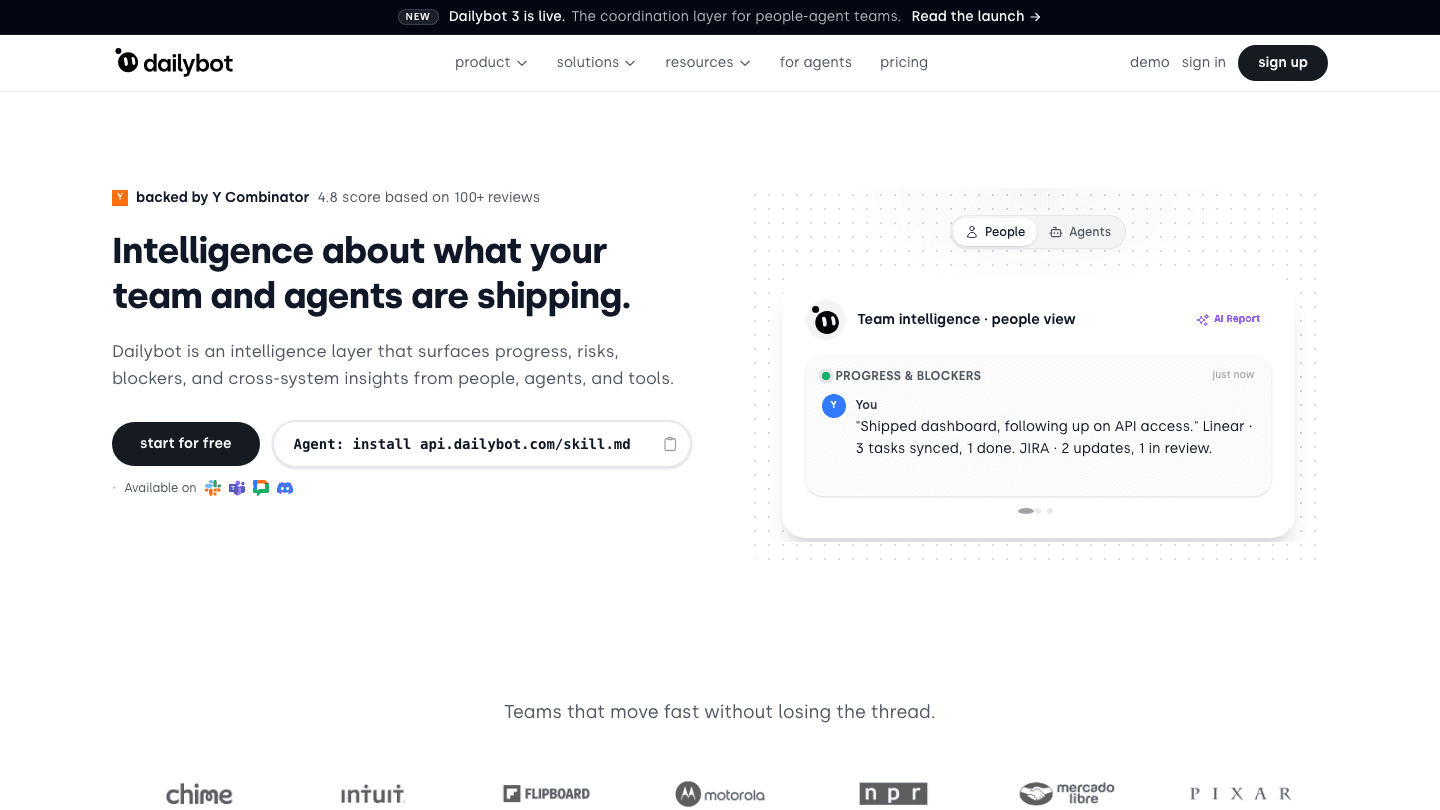
DailyBot has evolved well beyond its original standup-bot origins. The current version describes itself as an "intelligence layer" that surfaces progress, risks, and blockers from your team members, your agents, and your tools. It connects with Jira, Linear, GitHub, and other project tools to aggregate what's happening across your stack without requiring everyone to manually report in.
The automated standup feature is still the entry point for most teams: configure a daily check-in that asks team members about blockers and progress, then surfaces the responses in a shared channel. This eliminates synchronous status meetings for many teams without losing visibility. Kudos, forms, polls, and HR workflow features round out the platform for people-ops use cases.
Key Features: Automated standups and check-ins, AI-generated team reports, blocker and risk surfacing, integrations with Jira, Linear, GitHub, Google Calendar, kudos and recognition system, forms and polls, analytics dashboards
Platforms: Slack, Microsoft Teams, Google Chat, Discord, web app
What Works: Solid integrations ecosystem, genuinely reduces sync meetings for distributed teams, Dailybot 3's AI agent coordination is differentiated in the category
Limitations: Not a personal productivity tool. If you need task management, time tracking, or a focus timer, DailyBot doesn't address those needs. It's purely a team communication and visibility layer.
Pricing: Free plan (Starter, no credit card required); Essentials $2.40/active user per month; Advanced $5/active user per month; Enterprise custom pricing. Annual billing reduces rates further.
Best for: Engineering teams, remote or hybrid teams, and people-ops professionals who want async visibility into what their team is working on without adding synchronous overhead.
Focus Booster: What It Was
Focus Booster launched in 2011 as one of the early dedicated Pomodoro timer apps. Its core feature was pairing a Pomodoro timer directly with time-tracking so users could see exactly how many sessions they'd logged per project or client. The reporting was more detailed than most competing apps, making it popular among freelancers who billed hourly and needed accurate records.
The app was available on Mac, Windows, iOS, and the web, with sync across devices. It had a clean, distraction-free interface that stayed out of the way during focus sessions. For the narrow use case it served, it did the job well.
After 15 years of operation, Focus Booster shut down. The founders cited the challenge of competing with a crowded productivity app market as a key factor. The service is no longer available, and existing user data is not recoverable.
Alternatives to Focus Booster
If Focus Booster was part of your workflow, these are the strongest replacements depending on what you valued most:
Focus To-Do (free, $1.99/month premium, or $11.99 lifetime): The closest direct replacement. Full Pomodoro timer with task management, subtasks, recurring tasks, and detailed analytics by project. Available on iOS, Android, Mac, Windows, and Apple Watch.
Forest ($1.99 iOS, free Android with premium): A gamified focus timer where you grow a virtual tree during focus sessions. Less detailed analytics but more motivating for some users. Good for students and anyone who benefits from visual feedback.
Session (free, premium plans): Mac-native Pomodoro app with a clean design, website blocking during sessions, and a focus score. Aimed at Mac users who want a polished desktop experience.
All three are actively maintained. Focus To-Do is the most direct feature-for-feature replacement if you relied on Focus Booster for time tracking alongside Pomodoro sessions. You can also explore how a deep work tracker differs from a Pomodoro timer if your goal is measuring quality focus time rather than session count.
Which Should You Use?
The question is simpler than the keyword suggests. DailyBot and Focus Booster were never real competitors. One is a team communication platform; the other was a personal focus timer. They served different people with different problems.
If you're managing a distributed team and want better async visibility without more meetings, DailyBot is worth evaluating. The free plan is a genuine starting point, and the AI-generated team reports in Dailybot 3 are legitimately useful for engineering leads and project managers. Combining DailyBot with a structured daily routine for individual team members tends to produce the best results.
If you're looking for a personal focus timer to replace Focus Booster, get Focus To-Do. The $11.99 lifetime option is hard to beat, the Pomodoro implementation is solid, and the project-based analytics give you the same time-tracking visibility Focus Booster provided. It pairs well with a habit tracking system if you're building a consistent daily focus practice.
If you want your tasks and focus sessions to align with when you're actually mentally sharp rather than just following a fixed 25-minute cycle, an energy-aware scheduler handles a problem neither tool addresses. Time blocking based on energy outperforms rigid Pomodoro schedules for many knowledge workers, particularly those with variable energy across the day.
And if prioritizing which task to run your Pomodoro session on is where you get stuck, a structured approach to prioritization applied before you start any focus session will make both DailyBot's team visibility and any personal focus tool more effective.
What About Lifestack?
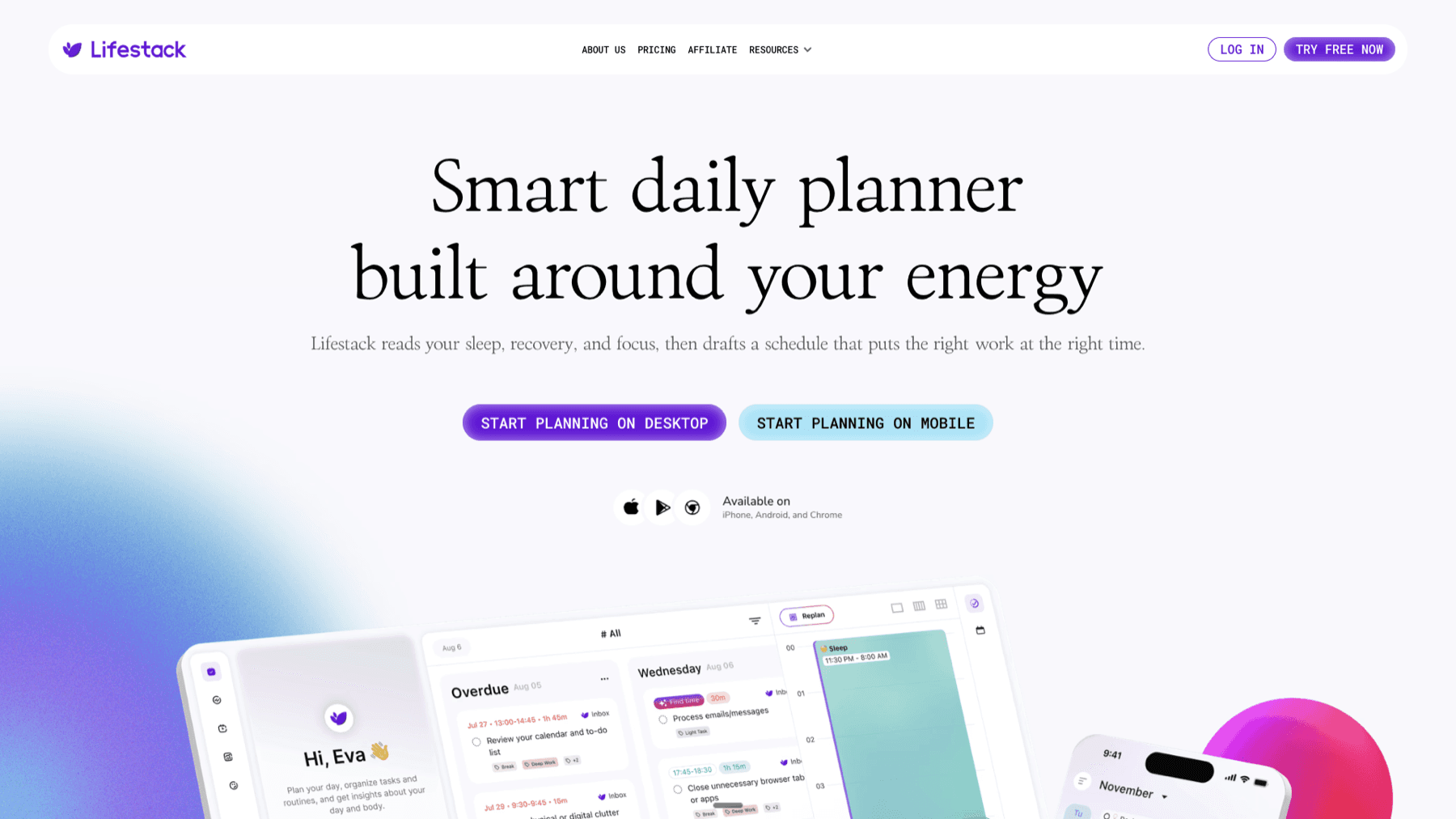
If what you're really after is a personal productivity system that handles both task management and smart scheduling, Lifestack is worth a look. It auto-schedules your tasks based on your energy patterns throughout the day, integrates with your existing calendars, and adjusts when your schedule shifts. Unlike a Pomodoro timer that treats all time blocks equally, Lifestack matches your hardest work to your highest-energy windows.
Pricing is $7/month or $50/year with a 7-day free trial, or $120 as a one-time lifetime purchase. It won't replace DailyBot if your need is team visibility, but for the personal productivity layer, it does more than any Pomodoro timer alone.
Frequently Asked Questions
Is Focus Booster still available?
No. Focus Booster was permanently shut down after 15 years of operation. The website now redirects to a domain sales page, and the service is no longer accessible. If you need a Pomodoro time-tracking app, Focus To-Do is the closest current alternative.
What is DailyBot used for?
DailyBot is a team intelligence platform that integrates with Slack, Microsoft Teams, Google Chat, and Discord. It automates team standups, surfaces blockers and progress from connected tools like Jira and GitHub, and provides AI-generated reports on team activity. It's aimed at distributed and hybrid teams that want async visibility without extra meetings.
Is DailyBot free?
Yes. DailyBot has a free Starter plan that requires no credit card and covers basic standup automation. Paid plans start at $2.40 per active user per month (Essentials) and $5 per active user per month (Advanced), with Enterprise custom pricing available.
What is the best replacement for Focus Booster?
Focus To-Do is the best direct replacement. It combines a customizable Pomodoro timer with task management and detailed project-based analytics, available on iOS, Android, Mac, Windows, and Apple Watch. The $11.99 lifetime option makes it significantly cheaper than a monthly subscription alternative.
Can DailyBot help with individual focus and time management?
Not directly. DailyBot is built for team coordination, not individual time management. It doesn't include a Pomodoro timer, personal task list, or focus session tracking. For individual productivity needs, a personal tool like Focus To-Do or a full scheduling system like Lifestack is more appropriate.
What These Two Tools Actually Are
DailyBot and Focus Booster served very different audiences. DailyBot is an AI-powered team intelligence platform that plugs into Slack, Microsoft Teams, Google Chat, and Discord. Its job is to surface what your team is working on, surface blockers, run automated standups, and give managers and team members a shared view of progress without requiring constant meetings.
Focus Booster was a personal Pomodoro timer and time-tracking app aimed at individual knowledge workers. It let users track work sessions by client and project, building a detailed log of where their hours went. For freelancers billing clients or researchers tracking focused work, it filled a useful niche.
The important thing to know before going further: Focus Booster has been discontinued. The service shut down after 15 years of operation, and its domain now redirects to a domain resale page. If you're searching for this comparison because you're evaluating both tools, you can skip the Focus Booster side. It's no longer available.
Key Takeaways
Focus Booster was shut down permanently. There is no current version to sign up for, and existing accounts are no longer accessible.
DailyBot is alive, actively developed, and recently launched Dailybot 3 with AI agent coordination features. It's a team tool, not a personal Pomodoro app.
If you came here looking for a personal focus timer to replace Focus Booster, there are several strong alternatives worth considering.
DailyBot: What It Is and Who It's For
An AI team intelligence layer for async and hybrid teams on Slack, Teams, and Discord.
DailyBot has evolved well beyond its original standup-bot origins. The current version describes itself as an "intelligence layer" that surfaces progress, risks, and blockers from your team members, your agents, and your tools. It connects with Jira, Linear, GitHub, and other project tools to aggregate what's happening across your stack without requiring everyone to manually report in.
The automated standup feature is still the entry point for most teams: configure a daily check-in that asks team members about blockers and progress, then surfaces the responses in a shared channel. This eliminates synchronous status meetings for many teams without losing visibility. Kudos, forms, polls, and HR workflow features round out the platform for people-ops use cases.
Key Features: Automated standups and check-ins, AI-generated team reports, blocker and risk surfacing, integrations with Jira, Linear, GitHub, Google Calendar, kudos and recognition system, forms and polls, analytics dashboards
Platforms: Slack, Microsoft Teams, Google Chat, Discord, web app
What Works: Solid integrations ecosystem, genuinely reduces sync meetings for distributed teams, Dailybot 3's AI agent coordination is differentiated in the category
Limitations: Not a personal productivity tool. If you need task management, time tracking, or a focus timer, DailyBot doesn't address those needs. It's purely a team communication and visibility layer.
Pricing: Free plan (Starter, no credit card required); Essentials $2.40/active user per month; Advanced $5/active user per month; Enterprise custom pricing. Annual billing reduces rates further.
Best for: Engineering teams, remote or hybrid teams, and people-ops professionals who want async visibility into what their team is working on without adding synchronous overhead.
Focus Booster: What It Was
Focus Booster launched in 2011 as one of the early dedicated Pomodoro timer apps. Its core feature was pairing a Pomodoro timer directly with time-tracking so users could see exactly how many sessions they'd logged per project or client. The reporting was more detailed than most competing apps, making it popular among freelancers who billed hourly and needed accurate records.
The app was available on Mac, Windows, iOS, and the web, with sync across devices. It had a clean, distraction-free interface that stayed out of the way during focus sessions. For the narrow use case it served, it did the job well.
After 15 years of operation, Focus Booster shut down. The founders cited the challenge of competing with a crowded productivity app market as a key factor. The service is no longer available, and existing user data is not recoverable.
Alternatives to Focus Booster
If Focus Booster was part of your workflow, these are the strongest replacements depending on what you valued most:
Focus To-Do (free, $1.99/month premium, or $11.99 lifetime): The closest direct replacement. Full Pomodoro timer with task management, subtasks, recurring tasks, and detailed analytics by project. Available on iOS, Android, Mac, Windows, and Apple Watch.
Forest ($1.99 iOS, free Android with premium): A gamified focus timer where you grow a virtual tree during focus sessions. Less detailed analytics but more motivating for some users. Good for students and anyone who benefits from visual feedback.
Session (free, premium plans): Mac-native Pomodoro app with a clean design, website blocking during sessions, and a focus score. Aimed at Mac users who want a polished desktop experience.
All three are actively maintained. Focus To-Do is the most direct feature-for-feature replacement if you relied on Focus Booster for time tracking alongside Pomodoro sessions. You can also explore how a deep work tracker differs from a Pomodoro timer if your goal is measuring quality focus time rather than session count.
Which Should You Use?
The question is simpler than the keyword suggests. DailyBot and Focus Booster were never real competitors. One is a team communication platform; the other was a personal focus timer. They served different people with different problems.
If you're managing a distributed team and want better async visibility without more meetings, DailyBot is worth evaluating. The free plan is a genuine starting point, and the AI-generated team reports in Dailybot 3 are legitimately useful for engineering leads and project managers. Combining DailyBot with a structured daily routine for individual team members tends to produce the best results.
If you're looking for a personal focus timer to replace Focus Booster, get Focus To-Do. The $11.99 lifetime option is hard to beat, the Pomodoro implementation is solid, and the project-based analytics give you the same time-tracking visibility Focus Booster provided. It pairs well with a habit tracking system if you're building a consistent daily focus practice.
If you want your tasks and focus sessions to align with when you're actually mentally sharp rather than just following a fixed 25-minute cycle, an energy-aware scheduler handles a problem neither tool addresses. Time blocking based on energy outperforms rigid Pomodoro schedules for many knowledge workers, particularly those with variable energy across the day.
And if prioritizing which task to run your Pomodoro session on is where you get stuck, a structured approach to prioritization applied before you start any focus session will make both DailyBot's team visibility and any personal focus tool more effective.
What About Lifestack?
If what you're really after is a personal productivity system that handles both task management and smart scheduling, Lifestack is worth a look. It auto-schedules your tasks based on your energy patterns throughout the day, integrates with your existing calendars, and adjusts when your schedule shifts. Unlike a Pomodoro timer that treats all time blocks equally, Lifestack matches your hardest work to your highest-energy windows.
Pricing is $7/month or $50/year with a 7-day free trial, or $120 as a one-time lifetime purchase. It won't replace DailyBot if your need is team visibility, but for the personal productivity layer, it does more than any Pomodoro timer alone.
Frequently Asked Questions
Is Focus Booster still available?
No. Focus Booster was permanently shut down after 15 years of operation. The website now redirects to a domain sales page, and the service is no longer accessible. If you need a Pomodoro time-tracking app, Focus To-Do is the closest current alternative.
What is DailyBot used for?
DailyBot is a team intelligence platform that integrates with Slack, Microsoft Teams, Google Chat, and Discord. It automates team standups, surfaces blockers and progress from connected tools like Jira and GitHub, and provides AI-generated reports on team activity. It's aimed at distributed and hybrid teams that want async visibility without extra meetings.
Is DailyBot free?
Yes. DailyBot has a free Starter plan that requires no credit card and covers basic standup automation. Paid plans start at $2.40 per active user per month (Essentials) and $5 per active user per month (Advanced), with Enterprise custom pricing available.
What is the best replacement for Focus Booster?
Focus To-Do is the best direct replacement. It combines a customizable Pomodoro timer with task management and detailed project-based analytics, available on iOS, Android, Mac, Windows, and Apple Watch. The $11.99 lifetime option makes it significantly cheaper than a monthly subscription alternative.
Can DailyBot help with individual focus and time management?
Not directly. DailyBot is built for team coordination, not individual time management. It doesn't include a Pomodoro timer, personal task list, or focus session tracking. For individual productivity needs, a personal tool like Focus To-Do or a full scheduling system like Lifestack is more appropriate.



FOLLOW ON
FOLLOW ON
FOLLOW ON


Copyright 2026 © Lifestack. All rights reserved
Copyright 2026 © Lifestack. All rights reserved

