
App
Best Daylio Alternatives in 2026
Best Daylio Alternatives in 2026

Daylio has a lot going for it: quick mood logging, activity tagging, streak tracking, and colorful charts that show your emotional patterns over time. What it doesn't do is act on any of that data. You track how you're feeling, you see the patterns, and then you go back to a schedule that was built without any of that information in mind.
That gap is why people look for Daylio alternatives. Sometimes it's to go deeper (more journaling, more health data, more analysis). Sometimes it's to track differently (objective data instead of self-reported mood). Sometimes it's just that the interface or the feature set no longer fits what they need. Whatever the reason, there are good options across a range of approaches.
We tested five apps that cover different angles: objective energy tracking, detailed health logging, AI journaling, self-care gamification, and visual mood calendaring. Here's how they compare.
Key Takeaways
The best Daylio alternative depends on whether you want to go deeper on mood journaling, track objective health signals, or turn your data into a daily plan
Lifestack is the only option that reads wearable data and automatically adjusts your schedule based on how you're actually recovering, not just how you report feeling
Bearable is the closest to Daylio for detailed symptom and mood tracking, with a broader data model and correlation insights
Quick Guide
Lifestack: Best for turning health tracking into an actionable daily schedule, auto-scheduled around your recovery data
Bearable: Best for detailed symptom and mood tracking with correlation insights
Reflectly: Best for AI-guided journaling with mood tracking and positive psychology prompts
Finch: Best for self-care habit building through gamification and a virtual pet
Moodflow: Best for visual mood calendaring with a minimal, distraction-free interface
How We Evaluated
Data depth: how much can you track, and how detailed is the analysis?
Actionability: does the app help you do something with your data, or just log it?
Platform: iOS only, Android only, or both?
Journaling quality: does it support text, prompts, or is it icon-only?
Pricing: free tier availability and what the paid plan costs
1. Lifestack
The Daylio alternative that turns your health data into an auto-scheduled day

Lifestack takes a fundamentally different approach to tracking your wellbeing. Instead of asking you to log how you feel each morning, it reads objective data from your wearable (Oura Ring, WHOOP, Fitbit, Garmin, Apple Health) and tracks your recovery, sleep quality, and readiness automatically. Then it uses that data to build your daily schedule: high cognitive tasks when your recovery is strong, lighter work when you've had a rough night.
This makes Lifestack the strongest option for people who find self-reported mood logging inconsistent or inaccurate. You don't have to remember to check in, and you're not relying on your own perception of how you feel, which can itself be affected by how you slept. The data comes from the wearable and the schedule adapts accordingly. See the guide on how to track fluctuating energy for more on why objective data often tells a different story than self-reports.
Reads sleep, HRV, and recovery data from wearables automatically
Auto-schedules your tasks based on your actual readiness each day
Syncs with Google Calendar and Apple Calendar
Available on iOS and Android
Works with Oura Ring, WHOOP, Fitbit, Garmin, Apple Health
What Works: The integration between health data and scheduling is genuinely useful. If you've ever looked at a Daylio chart showing that you feel better on days you sleep well, Lifestack closes the loop: it reads that sleep quality before you wake up and adjusts your plan for the day. This is personal energy management made automatic rather than manual.
Limitations: Not a mood tracker or journal. No activity tagging, no text entries, no streak visualization. Requires a wearable device to get the full benefit. If your primary use case is journaling about your day or logging what you did, this isn't the right fit.
Pricing: $7/month or $50/year with a 7-day free trial on the annual plan. See how Lifestack works for more on the energy-scheduling approach.
Best for: Wearable users who want their tracking data to actually change how their day is structured.
2. Bearable
The most detailed mood and symptom tracker for people who want deep correlation insights
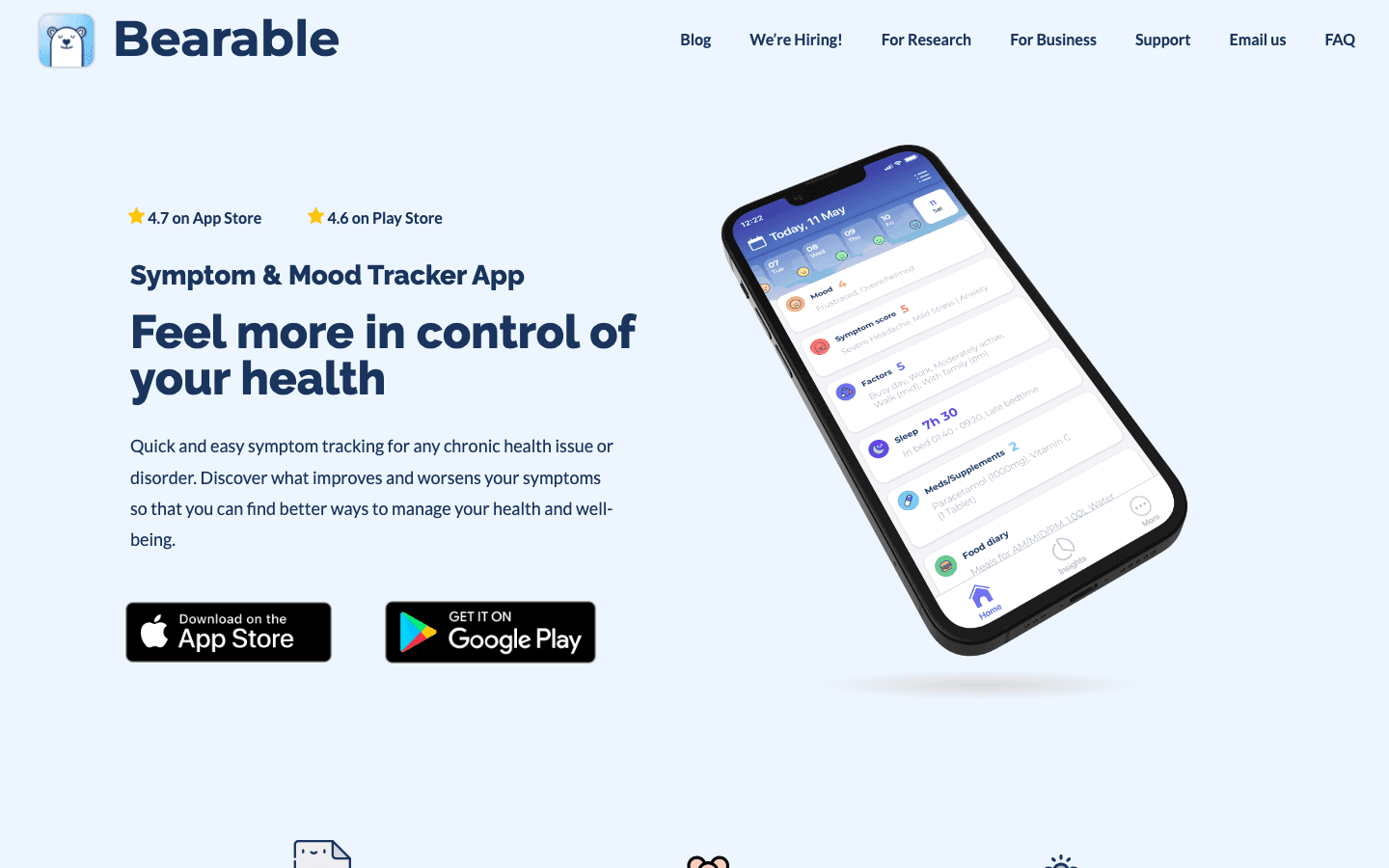
Bearable is the closest thing on this list to a direct Daylio upgrade. It tracks mood, energy, sleep, symptoms, medications, habits, nutrition, and more, all from a single daily log. Where Daylio gives you mood and activities, Bearable gives you a much broader health picture and the ability to run correlations: does your mood drop when you sleep less than 7 hours? Does your energy improve on days you exercise? Bearable can show you.
The app is particularly popular with people managing chronic health conditions, but its flexibility makes it useful for anyone who wants a detailed picture of how different factors affect how they feel. The free tier covers most features, which is generous for a tracker this capable.
Tracks mood, energy, symptoms, medications, sleep, and custom factors
Correlation analysis to identify what affects your wellbeing
Free tier with most features available
iOS and Android
Limitations: The data model is deep but this also means the daily log can feel involved. No AI journaling or prompted reflection. No schedule integration or task management. It logs, it correlates, but it doesn't tell you what to do with the information.
Pricing: Free tier available. Premium: $6.99/month or $34.99/year.
Best for: People who want significantly more data depth than Daylio provides and want to understand what factors actually influence their mood and health.
3. Reflectly
AI-powered journaling with mood tracking and positive psychology prompts
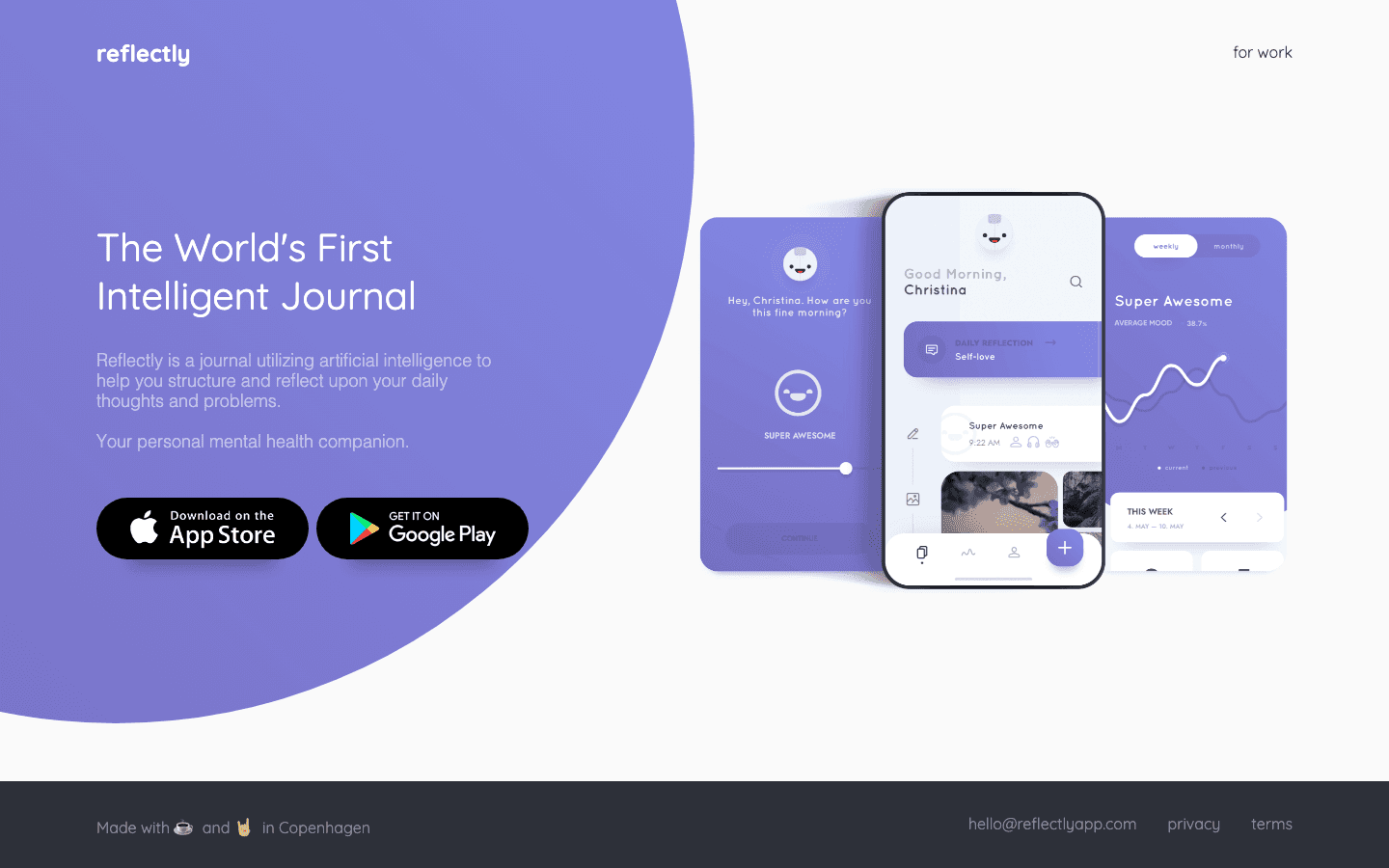
Reflectly positions itself as an AI journal: you log your mood, and the app responds with thoughtful prompts designed to help you reflect more deeply on what's driving it. The journaling experience is more guided and conversational than Daylio, which keeps things icon-based. If you've ever felt that Daylio's emoji system is too shallow for what you're actually going through, Reflectly addresses that directly.
The app draws on positive psychology frameworks and CBT-inspired prompts. It tracks mood over time and helps you spot patterns through its weekly and monthly summaries. The interface is clean and the daily habit of opening Reflectly and spending a few minutes journaling is easy to build. See our roundup of the best mood tracker apps for how it compares across the category.
Conversational AI prompts for deeper daily reflection
Mood tracking with weekly and monthly pattern summaries
Clean interface designed for daily journaling habits
iOS and Android
Limitations: Less quantitative than Daylio or Bearable. Fewer activity tags and data points. The AI journaling is helpful but can feel repetitive over time for some users.
Pricing: Free with in-app purchases for premium features.
Best for: People who want more journaling depth and reflective prompts alongside mood tracking, not just icons and tags.
4. Finch
Self-care habit building through gamification and a virtual pet
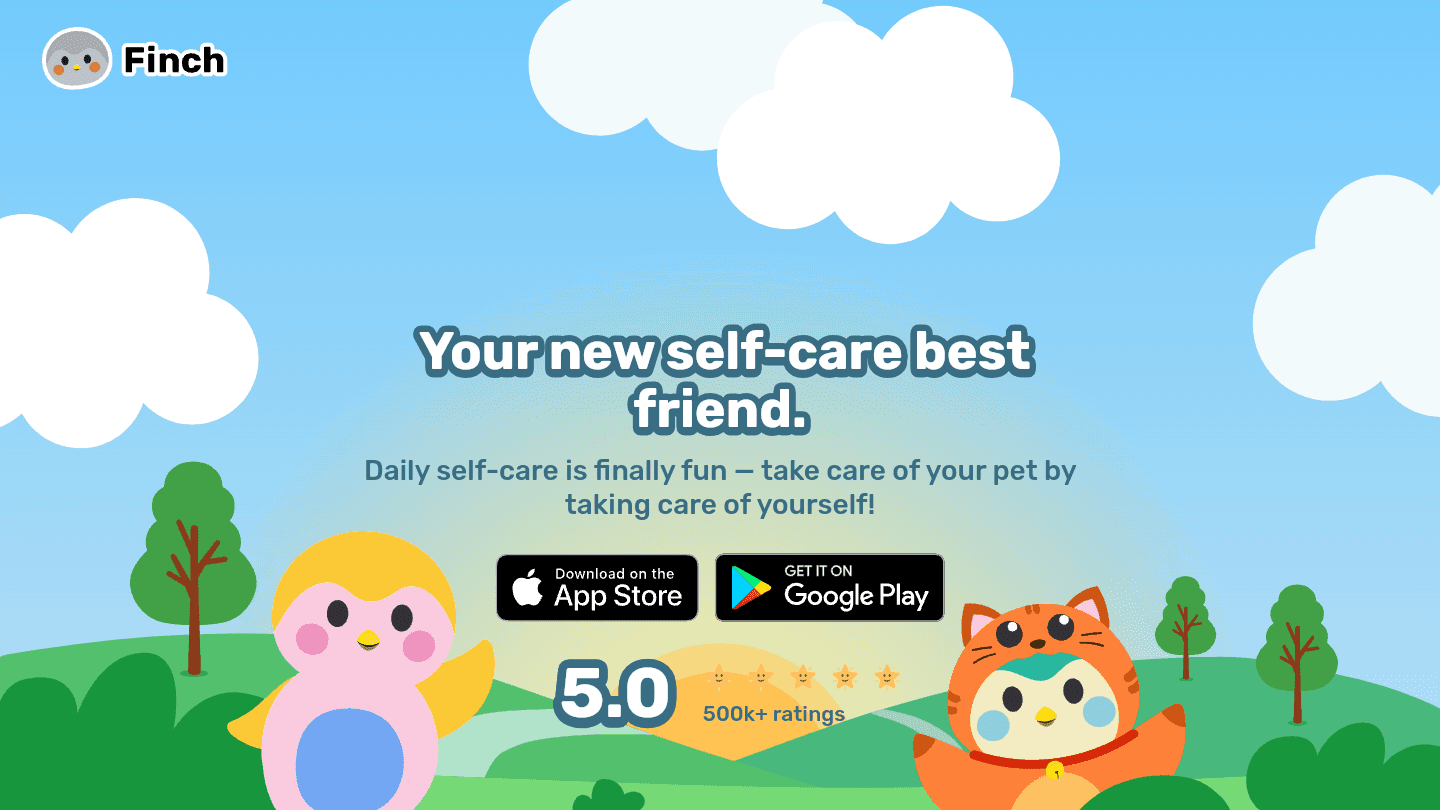
Finch is unlike anything else on this list. Instead of charts and correlation data, Finch gives you a virtual baby bird that grows as you complete daily self-care goals. Set intentions for the day, complete them, and your Finch develops. It's a gamified approach to consistency: you're more likely to log your mood and do your self-care routine if there's a character depending on it.
The app includes mood check-ins, daily goal setting, a journey log for reflection, and self-care exercises. It's particularly popular with younger users and people who need an engaging hook to build self-care habits. The game mechanics work well as an accountability layer, similar to how the best self-care apps make tracking feel sustainable rather than like another obligation.
Virtual pet that grows with your self-care habits
Daily mood check-ins and goal setting
Reflection journal and guided self-care exercises
iOS and Android; over 600,000 5-star ratings
Limitations: The gamification may feel childish to some users. Less analytical than Daylio or Bearable. No deep data tracking or correlation insights. For more options in this category, see the best Finch alternatives.
Pricing: Free with in-app purchases for premium features.
Best for: People who need a fun, low-pressure hook to build consistent self-care and mood tracking habits.
5. Moodflow
Visual mood calendar tracking with a minimal, distraction-free interface
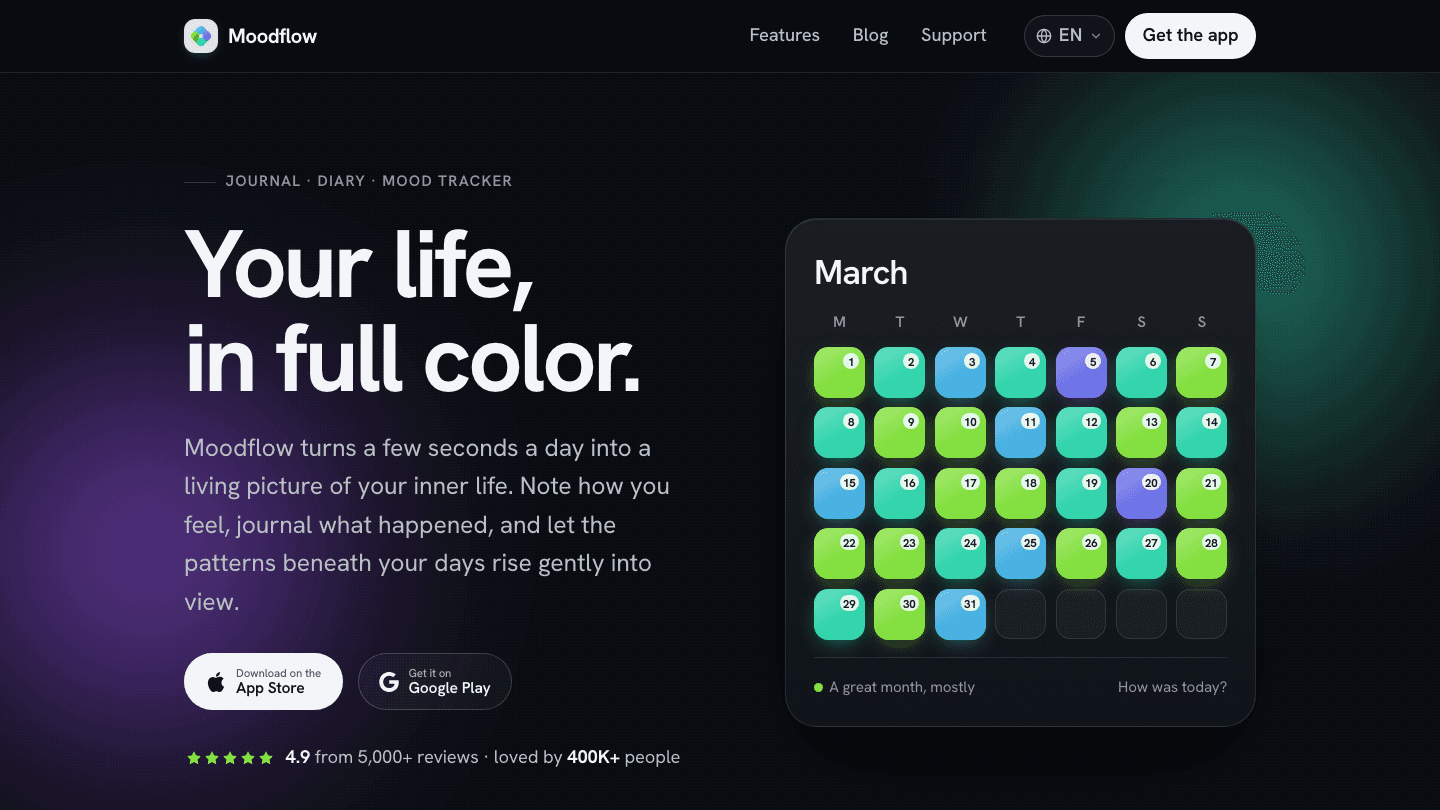
Moodflow gives you a month-view color calendar where each day is filled with the color of your recorded mood, creating a visual map of how you've been doing over time. The concept is simple: take a few seconds, log your mood and a brief note, and over time you get a colorful picture of your emotional patterns. The interface is minimal and designed to be calming.
What makes Moodflow appealing as a Daylio alternative is exactly this simplicity. If you find Daylio's activity tags and statistics more than you need, Moodflow strips it back to the core: how did you feel, and can you see the pattern? The journal entry feature allows text notes. The health diary approach (logging daily, looking at patterns) is what Moodflow executes most cleanly.
Month-view color calendar visualizing mood at a glance
Fast daily check-ins with optional text notes
Minimal, calming interface focused on one thing
iOS and Android
Limitations: Less data depth than Daylio or Bearable. No activity tags, no correlation analysis, no habit tracking. Premium pricing not publicly listed.
Pricing: Free to download with in-app purchases.
Best for: People who want the mood calendar visual without the complexity of a full tracking system.
Which Daylio Alternative Is Right for You?
You want to act on your tracking data, not just log it: Lifestack. It reads your wearable data and auto-schedules your day accordingly.
You want more depth and correlation insights than Daylio offers: Bearable. It's the most powerful tracker on this list for understanding what's actually affecting your mood.
You want guided journaling alongside mood tracking: Reflectly. The AI prompts create a more reflective experience than icon-only logging.
You want tracking to feel engaging and motivating: Finch. The pet mechanic adds accountability that purely data-driven apps don't have.
You want mood tracking with a minimal, visual interface: Moodflow. Strip everything back to the color calendar and a daily note.
For more options in the broader self-tracking space, see the full roundup of mood tracker apps. If wearable-based health data interests you, the guide on personal energy management explains how to use that data to plan your days differently.
FAQ
What is Daylio used for?
Daylio is a mood tracking app that lets you log how you're feeling each day using emoji, tag activities (exercise, sleep, work, etc.), and add brief notes. Over time it shows you patterns: which activities correlate with better or worse mood days, how your mood trends week to week, and how consistent your tracking habits are. It's popular for mental health awareness, habit tracking, and daily journaling without writing full paragraphs.
Is there a free Daylio alternative?
Yes. Bearable, Reflectly, Finch, and Moodflow all offer free tiers that cover the core tracking features. Bearable's free tier is particularly generous. If you're primarily looking for mood tracking without paying, Bearable or Moodflow are the strongest free starting points. Lifestack offers a 7-day free trial but requires a paid subscription after that.
What's the best Daylio alternative for detailed health tracking?
Bearable. It tracks more data types than Daylio, including symptoms, medications, nutrition, and sleep alongside mood, and it runs correlations to help you understand which factors influence how you feel. For people managing chronic health conditions or wanting a more detailed picture of their wellbeing, Bearable is the most capable option on this list.
Can Lifestack replace Daylio?
Only partially, and only for a specific use case. If you use Daylio to understand how you're doing so you can plan your days better, Lifestack does that more automatically: it reads your wearable data and adjusts your schedule based on how recovered you actually are. If you use Daylio primarily for journaling, activity logging, or visualizing mood streaks, Lifestack doesn't replace those features. It's a different tool that solves an adjacent problem.
Which Daylio alternative is best for Android?
All five apps on this list are available on Android. Bearable and Moodflow have strong Android versions. Finch and Reflectly are also available. Lifestack supports Android via Google Fit, Fitbit, and Garmin integrations.
Daylio has a lot going for it: quick mood logging, activity tagging, streak tracking, and colorful charts that show your emotional patterns over time. What it doesn't do is act on any of that data. You track how you're feeling, you see the patterns, and then you go back to a schedule that was built without any of that information in mind.
That gap is why people look for Daylio alternatives. Sometimes it's to go deeper (more journaling, more health data, more analysis). Sometimes it's to track differently (objective data instead of self-reported mood). Sometimes it's just that the interface or the feature set no longer fits what they need. Whatever the reason, there are good options across a range of approaches.
We tested five apps that cover different angles: objective energy tracking, detailed health logging, AI journaling, self-care gamification, and visual mood calendaring. Here's how they compare.
Key Takeaways
The best Daylio alternative depends on whether you want to go deeper on mood journaling, track objective health signals, or turn your data into a daily plan
Lifestack is the only option that reads wearable data and automatically adjusts your schedule based on how you're actually recovering, not just how you report feeling
Bearable is the closest to Daylio for detailed symptom and mood tracking, with a broader data model and correlation insights
Quick Guide
Lifestack: Best for turning health tracking into an actionable daily schedule, auto-scheduled around your recovery data
Bearable: Best for detailed symptom and mood tracking with correlation insights
Reflectly: Best for AI-guided journaling with mood tracking and positive psychology prompts
Finch: Best for self-care habit building through gamification and a virtual pet
Moodflow: Best for visual mood calendaring with a minimal, distraction-free interface
How We Evaluated
Data depth: how much can you track, and how detailed is the analysis?
Actionability: does the app help you do something with your data, or just log it?
Platform: iOS only, Android only, or both?
Journaling quality: does it support text, prompts, or is it icon-only?
Pricing: free tier availability and what the paid plan costs
1. Lifestack
The Daylio alternative that turns your health data into an auto-scheduled day
Lifestack takes a fundamentally different approach to tracking your wellbeing. Instead of asking you to log how you feel each morning, it reads objective data from your wearable (Oura Ring, WHOOP, Fitbit, Garmin, Apple Health) and tracks your recovery, sleep quality, and readiness automatically. Then it uses that data to build your daily schedule: high cognitive tasks when your recovery is strong, lighter work when you've had a rough night.
This makes Lifestack the strongest option for people who find self-reported mood logging inconsistent or inaccurate. You don't have to remember to check in, and you're not relying on your own perception of how you feel, which can itself be affected by how you slept. The data comes from the wearable and the schedule adapts accordingly. See the guide on how to track fluctuating energy for more on why objective data often tells a different story than self-reports.
Reads sleep, HRV, and recovery data from wearables automatically
Auto-schedules your tasks based on your actual readiness each day
Syncs with Google Calendar and Apple Calendar
Available on iOS and Android
Works with Oura Ring, WHOOP, Fitbit, Garmin, Apple Health
What Works: The integration between health data and scheduling is genuinely useful. If you've ever looked at a Daylio chart showing that you feel better on days you sleep well, Lifestack closes the loop: it reads that sleep quality before you wake up and adjusts your plan for the day. This is personal energy management made automatic rather than manual.
Limitations: Not a mood tracker or journal. No activity tagging, no text entries, no streak visualization. Requires a wearable device to get the full benefit. If your primary use case is journaling about your day or logging what you did, this isn't the right fit.
Pricing: $7/month or $50/year with a 7-day free trial on the annual plan. See how Lifestack works for more on the energy-scheduling approach.
Best for: Wearable users who want their tracking data to actually change how their day is structured.
2. Bearable
The most detailed mood and symptom tracker for people who want deep correlation insights
Bearable is the closest thing on this list to a direct Daylio upgrade. It tracks mood, energy, sleep, symptoms, medications, habits, nutrition, and more, all from a single daily log. Where Daylio gives you mood and activities, Bearable gives you a much broader health picture and the ability to run correlations: does your mood drop when you sleep less than 7 hours? Does your energy improve on days you exercise? Bearable can show you.
The app is particularly popular with people managing chronic health conditions, but its flexibility makes it useful for anyone who wants a detailed picture of how different factors affect how they feel. The free tier covers most features, which is generous for a tracker this capable.
Tracks mood, energy, symptoms, medications, sleep, and custom factors
Correlation analysis to identify what affects your wellbeing
Free tier with most features available
iOS and Android
Limitations: The data model is deep but this also means the daily log can feel involved. No AI journaling or prompted reflection. No schedule integration or task management. It logs, it correlates, but it doesn't tell you what to do with the information.
Pricing: Free tier available. Premium: $6.99/month or $34.99/year.
Best for: People who want significantly more data depth than Daylio provides and want to understand what factors actually influence their mood and health.
3. Reflectly
AI-powered journaling with mood tracking and positive psychology prompts
Reflectly positions itself as an AI journal: you log your mood, and the app responds with thoughtful prompts designed to help you reflect more deeply on what's driving it. The journaling experience is more guided and conversational than Daylio, which keeps things icon-based. If you've ever felt that Daylio's emoji system is too shallow for what you're actually going through, Reflectly addresses that directly.
The app draws on positive psychology frameworks and CBT-inspired prompts. It tracks mood over time and helps you spot patterns through its weekly and monthly summaries. The interface is clean and the daily habit of opening Reflectly and spending a few minutes journaling is easy to build. See our roundup of the best mood tracker apps for how it compares across the category.
Conversational AI prompts for deeper daily reflection
Mood tracking with weekly and monthly pattern summaries
Clean interface designed for daily journaling habits
iOS and Android
Limitations: Less quantitative than Daylio or Bearable. Fewer activity tags and data points. The AI journaling is helpful but can feel repetitive over time for some users.
Pricing: Free with in-app purchases for premium features.
Best for: People who want more journaling depth and reflective prompts alongside mood tracking, not just icons and tags.
4. Finch
Self-care habit building through gamification and a virtual pet
Finch is unlike anything else on this list. Instead of charts and correlation data, Finch gives you a virtual baby bird that grows as you complete daily self-care goals. Set intentions for the day, complete them, and your Finch develops. It's a gamified approach to consistency: you're more likely to log your mood and do your self-care routine if there's a character depending on it.
The app includes mood check-ins, daily goal setting, a journey log for reflection, and self-care exercises. It's particularly popular with younger users and people who need an engaging hook to build self-care habits. The game mechanics work well as an accountability layer, similar to how the best self-care apps make tracking feel sustainable rather than like another obligation.
Virtual pet that grows with your self-care habits
Daily mood check-ins and goal setting
Reflection journal and guided self-care exercises
iOS and Android; over 600,000 5-star ratings
Limitations: The gamification may feel childish to some users. Less analytical than Daylio or Bearable. No deep data tracking or correlation insights. For more options in this category, see the best Finch alternatives.
Pricing: Free with in-app purchases for premium features.
Best for: People who need a fun, low-pressure hook to build consistent self-care and mood tracking habits.
5. Moodflow
Visual mood calendar tracking with a minimal, distraction-free interface
Moodflow gives you a month-view color calendar where each day is filled with the color of your recorded mood, creating a visual map of how you've been doing over time. The concept is simple: take a few seconds, log your mood and a brief note, and over time you get a colorful picture of your emotional patterns. The interface is minimal and designed to be calming.
What makes Moodflow appealing as a Daylio alternative is exactly this simplicity. If you find Daylio's activity tags and statistics more than you need, Moodflow strips it back to the core: how did you feel, and can you see the pattern? The journal entry feature allows text notes. The health diary approach (logging daily, looking at patterns) is what Moodflow executes most cleanly.
Month-view color calendar visualizing mood at a glance
Fast daily check-ins with optional text notes
Minimal, calming interface focused on one thing
iOS and Android
Limitations: Less data depth than Daylio or Bearable. No activity tags, no correlation analysis, no habit tracking. Premium pricing not publicly listed.
Pricing: Free to download with in-app purchases.
Best for: People who want the mood calendar visual without the complexity of a full tracking system.
Which Daylio Alternative Is Right for You?
You want to act on your tracking data, not just log it: Lifestack. It reads your wearable data and auto-schedules your day accordingly.
You want more depth and correlation insights than Daylio offers: Bearable. It's the most powerful tracker on this list for understanding what's actually affecting your mood.
You want guided journaling alongside mood tracking: Reflectly. The AI prompts create a more reflective experience than icon-only logging.
You want tracking to feel engaging and motivating: Finch. The pet mechanic adds accountability that purely data-driven apps don't have.
You want mood tracking with a minimal, visual interface: Moodflow. Strip everything back to the color calendar and a daily note.
For more options in the broader self-tracking space, see the full roundup of mood tracker apps. If wearable-based health data interests you, the guide on personal energy management explains how to use that data to plan your days differently.
FAQ
What is Daylio used for?
Daylio is a mood tracking app that lets you log how you're feeling each day using emoji, tag activities (exercise, sleep, work, etc.), and add brief notes. Over time it shows you patterns: which activities correlate with better or worse mood days, how your mood trends week to week, and how consistent your tracking habits are. It's popular for mental health awareness, habit tracking, and daily journaling without writing full paragraphs.
Is there a free Daylio alternative?
Yes. Bearable, Reflectly, Finch, and Moodflow all offer free tiers that cover the core tracking features. Bearable's free tier is particularly generous. If you're primarily looking for mood tracking without paying, Bearable or Moodflow are the strongest free starting points. Lifestack offers a 7-day free trial but requires a paid subscription after that.
What's the best Daylio alternative for detailed health tracking?
Bearable. It tracks more data types than Daylio, including symptoms, medications, nutrition, and sleep alongside mood, and it runs correlations to help you understand which factors influence how you feel. For people managing chronic health conditions or wanting a more detailed picture of their wellbeing, Bearable is the most capable option on this list.
Can Lifestack replace Daylio?
Only partially, and only for a specific use case. If you use Daylio to understand how you're doing so you can plan your days better, Lifestack does that more automatically: it reads your wearable data and adjusts your schedule based on how recovered you actually are. If you use Daylio primarily for journaling, activity logging, or visualizing mood streaks, Lifestack doesn't replace those features. It's a different tool that solves an adjacent problem.
Which Daylio alternative is best for Android?
All five apps on this list are available on Android. Bearable and Moodflow have strong Android versions. Finch and Reflectly are also available. Lifestack supports Android via Google Fit, Fitbit, and Garmin integrations.



FOLLOW ON
FOLLOW ON
FOLLOW ON


Copyright 2026 © Lifestack. All rights reserved
Copyright 2026 © Lifestack. All rights reserved

