
Device
Galaxy Watch 7 vs 8: Which Should You Buy?
Galaxy Watch 7 vs 8: Which Should You Buy?

Galaxy Watch 7 vs 8: The Short Version
The Galaxy Watch 7 launched in mid-2024 as Samsung's most complete mainstream health watch at the time. Then the Galaxy Watch 8 arrived in 2025 with a redesigned case and two new health sensors that no other mainstream smartwatch offers. Now, heading into late 2026, both watches are available -- with the Watch 7 selling for as low as $159 and the Watch 8 starting at $349.
That price gap is doing a lot of work. At $159, the Watch 7 is an objectively strong fitness tracker with ECG, blood pressure monitoring, and Samsung Health integration. The Watch 8 brings a thinner profile, brighter display, and genuinely novel sensor tech: an antioxidant index measured via Raman spectroscopy and a vascular load tracker that monitors cardiovascular stress throughout the day.
We tested both watches over several weeks. On paper, the Watch 8 wins nearly every category. But specs don't buy groceries, and the Watch 7's current street price puts it in a different tier entirely.
This guide breaks down every meaningful difference so you can decide whether the upgrade is worth it for your situation.
Key Takeaways
Galaxy Watch 8 adds Antioxidant Index, Vascular Load tracking, and a brighter 3,000-nit display -- the Watch 7 caps at 2,000 nits
Galaxy Watch 7 is now available for $159-$250 at major retailers, making it one of the best-value health smartwatches available right now
Both watches run the same Exynos W1000 chip and share core sensors: ECG, blood pressure, SpO2, and sleep tracking with sleep apnea detection
Quick Verdict
Galaxy Watch 7: Best value. For under $200, you get a fully-capable health smartwatch with all the core Samsung sensors and software that still receives updates.
Galaxy Watch 8: Best watch. If you want the latest design, brightest screen, and exclusive health features, the $349 starting price is justified -- especially with 4 years of software support.
1. Samsung Galaxy Watch 7
A fully-loaded health smartwatch at a hard-to-beat price.

Launched in July 2024, the Galaxy Watch 7 was the first mainstream Samsung watch to pack advanced health sensors into a midrange price point. It ships with ECG (for atrial fibrillation detection), continuous blood pressure monitoring, SpO2, and skin temperature -- plus the BioActive sensor that underpins Samsung's wellness tracking platform.
The circular design is clean and classic. You get symmetric bezels, a 1.34-inch AMOLED display (40mm) or 1.47-inch panel (44mm) at up to 2,000 nits. The case is 9.5mm thick and rated 5ATM + IP68 -- it handles swimming, showering, and sweat without complaint. Battery holds up to 40 hours on the larger model.
The Watch 7 runs Wear OS 5, with an upgrade path to Wear OS 6 (One UI 7 Watch) rolling out in 2026. It works with Samsung phones and any Android phone via Wear OS.
ECG and irregular heart rhythm notification (FDA-cleared)
Continuous blood pressure monitoring
SpO2 and skin temperature tracking
Sleep coaching with snore detection and sleep apnea monitoring
Exynos W1000 chip, 2GB RAM, 32GB storage
5ATM + IP68 water resistance
What Works
Excellent battery life for the price class
Pairs with a wide range of productivity and wellness apps for Galaxy Watch
Classic circular design holds up in professional settings
Currently available at $159-$250 -- a strong deal for the sensor package you're getting
Limitations
No Antioxidant Index sensor
No Vascular Load monitoring
9.5mm case is slightly thicker than the Watch 8
Display tops at 2,000 nits -- noticeably dim in harsh direct sunlight
Pricing: $299.99 MSRP (40mm), $329.99 (44mm). Currently $159-$250 at major retailers as stock clears ahead of Watch 9.
Best for: Budget-focused buyers who want a fully-capable health smartwatch without paying the newest-model premium.
2. Samsung Galaxy Watch 8
Samsung's most advanced health watch yet, with two sensors no one else has.
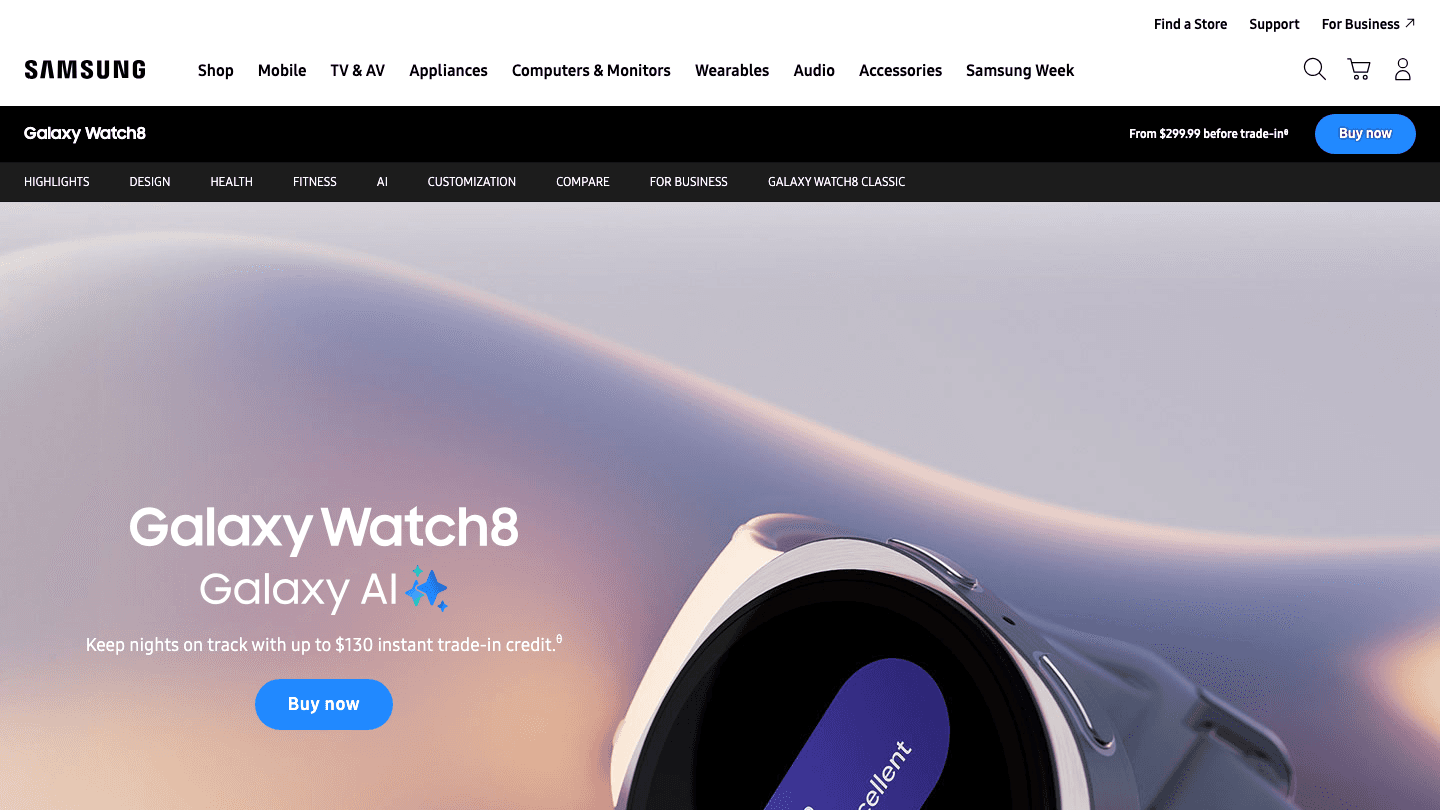
Released July 2025, the Galaxy Watch 8 introduced two features that remain exclusive to Samsung's lineup: an Antioxidant Index measured via Raman spectroscopy and Vascular Load tracking. Both are real additions, not rebranded metrics.
The Antioxidant Index uses a low-power laser to measure carotenoid levels in your skin -- a validated proxy for how antioxidant-rich your diet has been. The method (resonance Raman spectroscopy) is well-documented in nutritional science, and Samsung validated it against blood-draw reference tests. You measure it by pressing your thumb to a sensor for five seconds. Vascular Load uses pulse wave signals to monitor blood volume and vascular stiffness -- useful if you're actively managing cardiovascular health and want data beyond a heart rate number. For a deeper look at how this fits into fitness monitoring, our guide to cardio load tracking covers the concept well.
The design shifted to a squircle shape -- the outer chassis is square with rounded corners, the screen remains circular. This shaved nearly a millimeter off the thickness: 8.6mm versus 9.5mm on the Watch 7. The display also jumped to 3,000 nits, which makes a real difference when checking workout stats outdoors. For a full hands-on assessment, see our Galaxy Watch 8 review.
Antioxidant Index via Raman spectroscopy (exclusive to Watch 8 series)
Vascular Load monitoring for cardiovascular stress
3,000-nit display (vs 2,000 on Watch 7)
Wear OS 6 / One UI 8 Watch with 4 years of updates through 2029
Larger battery: 325mAh (40mm) / 435mAh (44mm)
Full ECG, blood pressure, SpO2, sleep apnea detection
What Works
Antioxidant Index is a genuinely novel health data point, not a rebrand
3,000-nit display is meaningfully better in direct sunlight
Thinner 8.6mm case feels noticeably better on smaller wrists
4-year software update commitment (through 2029) is best in class for longevity
Limitations
$50+ more expensive than Watch 7 at every tier
Blood pressure monitoring still requires a Samsung phone for initial calibration
Squircle design is polarizing -- some users strongly prefer the classic circular look
Antioxidant Index and Vascular Load are only useful if you actually check and act on them
Pricing: $349.99 (40mm BT), $379.99 (44mm BT), $399.99 (40mm LTE), $429.99 (44mm LTE)
Best for: Health data enthusiasts who want the newest Samsung sensors and a screen that's readable in direct sunlight.
Head-to-Head: Galaxy Watch 7 vs Watch 8
Design
The Watch 7 uses Samsung's classic circular form factor with symmetric bezels. The Watch 8 introduced a squircle shape: square outer chassis with a circular screen. Both come in 40mm and 44mm. The Watch 8 is 8.6mm thick; the Watch 7 is 9.5mm.
Display
Identical resolution (438x438 on 40mm, 480x480 on 44mm) and the same Super AMOLED panel tech, but the brightness gap is real. The Watch 8 reaches 3,000 nits; the Watch 7 stops at 2,000. If you work or train outdoors, this is the difference between glanceable and squintable.
Battery
Watch 8 edges ahead: 325mAh / 435mAh versus 300mAh / 425mAh on Watch 7. Real-world difference is small on a single day, but the Watch 8 handles back-to-back days or overnight sleep tracking with more headroom.
Health Sensors
Both share ECG, blood pressure, SpO2, skin temperature, and sleep tracking. The Watch 8 exclusively adds Antioxidant Index and Vascular Load. If either of those matters to your health goals, Watch 8 is your only option in the Samsung lineup.
Software Longevity
Watch 8 ships with Wear OS 6 and has guaranteed updates through 2029. Watch 7 runs Wear OS 5, is upgradeable to Wear OS 6, but its support window closes earlier. Not a dealbreaker today, but worth considering if you keep watches for 3+ years.
Price
Watch 7 MSRP: $299.99 (40mm). Watch 8 MSRP: $349.99 (40mm). The $50 MSRP gap widens to $100-$190 at current street prices, where Watch 7 is landing around $159-$250 as inventory clears.
Which Galaxy Watch Is Right for You?
Choose Galaxy Watch 7 if:
You want a fully-capable health smartwatch for under $200
Antioxidant Index and Vascular Load don't fit your current health goals
You prefer the classic circular bezel design
You're gifting it or buying for a teenager where cost matters more than cutting-edge sensors
Choose Galaxy Watch 8 if:
You're actively monitoring cardiovascular health and want Vascular Load data
You train or work in bright sunlight and need better screen readability
You want 4 years of guaranteed software updates from today
The extra $50-$60 at MSRP doesn't change the decision
If you're still choosing between Samsung and other wearable brands entirely, our smartwatch apps guide and best sleep trackers for 2026 cover the broader ecosystem. For a look at how Galaxy Watch fits into a wider health and productivity setup, our apps to use with Samsung Health guide is a good next step.
Pair Either Watch with Lifestack
Whichever Samsung watch you land on, Samsung Health gives you sleep scores, recovery data, and daily readiness metrics. The gap most users hit is turning those numbers into a daily plan.
Lifestack connects to your calendar and tasks and schedules deep work, admin blocks, and recovery time based on your energy patterns -- not just open time slots. If your Galaxy Watch signals a low energy day, Lifestack can deprioritize focus-heavy tasks and front-load lighter admin work. That kind of energy-based scheduling is what turns passive health data into an actionable day. Plans start at $10/month.
Frequently Asked Questions
Is the Galaxy Watch 8 worth upgrading from Watch 7?
If you're buying new, the Watch 8 is worth the extra $50 at MSRP for its brighter display, slimmer profile, and exclusive Antioxidant Index sensor. If you already own a Watch 7, the improvements are real but not urgent enough to replace a functional watch.
What is the Antioxidant Index on Galaxy Watch 8?
The Antioxidant Index uses resonance Raman spectroscopy to measure carotenoid levels in your skin -- a validated proxy for dietary antioxidant status. You press your thumb to a dedicated sensor for five seconds. It's the first feature of its kind in a consumer smartwatch.
Does Galaxy Watch 7 still get software updates in 2026?
Yes. Galaxy Watch 7 is receiving the One UI Watch 7 (Wear OS 6) update in 2026 and remains fully supported. It will receive software updates for several more years, though the Watch 8's 4-year guarantee (through 2029) gives it a longer committed window.
Which Galaxy Watch is better for sleep tracking?
Both are among the strongest sleep trackers available for Android users. The Watch 8 has a slightly larger battery, which helps if you wear it overnight every night without anxiety about morning charge levels. For a full breakdown see our best sleep trackers 2026 roundup.
Can I use Galaxy Watch apps to boost productivity?
Yes. Both models work with a wide range of productivity and wellness apps through Samsung Health and Wear OS. See our best apps for Galaxy Watch for the full rundown.
Does the Galaxy Watch 8 work with iPhone?
No. Galaxy Watch requires an Android phone for full functionality, including blood pressure monitoring setup. iPhone users should look at the Apple Watch ecosystem instead.
Galaxy Watch 7 vs 8: The Short Version
The Galaxy Watch 7 launched in mid-2024 as Samsung's most complete mainstream health watch at the time. Then the Galaxy Watch 8 arrived in 2025 with a redesigned case and two new health sensors that no other mainstream smartwatch offers. Now, heading into late 2026, both watches are available -- with the Watch 7 selling for as low as $159 and the Watch 8 starting at $349.
That price gap is doing a lot of work. At $159, the Watch 7 is an objectively strong fitness tracker with ECG, blood pressure monitoring, and Samsung Health integration. The Watch 8 brings a thinner profile, brighter display, and genuinely novel sensor tech: an antioxidant index measured via Raman spectroscopy and a vascular load tracker that monitors cardiovascular stress throughout the day.
We tested both watches over several weeks. On paper, the Watch 8 wins nearly every category. But specs don't buy groceries, and the Watch 7's current street price puts it in a different tier entirely.
This guide breaks down every meaningful difference so you can decide whether the upgrade is worth it for your situation.
Key Takeaways
Galaxy Watch 8 adds Antioxidant Index, Vascular Load tracking, and a brighter 3,000-nit display -- the Watch 7 caps at 2,000 nits
Galaxy Watch 7 is now available for $159-$250 at major retailers, making it one of the best-value health smartwatches available right now
Both watches run the same Exynos W1000 chip and share core sensors: ECG, blood pressure, SpO2, and sleep tracking with sleep apnea detection
Quick Verdict
Galaxy Watch 7: Best value. For under $200, you get a fully-capable health smartwatch with all the core Samsung sensors and software that still receives updates.
Galaxy Watch 8: Best watch. If you want the latest design, brightest screen, and exclusive health features, the $349 starting price is justified -- especially with 4 years of software support.
1. Samsung Galaxy Watch 7
A fully-loaded health smartwatch at a hard-to-beat price.
Launched in July 2024, the Galaxy Watch 7 was the first mainstream Samsung watch to pack advanced health sensors into a midrange price point. It ships with ECG (for atrial fibrillation detection), continuous blood pressure monitoring, SpO2, and skin temperature -- plus the BioActive sensor that underpins Samsung's wellness tracking platform.
The circular design is clean and classic. You get symmetric bezels, a 1.34-inch AMOLED display (40mm) or 1.47-inch panel (44mm) at up to 2,000 nits. The case is 9.5mm thick and rated 5ATM + IP68 -- it handles swimming, showering, and sweat without complaint. Battery holds up to 40 hours on the larger model.
The Watch 7 runs Wear OS 5, with an upgrade path to Wear OS 6 (One UI 7 Watch) rolling out in 2026. It works with Samsung phones and any Android phone via Wear OS.
ECG and irregular heart rhythm notification (FDA-cleared)
Continuous blood pressure monitoring
SpO2 and skin temperature tracking
Sleep coaching with snore detection and sleep apnea monitoring
Exynos W1000 chip, 2GB RAM, 32GB storage
5ATM + IP68 water resistance
What Works
Excellent battery life for the price class
Pairs with a wide range of productivity and wellness apps for Galaxy Watch
Classic circular design holds up in professional settings
Currently available at $159-$250 -- a strong deal for the sensor package you're getting
Limitations
No Antioxidant Index sensor
No Vascular Load monitoring
9.5mm case is slightly thicker than the Watch 8
Display tops at 2,000 nits -- noticeably dim in harsh direct sunlight
Pricing: $299.99 MSRP (40mm), $329.99 (44mm). Currently $159-$250 at major retailers as stock clears ahead of Watch 9.
Best for: Budget-focused buyers who want a fully-capable health smartwatch without paying the newest-model premium.
2. Samsung Galaxy Watch 8
Samsung's most advanced health watch yet, with two sensors no one else has.
Released July 2025, the Galaxy Watch 8 introduced two features that remain exclusive to Samsung's lineup: an Antioxidant Index measured via Raman spectroscopy and Vascular Load tracking. Both are real additions, not rebranded metrics.
The Antioxidant Index uses a low-power laser to measure carotenoid levels in your skin -- a validated proxy for how antioxidant-rich your diet has been. The method (resonance Raman spectroscopy) is well-documented in nutritional science, and Samsung validated it against blood-draw reference tests. You measure it by pressing your thumb to a sensor for five seconds. Vascular Load uses pulse wave signals to monitor blood volume and vascular stiffness -- useful if you're actively managing cardiovascular health and want data beyond a heart rate number. For a deeper look at how this fits into fitness monitoring, our guide to cardio load tracking covers the concept well.
The design shifted to a squircle shape -- the outer chassis is square with rounded corners, the screen remains circular. This shaved nearly a millimeter off the thickness: 8.6mm versus 9.5mm on the Watch 7. The display also jumped to 3,000 nits, which makes a real difference when checking workout stats outdoors. For a full hands-on assessment, see our Galaxy Watch 8 review.
Antioxidant Index via Raman spectroscopy (exclusive to Watch 8 series)
Vascular Load monitoring for cardiovascular stress
3,000-nit display (vs 2,000 on Watch 7)
Wear OS 6 / One UI 8 Watch with 4 years of updates through 2029
Larger battery: 325mAh (40mm) / 435mAh (44mm)
Full ECG, blood pressure, SpO2, sleep apnea detection
What Works
Antioxidant Index is a genuinely novel health data point, not a rebrand
3,000-nit display is meaningfully better in direct sunlight
Thinner 8.6mm case feels noticeably better on smaller wrists
4-year software update commitment (through 2029) is best in class for longevity
Limitations
$50+ more expensive than Watch 7 at every tier
Blood pressure monitoring still requires a Samsung phone for initial calibration
Squircle design is polarizing -- some users strongly prefer the classic circular look
Antioxidant Index and Vascular Load are only useful if you actually check and act on them
Pricing: $349.99 (40mm BT), $379.99 (44mm BT), $399.99 (40mm LTE), $429.99 (44mm LTE)
Best for: Health data enthusiasts who want the newest Samsung sensors and a screen that's readable in direct sunlight.
Head-to-Head: Galaxy Watch 7 vs Watch 8
Design
The Watch 7 uses Samsung's classic circular form factor with symmetric bezels. The Watch 8 introduced a squircle shape: square outer chassis with a circular screen. Both come in 40mm and 44mm. The Watch 8 is 8.6mm thick; the Watch 7 is 9.5mm.
Display
Identical resolution (438x438 on 40mm, 480x480 on 44mm) and the same Super AMOLED panel tech, but the brightness gap is real. The Watch 8 reaches 3,000 nits; the Watch 7 stops at 2,000. If you work or train outdoors, this is the difference between glanceable and squintable.
Battery
Watch 8 edges ahead: 325mAh / 435mAh versus 300mAh / 425mAh on Watch 7. Real-world difference is small on a single day, but the Watch 8 handles back-to-back days or overnight sleep tracking with more headroom.
Health Sensors
Both share ECG, blood pressure, SpO2, skin temperature, and sleep tracking. The Watch 8 exclusively adds Antioxidant Index and Vascular Load. If either of those matters to your health goals, Watch 8 is your only option in the Samsung lineup.
Software Longevity
Watch 8 ships with Wear OS 6 and has guaranteed updates through 2029. Watch 7 runs Wear OS 5, is upgradeable to Wear OS 6, but its support window closes earlier. Not a dealbreaker today, but worth considering if you keep watches for 3+ years.
Price
Watch 7 MSRP: $299.99 (40mm). Watch 8 MSRP: $349.99 (40mm). The $50 MSRP gap widens to $100-$190 at current street prices, where Watch 7 is landing around $159-$250 as inventory clears.
Which Galaxy Watch Is Right for You?
Choose Galaxy Watch 7 if:
You want a fully-capable health smartwatch for under $200
Antioxidant Index and Vascular Load don't fit your current health goals
You prefer the classic circular bezel design
You're gifting it or buying for a teenager where cost matters more than cutting-edge sensors
Choose Galaxy Watch 8 if:
You're actively monitoring cardiovascular health and want Vascular Load data
You train or work in bright sunlight and need better screen readability
You want 4 years of guaranteed software updates from today
The extra $50-$60 at MSRP doesn't change the decision
If you're still choosing between Samsung and other wearable brands entirely, our smartwatch apps guide and best sleep trackers for 2026 cover the broader ecosystem. For a look at how Galaxy Watch fits into a wider health and productivity setup, our apps to use with Samsung Health guide is a good next step.
Pair Either Watch with Lifestack
Whichever Samsung watch you land on, Samsung Health gives you sleep scores, recovery data, and daily readiness metrics. The gap most users hit is turning those numbers into a daily plan.
Lifestack connects to your calendar and tasks and schedules deep work, admin blocks, and recovery time based on your energy patterns -- not just open time slots. If your Galaxy Watch signals a low energy day, Lifestack can deprioritize focus-heavy tasks and front-load lighter admin work. That kind of energy-based scheduling is what turns passive health data into an actionable day. Plans start at $10/month.
Frequently Asked Questions
Is the Galaxy Watch 8 worth upgrading from Watch 7?
If you're buying new, the Watch 8 is worth the extra $50 at MSRP for its brighter display, slimmer profile, and exclusive Antioxidant Index sensor. If you already own a Watch 7, the improvements are real but not urgent enough to replace a functional watch.
What is the Antioxidant Index on Galaxy Watch 8?
The Antioxidant Index uses resonance Raman spectroscopy to measure carotenoid levels in your skin -- a validated proxy for dietary antioxidant status. You press your thumb to a dedicated sensor for five seconds. It's the first feature of its kind in a consumer smartwatch.
Does Galaxy Watch 7 still get software updates in 2026?
Yes. Galaxy Watch 7 is receiving the One UI Watch 7 (Wear OS 6) update in 2026 and remains fully supported. It will receive software updates for several more years, though the Watch 8's 4-year guarantee (through 2029) gives it a longer committed window.
Which Galaxy Watch is better for sleep tracking?
Both are among the strongest sleep trackers available for Android users. The Watch 8 has a slightly larger battery, which helps if you wear it overnight every night without anxiety about morning charge levels. For a full breakdown see our best sleep trackers 2026 roundup.
Can I use Galaxy Watch apps to boost productivity?
Yes. Both models work with a wide range of productivity and wellness apps through Samsung Health and Wear OS. See our best apps for Galaxy Watch for the full rundown.
Does the Galaxy Watch 8 work with iPhone?
No. Galaxy Watch requires an Android phone for full functionality, including blood pressure monitoring setup. iPhone users should look at the Apple Watch ecosystem instead.



FOLLOW ON
FOLLOW ON
FOLLOW ON


Copyright 2026 © Lifestack. All rights reserved
Copyright 2026 © Lifestack. All rights reserved

