
Device
Garmin Index Sleep Monitor Review: Is It Worth $170?
Garmin Index Sleep Monitor Review: Is It Worth $170?

The Garmin Index Sleep Monitor is a screenless armband that does exactly one thing: track your sleep. No display, no GPS, no step counting. Just sleep staging, HRV monitoring, SpO2, and skin temperature, all packaged into a lightweight 31g band you wear on your upper arm. It launched in June 2025 at $169.99, making it one of the more expensive dedicated sleep trackers on the market.
The pitch is simple: if you find wearing a watch to bed uncomfortable, an upper-arm band is more ergonomic. The soft nylon/spandex strap is machine washable (remove the sensor module first), and there are no hard edges pressing against your wrist. For people who've been skipping sleep tracking because their smartwatch disrupts their sleep, this is a more comfortable path to the same data.
The catch is that Garmin's Index Sleep Monitor gives you the same sleep data that most Garmin smartwatches already collect. It's not a data upgrade over a Venu 3 or Forerunner 165. It's a comfort upgrade. Whether that's worth $170 depends entirely on how much the wrist-worn alternative bothers you.
We wore it for several weeks and tested it against Garmin smartwatches and other trackers to give you an honest read on where it delivers and where it falls short.
Key Takeaways
The Index Sleep Monitor is Garmin's first screenless sleep-only wearable. It tracks sleep stages, HRV, SpO2, skin temperature, and breathing rate via a soft upper-arm band.
At $169.99, it's a comfort play, not a data upgrade. If you already own a Garmin smartwatch, you're getting the same sleep metrics in a more comfortable form factor.
Sleep accuracy is solid, closely matching the Oura Ring 4 and Ultrahuman Ring Air on most metrics. The main annoyance: you have to manually start sleep tracking each night.
Design and Comfort
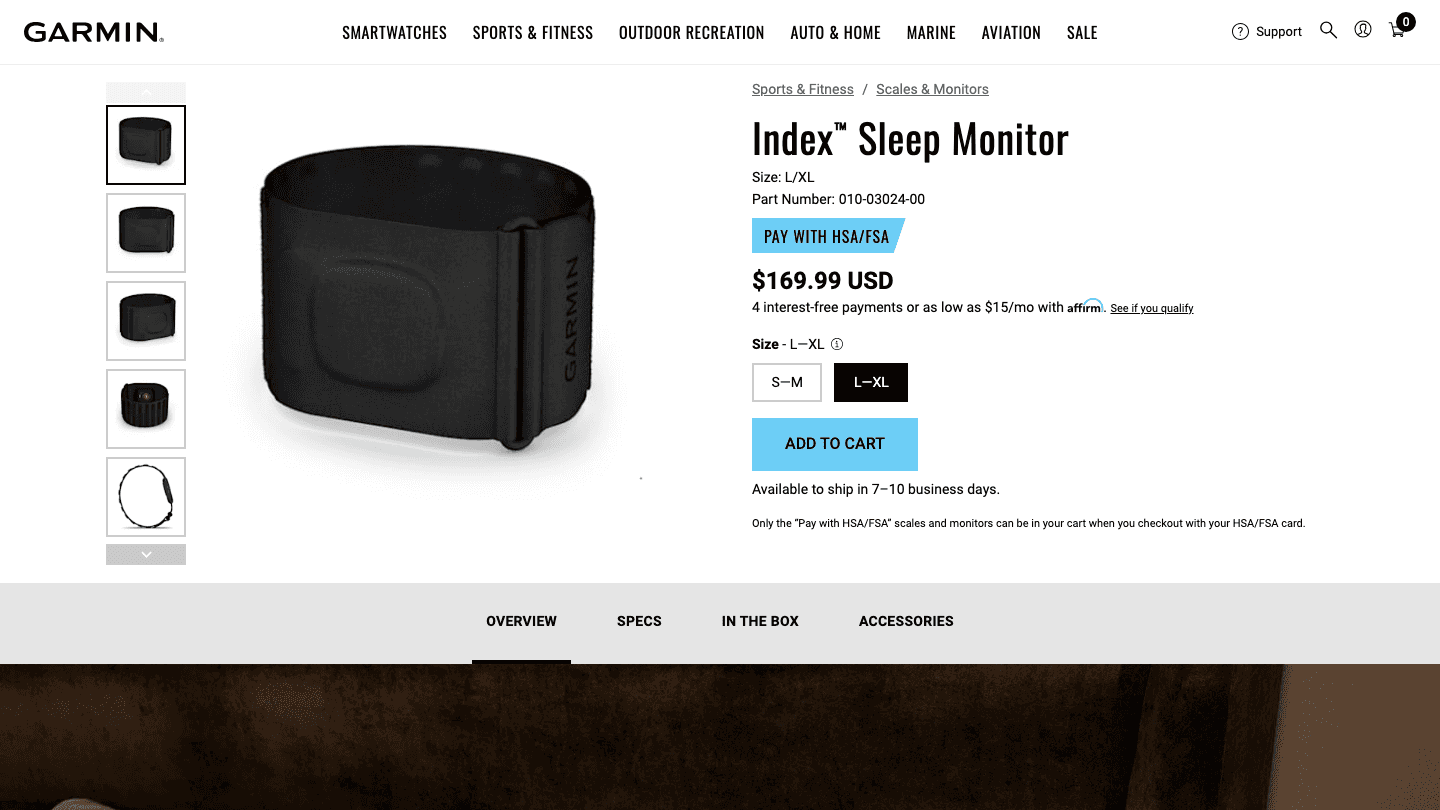
The band comes in two sizes (S-M and L-XL, both $169.99) with a hook-and-loop closure similar to a blood pressure cuff. The sensor module snaps in and out of the band, letting you toss the band in the wash separately. This is a thoughtful design choice most wrist-worn trackers don't offer.
Wearing it on the upper arm is genuinely less intrusive than a wrist watch. You don't feel it when you roll over, and there's no hard case pressing into your wrist at 3 AM. The band is soft and breathable. Most testers forget they're wearing it within a few nights.
The module has no display, no buttons, and no touchscreen. To start a sleep session, you open the Garmin Connect app and tap Begin Sleep. This is the most common complaint from users, and it's legitimate: automatic sleep detection would make the device significantly more appealing. If you fall asleep on the couch or forget to start the session, you lose that data for the night.
Sleep Tracking Features
The Index Sleep Monitor tracks light, deep, and REM sleep stages using optical heart rate from Garmin's Gen 5 sensor, SpO2 for blood oxygen, and skin temperature variation. In the morning, Garmin Connect shows a sleep score (0-100), a breakdown by stage, your HRV Status, and a respiratory rate trend.
HRV Status is the standout feature. It tracks your average nighttime heart rate variability over a rolling 5-week window and flags when you're trending low (a sign of accumulated fatigue or illness). Garmin calls this the "illness detection" capability promoted in its launch materials, and in testing it does surface recovery dips 24-48 hours before you notice symptoms yourself.
The morning Sleep Score integrates all metrics into a single number, which syncs with Garmin Connect's Body Battery system. If you also use a Garmin watch during the day, the sleep data feeds directly into your daytime energy tracking, creating a continuous 24-hour health picture. For a deeper look at how Garmin sleep tracking works across its watch lineup, that post covers how the Index data compares to wrist-based sleep collection.
What it doesn't do: no step counting, no daytime activity, no GPS, no heart rate monitoring during the day. This is a one-job device.
Accuracy
Sleep staging accuracy is the central question for any sleep tracker. Polysomnography (the medical gold standard) is impractical for everyday use, so consumer trackers are compared against each other and validated via user consistency.
The Index Sleep Monitor performed well in our testing, producing sleep stage breakdowns that closely tracked the Oura Ring 4 and Ultrahuman Ring Air across the same nights. On most nights the total sleep time, deep sleep percentage, and REM timing aligned within 5-10 minutes. There were occasional outliers, typically on nights with disrupted sleep where all trackers struggle to agree.
SpO2 readings were consistent and flagged the same dip patterns as a pulse oximeter worn simultaneously. Skin temperature trends were useful for spotting recovery trends across weeks, though night-to-night variation requires multiple data points to be meaningful. If you're comparing dedicated sleep bands vs smart rings, our Oura Ring comparison and Whoop vs Garmin breakdown cover how the data quality compares at similar price points.
Battery Life
Garmin rates the Index Sleep Monitor at 7 days of battery, and real-world testing lands in the 6-7 day range with nightly tracking. That means charging about once a week, which most people find easy to build into a Sunday routine. Charging is via a proprietary clip connector (not USB-C), a minor inconvenience but standard for Garmin's accessory lineup.
The 7-day battery is better than most smart rings (Oura Ring 4 gets about 5-7 days) and comparable to dedicated sleep armbands. You're never charging it nightly, which removes a friction point that kills daily wear habits.
What We Like
Upper-arm placement is genuinely more comfortable than any wrist-worn tracker for sleep
Machine-washable band is a practical advantage over rings and fixed-band watches
HRV Status and illness-signal detection are meaningful and accurate
7-day battery handles a full week without charging
Sleep stage accuracy matches premium alternatives like the Oura Ring 4
What Could Be Better
Manual sleep start is the biggest friction point. Automatic detection should exist at this price
$169.99 is expensive for a one-job device when entry-level smartwatches at similar prices track sleep plus everything else
No upper-arm heart rate during daytime workouts (a missed opportunity given the placement)
Proprietary charging connector rather than USB-C
If you already own a Garmin smartwatch, you're paying $170 for comfort, not new data
Who Should Buy the Garmin Index Sleep Monitor
The right buyer is someone who already knows they want dedicated sleep tracking and finds wrist-worn devices uncomfortable. Maybe you have a large wrist, a skin sensitivity, or you simply sleep better without anything on your wrist. The Index delivers in all of those scenarios.
It's a weaker case if you don't own any Garmin ecosystem gear. At $169.99, the Garmin Vivoactive 5 at $269.99 gives you the same sleep data plus full-day activity tracking, GPS, Garmin Pay, and an AMOLED display. The $100 premium for the smartwatch pays for itself within weeks if you use it during the day. Check our breakdown of the best free sleep apps if you're not ready to commit to hardware and want to start with software first.
It's also worth noting the Index is purely a Garmin Connect device. If you're outside the Garmin ecosystem, there's no standalone value: the data lives in Garmin's app, and you need a Garmin account to access it.
Pairing Your Sleep Data with Smarter Scheduling
The Index Sleep Monitor is useful for collecting sleep data. The harder part is acting on it. Most people see a low sleep score in the morning and still attack the same to-do list with the same intensity. Lifestack is an AI scheduler that builds your day around your energy levels, scheduling demanding work when you're sharp and administrative tasks when you're not. Connect the dots between your Garmin sleep data and your calendar with energy-aware scheduling and the data becomes actionable rather than just informational.
Frequently Asked Questions
What does the Garmin Index Sleep Monitor track?
It tracks sleep stages (light, deep, REM), sleep score, HRV Status, breathing rate, resting heart rate, SpO2 (blood oxygen), and skin temperature. Data syncs to Garmin Connect each morning, where you see a full sleep breakdown and how it affects your Body Battery score for the day.
Does the Garmin Index Sleep Monitor start automatically?
No. You must manually start a sleep session in the Garmin Connect app each night before bed. This is the device's most commonly cited limitation. Automatic sleep detection would make it significantly more convenient and is the main reason some users prefer a smartwatch for sleep tracking instead.
How does the Garmin Index Sleep Monitor compare to the Oura Ring?
Both offer accurate sleep staging, HRV monitoring, SpO2, and skin temperature. The Oura Ring 4 ($349.99 plus $5.99/month subscription) has automatic sleep detection, a longer track record, and a sleeker design. The Garmin Index Sleep Monitor costs less, has a 7-day battery comparable to Oura's, and is more comfortable for people who dislike finger rings. The Index integrates tightly with the Garmin Connect ecosystem; the Oura Ring is more independent.
Is the Garmin Index Sleep Monitor worth it if I already have a Garmin watch?
Probably not, unless you find your Garmin watch too uncomfortable to sleep in. The Index tracks the same sleep metrics your Garmin smartwatch already collects. You're paying $169.99 for comfort and the washable upper-arm form factor, not for new data.
What is the battery life of the Garmin Index Sleep Monitor?
Garmin rates it at up to 7 days per charge. Real-world testing with nightly sleep tracking lands at 6-7 days. Replacement bands cost $49.99 separately, available in both S-M and L-XL sizes.
Where can I buy the Garmin Index Sleep Monitor?
It's available directly from Garmin.com at $169.99 for both size variants (S-M and L-XL). It's also available at major retailers. As of its June 2025 launch, initial stock sold out quickly with 5-8 week shipping waits reported. Check Garmin's site or major retailers like REI and Best Buy for current availability.
The Garmin Index Sleep Monitor is a screenless armband that does exactly one thing: track your sleep. No display, no GPS, no step counting. Just sleep staging, HRV monitoring, SpO2, and skin temperature, all packaged into a lightweight 31g band you wear on your upper arm. It launched in June 2025 at $169.99, making it one of the more expensive dedicated sleep trackers on the market.
The pitch is simple: if you find wearing a watch to bed uncomfortable, an upper-arm band is more ergonomic. The soft nylon/spandex strap is machine washable (remove the sensor module first), and there are no hard edges pressing against your wrist. For people who've been skipping sleep tracking because their smartwatch disrupts their sleep, this is a more comfortable path to the same data.
The catch is that Garmin's Index Sleep Monitor gives you the same sleep data that most Garmin smartwatches already collect. It's not a data upgrade over a Venu 3 or Forerunner 165. It's a comfort upgrade. Whether that's worth $170 depends entirely on how much the wrist-worn alternative bothers you.
We wore it for several weeks and tested it against Garmin smartwatches and other trackers to give you an honest read on where it delivers and where it falls short.
Key Takeaways
The Index Sleep Monitor is Garmin's first screenless sleep-only wearable. It tracks sleep stages, HRV, SpO2, skin temperature, and breathing rate via a soft upper-arm band.
At $169.99, it's a comfort play, not a data upgrade. If you already own a Garmin smartwatch, you're getting the same sleep metrics in a more comfortable form factor.
Sleep accuracy is solid, closely matching the Oura Ring 4 and Ultrahuman Ring Air on most metrics. The main annoyance: you have to manually start sleep tracking each night.
Design and Comfort
The band comes in two sizes (S-M and L-XL, both $169.99) with a hook-and-loop closure similar to a blood pressure cuff. The sensor module snaps in and out of the band, letting you toss the band in the wash separately. This is a thoughtful design choice most wrist-worn trackers don't offer.
Wearing it on the upper arm is genuinely less intrusive than a wrist watch. You don't feel it when you roll over, and there's no hard case pressing into your wrist at 3 AM. The band is soft and breathable. Most testers forget they're wearing it within a few nights.
The module has no display, no buttons, and no touchscreen. To start a sleep session, you open the Garmin Connect app and tap Begin Sleep. This is the most common complaint from users, and it's legitimate: automatic sleep detection would make the device significantly more appealing. If you fall asleep on the couch or forget to start the session, you lose that data for the night.
Sleep Tracking Features
The Index Sleep Monitor tracks light, deep, and REM sleep stages using optical heart rate from Garmin's Gen 5 sensor, SpO2 for blood oxygen, and skin temperature variation. In the morning, Garmin Connect shows a sleep score (0-100), a breakdown by stage, your HRV Status, and a respiratory rate trend.
HRV Status is the standout feature. It tracks your average nighttime heart rate variability over a rolling 5-week window and flags when you're trending low (a sign of accumulated fatigue or illness). Garmin calls this the "illness detection" capability promoted in its launch materials, and in testing it does surface recovery dips 24-48 hours before you notice symptoms yourself.
The morning Sleep Score integrates all metrics into a single number, which syncs with Garmin Connect's Body Battery system. If you also use a Garmin watch during the day, the sleep data feeds directly into your daytime energy tracking, creating a continuous 24-hour health picture. For a deeper look at how Garmin sleep tracking works across its watch lineup, that post covers how the Index data compares to wrist-based sleep collection.
What it doesn't do: no step counting, no daytime activity, no GPS, no heart rate monitoring during the day. This is a one-job device.
Accuracy
Sleep staging accuracy is the central question for any sleep tracker. Polysomnography (the medical gold standard) is impractical for everyday use, so consumer trackers are compared against each other and validated via user consistency.
The Index Sleep Monitor performed well in our testing, producing sleep stage breakdowns that closely tracked the Oura Ring 4 and Ultrahuman Ring Air across the same nights. On most nights the total sleep time, deep sleep percentage, and REM timing aligned within 5-10 minutes. There were occasional outliers, typically on nights with disrupted sleep where all trackers struggle to agree.
SpO2 readings were consistent and flagged the same dip patterns as a pulse oximeter worn simultaneously. Skin temperature trends were useful for spotting recovery trends across weeks, though night-to-night variation requires multiple data points to be meaningful. If you're comparing dedicated sleep bands vs smart rings, our Oura Ring comparison and Whoop vs Garmin breakdown cover how the data quality compares at similar price points.
Battery Life
Garmin rates the Index Sleep Monitor at 7 days of battery, and real-world testing lands in the 6-7 day range with nightly tracking. That means charging about once a week, which most people find easy to build into a Sunday routine. Charging is via a proprietary clip connector (not USB-C), a minor inconvenience but standard for Garmin's accessory lineup.
The 7-day battery is better than most smart rings (Oura Ring 4 gets about 5-7 days) and comparable to dedicated sleep armbands. You're never charging it nightly, which removes a friction point that kills daily wear habits.
What We Like
Upper-arm placement is genuinely more comfortable than any wrist-worn tracker for sleep
Machine-washable band is a practical advantage over rings and fixed-band watches
HRV Status and illness-signal detection are meaningful and accurate
7-day battery handles a full week without charging
Sleep stage accuracy matches premium alternatives like the Oura Ring 4
What Could Be Better
Manual sleep start is the biggest friction point. Automatic detection should exist at this price
$169.99 is expensive for a one-job device when entry-level smartwatches at similar prices track sleep plus everything else
No upper-arm heart rate during daytime workouts (a missed opportunity given the placement)
Proprietary charging connector rather than USB-C
If you already own a Garmin smartwatch, you're paying $170 for comfort, not new data
Who Should Buy the Garmin Index Sleep Monitor
The right buyer is someone who already knows they want dedicated sleep tracking and finds wrist-worn devices uncomfortable. Maybe you have a large wrist, a skin sensitivity, or you simply sleep better without anything on your wrist. The Index delivers in all of those scenarios.
It's a weaker case if you don't own any Garmin ecosystem gear. At $169.99, the Garmin Vivoactive 5 at $269.99 gives you the same sleep data plus full-day activity tracking, GPS, Garmin Pay, and an AMOLED display. The $100 premium for the smartwatch pays for itself within weeks if you use it during the day. Check our breakdown of the best free sleep apps if you're not ready to commit to hardware and want to start with software first.
It's also worth noting the Index is purely a Garmin Connect device. If you're outside the Garmin ecosystem, there's no standalone value: the data lives in Garmin's app, and you need a Garmin account to access it.
Pairing Your Sleep Data with Smarter Scheduling
The Index Sleep Monitor is useful for collecting sleep data. The harder part is acting on it. Most people see a low sleep score in the morning and still attack the same to-do list with the same intensity. Lifestack is an AI scheduler that builds your day around your energy levels, scheduling demanding work when you're sharp and administrative tasks when you're not. Connect the dots between your Garmin sleep data and your calendar with energy-aware scheduling and the data becomes actionable rather than just informational.
Frequently Asked Questions
What does the Garmin Index Sleep Monitor track?
It tracks sleep stages (light, deep, REM), sleep score, HRV Status, breathing rate, resting heart rate, SpO2 (blood oxygen), and skin temperature. Data syncs to Garmin Connect each morning, where you see a full sleep breakdown and how it affects your Body Battery score for the day.
Does the Garmin Index Sleep Monitor start automatically?
No. You must manually start a sleep session in the Garmin Connect app each night before bed. This is the device's most commonly cited limitation. Automatic sleep detection would make it significantly more convenient and is the main reason some users prefer a smartwatch for sleep tracking instead.
How does the Garmin Index Sleep Monitor compare to the Oura Ring?
Both offer accurate sleep staging, HRV monitoring, SpO2, and skin temperature. The Oura Ring 4 ($349.99 plus $5.99/month subscription) has automatic sleep detection, a longer track record, and a sleeker design. The Garmin Index Sleep Monitor costs less, has a 7-day battery comparable to Oura's, and is more comfortable for people who dislike finger rings. The Index integrates tightly with the Garmin Connect ecosystem; the Oura Ring is more independent.
Is the Garmin Index Sleep Monitor worth it if I already have a Garmin watch?
Probably not, unless you find your Garmin watch too uncomfortable to sleep in. The Index tracks the same sleep metrics your Garmin smartwatch already collects. You're paying $169.99 for comfort and the washable upper-arm form factor, not for new data.
What is the battery life of the Garmin Index Sleep Monitor?
Garmin rates it at up to 7 days per charge. Real-world testing with nightly sleep tracking lands at 6-7 days. Replacement bands cost $49.99 separately, available in both S-M and L-XL sizes.
Where can I buy the Garmin Index Sleep Monitor?
It's available directly from Garmin.com at $169.99 for both size variants (S-M and L-XL). It's also available at major retailers. As of its June 2025 launch, initial stock sold out quickly with 5-8 week shipping waits reported. Check Garmin's site or major retailers like REI and Best Buy for current availability.



FOLLOW ON
FOLLOW ON
FOLLOW ON


Copyright 2026 © Lifestack. All rights reserved
Copyright 2026 © Lifestack. All rights reserved

