
Device
Garmin Venu 3 vs Venu 4: Is the Upgrade Worth It?
Garmin Venu 3 vs Venu 4: Is the Upgrade Worth It?
Garmin launched the Venu 4 in September 2025, and the question it immediately raised was whether it's worth $100 more than the Venu 3 it replaces. The short answer depends on three things: whether you care about multi-band GPS accuracy, whether an LED flashlight matters to you, and whether the brighter display is worth giving up two days of battery life.
The Venu 3 at $449.99 remains a capable smartwatch with an AMOLED display, ECG, built-in speaker and microphone, and Garmin's full health tracking suite. The Venu 4 at $549.99 builds on that foundation with a full metal case, a built-in LED flashlight, dual-band GPS, a brighter 2,000-nit display, and new health analysis features like Health Status and Lifestyle Logging.
Neither watch changes what Garmin is fundamentally good at: energy tracking, sleep staging, HRV monitoring, and fitness coaching. The Venu 4 refines the hardware and expands the analytics. Whether you need those additions is the real question. We tested both to help you decide.
Key Takeaways
The Venu 4 ($549.99) adds multi-band GPS, an LED flashlight, a brighter 2,000-nit AMOLED, a full metal case, and new Health Status and Lifestyle Logging features over the Venu 3 ($449.99).
The Venu 3 wins on battery: 14 days vs 12 days in smartwatch mode. It's also lighter (47g vs 56g on the 45mm model) and costs $100 less.
Both watches include ECG, Body Battery, sleep tracking, HRV Status, speaker and microphone for calls, and the Garmin Connect ecosystem. The core health and smart features are shared.
Quick Verdict
Garmin Venu 3: Best for users who want Garmin's full lifestyle smartwatch experience at a lower price with better battery life and a lighter build.
Garmin Venu 4: Best for users who want a premium metal build, brighter display, multi-band GPS accuracy, built-in flashlight, and deeper health analytics for $100 more.
Garmin Venu 3 Overview
The proven lifestyle smartwatch that still holds up in 2025
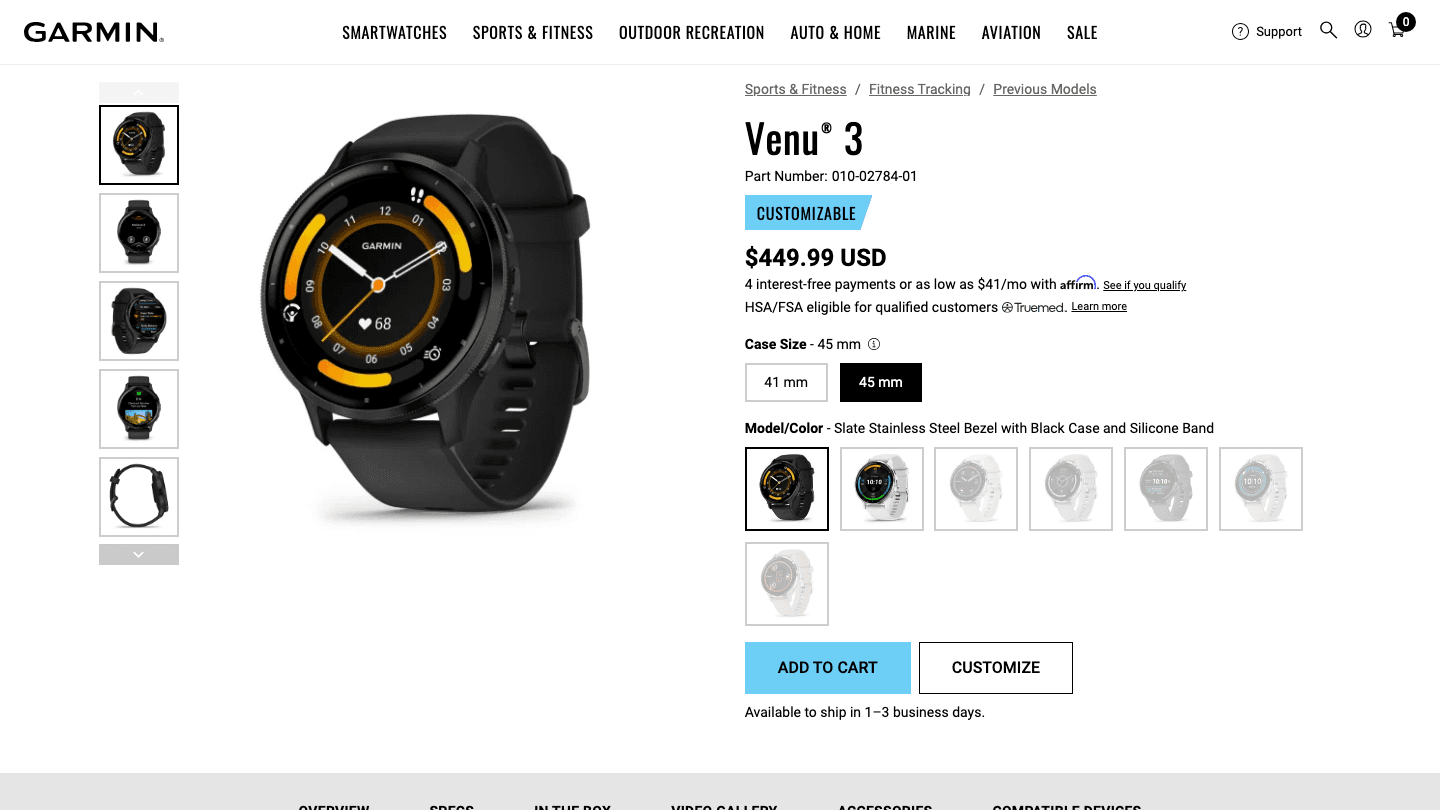
The Venu 3 launched in August 2023 and represented a significant step up from its predecessor with its AMOLED display, Gen 5 heart rate sensor, ECG capability, and built-in speaker and microphone. Two years on, it's still one of Garmin's most complete lifestyle watches and benefits from frequent software updates that keep adding features.
The 45mm version has a 1.4-inch AMOLED at 454x454 resolution with Gorilla Glass 3, a stainless steel bezel, and 8GB of storage. The smaller Venu 3S at 41mm shares the same price ($449.99) with a 1.2-inch display. Battery life reaches 14 days in smartwatch mode and about 5 days with always-on display, which is the Venu 3's strongest selling point over the Venu 4. For more on what the Venu line offers vs. Garmin's more budget-focused options, see our Garmin Venu vs Vivoactive comparison.
1.4-inch AMOLED, 454x454, Gorilla Glass 3 (45mm)
14-day battery (smartwatch mode), 5 days AOD
47g weight (45mm), stainless steel bezel
Gen 5 HR sensor with ECG, barometric altimeter, gyroscope
Speaker and microphone for calls and voice assistant
8GB storage, Garmin Pay, single-band GPS
Body Battery, sleep staging, HRV Status, stress tracking
What Works
14-day battery is significantly better than most AMOLED smartwatches
Lighter at 47g for more comfortable all-day wear
Full ECG and health sensor suite matches the Venu 4
$100 cheaper with essentially the same core features
Limitations
Single-band GPS is less accurate in urban canyons and dense canopy
No LED flashlight
Display tops out at lower brightness than Venu 4 in direct sunlight
No Lifestyle Logging or Health Status feature
Price: $449.99
Best for: Budget-conscious buyers, those who prioritize battery life, and anyone who doesn't need multi-band GPS or a flashlight
Garmin Venu 4 Overview
The premium upgrade with a flashlight, dual-band GPS, and a brighter display

The Venu 4 is a substantial hardware upgrade over the Venu 3. The most visible change is the move to a full metal case, which adds weight (56g vs 47g on the 45mm) but gives the watch a more premium feel. The AMOLED display brightness doubles to 2,000 nits, making it significantly more readable in direct sunlight. A built-in LED flashlight is a first for the Venu series and earns its place for early-morning or late-evening runs.
Dual-band GNSS is the other headline addition. It improves GPS accuracy in challenging environments (urban canyons, tree cover, multi-path reflection) by using two GPS frequencies simultaneously. For road runners, the difference is minor. For trail runners, it's meaningful. The trade-off is GPS battery life: the Venu 4 gets 20 hours in GPS mode vs. the Venu 3's 26 hours.
New software features include Health Status (combining HRV trends, resting heart rate, and skin temperature into a single morning readiness score) and Lifestyle Logging (logging caffeine, alcohol, and other inputs that affect recovery). For deeper analysis of how Garmin's health tracking compares to dedicated recovery devices, see our Whoop vs Garmin comparison.
1.4-inch AMOLED at 2,000 nits, 454x454 (45mm)
12-day battery (smartwatch mode), dual-band GNSS GPS
56g weight (45mm), full metal case, two buttons plus touchscreen
Gen 5 HR sensor with ECG, barometric altimeter, LED flashlight
Health Status, Lifestyle Logging, Training Readiness
Speaker and microphone, Garmin Pay, 8GB storage
What Works
2,000-nit display is dramatically more readable in direct sunlight
LED flashlight is genuinely useful for early-morning and evening runs
Multi-band GPS gives meaningfully better accuracy on trail runs
Health Status and Lifestyle Logging add depth to recovery tracking
Premium metal build feels appropriately high-end for the price
Limitations
12-day battery is 2 days shorter than the Venu 3
56g is noticeably heavier than the Venu 3's 47g
$549.99 is a significant premium over the Venu 3, now widely available below $350
Price: $549.99 (street price often $499.99)
Best for: Trail runners, outdoor enthusiasts, those who want maximum display brightness, and anyone upgrading from a non-AMOLED Garmin
Head-to-Head: Venu 3 vs Venu 4
Display: Both use AMOLED touchscreens at 454x454 (45mm). The Venu 4's 2,000-nit brightness is a real upgrade outdoors; the Venu 3 is fine in most conditions but washes out in harsh sunlight. Indoors and at normal brightness levels, both look excellent.
Battery life: Venu 3 wins with 14 vs 12 days. For most people, both watches charge once a week or less. If you travel without a charger or want the longest gap between charges, the Venu 3 holds the edge.
GPS accuracy: Venu 4 wins with dual-band GNSS. Road runners won't notice the difference. Trail runners and those in cities with tall buildings will. The Venu 3's single-band GPS is accurate enough for most training.
Build and weight: Venu 4 has a full metal case that feels premium; the Venu 3 uses a stainless steel bezel with a fiber-reinforced polymer case, which is lighter (47g vs 56g). Neither feels cheap, but they're meaningfully different in hand.
Flashlight: The Venu 4 has one; the Venu 3 does not. It's surprisingly useful for pre-dawn runs, late-night dog walks, or just finding something in a dark bag. If you run in the dark, this alone may tip the decision.
Health features: Both have Body Battery, sleep staging, HRV Status, ECG, barometric altimeter, and stress tracking. The Venu 4 adds Health Status (a combined readiness score), Lifestyle Logging, and Training Readiness. These are useful additions, not must-haves. Garmin's sleep tracking works well on both; see our Garmin sleep tracker guide for a full breakdown of what to expect.
Price: The Venu 3 is now widely available below $350; the Venu 4 starts at $499.99 on sale. The effective gap is often closer to $150-200, which changes the calculus.
Which Should You Choose?
Get the Venu 3 if:
You want Garmin's flagship lifestyle smartwatch without paying for extras you don't need
Battery life is a priority and two extra days matters to you
You run roads or track where single-band GPS is accurate enough
You don't run in the dark and don't need a flashlight
You prefer a lighter watch for all-day wear
Get the Venu 4 if:
You run trails or in dense urban areas where multi-band GPS accuracy matters
You run early mornings or evenings and would use the flashlight regularly
Direct sunlight readability is important to you
You want the premium metal build and are upgrading from an older non-AMOLED Garmin
The Health Status and Lifestyle Logging features fit your tracking habits
For context on where both sit in Garmin's broader lineup, see the full Garmin Venu 4 review and our Garmin Instinct 3 review if you're also considering Garmin's rugged outdoor option.
Getting More From Your Garmin Data
Whichever watch you choose, the data it generates is only useful if you build your day around it. Body Battery and HRV readings tell you when to push and when to recover, but most people ignore those signals when their task list looks the same every morning. Lifestack is an AI scheduler that arranges your day around your energy levels, making sure your hardest work happens when you're sharpest. Pair it with either Garmin watch and the data becomes part of your daily planning, not just numbers in an app. See how energy-aware scheduling works in practice.
Frequently Asked Questions
Is the Garmin Venu 4 worth the upgrade over the Venu 3?
It depends on your use case. Trail runners and those who run in the dark will get clear value from dual-band GPS and the LED flashlight. For road runners or casual users, the Venu 3 covers the same core health and fitness features for $100 less, now often found below $350 at retail.
What is new in the Garmin Venu 4 compared to the Venu 3?
The Venu 4 adds dual-band GNSS GPS, an LED flashlight, a brighter 2,000-nit AMOLED display, a full metal case, Health Status, Lifestyle Logging, Training Readiness, and a two-button layout. It loses 2 days of battery life and gains 9g of weight in exchange.
Does the Garmin Venu 3 have ECG?
Yes. The Venu 3 includes Garmin's Gen 5 optical heart rate sensor with ECG functionality in supported countries. The Venu 4 also has ECG. This is one of the features shared across both models.
Which Garmin Venu has the best battery life?
The Venu 3 at 14 days smartwatch mode vs the Venu 4's 12 days. For GPS mode, the Venu 3 runs for 26 hours vs the Venu 4's 20 hours. The battery trade-off comes from the dual-band GPS and brighter display in the Venu 4.
Does the Garmin Venu 4 have a flashlight?
Yes. The Venu 4 has a built-in LED flashlight, a first for the Venu series. It activates with a long-press of the top button. The Venu 3 does not have a flashlight.
How does the Garmin Venu 3 vs Venu 4 compare in GPS accuracy?
The Venu 4 has dual-band GNSS (multi-frequency GPS), which is significantly more accurate in urban canyons, under heavy tree cover, and on technical trails. The Venu 3 uses single-band GPS, which is accurate enough for road running and flat trail running but may show drift in challenging GPS environments.
Garmin launched the Venu 4 in September 2025, and the question it immediately raised was whether it's worth $100 more than the Venu 3 it replaces. The short answer depends on three things: whether you care about multi-band GPS accuracy, whether an LED flashlight matters to you, and whether the brighter display is worth giving up two days of battery life.
The Venu 3 at $449.99 remains a capable smartwatch with an AMOLED display, ECG, built-in speaker and microphone, and Garmin's full health tracking suite. The Venu 4 at $549.99 builds on that foundation with a full metal case, a built-in LED flashlight, dual-band GPS, a brighter 2,000-nit display, and new health analysis features like Health Status and Lifestyle Logging.
Neither watch changes what Garmin is fundamentally good at: energy tracking, sleep staging, HRV monitoring, and fitness coaching. The Venu 4 refines the hardware and expands the analytics. Whether you need those additions is the real question. We tested both to help you decide.
Key Takeaways
The Venu 4 ($549.99) adds multi-band GPS, an LED flashlight, a brighter 2,000-nit AMOLED, a full metal case, and new Health Status and Lifestyle Logging features over the Venu 3 ($449.99).
The Venu 3 wins on battery: 14 days vs 12 days in smartwatch mode. It's also lighter (47g vs 56g on the 45mm model) and costs $100 less.
Both watches include ECG, Body Battery, sleep tracking, HRV Status, speaker and microphone for calls, and the Garmin Connect ecosystem. The core health and smart features are shared.
Quick Verdict
Garmin Venu 3: Best for users who want Garmin's full lifestyle smartwatch experience at a lower price with better battery life and a lighter build.
Garmin Venu 4: Best for users who want a premium metal build, brighter display, multi-band GPS accuracy, built-in flashlight, and deeper health analytics for $100 more.
Garmin Venu 3 Overview
The proven lifestyle smartwatch that still holds up in 2025
The Venu 3 launched in August 2023 and represented a significant step up from its predecessor with its AMOLED display, Gen 5 heart rate sensor, ECG capability, and built-in speaker and microphone. Two years on, it's still one of Garmin's most complete lifestyle watches and benefits from frequent software updates that keep adding features.
The 45mm version has a 1.4-inch AMOLED at 454x454 resolution with Gorilla Glass 3, a stainless steel bezel, and 8GB of storage. The smaller Venu 3S at 41mm shares the same price ($449.99) with a 1.2-inch display. Battery life reaches 14 days in smartwatch mode and about 5 days with always-on display, which is the Venu 3's strongest selling point over the Venu 4. For more on what the Venu line offers vs. Garmin's more budget-focused options, see our Garmin Venu vs Vivoactive comparison.
1.4-inch AMOLED, 454x454, Gorilla Glass 3 (45mm)
14-day battery (smartwatch mode), 5 days AOD
47g weight (45mm), stainless steel bezel
Gen 5 HR sensor with ECG, barometric altimeter, gyroscope
Speaker and microphone for calls and voice assistant
8GB storage, Garmin Pay, single-band GPS
Body Battery, sleep staging, HRV Status, stress tracking
What Works
14-day battery is significantly better than most AMOLED smartwatches
Lighter at 47g for more comfortable all-day wear
Full ECG and health sensor suite matches the Venu 4
$100 cheaper with essentially the same core features
Limitations
Single-band GPS is less accurate in urban canyons and dense canopy
No LED flashlight
Display tops out at lower brightness than Venu 4 in direct sunlight
No Lifestyle Logging or Health Status feature
Price: $449.99
Best for: Budget-conscious buyers, those who prioritize battery life, and anyone who doesn't need multi-band GPS or a flashlight
Garmin Venu 4 Overview
The premium upgrade with a flashlight, dual-band GPS, and a brighter display
The Venu 4 is a substantial hardware upgrade over the Venu 3. The most visible change is the move to a full metal case, which adds weight (56g vs 47g on the 45mm) but gives the watch a more premium feel. The AMOLED display brightness doubles to 2,000 nits, making it significantly more readable in direct sunlight. A built-in LED flashlight is a first for the Venu series and earns its place for early-morning or late-evening runs.
Dual-band GNSS is the other headline addition. It improves GPS accuracy in challenging environments (urban canyons, tree cover, multi-path reflection) by using two GPS frequencies simultaneously. For road runners, the difference is minor. For trail runners, it's meaningful. The trade-off is GPS battery life: the Venu 4 gets 20 hours in GPS mode vs. the Venu 3's 26 hours.
New software features include Health Status (combining HRV trends, resting heart rate, and skin temperature into a single morning readiness score) and Lifestyle Logging (logging caffeine, alcohol, and other inputs that affect recovery). For deeper analysis of how Garmin's health tracking compares to dedicated recovery devices, see our Whoop vs Garmin comparison.
1.4-inch AMOLED at 2,000 nits, 454x454 (45mm)
12-day battery (smartwatch mode), dual-band GNSS GPS
56g weight (45mm), full metal case, two buttons plus touchscreen
Gen 5 HR sensor with ECG, barometric altimeter, LED flashlight
Health Status, Lifestyle Logging, Training Readiness
Speaker and microphone, Garmin Pay, 8GB storage
What Works
2,000-nit display is dramatically more readable in direct sunlight
LED flashlight is genuinely useful for early-morning and evening runs
Multi-band GPS gives meaningfully better accuracy on trail runs
Health Status and Lifestyle Logging add depth to recovery tracking
Premium metal build feels appropriately high-end for the price
Limitations
12-day battery is 2 days shorter than the Venu 3
56g is noticeably heavier than the Venu 3's 47g
$549.99 is a significant premium over the Venu 3, now widely available below $350
Price: $549.99 (street price often $499.99)
Best for: Trail runners, outdoor enthusiasts, those who want maximum display brightness, and anyone upgrading from a non-AMOLED Garmin
Head-to-Head: Venu 3 vs Venu 4
Display: Both use AMOLED touchscreens at 454x454 (45mm). The Venu 4's 2,000-nit brightness is a real upgrade outdoors; the Venu 3 is fine in most conditions but washes out in harsh sunlight. Indoors and at normal brightness levels, both look excellent.
Battery life: Venu 3 wins with 14 vs 12 days. For most people, both watches charge once a week or less. If you travel without a charger or want the longest gap between charges, the Venu 3 holds the edge.
GPS accuracy: Venu 4 wins with dual-band GNSS. Road runners won't notice the difference. Trail runners and those in cities with tall buildings will. The Venu 3's single-band GPS is accurate enough for most training.
Build and weight: Venu 4 has a full metal case that feels premium; the Venu 3 uses a stainless steel bezel with a fiber-reinforced polymer case, which is lighter (47g vs 56g). Neither feels cheap, but they're meaningfully different in hand.
Flashlight: The Venu 4 has one; the Venu 3 does not. It's surprisingly useful for pre-dawn runs, late-night dog walks, or just finding something in a dark bag. If you run in the dark, this alone may tip the decision.
Health features: Both have Body Battery, sleep staging, HRV Status, ECG, barometric altimeter, and stress tracking. The Venu 4 adds Health Status (a combined readiness score), Lifestyle Logging, and Training Readiness. These are useful additions, not must-haves. Garmin's sleep tracking works well on both; see our Garmin sleep tracker guide for a full breakdown of what to expect.
Price: The Venu 3 is now widely available below $350; the Venu 4 starts at $499.99 on sale. The effective gap is often closer to $150-200, which changes the calculus.
Which Should You Choose?
Get the Venu 3 if:
You want Garmin's flagship lifestyle smartwatch without paying for extras you don't need
Battery life is a priority and two extra days matters to you
You run roads or track where single-band GPS is accurate enough
You don't run in the dark and don't need a flashlight
You prefer a lighter watch for all-day wear
Get the Venu 4 if:
You run trails or in dense urban areas where multi-band GPS accuracy matters
You run early mornings or evenings and would use the flashlight regularly
Direct sunlight readability is important to you
You want the premium metal build and are upgrading from an older non-AMOLED Garmin
The Health Status and Lifestyle Logging features fit your tracking habits
For context on where both sit in Garmin's broader lineup, see the full Garmin Venu 4 review and our Garmin Instinct 3 review if you're also considering Garmin's rugged outdoor option.
Getting More From Your Garmin Data
Whichever watch you choose, the data it generates is only useful if you build your day around it. Body Battery and HRV readings tell you when to push and when to recover, but most people ignore those signals when their task list looks the same every morning. Lifestack is an AI scheduler that arranges your day around your energy levels, making sure your hardest work happens when you're sharpest. Pair it with either Garmin watch and the data becomes part of your daily planning, not just numbers in an app. See how energy-aware scheduling works in practice.
Frequently Asked Questions
Is the Garmin Venu 4 worth the upgrade over the Venu 3?
It depends on your use case. Trail runners and those who run in the dark will get clear value from dual-band GPS and the LED flashlight. For road runners or casual users, the Venu 3 covers the same core health and fitness features for $100 less, now often found below $350 at retail.
What is new in the Garmin Venu 4 compared to the Venu 3?
The Venu 4 adds dual-band GNSS GPS, an LED flashlight, a brighter 2,000-nit AMOLED display, a full metal case, Health Status, Lifestyle Logging, Training Readiness, and a two-button layout. It loses 2 days of battery life and gains 9g of weight in exchange.
Does the Garmin Venu 3 have ECG?
Yes. The Venu 3 includes Garmin's Gen 5 optical heart rate sensor with ECG functionality in supported countries. The Venu 4 also has ECG. This is one of the features shared across both models.
Which Garmin Venu has the best battery life?
The Venu 3 at 14 days smartwatch mode vs the Venu 4's 12 days. For GPS mode, the Venu 3 runs for 26 hours vs the Venu 4's 20 hours. The battery trade-off comes from the dual-band GPS and brighter display in the Venu 4.
Does the Garmin Venu 4 have a flashlight?
Yes. The Venu 4 has a built-in LED flashlight, a first for the Venu series. It activates with a long-press of the top button. The Venu 3 does not have a flashlight.
How does the Garmin Venu 3 vs Venu 4 compare in GPS accuracy?
The Venu 4 has dual-band GNSS (multi-frequency GPS), which is significantly more accurate in urban canyons, under heavy tree cover, and on technical trails. The Venu 3 uses single-band GPS, which is accurate enough for road running and flat trail running but may show drift in challenging GPS environments.



FOLLOW ON
FOLLOW ON
FOLLOW ON


Copyright 2026 © Lifestack. All rights reserved
Copyright 2026 © Lifestack. All rights reserved

