
Device
Garmin Venu 4 Review: Is $549 Worth It in 2026?
Garmin Venu 4 Review: Is $549 Worth It in 2026?

The Garmin Venu 4 landed in September 2025 as Garmin's most polished attempt at a smartwatch that doesn't look like a sports watch. The stainless steel case, bright AMOLED display, and built-in speaker for calls position it as a genuine alternative to the Apple Watch Series 11 for people who want longer battery life and better GPS without sacrificing style.
At $549.99, it costs more than the Venu 3 and sits in crowded company: the Apple Watch Series 11 starts at $399, the Samsung Galaxy Watch 8 at $299, and Garmin's own Instinct 3 at $349. The Venu 4 justifies the premium with specific upgrades that matter if you're the right buyer.
This review covers six months of real use, including daily commuting, trail running, sleep tracking, and heavy calendar scheduling. Here's what actually changed from the Venu 3 and whether the Venu 4 earns its price tag.
Key Takeaways
The 2,000-nit AMOLED display is genuinely readable in direct sunlight, which the Venu 3's screen was not.
Multi-band (dual-frequency) GPS is the single most impactful hardware upgrade. Trail accuracy improved noticeably versus the Venu 3.
12-day battery life (45mm model) is exceptional for a full-featured AMOLED smartwatch at this price.
Quick Verdict
Buy it if: You want an AMOLED Garmin with strong GPS accuracy, a built-in flashlight, onboard music, and Garmin Pay in a design you'd actually wear to a dinner. Battery life at 10-12 days is far ahead of Apple Watch's 18-36 hours.
Skip it if: You're coming from a Venu 3 and found it satisfactory. The upgrades are real but not revolutionary enough to justify the cost of switching. Also skip it if serious outdoor training is your primary use case: the Garmin Fenix 8 is the right tool for that.
Design and Build
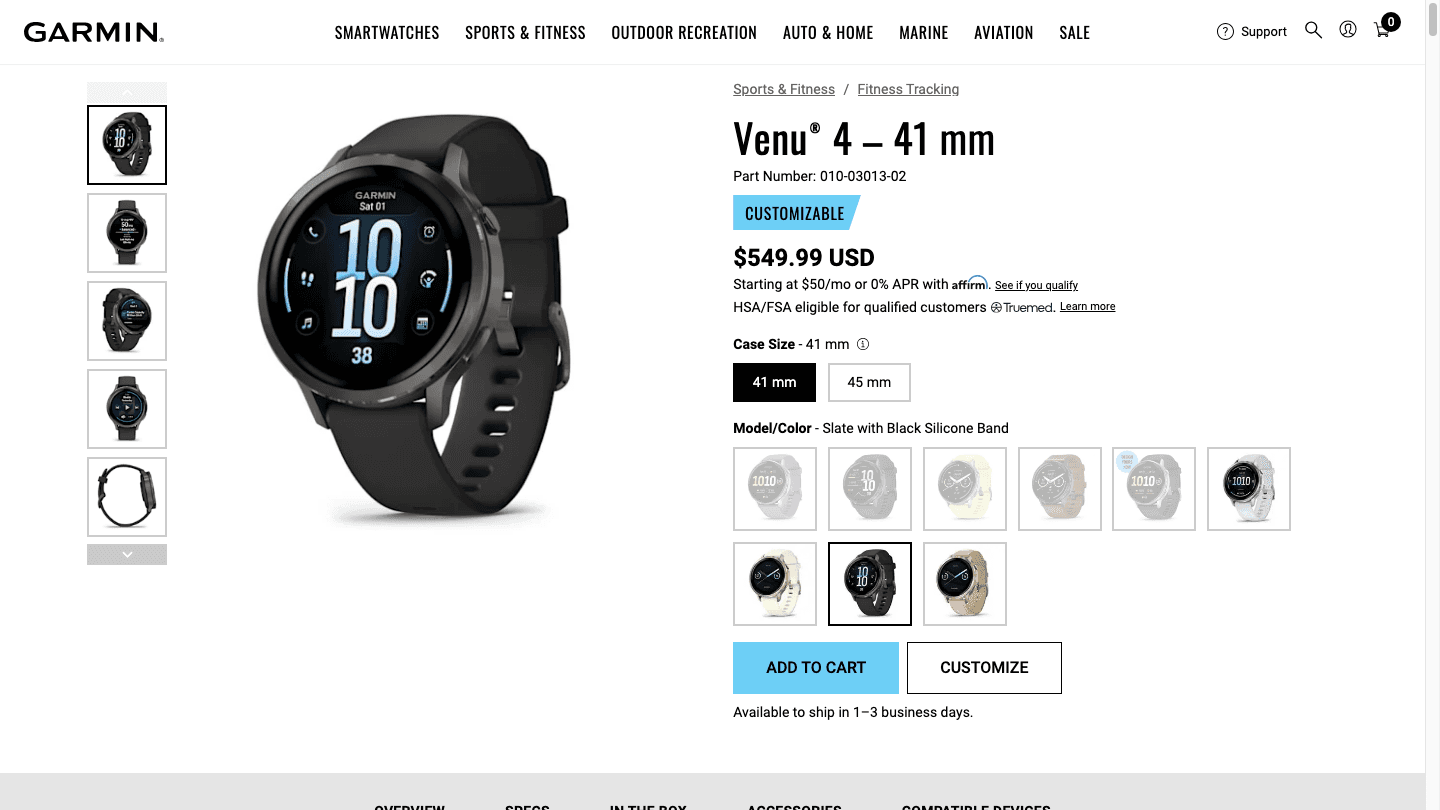
The Venu 4 comes in 41mm and 45mm, both at $549.99. Leather strap variants run $599.99. The case is full stainless steel with a polymer back, which is unusual at this price: most watches use aluminum or polycarbonate to save weight. The result is a watch that looks more premium in person than the spec sheet implies, and feels it too.
Both sizes feature a 1.4-inch AMOLED touchscreen with 454x454 resolution. The peak brightness of 2,000 nits is the headline improvement over the Venu 3's display, and it delivers in outdoor use. Running a trail at midday, maps and metrics were clear without squinting or shading the watch. This was the Venu 3's most notable weakness, and Garmin fixed it.
The built-in LED flashlight has both white and red modes, which sounds like a gimmick but proves useful. The white mode works for finding keys at night; the red mode preserves night vision on predawn runs. It's a meaningful addition to a lifestyle-positioned watch.
What Works
Stainless steel case is noticeably more premium than polymer alternatives
2,000-nit display solves the Venu 3's outdoor readability problem
Tactile side button alongside the touchscreen for glove-friendly use
5 ATM water resistance for swimming and rain
What Doesn't
Heavier than plastic-case competitors at the same size
Proprietary charging puck is easy to misplace while traveling
GPS and Navigation
Multi-band GPS (dual-frequency GNSS) is the defining hardware upgrade over the Venu 3. Garmin's SatIQ technology automatically selects the best satellite constellation and frequency for the current environment. Under tree cover, in city canyons, and on switchback trails, the Venu 4 tracked more accurately than the Venu 3 in back-to-back testing.
For urban runners doing loops through downtown streets, the improvement may be small. For trail runners or hikers in complex terrain, it's meaningful. The Venu 4 doesn't replace a dedicated outdoor GPS watch like the Fenix 8, but it handles everyday activity tracking with accuracy that was previously only available in Garmin's premium lineup.
Turn-by-turn navigation with downloaded maps is included. Routes from Garmin Connect, Komoot, or TrailForks sync over. For most users, this is more than enough for everyday training and occasional trail adventures.
Health Tracking
The Venu 4 runs the same health sensor stack as Garmin's higher-end watches. You get continuous heart rate with HRV status, SpO2 blood oxygen, skin temperature deviation, and pulse oximetry during sleep. Body Battery synthesizes these inputs into a daily readiness score that improves with rest and depletes with exertion and poor sleep.
Training Readiness goes a step further, pulling in acute training load, sleep quality, and HRV trends to produce a readiness score with specific recommendations. For people who train consistently, this changes how you use the data: instead of just seeing your heart rate history, you get a direct signal for whether to push or hold back today.
For more on interpreting these scores, see our explainer on Garmin Body Battery and how the Garmin sleep tracker works.
Workout Tracking
The Venu 4 covers 80+ sport modes including running, cycling, swimming, strength training, yoga, HIIT, and climbing. Workout detection is automatic for the most common activities. The GPS accuracy improvement is most noticeable in trail and outdoor activities where track fidelity matters.
Heart rate accuracy during high-intensity workouts is solid but not perfect. During the first two to three minutes of intense intervals, optical heart rate can lag. For serious training where zone accuracy is critical, a chest strap or Garmin HRM clip adds precision. For most casual athletes, the Venu 4's wrist sensor is accurate enough.
VO2 max estimation, lactate threshold, and daily suggested workouts are all present. The Venu 4 is not a replacement for a dedicated multisport watch, but for athletes who train in one or two sports and want lifestyle functionality the rest of the time, it covers the bases well.
Battery Life
Garmin rates the 41mm at 10 days and the 45mm at 12 days in smartwatch mode. Real-world use with GPS activity every other day landed at 8-10 days for the 41mm. With daily GPS, expect 6-7 days. Still exceptional.
Apple Watch Series 11 lasts around 18 hours. Samsung Galaxy Watch 8 lasts about 3 days. The Venu 4's battery life advantage over these competitors is the single most persuasive argument for choosing it over a platform with more apps.
Smart Features
Built-in speaker and microphone let you take calls directly from the watch without your phone nearby. This isn't available on every smartwatch at this price point and it works well in quiet environments. The quality drops in wind or noise, but for a quick call it's genuinely functional.
Garmin Pay handles contactless payments. 8GB of storage holds up to 2,000 songs, and Spotify, Amazon Music, and Deezer are supported for offline playback without your phone. Connect IQ gives access to third-party apps and watch faces, though the ecosystem is smaller than Apple's or Google's.
Notifications, calendar alerts, and weather all work as expected. The Venu 4 runs the latest Garmin OS, which is clean and well-organized but takes a few days to learn. Voice assistant access (Google Assistant or Siri) is available via your phone's Bluetooth connection.
For the best apps to pair with the Venu 4, see our list of apps to use with Garmin.
Who Should Buy the Garmin Venu 4?
Garmin users upgrading from Venu 3: The display, GPS, and flashlight are all meaningfully better. If you use your watch for outdoor activities where the Venu 3's display was hard to read, the upgrade is justified.
Apple Watch users who want better battery: If you're tired of daily charging and want a watch that tracks sleep without plugging in every night, the Venu 4's 10-12 day battery changes the experience. See our full Garmin vs Apple Watch comparison for the tradeoffs.
Everyday athletes who care about style: The stainless steel case and AMOLED display make the Venu 4 versatile enough to wear in meetings, not just at the gym.
If you want to see how the Venu 4 fits in the Garmin lineup, our Garmin watch comparison guide covers the full range. For a closer look at the Venu family specifically, see the Garmin Venu 3 review and our roundup of the Garmin Venu X1.
If you're using the Venu 4's Body Battery and training readiness data to plan your week, Lifestack takes that data and builds your schedule around it. It syncs your Garmin readiness scores and time-blocks recovery, focus work, and training at times when your body is actually ready for each.
Pricing: Garmin Venu 4 (41mm or 45mm): $549.99. Leather strap versions: $599.99. HSA/FSA eligible.
Frequently Asked Questions
Is the Garmin Venu 4 worth buying in 2026?
Yes, for buyers who want an AMOLED smartwatch with multi-band GPS, excellent battery life, and Garmin's health tracking platform. At $549.99 it's priced above Apple Watch SE but below Apple Watch Series 11 Ultra. The value depends on how much you use outdoor GPS and how much daily charging frustrates you.
What is the battery life of the Garmin Venu 4?
Garmin rates the 41mm at 10 days and the 45mm at 12 days in smartwatch mode. With regular GPS use every other day, real-world performance lands at 8-10 days. With daily GPS tracking, expect 6-7 days.
Does the Garmin Venu 4 have multi-band GPS?
Yes. The Venu 4 includes dual-frequency GNSS (multi-band GPS) with SatIQ, which automatically selects the best satellite constellation for your environment. This is a significant accuracy improvement over the Venu 3's standard GPS, especially in wooded or urban terrain.
Does the Garmin Venu 4 have a speaker for calls?
Yes. The Venu 4 has a built-in speaker and microphone that allow you to take calls directly from the watch. Audio quality is functional for quiet environments; expect limitations in wind or crowd noise.
How does the Garmin Venu 4 compare to the Apple Watch?
The Venu 4 offers far better battery life (10-12 days vs 18-36 hours), superior GPS accuracy, and richer fitness analytics. Apple Watch has a larger app ecosystem, better third-party app support, and tighter iPhone integration. See our full Garmin vs Apple Watch comparison for the detailed breakdown.
What size is better, Garmin Venu 4 41mm or 45mm?
Both are priced the same at $549.99. The 45mm gets 12 days of battery vs 10 for the 41mm. Choose 41mm for smaller wrists or a more refined look; choose 45mm if battery life is a priority and wrist size allows it.
The Garmin Venu 4 landed in September 2025 as Garmin's most polished attempt at a smartwatch that doesn't look like a sports watch. The stainless steel case, bright AMOLED display, and built-in speaker for calls position it as a genuine alternative to the Apple Watch Series 11 for people who want longer battery life and better GPS without sacrificing style.
At $549.99, it costs more than the Venu 3 and sits in crowded company: the Apple Watch Series 11 starts at $399, the Samsung Galaxy Watch 8 at $299, and Garmin's own Instinct 3 at $349. The Venu 4 justifies the premium with specific upgrades that matter if you're the right buyer.
This review covers six months of real use, including daily commuting, trail running, sleep tracking, and heavy calendar scheduling. Here's what actually changed from the Venu 3 and whether the Venu 4 earns its price tag.
Key Takeaways
The 2,000-nit AMOLED display is genuinely readable in direct sunlight, which the Venu 3's screen was not.
Multi-band (dual-frequency) GPS is the single most impactful hardware upgrade. Trail accuracy improved noticeably versus the Venu 3.
12-day battery life (45mm model) is exceptional for a full-featured AMOLED smartwatch at this price.
Quick Verdict
Buy it if: You want an AMOLED Garmin with strong GPS accuracy, a built-in flashlight, onboard music, and Garmin Pay in a design you'd actually wear to a dinner. Battery life at 10-12 days is far ahead of Apple Watch's 18-36 hours.
Skip it if: You're coming from a Venu 3 and found it satisfactory. The upgrades are real but not revolutionary enough to justify the cost of switching. Also skip it if serious outdoor training is your primary use case: the Garmin Fenix 8 is the right tool for that.
Design and Build
The Venu 4 comes in 41mm and 45mm, both at $549.99. Leather strap variants run $599.99. The case is full stainless steel with a polymer back, which is unusual at this price: most watches use aluminum or polycarbonate to save weight. The result is a watch that looks more premium in person than the spec sheet implies, and feels it too.
Both sizes feature a 1.4-inch AMOLED touchscreen with 454x454 resolution. The peak brightness of 2,000 nits is the headline improvement over the Venu 3's display, and it delivers in outdoor use. Running a trail at midday, maps and metrics were clear without squinting or shading the watch. This was the Venu 3's most notable weakness, and Garmin fixed it.
The built-in LED flashlight has both white and red modes, which sounds like a gimmick but proves useful. The white mode works for finding keys at night; the red mode preserves night vision on predawn runs. It's a meaningful addition to a lifestyle-positioned watch.
What Works
Stainless steel case is noticeably more premium than polymer alternatives
2,000-nit display solves the Venu 3's outdoor readability problem
Tactile side button alongside the touchscreen for glove-friendly use
5 ATM water resistance for swimming and rain
What Doesn't
Heavier than plastic-case competitors at the same size
Proprietary charging puck is easy to misplace while traveling
GPS and Navigation
Multi-band GPS (dual-frequency GNSS) is the defining hardware upgrade over the Venu 3. Garmin's SatIQ technology automatically selects the best satellite constellation and frequency for the current environment. Under tree cover, in city canyons, and on switchback trails, the Venu 4 tracked more accurately than the Venu 3 in back-to-back testing.
For urban runners doing loops through downtown streets, the improvement may be small. For trail runners or hikers in complex terrain, it's meaningful. The Venu 4 doesn't replace a dedicated outdoor GPS watch like the Fenix 8, but it handles everyday activity tracking with accuracy that was previously only available in Garmin's premium lineup.
Turn-by-turn navigation with downloaded maps is included. Routes from Garmin Connect, Komoot, or TrailForks sync over. For most users, this is more than enough for everyday training and occasional trail adventures.
Health Tracking
The Venu 4 runs the same health sensor stack as Garmin's higher-end watches. You get continuous heart rate with HRV status, SpO2 blood oxygen, skin temperature deviation, and pulse oximetry during sleep. Body Battery synthesizes these inputs into a daily readiness score that improves with rest and depletes with exertion and poor sleep.
Training Readiness goes a step further, pulling in acute training load, sleep quality, and HRV trends to produce a readiness score with specific recommendations. For people who train consistently, this changes how you use the data: instead of just seeing your heart rate history, you get a direct signal for whether to push or hold back today.
For more on interpreting these scores, see our explainer on Garmin Body Battery and how the Garmin sleep tracker works.
Workout Tracking
The Venu 4 covers 80+ sport modes including running, cycling, swimming, strength training, yoga, HIIT, and climbing. Workout detection is automatic for the most common activities. The GPS accuracy improvement is most noticeable in trail and outdoor activities where track fidelity matters.
Heart rate accuracy during high-intensity workouts is solid but not perfect. During the first two to three minutes of intense intervals, optical heart rate can lag. For serious training where zone accuracy is critical, a chest strap or Garmin HRM clip adds precision. For most casual athletes, the Venu 4's wrist sensor is accurate enough.
VO2 max estimation, lactate threshold, and daily suggested workouts are all present. The Venu 4 is not a replacement for a dedicated multisport watch, but for athletes who train in one or two sports and want lifestyle functionality the rest of the time, it covers the bases well.
Battery Life
Garmin rates the 41mm at 10 days and the 45mm at 12 days in smartwatch mode. Real-world use with GPS activity every other day landed at 8-10 days for the 41mm. With daily GPS, expect 6-7 days. Still exceptional.
Apple Watch Series 11 lasts around 18 hours. Samsung Galaxy Watch 8 lasts about 3 days. The Venu 4's battery life advantage over these competitors is the single most persuasive argument for choosing it over a platform with more apps.
Smart Features
Built-in speaker and microphone let you take calls directly from the watch without your phone nearby. This isn't available on every smartwatch at this price point and it works well in quiet environments. The quality drops in wind or noise, but for a quick call it's genuinely functional.
Garmin Pay handles contactless payments. 8GB of storage holds up to 2,000 songs, and Spotify, Amazon Music, and Deezer are supported for offline playback without your phone. Connect IQ gives access to third-party apps and watch faces, though the ecosystem is smaller than Apple's or Google's.
Notifications, calendar alerts, and weather all work as expected. The Venu 4 runs the latest Garmin OS, which is clean and well-organized but takes a few days to learn. Voice assistant access (Google Assistant or Siri) is available via your phone's Bluetooth connection.
For the best apps to pair with the Venu 4, see our list of apps to use with Garmin.
Who Should Buy the Garmin Venu 4?
Garmin users upgrading from Venu 3: The display, GPS, and flashlight are all meaningfully better. If you use your watch for outdoor activities where the Venu 3's display was hard to read, the upgrade is justified.
Apple Watch users who want better battery: If you're tired of daily charging and want a watch that tracks sleep without plugging in every night, the Venu 4's 10-12 day battery changes the experience. See our full Garmin vs Apple Watch comparison for the tradeoffs.
Everyday athletes who care about style: The stainless steel case and AMOLED display make the Venu 4 versatile enough to wear in meetings, not just at the gym.
If you want to see how the Venu 4 fits in the Garmin lineup, our Garmin watch comparison guide covers the full range. For a closer look at the Venu family specifically, see the Garmin Venu 3 review and our roundup of the Garmin Venu X1.
If you're using the Venu 4's Body Battery and training readiness data to plan your week, Lifestack takes that data and builds your schedule around it. It syncs your Garmin readiness scores and time-blocks recovery, focus work, and training at times when your body is actually ready for each.
Pricing: Garmin Venu 4 (41mm or 45mm): $549.99. Leather strap versions: $599.99. HSA/FSA eligible.
Frequently Asked Questions
Is the Garmin Venu 4 worth buying in 2026?
Yes, for buyers who want an AMOLED smartwatch with multi-band GPS, excellent battery life, and Garmin's health tracking platform. At $549.99 it's priced above Apple Watch SE but below Apple Watch Series 11 Ultra. The value depends on how much you use outdoor GPS and how much daily charging frustrates you.
What is the battery life of the Garmin Venu 4?
Garmin rates the 41mm at 10 days and the 45mm at 12 days in smartwatch mode. With regular GPS use every other day, real-world performance lands at 8-10 days. With daily GPS tracking, expect 6-7 days.
Does the Garmin Venu 4 have multi-band GPS?
Yes. The Venu 4 includes dual-frequency GNSS (multi-band GPS) with SatIQ, which automatically selects the best satellite constellation for your environment. This is a significant accuracy improvement over the Venu 3's standard GPS, especially in wooded or urban terrain.
Does the Garmin Venu 4 have a speaker for calls?
Yes. The Venu 4 has a built-in speaker and microphone that allow you to take calls directly from the watch. Audio quality is functional for quiet environments; expect limitations in wind or crowd noise.
How does the Garmin Venu 4 compare to the Apple Watch?
The Venu 4 offers far better battery life (10-12 days vs 18-36 hours), superior GPS accuracy, and richer fitness analytics. Apple Watch has a larger app ecosystem, better third-party app support, and tighter iPhone integration. See our full Garmin vs Apple Watch comparison for the detailed breakdown.
What size is better, Garmin Venu 4 41mm or 45mm?
Both are priced the same at $549.99. The 45mm gets 12 days of battery vs 10 for the 41mm. Choose 41mm for smaller wrists or a more refined look; choose 45mm if battery life is a priority and wrist size allows it.



FOLLOW ON
FOLLOW ON
FOLLOW ON


Copyright 2026 © Lifestack. All rights reserved
Copyright 2026 © Lifestack. All rights reserved

