
Tips
What Is Garmin Body Battery? A Complete Guide
What Is Garmin Body Battery? A Complete Guide

You glance at your Garmin watch in the morning and see a number between 0 and 100. That is your Body Battery score, and it is telling you something useful about how ready your body is for the day ahead. Understanding what it means and what drives it can change how you schedule your work, your workouts, and your rest.
Body Battery is not a fitness metric. It is an energy management metric. It does not tell you how fit you are or how well you slept in isolation. It synthesizes data from several physiological inputs to give you a single number representing how much energy your body has available right now.
This guide explains how it works, what your scores mean in practice, and how to use the readings to make better decisions about when to push hard and when to recover. Along the way, we also cover one tool that turns Body Battery-style energy awareness into an automatic daily schedule.
Key Takeaways
Body Battery scores range from 5 to 100. Waking up above 75 means your body recovered well. Below 50 means you are starting the day already depleted.
The score is driven by three main inputs: heart rate variability (HRV), sleep quality, and stress levels tracked throughout the day and night.
The most useful application is not just reading your score but scheduling your hardest mental and physical work for the windows when your Body Battery is highest.
What Is Garmin Body Battery?
Body Battery is Garmin's proprietary energy monitoring feature, available on most modern Garmin smartwatches and fitness trackers. It displays a score from 5 to 100 that represents your body's estimated energy reserves at any given moment. The score rises when you rest or sleep and falls when you exercise, experience stress, or stay active.
Think of it like a phone battery. Sleep charges it up overnight. Your morning workout, a stressful deadline, or a long afternoon of calls drains it. The difference from a phone battery is that the recharge rate depends on how well you are actually recovering, not just whether you are sitting still.
Garmin introduced Body Battery in 2018, and it has become one of the more practical health metrics on modern wearables because it is actionable. Unlike VO2 max estimates or sleep stage breakdowns (which require some exercise science knowledge to interpret), a single number from 5 to 100 is immediately readable.
How Does Garmin Body Battery Work?
Body Battery is calculated using data from Garmin's stress tracking system, which is itself derived from heart rate variability (HRV). HRV measures the variation in time between consecutive heartbeats. Higher variability generally reflects a body at rest and recovering well. Lower variability signals stress, fatigue, or high physiological load.
The three main inputs are:
Heart rate variability (HRV): The primary driver. High HRV during rest = Battery charges faster. Low HRV during the day = Battery drains.
Sleep: Garmin tracks sleep stages throughout the night. Better quality sleep (more deep and REM sleep, fewer interruptions) produces more Battery recovery overnight.
Stress: Garmin's continuous stress score, also derived from HRV patterns, tracks how your autonomic nervous system responds throughout the day. High stress drains Battery even when you are sitting still.
Activity and exercise are the most visible drains. A hard run or strength session will visibly drop your score in real time. But many people are surprised to find that a difficult meeting, a long drive, or a few hours of concentrated work can drain Body Battery nearly as fast as a moderate workout.
The algorithm also accounts for circadian rhythm patterns. Your body's overnight recovery window is weighted more heavily than daytime rest, which is why a 20-minute nap barely moves the needle compared to a full night of sleep.
What Do Body Battery Score Ranges Mean?
Scores above 75 in the morning indicate solid overnight recovery. You have the physiological reserves for a hard training session, a demanding creative day, or anything else that requires sustained focus or physical output.
A morning score between 50 and 74 suggests incomplete recovery. Moderate activity and normal knowledge work are fine, but starting a long hard run or an unusually stressful work sprint on a 55 is likely to leave you more depleted by afternoon than usual.
Scores below 50 in the morning are a signal that your body did not recover well. The causes vary: poor sleep quality, high stress from the previous day, illness, or cumulative fatigue from several demanding days in a row. This is the range where most people feel noticeably off before they even check the watch.
By end of day, most active people will see their score drop significantly. A score of 20 or below in the evening is normal after a full day. Where it matters most is your morning reading, which reflects how well your recovery window actually worked.
What Depletes Your Body Battery?
Exercise is the most obvious drain, and the most expected one. A 45-minute zone 2 run might drop Body Battery by 20-30 points. A hard interval session or heavy strength workout can take 40 or more points off in under an hour.
What catches more people off guard is the cognitive and emotional drain. Sustained mental effort, whether that is writing, coding, analyzing, or making difficult decisions, shows up as stress in Garmin's HRV-derived tracking. A four-hour deep work block can drain Battery nearly as much as a moderate workout. Back-to-back calls compound this further.
Workouts and physical activity (the largest single drains)
Sustained mental work and concentration
Stress events: difficult conversations, deadlines, high-stakes meetings
Poor sleep (less overnight recharge than expected)
Illness or travel across time zones
Alcohol (disrupts HRV and deep sleep, reducing overnight recovery)
How to Charge Your Body Battery Faster
Sleep is the only thing that meaningfully recharges Body Battery. Everything else is about reducing drain, not adding charge. The good news is that improving sleep quality tends to produce more Battery recovery than simply sleeping longer.
The most reliable way to improve your morning Body Battery is to track what actually affects your overnight recovery. For most people, alcohol is the most dramatic variable: even two drinks can cut deep sleep significantly, which shows up as a morning Battery 10-20 points lower than usual.
Short rest periods during the day (eyes closed, completely still) can provide minor recharges, but the effect is small compared to actual sleep. Garmin will show a slight rise during an extended rest period if your stress levels drop sufficiently. Naps of 20-30 minutes, if they produce real sleep, provide more meaningful recovery.
Consistent sleep schedule (same bed and wake time stabilizes your HRV baseline)
Reduce alcohol, especially within three hours of bed
Lower daytime stress where possible (fewer back-to-back calls, scheduled recovery windows)
Physical activity improves overnight HRV over time, even if it drains Battery in the short term
Avoid intense workouts late at night; they suppress overnight HRV recovery
How to Use Body Battery to Plan Your Day
The most practical use of Body Battery is scheduling: doing your hardest work when your Battery is highest and scheduling easier tasks (email, admin, calls) for when it is lower. Most people do the opposite. They check messages and attend meetings all morning when their energy is at its peak, then try to do creative or focused work in the afternoon when they are already depleted.
If you wake up with a 85, that morning window before your first meeting is the ideal time for deep work, writing, or anything that requires your best thinking. If you wake up with a 42, adjust. Push the heavy cognitive load to the next morning and use today for lower-stakes tasks.
This kind of energy-based planning has clear benefits, but doing it manually every morning requires checking the watch, estimating your available hours, and rebuilding your schedule in your head. Most people do not sustain that process for more than a few days. The apps below show how to automate it.
Best Tool for Energy-Aware Daily Scheduling
Automate the Body Battery insight into a real schedule.
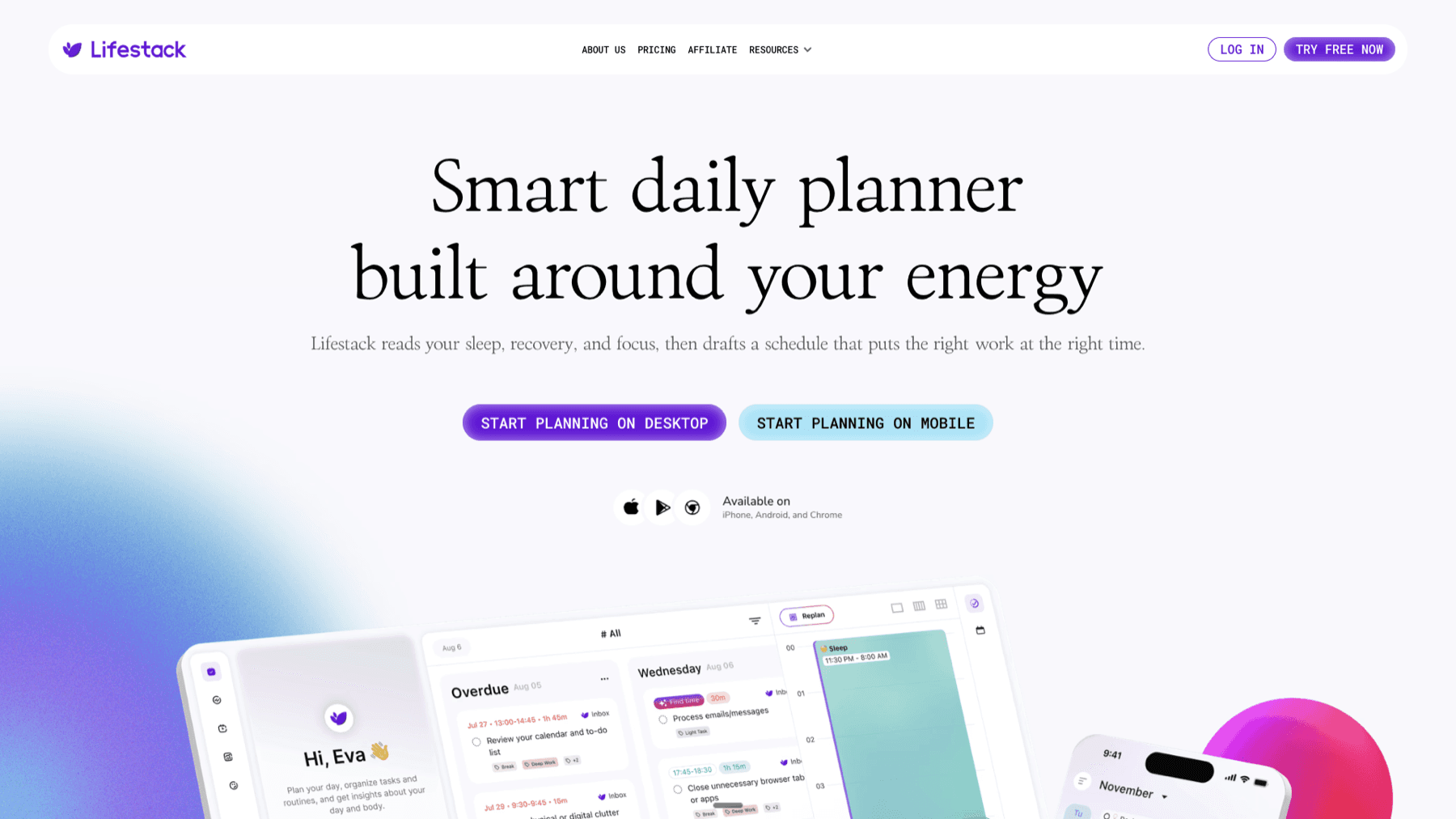
Lifestack is an AI daily planner built around the same premise that drives Body Battery: your energy levels should determine when you do your hardest work, not just your calendar. While Lifestack does not currently read directly from Garmin Connect, it uses its own energy modeling based on your activity patterns, task history, and calendar data to build a daily schedule that puts high-focus work into your peak hours automatically.
The practical result is similar to manually checking your Body Battery and rescheduling your day around it, but it happens without you having to do the rearranging. If you are interested in pairing wearable energy data with a scheduling tool, Lifestack is the closest thing available to an automatic translation of "I have high energy right now" into "here is what I should be working on." It works well for people who are already using Garmin to understand their energy but want a tool that acts on that data, not just displays it.
Lifestack is available on iOS and Android, with a Chrome extension. Pricing starts at $7/month or $50/year, with a 7-day trial on the annual plan.
Frequently Asked Questions
What is a good Garmin Body Battery score?
A morning score of 75 or above indicates solid overnight recovery. Scores of 50-74 suggest adequate but incomplete recovery. Below 50 in the morning signals significant fatigue. By the end of an active day, most people's Battery will naturally drop to 20 or below, which is normal.
How accurate is Garmin Body Battery?
Body Battery is not a clinical measurement. It is an estimate derived from HRV patterns, and individual variation in HRV baselines means some users will find it more accurate than others. Most people report that the score tracks their subjective energy levels well, particularly the overnight recovery trend. It is most useful as a relative indicator (today vs. yesterday) rather than an absolute number.
Why is my Body Battery not charging overnight?
The most common causes are high sleep stress (often from alcohol, late-night activity, or illness), sleep disruptions that prevent deep and REM stages, or wearing the watch too loosely so HRV data is inconsistent. If your score is consistently low in the morning despite adequate sleep hours, check your sleep quality data in Garmin Connect for fragmented sleep or low deep sleep percentage.
Does Body Battery work with all Garmin watches?
Body Battery is available on most Garmin devices from 2018 onward that include optical heart rate sensors. This covers most Forerunner, Fenix, Venu, Vivoactive, and Vivosmart models from that era on. Some older entry-level devices do not support it. Check Garmin's support site or your device's feature list to confirm.
How do I use Body Battery with health tracking apps?
Garmin Connect syncs data to Apple Health and Google Fit, but Body Battery itself is a Garmin-proprietary metric and does not export to third-party health platforms in its scored form. You can view Body Battery history and trends only within the Garmin Connect app. Other wearable platforms like Oura have their own equivalent metrics (Readiness Score for Oura) that serve a similar purpose.
Can I improve my Body Battery through better planning?
Yes. Scheduling demanding work at your peak energy hours reduces overall daily depletion and gives your body a better base for overnight recovery. Clustering stressful events (rather than spreading them across the whole day) also helps. Many users find that a structured morning routine that avoids high-stress inputs in the first hour of the day results in a consistently slower Body Battery drain throughout the morning. Planning your day around energy, not just time, is the underlying principle.
You glance at your Garmin watch in the morning and see a number between 0 and 100. That is your Body Battery score, and it is telling you something useful about how ready your body is for the day ahead. Understanding what it means and what drives it can change how you schedule your work, your workouts, and your rest.
Body Battery is not a fitness metric. It is an energy management metric. It does not tell you how fit you are or how well you slept in isolation. It synthesizes data from several physiological inputs to give you a single number representing how much energy your body has available right now.
This guide explains how it works, what your scores mean in practice, and how to use the readings to make better decisions about when to push hard and when to recover. Along the way, we also cover one tool that turns Body Battery-style energy awareness into an automatic daily schedule.
Key Takeaways
Body Battery scores range from 5 to 100. Waking up above 75 means your body recovered well. Below 50 means you are starting the day already depleted.
The score is driven by three main inputs: heart rate variability (HRV), sleep quality, and stress levels tracked throughout the day and night.
The most useful application is not just reading your score but scheduling your hardest mental and physical work for the windows when your Body Battery is highest.
What Is Garmin Body Battery?
Body Battery is Garmin's proprietary energy monitoring feature, available on most modern Garmin smartwatches and fitness trackers. It displays a score from 5 to 100 that represents your body's estimated energy reserves at any given moment. The score rises when you rest or sleep and falls when you exercise, experience stress, or stay active.
Think of it like a phone battery. Sleep charges it up overnight. Your morning workout, a stressful deadline, or a long afternoon of calls drains it. The difference from a phone battery is that the recharge rate depends on how well you are actually recovering, not just whether you are sitting still.
Garmin introduced Body Battery in 2018, and it has become one of the more practical health metrics on modern wearables because it is actionable. Unlike VO2 max estimates or sleep stage breakdowns (which require some exercise science knowledge to interpret), a single number from 5 to 100 is immediately readable.
How Does Garmin Body Battery Work?
Body Battery is calculated using data from Garmin's stress tracking system, which is itself derived from heart rate variability (HRV). HRV measures the variation in time between consecutive heartbeats. Higher variability generally reflects a body at rest and recovering well. Lower variability signals stress, fatigue, or high physiological load.
The three main inputs are:
Heart rate variability (HRV): The primary driver. High HRV during rest = Battery charges faster. Low HRV during the day = Battery drains.
Sleep: Garmin tracks sleep stages throughout the night. Better quality sleep (more deep and REM sleep, fewer interruptions) produces more Battery recovery overnight.
Stress: Garmin's continuous stress score, also derived from HRV patterns, tracks how your autonomic nervous system responds throughout the day. High stress drains Battery even when you are sitting still.
Activity and exercise are the most visible drains. A hard run or strength session will visibly drop your score in real time. But many people are surprised to find that a difficult meeting, a long drive, or a few hours of concentrated work can drain Body Battery nearly as fast as a moderate workout.
The algorithm also accounts for circadian rhythm patterns. Your body's overnight recovery window is weighted more heavily than daytime rest, which is why a 20-minute nap barely moves the needle compared to a full night of sleep.
What Do Body Battery Score Ranges Mean?
Scores above 75 in the morning indicate solid overnight recovery. You have the physiological reserves for a hard training session, a demanding creative day, or anything else that requires sustained focus or physical output.
A morning score between 50 and 74 suggests incomplete recovery. Moderate activity and normal knowledge work are fine, but starting a long hard run or an unusually stressful work sprint on a 55 is likely to leave you more depleted by afternoon than usual.
Scores below 50 in the morning are a signal that your body did not recover well. The causes vary: poor sleep quality, high stress from the previous day, illness, or cumulative fatigue from several demanding days in a row. This is the range where most people feel noticeably off before they even check the watch.
By end of day, most active people will see their score drop significantly. A score of 20 or below in the evening is normal after a full day. Where it matters most is your morning reading, which reflects how well your recovery window actually worked.
What Depletes Your Body Battery?
Exercise is the most obvious drain, and the most expected one. A 45-minute zone 2 run might drop Body Battery by 20-30 points. A hard interval session or heavy strength workout can take 40 or more points off in under an hour.
What catches more people off guard is the cognitive and emotional drain. Sustained mental effort, whether that is writing, coding, analyzing, or making difficult decisions, shows up as stress in Garmin's HRV-derived tracking. A four-hour deep work block can drain Battery nearly as much as a moderate workout. Back-to-back calls compound this further.
Workouts and physical activity (the largest single drains)
Sustained mental work and concentration
Stress events: difficult conversations, deadlines, high-stakes meetings
Poor sleep (less overnight recharge than expected)
Illness or travel across time zones
Alcohol (disrupts HRV and deep sleep, reducing overnight recovery)
How to Charge Your Body Battery Faster
Sleep is the only thing that meaningfully recharges Body Battery. Everything else is about reducing drain, not adding charge. The good news is that improving sleep quality tends to produce more Battery recovery than simply sleeping longer.
The most reliable way to improve your morning Body Battery is to track what actually affects your overnight recovery. For most people, alcohol is the most dramatic variable: even two drinks can cut deep sleep significantly, which shows up as a morning Battery 10-20 points lower than usual.
Short rest periods during the day (eyes closed, completely still) can provide minor recharges, but the effect is small compared to actual sleep. Garmin will show a slight rise during an extended rest period if your stress levels drop sufficiently. Naps of 20-30 minutes, if they produce real sleep, provide more meaningful recovery.
Consistent sleep schedule (same bed and wake time stabilizes your HRV baseline)
Reduce alcohol, especially within three hours of bed
Lower daytime stress where possible (fewer back-to-back calls, scheduled recovery windows)
Physical activity improves overnight HRV over time, even if it drains Battery in the short term
Avoid intense workouts late at night; they suppress overnight HRV recovery
How to Use Body Battery to Plan Your Day
The most practical use of Body Battery is scheduling: doing your hardest work when your Battery is highest and scheduling easier tasks (email, admin, calls) for when it is lower. Most people do the opposite. They check messages and attend meetings all morning when their energy is at its peak, then try to do creative or focused work in the afternoon when they are already depleted.
If you wake up with a 85, that morning window before your first meeting is the ideal time for deep work, writing, or anything that requires your best thinking. If you wake up with a 42, adjust. Push the heavy cognitive load to the next morning and use today for lower-stakes tasks.
This kind of energy-based planning has clear benefits, but doing it manually every morning requires checking the watch, estimating your available hours, and rebuilding your schedule in your head. Most people do not sustain that process for more than a few days. The apps below show how to automate it.
Best Tool for Energy-Aware Daily Scheduling
Automate the Body Battery insight into a real schedule.
Lifestack is an AI daily planner built around the same premise that drives Body Battery: your energy levels should determine when you do your hardest work, not just your calendar. While Lifestack does not currently read directly from Garmin Connect, it uses its own energy modeling based on your activity patterns, task history, and calendar data to build a daily schedule that puts high-focus work into your peak hours automatically.
The practical result is similar to manually checking your Body Battery and rescheduling your day around it, but it happens without you having to do the rearranging. If you are interested in pairing wearable energy data with a scheduling tool, Lifestack is the closest thing available to an automatic translation of "I have high energy right now" into "here is what I should be working on." It works well for people who are already using Garmin to understand their energy but want a tool that acts on that data, not just displays it.
Lifestack is available on iOS and Android, with a Chrome extension. Pricing starts at $7/month or $50/year, with a 7-day trial on the annual plan.
Frequently Asked Questions
What is a good Garmin Body Battery score?
A morning score of 75 or above indicates solid overnight recovery. Scores of 50-74 suggest adequate but incomplete recovery. Below 50 in the morning signals significant fatigue. By the end of an active day, most people's Battery will naturally drop to 20 or below, which is normal.
How accurate is Garmin Body Battery?
Body Battery is not a clinical measurement. It is an estimate derived from HRV patterns, and individual variation in HRV baselines means some users will find it more accurate than others. Most people report that the score tracks their subjective energy levels well, particularly the overnight recovery trend. It is most useful as a relative indicator (today vs. yesterday) rather than an absolute number.
Why is my Body Battery not charging overnight?
The most common causes are high sleep stress (often from alcohol, late-night activity, or illness), sleep disruptions that prevent deep and REM stages, or wearing the watch too loosely so HRV data is inconsistent. If your score is consistently low in the morning despite adequate sleep hours, check your sleep quality data in Garmin Connect for fragmented sleep or low deep sleep percentage.
Does Body Battery work with all Garmin watches?
Body Battery is available on most Garmin devices from 2018 onward that include optical heart rate sensors. This covers most Forerunner, Fenix, Venu, Vivoactive, and Vivosmart models from that era on. Some older entry-level devices do not support it. Check Garmin's support site or your device's feature list to confirm.
How do I use Body Battery with health tracking apps?
Garmin Connect syncs data to Apple Health and Google Fit, but Body Battery itself is a Garmin-proprietary metric and does not export to third-party health platforms in its scored form. You can view Body Battery history and trends only within the Garmin Connect app. Other wearable platforms like Oura have their own equivalent metrics (Readiness Score for Oura) that serve a similar purpose.
Can I improve my Body Battery through better planning?
Yes. Scheduling demanding work at your peak energy hours reduces overall daily depletion and gives your body a better base for overnight recovery. Clustering stressful events (rather than spreading them across the whole day) also helps. Many users find that a structured morning routine that avoids high-stress inputs in the first hour of the day results in a consistently slower Body Battery drain throughout the morning. Planning your day around energy, not just time, is the underlying principle.



FOLLOW ON
FOLLOW ON
FOLLOW ON


Copyright 2026 © Lifestack. All rights reserved
Copyright 2026 © Lifestack. All rights reserved

