
App
Garmin vs Apple Watch: Which Should You Buy?
Garmin vs Apple Watch: Which Should You Buy?

If you've spent any time researching fitness trackers, you've probably ended up in the same place: staring at Garmin and Apple Watch as the two most serious options, trying to figure out which one actually fits how you live. They're both capable. They're both expensive. And they're genuinely designed for different people.
The short version: Garmin builds watches for athletes and outdoor adventurers who want precise sports tracking, multi-week battery life, and detailed recovery metrics. Apple Watch is built for iPhone users who want medical-grade health monitoring, deep iOS integration, and a watch that does everything your phone does. Just on your wrist. Choosing between them mostly comes down to what you actually do, not which one has a longer spec sheet.
This comparison covers the 2026 lineup: Garmin's Forerunner, Venu, and Fenix series against Apple Watch Series 12, Apple Watch Ultra 4, and Apple Watch SE 3. We looked at battery life, GPS performance, health tracking depth, ecosystem lock-in, and who each is genuinely built for.
Key Takeaways
Garmin wins on battery life and GPS precision: some models last 14+ days on a charge versus Apple Watch's 18-36 hours, and Garmin's multi-band GPS is significantly more accurate in challenging terrain.
Apple Watch wins on iPhone integration, medical-grade features (ECG, sleep apnea detection, crash detection), and the sheer depth of the App Store ecosystem.
Price ranges overlap: both brands have options starting around $249 and premium models pushing $800+, so budget alone doesn't decide the comparison.
Quick Verdict
Garmin: The better choice for serious runners, cyclists, hikers, and anyone who needs GPS + battery life to outlast a long weekend without a charger.
Apple Watch: The better choice for iPhone users who want their watch to function as a health companion and phone extension, not just a fitness tracker.
Garmin Overview
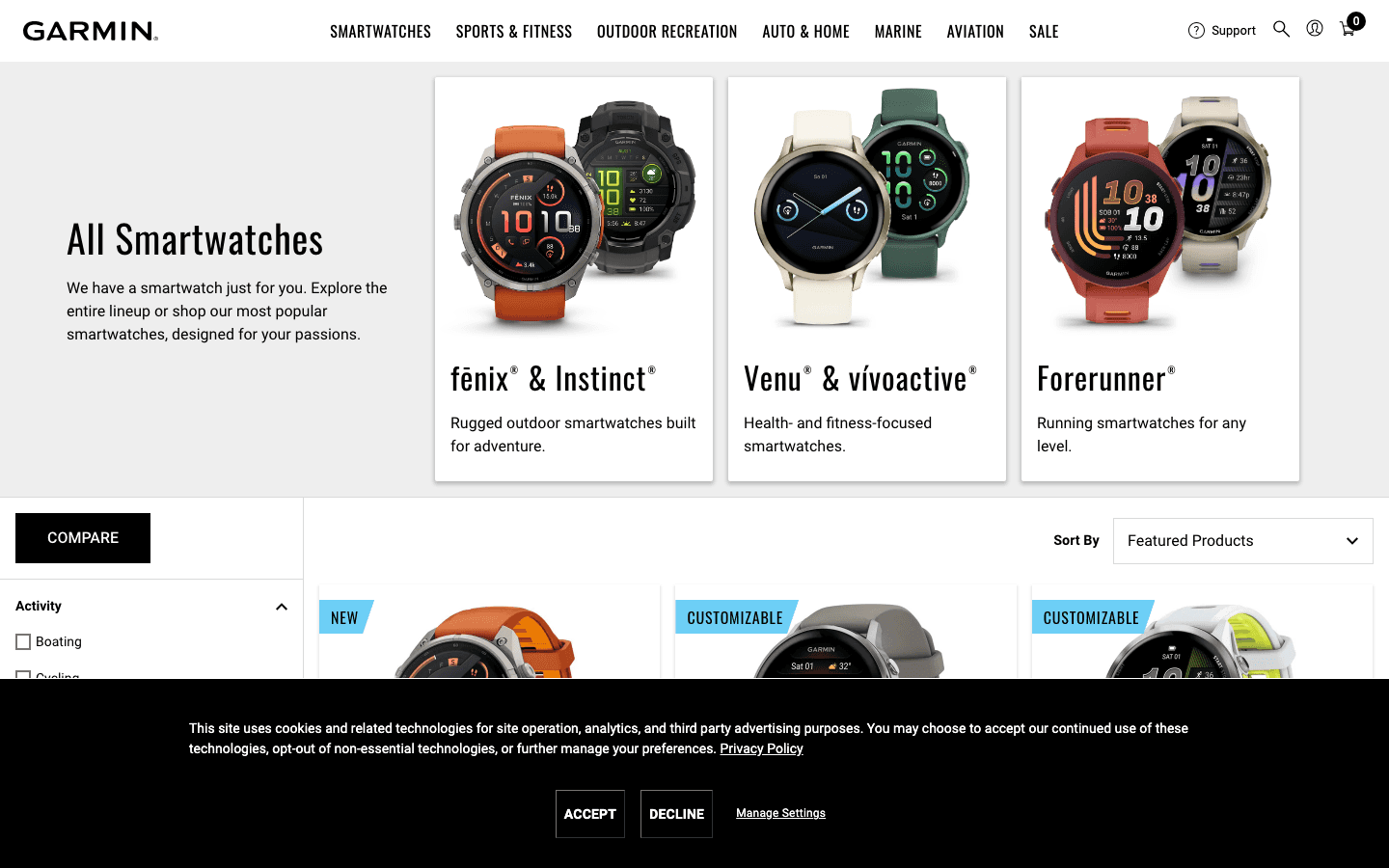
Garmin has been making GPS devices since the early 1990s, and that heritage shows in how their watches handle location and navigation. Where most smartwatches treat GPS as one feature among many, Garmin treats it as the foundation. Their mid-range and premium watches use multi-band SatIQ technology that pulls from multiple satellite networks simultaneously, producing route accuracy that holds up in dense forests, deep canyons, and urban canyons where single-band GPS loses signal.
The 2026 Garmin lineup spans a wide range of use cases. The Garmin Forerunner 165 ($249) is the entry point for runners who want training metrics without paying premium prices. The Forerunner 265 ($449) steps up with an AMOLED display, multi-band GPS, and more detailed training load and recovery data. At the top sits the Fenix 9 ($999+), a multi-sport expedition watch with up to 16 days of battery life, solar charging, offline topographic maps, and satellite messaging on Pro models.
What Garmin Does Well
Battery life that no Apple Watch comes close to matching (7-16+ days depending on model and GPS usage)
Multi-band GPS with offline mapping and turn-by-turn navigation on premium models
Body Battery energy tracking, HRV status, and training readiness scores (athlete-grade recovery analytics)
ABC sensors (altimeter, barometer, compass) on mid and high-tier models
Works with both iPhone and Android, unlike Apple Watch
Garmin Limitations
No FDA-cleared medical features (no sleep apnea detection, no fall detection, no crash detection)
App ecosystem is thin: third-party apps exist but are nowhere near the breadth of Apple's App Store
The interface is functional but not as polished as watchOS (more menus, steeper learning curve)
Garmin Connect app is fine, but Siri, Apple Pay, and direct iMessage replies require Apple Watch
Pricing: Forerunner 165 from $249 | Forerunner 265 at $449.99 | Venu 3 at $450 | Fenix 9 from $999.99
Best for: Runners, cyclists, hikers, triathletes, and anyone prioritizing GPS accuracy and multi-day battery life over smartphone integration.
Apple Watch Overview
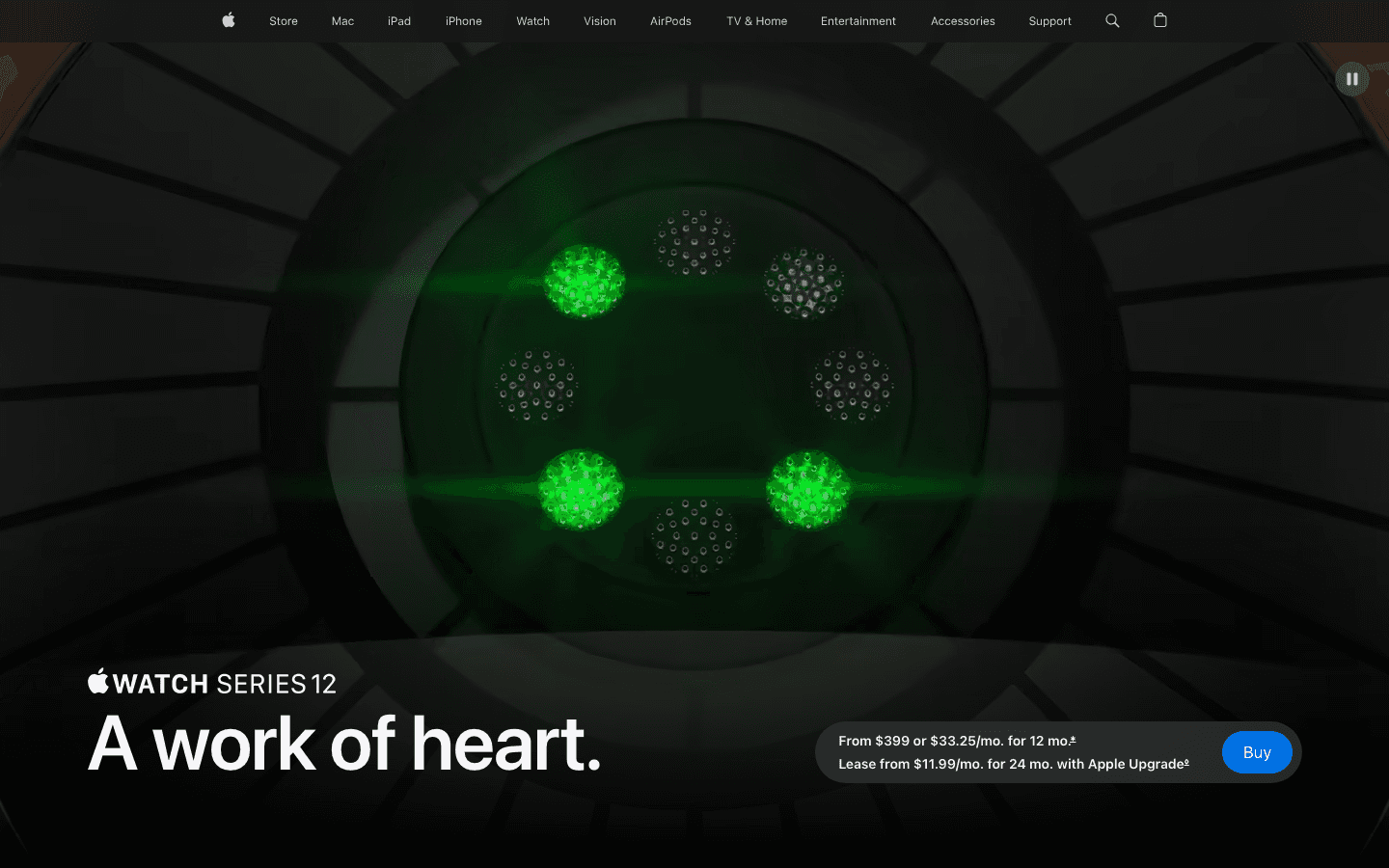
Apple Watch's identity has shifted meaningfully over the past few years. It launched as a fashion accessory and notification mirror. It's now one of the most medically capable consumer devices on the market. The Series 12 added a full Health Sensing System, delivering what Apple claims is the most accurate heart rate in a wearable, with readings every five seconds and HRV measurements as frequent as every five minutes.
The 2026 Apple Watch lineup has three tiers: the SE 3 ($249) for budget-conscious users who want the core fitness and safety features; the Series 12 ($399) with the full Health Sensing System, ECG, blood oxygen, sleep apnea and hypertension notifications; and the Ultra 4 ($799) aimed directly at serious athletes and outdoor adventurers with 60+ hour battery life and a titanium case. Apple also recently confirmed that the Ultra 4's battery outlasts the Series 12 by roughly 2.5x in standard use.
What Apple Watch Does Well
FDA-cleared medical-grade features: sleep apnea detection, ECG app, fall detection, crash detection
Deep iPhone integration: iMessage replies, Siri, Apple Pay, Find My, and AirPods control all work from the watch
The largest smartwatch app ecosystem by a significant margin
Readiness scores and sleep tracking with the Series 12 Health Sensing System are more refined than previous generations
watchOS is polished and fast, with a large third-party app library (see our guide to best Apple Watch apps for what's worth installing)
Apple Watch Limitations
Battery life is the defining weakness: Series 12 lasts 18-24 hours in normal use, requiring daily charging
GPS accuracy is good but not Garmin-level (single-band on SE 3 and Series 12, dual-band on Ultra 4 only)
Requires iPhone (no Android support at all)
No offline maps or turn-by-turn navigation without a cellular connection
Pricing: SE 3 from $249 | Series 12 from $399 | Ultra 4 from $799
Best for: iPhone users who want a health companion, people who rely on watch-to-phone integration, and anyone who prioritizes medical-grade monitoring over endurance sports metrics.
Head-to-Head: Garmin vs Apple Watch
Battery Life
Garmin wins, and it's not close. The Forerunner 265 lasts 13 days in smartwatch mode and 24 hours with GPS active. The Fenix 9 pushes to 16+ days in smartwatch mode and up to 80 hours with multi-band GPS running. Apple Watch Series 12 needs a charge every 18-24 hours. The Ultra 4 extends this to around 60 hours, making it the only Apple Watch that can compete with mid-range Garmin models on battery. For multi-day trips (hiking, bikepacking, ultramarathons), Garmin is the only viable option unless you're comfortable carrying a charger everywhere.
GPS Accuracy
This is the area where Garmin's decades of navigation experience shows up most directly. The Forerunner 265 and above use multi-band GPS that locks onto multiple satellite networks (GPS, GLONASS, Galileo, BeiDou) simultaneously. Apple Watch Series 12 uses single-band GPS and relies on iPhone-assisted location when paired. The Ultra 4 upgrades to dual-band, which closes the gap with Garmin significantly. For trail running, mountaineering, or any activity where route accuracy matters, mid-range Garmin still holds an edge in challenging signal environments.
Health and Medical Features
Apple Watch leads on medical-grade monitoring. The FDA-cleared sleep apnea detection, ECG app, and blood oxygen monitoring on the Series 12 have no equivalent in Garmin's lineup. Garmin leads on athlete-focused analytics. Body Battery, HRV status, training load tracking, and performance condition scores give serious athletes a level of recovery visibility that Apple's readiness scores are only beginning to approximate. If you have specific health concerns or family history that makes cardiac monitoring important, Apple Watch Series 12 is the stronger tool. If you want to optimize training and prevent overtraining, Garmin's metrics are more actionable. Sleep tracking comparison is covered in depth in our Apple Watch sleep tracking guide and our roundup of best sleep trackers in 2026.
Ecosystem and Integrations
Apple Watch only works with iPhone. If you have an Android phone, you're looking at Garmin (or one of the Fitbit vs Apple Watch alternatives). For iPhone users, Apple Watch's integration is arguably its strongest feature. Siri, iMessage, Apple Pay, and AirPods control all work reliably in ways Garmin never attempts to replicate. Garmin's Garmin Connect platform is a capable fitness hub with a health snapshot, workout analysis, and course creation, but the third-party ecosystem is thin compared to watchOS.
Design and Wearability
This comes down to taste and use case. Apple Watch has a more recognizable, fashion-forward design with interchangeable bands and a wide range of case materials. Garmin's running watches have a sportier look that most people would describe as functional over fashionable, though the Venu 3 series is Garmin's attempt at a lifestyle-focused design. For wearing to work or dinner, most people reach for Apple Watch. For a 50-mile trail run, the extra weight and bulk of a Garmin Fenix becomes worth it for the buttons and rugged build.
Price-to-Value
At comparable price points ($249-$450), Garmin gives you more GPS capability and battery life; Apple Watch gives you better phone integration and medical monitoring. At the top end, the Fenix 9 at $999 is a very different product than the Apple Watch Ultra 4 at $799. The Fenix is a true multi-sport expedition computer, the Ultra 4 is an Apple Watch with longer battery and a tougher case. Both are excellent but genuinely distinct. If you're comparing to other tracker categories, our Garmin vs Fitbit breakdown is useful context.
Which Should You Choose?
Choose Garmin if: You run, cycle, hike, or train seriously and need GPS + battery to outlast your activities. You have an Android phone. You want detailed training load and recovery analytics. You go on multi-day outdoor trips where charging isn't an option.
Choose Apple Watch SE 3 ($249) if: You want the basics (fitness tracking, fall detection, iPhone notifications) at the lowest price in the Apple lineup.
Choose Apple Watch Series 12 ($399) if: You're an iPhone user who wants the full health monitoring suite, including sleep apnea detection and ECG. You use your watch as an extension of your phone. You prioritize medical-grade features over athletic depth.
Choose Apple Watch Ultra 4 ($799) if: You want Apple's ecosystem but also do serious endurance sports and need the battery life and dual-band GPS to support them.
Choose Garmin Fenix 9 ($999+) if: You're doing ultramarathons, multi-day expeditions, or any activity where a watch needs to function as a navigation device for days without a charge.
A Note on Acting on Your Biometric Data
Both Garmin and Apple Watch generate a lot of data about your recovery, readiness, and energy levels. Both leave you to figure out what to do with it. If you want your schedule to actually respond to how recovered you are (scheduling demanding meetings and deep work on high-readiness days, lighter tasks when your body battery is depleted), Lifestack connects your wearable data to your calendar and does this automatically. The energy calendar guide explains the approach.
Frequently Asked Questions
Can Garmin work with iPhone?
Yes. Garmin watches pair with both iPhone and Android via Bluetooth. The Garmin Connect app is available on iOS and you get fitness tracking, notifications, and data syncing across both platforms. What you don't get with Garmin on iPhone is Siri, Apple Pay, or the deep watchOS integrations that Apple Watch provides. If full iPhone integration matters, Apple Watch is the better choice.
Does Apple Watch work with Android?
No. Apple Watch requires an iPhone and is one of the tighter ecosystem lock-ins in consumer tech. If you have an Android phone, your serious fitness tracker options are Garmin, Fitbit, Samsung Galaxy Watch, or Pixel Watch. Garmin is the strongest choice among these for serious athletes.
Which has better sleep tracking: Garmin or Apple Watch?
Both have improved significantly. Apple Watch Series 12 added sleep apnea detection (FDA-cleared) alongside sleep stages and recovery scores. Garmin's sleep tracking on models like the Venu 3 and Forerunner 265 provides detailed sleep stages, HRV during sleep, and Body Battery recovery data. Apple Watch wins on medical-grade monitoring; Garmin's recovery data is more actionable for training periodization. Our full breakdown of Apple Watch sleep tracking accuracy covers the details.
Is Garmin or Apple Watch better for running?
Garmin, for most serious runners. Multi-band GPS, running dynamics (cadence, stride length, ground contact time), training load management, and 24+ hours of GPS battery life in race mode give Garmin an edge for anyone training seriously. Apple Watch has a capable workout app and Pacer feature, but it can't match Garmin for long runs where battery life becomes a constraint or for athletes who want deep performance analytics.
Which lasts longer on a charge?
Garmin is dramatically better for battery. The Forerunner 265 lasts 13 days in smartwatch mode; the Fenix 9 lasts 16+ days. Apple Watch Series 12 needs daily charging (18-24 hours). The Apple Watch Ultra 4 extends this to ~60 hours, which is better but still trails mid-range Garmin models. If you hate charging your watch, Garmin is the clear answer.
Can I use Garmin and Apple Watch together?
Technically yes. Some athletes wear a Garmin for outdoor workouts and an Apple Watch for daily health monitoring and iPhone integration. In practice, most people pick one. The main scenario where dual-wearing makes sense is if you have a specific medical reason to use Apple Watch's FDA-cleared features (ECG, sleep apnea monitoring) while also doing serious endurance sports where Garmin's GPS and battery are non-negotiable.
If you've spent any time researching fitness trackers, you've probably ended up in the same place: staring at Garmin and Apple Watch as the two most serious options, trying to figure out which one actually fits how you live. They're both capable. They're both expensive. And they're genuinely designed for different people.
The short version: Garmin builds watches for athletes and outdoor adventurers who want precise sports tracking, multi-week battery life, and detailed recovery metrics. Apple Watch is built for iPhone users who want medical-grade health monitoring, deep iOS integration, and a watch that does everything your phone does. Just on your wrist. Choosing between them mostly comes down to what you actually do, not which one has a longer spec sheet.
This comparison covers the 2026 lineup: Garmin's Forerunner, Venu, and Fenix series against Apple Watch Series 12, Apple Watch Ultra 4, and Apple Watch SE 3. We looked at battery life, GPS performance, health tracking depth, ecosystem lock-in, and who each is genuinely built for.
Key Takeaways
Garmin wins on battery life and GPS precision: some models last 14+ days on a charge versus Apple Watch's 18-36 hours, and Garmin's multi-band GPS is significantly more accurate in challenging terrain.
Apple Watch wins on iPhone integration, medical-grade features (ECG, sleep apnea detection, crash detection), and the sheer depth of the App Store ecosystem.
Price ranges overlap: both brands have options starting around $249 and premium models pushing $800+, so budget alone doesn't decide the comparison.
Quick Verdict
Garmin: The better choice for serious runners, cyclists, hikers, and anyone who needs GPS + battery life to outlast a long weekend without a charger.
Apple Watch: The better choice for iPhone users who want their watch to function as a health companion and phone extension, not just a fitness tracker.
Garmin Overview
Garmin has been making GPS devices since the early 1990s, and that heritage shows in how their watches handle location and navigation. Where most smartwatches treat GPS as one feature among many, Garmin treats it as the foundation. Their mid-range and premium watches use multi-band SatIQ technology that pulls from multiple satellite networks simultaneously, producing route accuracy that holds up in dense forests, deep canyons, and urban canyons where single-band GPS loses signal.
The 2026 Garmin lineup spans a wide range of use cases. The Garmin Forerunner 165 ($249) is the entry point for runners who want training metrics without paying premium prices. The Forerunner 265 ($449) steps up with an AMOLED display, multi-band GPS, and more detailed training load and recovery data. At the top sits the Fenix 9 ($999+), a multi-sport expedition watch with up to 16 days of battery life, solar charging, offline topographic maps, and satellite messaging on Pro models.
What Garmin Does Well
Battery life that no Apple Watch comes close to matching (7-16+ days depending on model and GPS usage)
Multi-band GPS with offline mapping and turn-by-turn navigation on premium models
Body Battery energy tracking, HRV status, and training readiness scores (athlete-grade recovery analytics)
ABC sensors (altimeter, barometer, compass) on mid and high-tier models
Works with both iPhone and Android, unlike Apple Watch
Garmin Limitations
No FDA-cleared medical features (no sleep apnea detection, no fall detection, no crash detection)
App ecosystem is thin: third-party apps exist but are nowhere near the breadth of Apple's App Store
The interface is functional but not as polished as watchOS (more menus, steeper learning curve)
Garmin Connect app is fine, but Siri, Apple Pay, and direct iMessage replies require Apple Watch
Pricing: Forerunner 165 from $249 | Forerunner 265 at $449.99 | Venu 3 at $450 | Fenix 9 from $999.99
Best for: Runners, cyclists, hikers, triathletes, and anyone prioritizing GPS accuracy and multi-day battery life over smartphone integration.
Apple Watch Overview
Apple Watch's identity has shifted meaningfully over the past few years. It launched as a fashion accessory and notification mirror. It's now one of the most medically capable consumer devices on the market. The Series 12 added a full Health Sensing System, delivering what Apple claims is the most accurate heart rate in a wearable, with readings every five seconds and HRV measurements as frequent as every five minutes.
The 2026 Apple Watch lineup has three tiers: the SE 3 ($249) for budget-conscious users who want the core fitness and safety features; the Series 12 ($399) with the full Health Sensing System, ECG, blood oxygen, sleep apnea and hypertension notifications; and the Ultra 4 ($799) aimed directly at serious athletes and outdoor adventurers with 60+ hour battery life and a titanium case. Apple also recently confirmed that the Ultra 4's battery outlasts the Series 12 by roughly 2.5x in standard use.
What Apple Watch Does Well
FDA-cleared medical-grade features: sleep apnea detection, ECG app, fall detection, crash detection
Deep iPhone integration: iMessage replies, Siri, Apple Pay, Find My, and AirPods control all work from the watch
The largest smartwatch app ecosystem by a significant margin
Readiness scores and sleep tracking with the Series 12 Health Sensing System are more refined than previous generations
watchOS is polished and fast, with a large third-party app library (see our guide to best Apple Watch apps for what's worth installing)
Apple Watch Limitations
Battery life is the defining weakness: Series 12 lasts 18-24 hours in normal use, requiring daily charging
GPS accuracy is good but not Garmin-level (single-band on SE 3 and Series 12, dual-band on Ultra 4 only)
Requires iPhone (no Android support at all)
No offline maps or turn-by-turn navigation without a cellular connection
Pricing: SE 3 from $249 | Series 12 from $399 | Ultra 4 from $799
Best for: iPhone users who want a health companion, people who rely on watch-to-phone integration, and anyone who prioritizes medical-grade monitoring over endurance sports metrics.
Head-to-Head: Garmin vs Apple Watch
Battery Life
Garmin wins, and it's not close. The Forerunner 265 lasts 13 days in smartwatch mode and 24 hours with GPS active. The Fenix 9 pushes to 16+ days in smartwatch mode and up to 80 hours with multi-band GPS running. Apple Watch Series 12 needs a charge every 18-24 hours. The Ultra 4 extends this to around 60 hours, making it the only Apple Watch that can compete with mid-range Garmin models on battery. For multi-day trips (hiking, bikepacking, ultramarathons), Garmin is the only viable option unless you're comfortable carrying a charger everywhere.
GPS Accuracy
This is the area where Garmin's decades of navigation experience shows up most directly. The Forerunner 265 and above use multi-band GPS that locks onto multiple satellite networks (GPS, GLONASS, Galileo, BeiDou) simultaneously. Apple Watch Series 12 uses single-band GPS and relies on iPhone-assisted location when paired. The Ultra 4 upgrades to dual-band, which closes the gap with Garmin significantly. For trail running, mountaineering, or any activity where route accuracy matters, mid-range Garmin still holds an edge in challenging signal environments.
Health and Medical Features
Apple Watch leads on medical-grade monitoring. The FDA-cleared sleep apnea detection, ECG app, and blood oxygen monitoring on the Series 12 have no equivalent in Garmin's lineup. Garmin leads on athlete-focused analytics. Body Battery, HRV status, training load tracking, and performance condition scores give serious athletes a level of recovery visibility that Apple's readiness scores are only beginning to approximate. If you have specific health concerns or family history that makes cardiac monitoring important, Apple Watch Series 12 is the stronger tool. If you want to optimize training and prevent overtraining, Garmin's metrics are more actionable. Sleep tracking comparison is covered in depth in our Apple Watch sleep tracking guide and our roundup of best sleep trackers in 2026.
Ecosystem and Integrations
Apple Watch only works with iPhone. If you have an Android phone, you're looking at Garmin (or one of the Fitbit vs Apple Watch alternatives). For iPhone users, Apple Watch's integration is arguably its strongest feature. Siri, iMessage, Apple Pay, and AirPods control all work reliably in ways Garmin never attempts to replicate. Garmin's Garmin Connect platform is a capable fitness hub with a health snapshot, workout analysis, and course creation, but the third-party ecosystem is thin compared to watchOS.
Design and Wearability
This comes down to taste and use case. Apple Watch has a more recognizable, fashion-forward design with interchangeable bands and a wide range of case materials. Garmin's running watches have a sportier look that most people would describe as functional over fashionable, though the Venu 3 series is Garmin's attempt at a lifestyle-focused design. For wearing to work or dinner, most people reach for Apple Watch. For a 50-mile trail run, the extra weight and bulk of a Garmin Fenix becomes worth it for the buttons and rugged build.
Price-to-Value
At comparable price points ($249-$450), Garmin gives you more GPS capability and battery life; Apple Watch gives you better phone integration and medical monitoring. At the top end, the Fenix 9 at $999 is a very different product than the Apple Watch Ultra 4 at $799. The Fenix is a true multi-sport expedition computer, the Ultra 4 is an Apple Watch with longer battery and a tougher case. Both are excellent but genuinely distinct. If you're comparing to other tracker categories, our Garmin vs Fitbit breakdown is useful context.
Which Should You Choose?
Choose Garmin if: You run, cycle, hike, or train seriously and need GPS + battery to outlast your activities. You have an Android phone. You want detailed training load and recovery analytics. You go on multi-day outdoor trips where charging isn't an option.
Choose Apple Watch SE 3 ($249) if: You want the basics (fitness tracking, fall detection, iPhone notifications) at the lowest price in the Apple lineup.
Choose Apple Watch Series 12 ($399) if: You're an iPhone user who wants the full health monitoring suite, including sleep apnea detection and ECG. You use your watch as an extension of your phone. You prioritize medical-grade features over athletic depth.
Choose Apple Watch Ultra 4 ($799) if: You want Apple's ecosystem but also do serious endurance sports and need the battery life and dual-band GPS to support them.
Choose Garmin Fenix 9 ($999+) if: You're doing ultramarathons, multi-day expeditions, or any activity where a watch needs to function as a navigation device for days without a charge.
A Note on Acting on Your Biometric Data
Both Garmin and Apple Watch generate a lot of data about your recovery, readiness, and energy levels. Both leave you to figure out what to do with it. If you want your schedule to actually respond to how recovered you are (scheduling demanding meetings and deep work on high-readiness days, lighter tasks when your body battery is depleted), Lifestack connects your wearable data to your calendar and does this automatically. The energy calendar guide explains the approach.
Frequently Asked Questions
Can Garmin work with iPhone?
Yes. Garmin watches pair with both iPhone and Android via Bluetooth. The Garmin Connect app is available on iOS and you get fitness tracking, notifications, and data syncing across both platforms. What you don't get with Garmin on iPhone is Siri, Apple Pay, or the deep watchOS integrations that Apple Watch provides. If full iPhone integration matters, Apple Watch is the better choice.
Does Apple Watch work with Android?
No. Apple Watch requires an iPhone and is one of the tighter ecosystem lock-ins in consumer tech. If you have an Android phone, your serious fitness tracker options are Garmin, Fitbit, Samsung Galaxy Watch, or Pixel Watch. Garmin is the strongest choice among these for serious athletes.
Which has better sleep tracking: Garmin or Apple Watch?
Both have improved significantly. Apple Watch Series 12 added sleep apnea detection (FDA-cleared) alongside sleep stages and recovery scores. Garmin's sleep tracking on models like the Venu 3 and Forerunner 265 provides detailed sleep stages, HRV during sleep, and Body Battery recovery data. Apple Watch wins on medical-grade monitoring; Garmin's recovery data is more actionable for training periodization. Our full breakdown of Apple Watch sleep tracking accuracy covers the details.
Is Garmin or Apple Watch better for running?
Garmin, for most serious runners. Multi-band GPS, running dynamics (cadence, stride length, ground contact time), training load management, and 24+ hours of GPS battery life in race mode give Garmin an edge for anyone training seriously. Apple Watch has a capable workout app and Pacer feature, but it can't match Garmin for long runs where battery life becomes a constraint or for athletes who want deep performance analytics.
Which lasts longer on a charge?
Garmin is dramatically better for battery. The Forerunner 265 lasts 13 days in smartwatch mode; the Fenix 9 lasts 16+ days. Apple Watch Series 12 needs daily charging (18-24 hours). The Apple Watch Ultra 4 extends this to ~60 hours, which is better but still trails mid-range Garmin models. If you hate charging your watch, Garmin is the clear answer.
Can I use Garmin and Apple Watch together?
Technically yes. Some athletes wear a Garmin for outdoor workouts and an Apple Watch for daily health monitoring and iPhone integration. In practice, most people pick one. The main scenario where dual-wearing makes sense is if you have a specific medical reason to use Apple Watch's FDA-cleared features (ECG, sleep apnea monitoring) while also doing serious endurance sports where Garmin's GPS and battery are non-negotiable.



FOLLOW ON
FOLLOW ON
FOLLOW ON


Copyright 2026 © Lifestack. All rights reserved
Copyright 2026 © Lifestack. All rights reserved

