
App
How to Set Up a Home Office That Works
How to Set Up a Home Office That Works

Setting up a home office sounds simple until you actually do it. You pick a spot, put a desk there, sit down to work, and promptly spend the next two hours distracted by the kitchen, your phone, household noise, and the general feeling that you're working in the wrong place. The physical environment matters more than most people expect.
A good home office doesn't require a dedicated room or expensive gear. It requires intentional decisions about location, ergonomics, light, sound, and how you structure your day inside it. Get those decisions right and the space starts working for you instead of against you.
This guide covers how to set up a home office from scratch: what to prioritize, what to skip, and how to build daily habits that make the space actually productive. Being productive at home is a skill that builds on itself once the fundamentals are in place.
Key Takeaways
Your location and lighting choices have more impact on focus than your desk or chair brand
Internet reliability and cable organization are the two tech investments that pay off fastest
A protected daily schedule is as important as the physical setup. The space only helps if you use it with intention
Choose the Right Location First
The single best thing you can do when figuring out how to set up a home office is to choose a location that is physically separate from where you relax. A desk in the bedroom works in theory but tends to collapse in practice because your brain doesn't switch into work mode when the environment doesn't change.
A dedicated room is ideal. If that's not available, a corner of a living room or dining area with visual separation (a bookshelf, a screen divider, even a change in rug) helps establish a psychological boundary. What you want to avoid is working from the couch or bed, where posture degrades, distractions multiply, and the association between the space and rest gets muddy.
Face a wall or face a window, but not a doorway. Doorways pull attention. A wall gives you a stable visual anchor. A window with natural light is even better, as long as you can control glare. If the window is behind your monitor, expect constant squinting.
Get Your Desk and Chair Right
You don't need a $1,500 standing desk. You need a surface at the right height (elbows roughly at 90 degrees when typing) and a chair that supports your lower back without pushing you forward into a slump. Most affordable desk chairs fail on lower back support specifically, so test before buying if possible.
Desk height matters more than desk size. A monitor at eye level means your screen's top edge should sit at or just below eye height. If you're using a laptop without an external monitor, you're either hunching (screen too low) or craning (screen on a riser with no external keyboard). Both cause neck and shoulder problems over time. A $25 laptop stand plus a cheap wireless keyboard fixes this.
Standing desks are worth it if you'll actually use them. The research on alternating sitting and standing is solid. But a manual crank desk you forget to adjust is wasted money. If budget allows, a motorized sit/stand desk becomes a habit in a way that a crank rarely does.
Set Up Your Tech and Connectivity
Wired ethernet beats Wi-Fi for video calls, period. A single bad connection during a client call does more damage to your reputation than a week of good calls repairs. If your router is far from your desk, a powerline adapter ($30-50) routes ethernet through your home's electrical wiring without running cables through walls.
For audio, a dedicated USB microphone or headset with a boom mic makes a bigger difference than your camera. People tolerate blurry video. They hang up on bad audio. A $50-80 USB headset from a reputable brand (Jabra, Logitech, Poly) puts you above 90% of remote workers on call quality.
Cable management is worth doing once and then forgetting about. A tangled desk raises baseline stress even when you're not consciously noticing it. Cable clips along the desk edge, a single power strip under the desk, and velcro ties for bundled cables takes about 30 minutes and changes how the space feels entirely.
Control Your Light and Sound
Natural light is better for mood and energy than any artificial alternative. If you have a window, use it. Position yourself so the light hits you from the side rather than directly in front of or behind your screen. A simple roller blind handles glare during the worst afternoon sun angles without blocking light entirely.
For artificial light, avoid overhead fluorescents if you can. A desk lamp with a warm-to-neutral color temperature (3000K-4000K) on your non-dominant side reduces eye strain during long sessions. Bias lighting behind your monitor (an LED strip at 6500K) reduces contrast fatigue if you do a lot of screen-intensive work.
Sound is harder to control than light. Noise-canceling headphones are the single most effective tool for home office focus, but they require wearing them even when you don't want music. For passive sound control, soft surfaces absorb noise: a rug, curtains, even a bookshelf full of books all help. If you're on calls frequently and your space is echo-y, a small acoustic panel behind your monitor makes a noticeable difference.
Organize Your Physical Space
A cluttered desk is a cognitive tax. Every object in your field of view is a potential distraction or mental note. The goal isn't minimalism for its own sake; it's reducing the number of visual decisions your brain has to make while you're trying to focus.
Keep only what you use daily on the desk surface. Everything else goes in a drawer, on a shelf, or out of the room. If you don't have storage, a simple desktop organizer with vertical sections for papers and supplies takes up less than 6 inches of desk real estate and handles most of what you need.
A small whiteboard or physical notepad near your desk is useful for capturing thoughts that interrupt deep work without losing them. The act of writing it down and returning to your main task is faster than switching tabs or apps. Decluttering your space and decluttering your task list often go together. Both reduce friction on the things that matter.
Build a Daily Schedule That Uses the Space Well
The physical setup only matters if you show up to it with a clear plan. A home office without a time blocking habit becomes a place where you sit and scroll. A structured daily schedule turns the space into something that reliably produces output.
The basic pattern: deep work in your highest-energy window (for most people, morning), meetings in early afternoon, admin and email at the end of the day. If you're not sure when your energy peaks, a week of paying attention to when you find it easiest to focus is usually enough to identify the pattern. Your peak hours are limited (typically 2-4 hours), so protecting them from meetings and interruptions is worth active effort.
The Pomodoro Technique (25 minutes of focused work, 5-minute break) works well for remote workers specifically because there's no natural rhythm imposed by an office environment. You create your own transitions. Timed blocks replicate some of what an office structure provides automatically.
Best Tool for Home Office Productivity
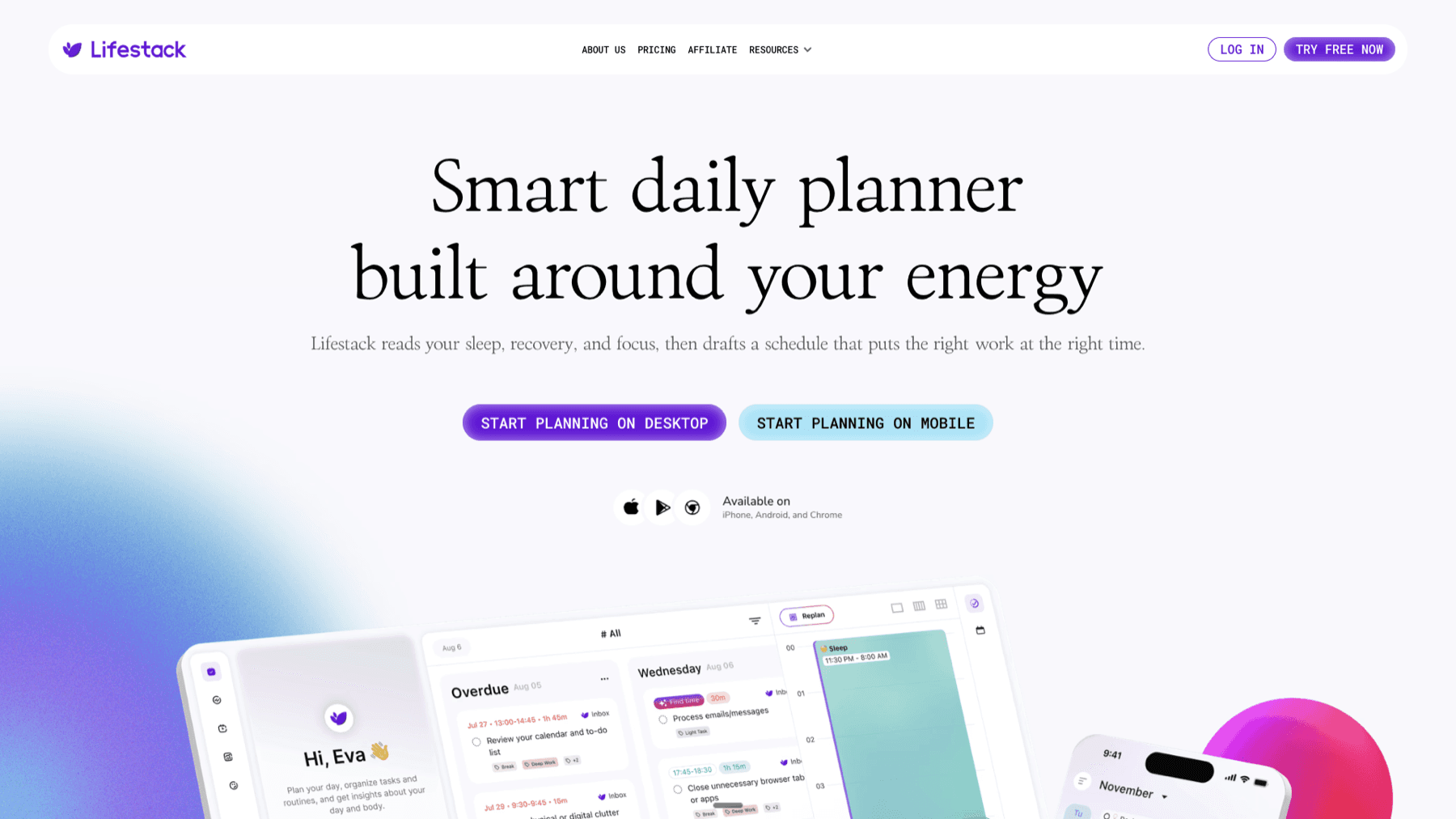
Once your physical home office is set up, the next challenge is what to put on your calendar and when. Lifestack solves this by reading your energy data from wearables (Apple Watch, Oura Ring, Garmin, Whoop) and automatically scheduling your tasks during your actual focus windows.
This matters more for home office workers than office workers. In an office, your schedule gets imposed externally by meetings and social norms. At home, you're in charge of every hour, which means you're also responsible for not wasting your best cognitive hours on shallow work. Lifestack takes that decision off your plate. It knows when your energy is high and puts your deep-work tasks there without you having to manually manage it.
Learn more about how Lifestack works, or see it compared against other AI planner apps if you're still deciding. Lifestack costs $7/month or $50/year, with a 7-day free trial on the annual plan.
Frequently Asked Questions
What do I need to set up a home office on a budget?
The essentials: a desk at the right height, a chair with lumbar support, ethernet or stable Wi-Fi, and a dedicated space that isn't your bedroom or couch. A laptop stand and external keyboard ($40-60 combined) handle ergonomics for laptop workers. Noise-canceling headphones ($80-150) handle sound. You don't need much more to start.
How do I reduce distractions when working from home?
Physical separation from high-traffic areas helps. Noise-canceling headphones are the fastest single fix. Beyond that, working from home effectively depends on having a schedule with clear start and end times, communicating those boundaries to anyone else in your space, and using your deep work hours for cognitively demanding tasks rather than email.
Is a standing desk worth it for a home office?
It depends on whether you'll actually use it. If you have back pain from sitting or already know you stand during phone calls, yes. A motorized sit/stand desk ($400-700) has better adoption rates than manual crank versions because the low friction matters. If budget is tight, a $30 standing desk converter for occasional use is a reasonable first step.
How should I handle lighting in a home office?
Prioritize natural light from the side (not behind your monitor). Add a desk lamp on your non-dominant side for evening work. Avoid overhead fluorescents if possible. If your setup involves a lot of screen time, bias lighting (an LED strip behind the monitor) reduces contrast fatigue noticeably over long sessions.
What's the best way to manage time when working from home?
Block your highest-energy hours for your most important work and guard that time from meetings. Use time blocking to assign specific tasks to specific slots rather than working from a general to-do list. If you're not sure where your energy peaks, track it for a week and build your schedule around what you observe, or use a tool like Lifestack that reads your wearable data and does this automatically.
How do I set up a home office if I don't have a separate room?
Use visual and physical cues to create separation within a shared space. A dedicated desk area with its own lamp, a chair that you only use for work, and a consistent "start work" routine (making coffee, putting on headphones) trains your brain to associate the spot with focus. Putting work items away when you finish reinforces the boundary at the end of the day. Check our guide on building a daily routine for more on how to structure the time around your space.
Setting up a home office sounds simple until you actually do it. You pick a spot, put a desk there, sit down to work, and promptly spend the next two hours distracted by the kitchen, your phone, household noise, and the general feeling that you're working in the wrong place. The physical environment matters more than most people expect.
A good home office doesn't require a dedicated room or expensive gear. It requires intentional decisions about location, ergonomics, light, sound, and how you structure your day inside it. Get those decisions right and the space starts working for you instead of against you.
This guide covers how to set up a home office from scratch: what to prioritize, what to skip, and how to build daily habits that make the space actually productive. Being productive at home is a skill that builds on itself once the fundamentals are in place.
Key Takeaways
Your location and lighting choices have more impact on focus than your desk or chair brand
Internet reliability and cable organization are the two tech investments that pay off fastest
A protected daily schedule is as important as the physical setup. The space only helps if you use it with intention
Choose the Right Location First
The single best thing you can do when figuring out how to set up a home office is to choose a location that is physically separate from where you relax. A desk in the bedroom works in theory but tends to collapse in practice because your brain doesn't switch into work mode when the environment doesn't change.
A dedicated room is ideal. If that's not available, a corner of a living room or dining area with visual separation (a bookshelf, a screen divider, even a change in rug) helps establish a psychological boundary. What you want to avoid is working from the couch or bed, where posture degrades, distractions multiply, and the association between the space and rest gets muddy.
Face a wall or face a window, but not a doorway. Doorways pull attention. A wall gives you a stable visual anchor. A window with natural light is even better, as long as you can control glare. If the window is behind your monitor, expect constant squinting.
Get Your Desk and Chair Right
You don't need a $1,500 standing desk. You need a surface at the right height (elbows roughly at 90 degrees when typing) and a chair that supports your lower back without pushing you forward into a slump. Most affordable desk chairs fail on lower back support specifically, so test before buying if possible.
Desk height matters more than desk size. A monitor at eye level means your screen's top edge should sit at or just below eye height. If you're using a laptop without an external monitor, you're either hunching (screen too low) or craning (screen on a riser with no external keyboard). Both cause neck and shoulder problems over time. A $25 laptop stand plus a cheap wireless keyboard fixes this.
Standing desks are worth it if you'll actually use them. The research on alternating sitting and standing is solid. But a manual crank desk you forget to adjust is wasted money. If budget allows, a motorized sit/stand desk becomes a habit in a way that a crank rarely does.
Set Up Your Tech and Connectivity
Wired ethernet beats Wi-Fi for video calls, period. A single bad connection during a client call does more damage to your reputation than a week of good calls repairs. If your router is far from your desk, a powerline adapter ($30-50) routes ethernet through your home's electrical wiring without running cables through walls.
For audio, a dedicated USB microphone or headset with a boom mic makes a bigger difference than your camera. People tolerate blurry video. They hang up on bad audio. A $50-80 USB headset from a reputable brand (Jabra, Logitech, Poly) puts you above 90% of remote workers on call quality.
Cable management is worth doing once and then forgetting about. A tangled desk raises baseline stress even when you're not consciously noticing it. Cable clips along the desk edge, a single power strip under the desk, and velcro ties for bundled cables takes about 30 minutes and changes how the space feels entirely.
Control Your Light and Sound
Natural light is better for mood and energy than any artificial alternative. If you have a window, use it. Position yourself so the light hits you from the side rather than directly in front of or behind your screen. A simple roller blind handles glare during the worst afternoon sun angles without blocking light entirely.
For artificial light, avoid overhead fluorescents if you can. A desk lamp with a warm-to-neutral color temperature (3000K-4000K) on your non-dominant side reduces eye strain during long sessions. Bias lighting behind your monitor (an LED strip at 6500K) reduces contrast fatigue if you do a lot of screen-intensive work.
Sound is harder to control than light. Noise-canceling headphones are the single most effective tool for home office focus, but they require wearing them even when you don't want music. For passive sound control, soft surfaces absorb noise: a rug, curtains, even a bookshelf full of books all help. If you're on calls frequently and your space is echo-y, a small acoustic panel behind your monitor makes a noticeable difference.
Organize Your Physical Space
A cluttered desk is a cognitive tax. Every object in your field of view is a potential distraction or mental note. The goal isn't minimalism for its own sake; it's reducing the number of visual decisions your brain has to make while you're trying to focus.
Keep only what you use daily on the desk surface. Everything else goes in a drawer, on a shelf, or out of the room. If you don't have storage, a simple desktop organizer with vertical sections for papers and supplies takes up less than 6 inches of desk real estate and handles most of what you need.
A small whiteboard or physical notepad near your desk is useful for capturing thoughts that interrupt deep work without losing them. The act of writing it down and returning to your main task is faster than switching tabs or apps. Decluttering your space and decluttering your task list often go together. Both reduce friction on the things that matter.
Build a Daily Schedule That Uses the Space Well
The physical setup only matters if you show up to it with a clear plan. A home office without a time blocking habit becomes a place where you sit and scroll. A structured daily schedule turns the space into something that reliably produces output.
The basic pattern: deep work in your highest-energy window (for most people, morning), meetings in early afternoon, admin and email at the end of the day. If you're not sure when your energy peaks, a week of paying attention to when you find it easiest to focus is usually enough to identify the pattern. Your peak hours are limited (typically 2-4 hours), so protecting them from meetings and interruptions is worth active effort.
The Pomodoro Technique (25 minutes of focused work, 5-minute break) works well for remote workers specifically because there's no natural rhythm imposed by an office environment. You create your own transitions. Timed blocks replicate some of what an office structure provides automatically.
Best Tool for Home Office Productivity
Once your physical home office is set up, the next challenge is what to put on your calendar and when. Lifestack solves this by reading your energy data from wearables (Apple Watch, Oura Ring, Garmin, Whoop) and automatically scheduling your tasks during your actual focus windows.
This matters more for home office workers than office workers. In an office, your schedule gets imposed externally by meetings and social norms. At home, you're in charge of every hour, which means you're also responsible for not wasting your best cognitive hours on shallow work. Lifestack takes that decision off your plate. It knows when your energy is high and puts your deep-work tasks there without you having to manually manage it.
Learn more about how Lifestack works, or see it compared against other AI planner apps if you're still deciding. Lifestack costs $7/month or $50/year, with a 7-day free trial on the annual plan.
Frequently Asked Questions
What do I need to set up a home office on a budget?
The essentials: a desk at the right height, a chair with lumbar support, ethernet or stable Wi-Fi, and a dedicated space that isn't your bedroom or couch. A laptop stand and external keyboard ($40-60 combined) handle ergonomics for laptop workers. Noise-canceling headphones ($80-150) handle sound. You don't need much more to start.
How do I reduce distractions when working from home?
Physical separation from high-traffic areas helps. Noise-canceling headphones are the fastest single fix. Beyond that, working from home effectively depends on having a schedule with clear start and end times, communicating those boundaries to anyone else in your space, and using your deep work hours for cognitively demanding tasks rather than email.
Is a standing desk worth it for a home office?
It depends on whether you'll actually use it. If you have back pain from sitting or already know you stand during phone calls, yes. A motorized sit/stand desk ($400-700) has better adoption rates than manual crank versions because the low friction matters. If budget is tight, a $30 standing desk converter for occasional use is a reasonable first step.
How should I handle lighting in a home office?
Prioritize natural light from the side (not behind your monitor). Add a desk lamp on your non-dominant side for evening work. Avoid overhead fluorescents if possible. If your setup involves a lot of screen time, bias lighting (an LED strip behind the monitor) reduces contrast fatigue noticeably over long sessions.
What's the best way to manage time when working from home?
Block your highest-energy hours for your most important work and guard that time from meetings. Use time blocking to assign specific tasks to specific slots rather than working from a general to-do list. If you're not sure where your energy peaks, track it for a week and build your schedule around what you observe, or use a tool like Lifestack that reads your wearable data and does this automatically.
How do I set up a home office if I don't have a separate room?
Use visual and physical cues to create separation within a shared space. A dedicated desk area with its own lamp, a chair that you only use for work, and a consistent "start work" routine (making coffee, putting on headphones) trains your brain to associate the spot with focus. Putting work items away when you finish reinforces the boundary at the end of the day. Check our guide on building a daily routine for more on how to structure the time around your space.



FOLLOW ON
FOLLOW ON
FOLLOW ON


Copyright 2026 © Lifestack. All rights reserved
Copyright 2026 © Lifestack. All rights reserved

