
Tips
Oura Ring App: What It Tracks and How to Use It
Oura Ring App: What It Tracks and How to Use It

The Oura Ring is one of the most accurate passive health trackers available, but the hardware is only half the story. The Oura app is where all that data becomes readable, and understanding what your scores mean is what makes the ring useful rather than just a piece of jewelry that charges every week.
Most Oura users spend 90% of their time looking at their Readiness score without fully understanding the six factors that drive it, why their sleep score sometimes doesn't match how they feel, or how to use the Activity tab to actually close loops rather than just watch circles fill. This guide covers all of it.
Key Takeaways
The Readiness score is Oura's most actionable daily number. It reflects your cumulative recovery, not just last night's sleep.
Sleep Score and Readiness Score are related but different: a good night's sleep doesn't automatically mean high readiness if your resting heart rate is still recovering from prior days.
The Oura app is a measurement tool; what you do with your Readiness score is up to you, unless you connect it to a scheduling system like Lifestack.
What the Oura Ring App Tracks
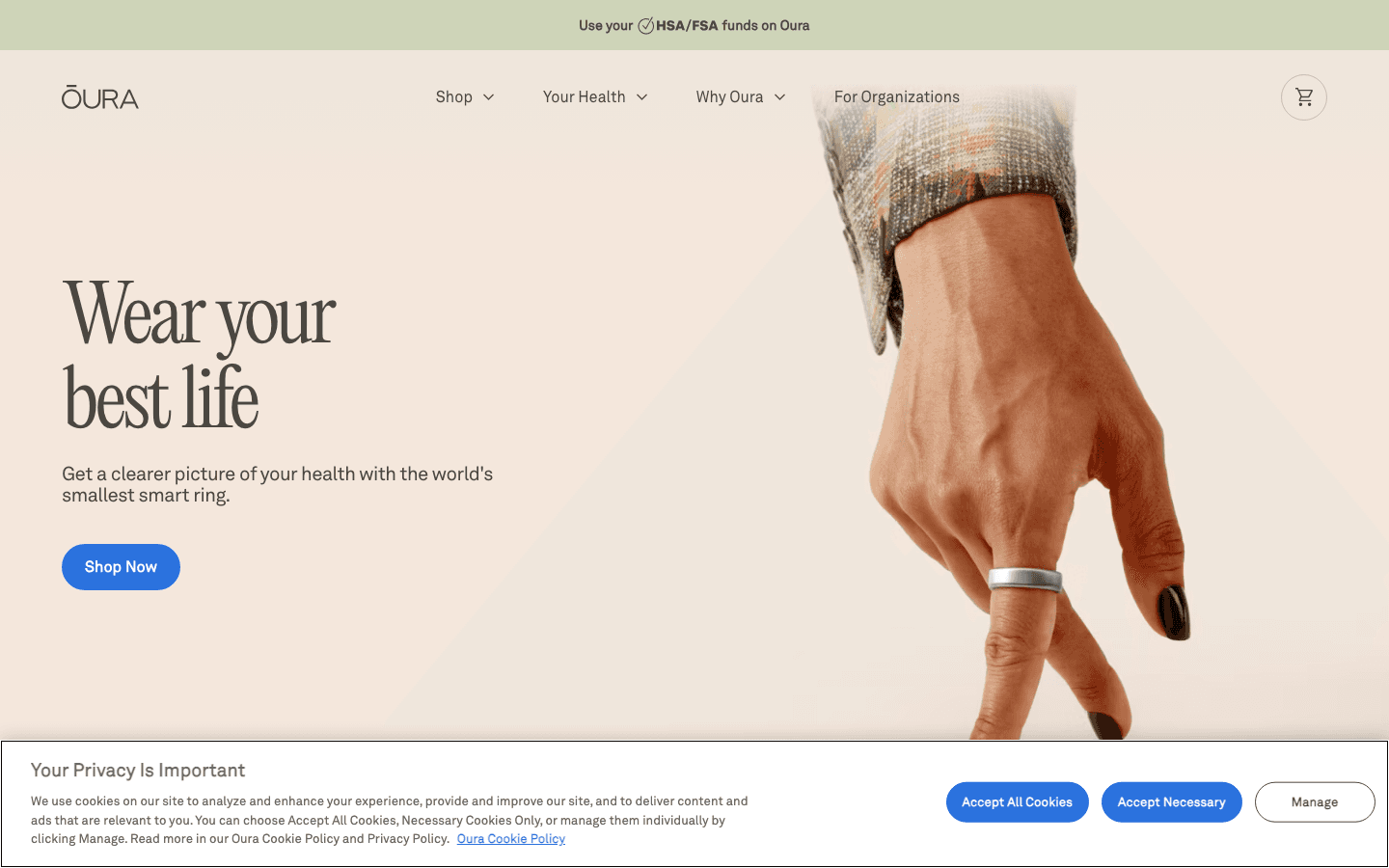
The Oura app processes data from the ring's optical sensors, accelerometer, and temperature sensor to produce over 50 metrics. The metrics you'll interact with most fall into three daily scores:
Readiness Score (0-100): Your overall recovery and preparedness for the day. Built from HRV, resting heart rate, body temperature, sleep balance, and recent activity history. Oura's most important number.
Sleep Score (0-100): How well you slept last night. Built from total sleep, sleep efficiency, sleep stages, timing, restfulness, and sleep latency.
Activity Score (0-100): How well you've balanced movement with recovery. Includes steps, training frequency, activity levels, and inactivity time throughout the day.
Beyond the three primary scores, the app shows continuous heart rate, HRV trend (which we cover in depth in our best HRV tracker guide), skin temperature deviation from baseline, respiratory rate, SpO2, and resting heart rate trends.
How to Read Your Readiness Score
Readiness is Oura's flagship metric, and it's more layered than it looks. A score above 85 is a "green" day: your body is well-recovered and ready for demanding activity or intense focus work. A score between 70 and 85 is "yellow," meaning fine for moderate activity but not the day to try a personal record or an 80-hour work push. Below 70 is a signal to prioritize recovery.
The six factors that feed into Readiness are displayed in the app under the Readiness tab:
Resting Heart Rate: How low your heart rate dropped during sleep. Lower is better; a higher RHR usually indicates stress, illness, or under-recovery.
HRV Balance: Your HRV relative to your personal baseline. High HRV balance means your nervous system is in recovery mode.
Body Temperature: Deviation from your personal baseline. A spike of more than 0.5 degrees Celsius often appears before illness symptoms.
Recovery Index: How quickly your heart rate stabilized during sleep. A short restabilization window means faster recovery.
Sleep Balance: Whether your recent sleep total is keeping pace with what you need.
Activity Balance: Whether you've been pushing too hard (need rest) or too little (need more movement).
When your Readiness score is low, tap through to the factor breakdown to identify which contributor is pulling it down. A low HRV balance with a stable temperature suggests accumulated fatigue. A temperature spike with normal HRV is more likely illness. The specifics guide the right response.
How to Read Your Sleep Score
The Sleep Score reflects last night's sleep quality across six factors: total sleep time, sleep efficiency (time asleep vs time in bed), the balance of sleep stages, timing relative to your sleep chronotype, restfulness (movements and wakings), and sleep latency (how long it took to fall asleep).
A few things that trip people up:
Waking in the early morning and lying still often counts as "light sleep" rather than waking time. Your total sleep might be lower than you think.
REM and deep sleep percentages matter more than total sleep time for restoration quality. A 7-hour night with good staging beats an 8-hour night in mostly light sleep.
Your sleep score can be high while your Readiness score is moderate, because Readiness accounts for the cumulative debt from previous nights.
The Oura app shows your sleep staging graphs in detail under the Sleep tab. Compare your actual sleep times against Oura's "optimal bedtime" recommendation, which is calibrated to your personal chronotype over time. For a broader comparison of sleep tracking platforms, see our guide to the best sleep trackers.
New Oura App Features in 2026
Oura added several notable features to the app in 2026 that meaningfully expand what the ring tracks:
Live Activity Tracking: Real-time workout data including pace and distance during runs, cycles, and strength training sessions, visible via a lock screen widget. Previously Oura focused exclusively on passive tracking; this fills the gap for active workout logging.
Lab Uploads: Users can import blood work results directly into the Oura app, allowing you to see how biomarkers like ferritin or vitamin D correlate with your recovery patterns over time.
Glucose Integration: Oura now connects to continuous glucose monitors, adding blood sugar context to your recovery and sleep data for users with CGM devices.
Locate Feature: Track multiple Oura devices and charging cases through the app, useful for households with multiple ring users.
The Activity Tab: Closing the Rings
Oura's Activity tab tracks daily movement with a goal system that adjusts based on your Readiness. On high-readiness days, the app nudges you toward higher step counts and more intense movement. On low-readiness days, it pulls the target down and prioritizes recovery-friendly activity like walking.
The "Stay Active" reminder fires when you've been stationary for too long. Activity Score contributors include steps, training frequency, activity burn, and inactivity time. Long sedentary stretches (over 2 to 3 hours without movement) pull the Activity Score down even if you hit your step goal.
One feature worth using: the Tags function in the app lets you log activities, food, alcohol, stress events, and other lifestyle factors. Over time, Oura's correlation engine starts to show you which tags most reliably predict worse sleep or lower Readiness. Logging alcohol before bed for two weeks typically generates a clear pattern showing its impact on HRV and Readiness.
Oura Ring App Pricing
The Oura Ring (Gen 4) costs $399 as a one-time hardware purchase. The Oura app requires a membership to access most of its features beyond basic metrics: $5.99/month or $69.99/year. New ring purchases include a one-month free trial of the membership.
Without membership, you can see your three daily scores but lose access to the detailed contributor breakdown, trend analysis, tag correlations, and the new 2026 features. The detailed Oura Ring pricing breakdown covers what's included at each tier and how it compares to similar devices.
How Oura Ring Compares to Other Trackers
The ring form factor gives Oura a measurement advantage over wrist-based trackers for sleep HRV and overnight heart rate, since finger-based optical sensors sit closer to arteries and capture cleaner signals. For active workout tracking, Apple Watch and Garmin are more capable. For head-to-head context, our Oura Ring vs Apple Watch comparison breaks down where each excels.
Best App for Acting on Oura Data

The Oura app tells you how recovered you are. It doesn't tell you what to do about it or how to restructure your day around that information. That's where Lifestack comes in. It connects to Oura via Apple Health, reads your Readiness score and HRV data, and uses that to build your daily schedule around your actual energy state. High Readiness gets your deep work front-loaded. A low Readiness morning gets protected time for recovery tasks and lighter demands.
The combination of Oura (measurement) and Lifestack (action) creates a loop that most wearable users never close: from health data to actual daily behavior change. Learn more about how Lifestack integrates with wearable data to build energy-aware schedules.
Frequently Asked Questions
What does the Oura Ring app track?
The Oura app tracks sleep stages, sleep score, HRV, resting heart rate, body temperature deviation, respiratory rate, SpO2, steps, activity levels, and stress. It synthesizes these into three daily scores: Readiness, Sleep, and Activity. New 2026 features include live workout tracking, lab result uploads, and CGM glucose integration.
Is the Oura Ring app free?
The app download is free, but a membership ($5.99/month or $69.99/year) is required to access most features beyond basic scores. Without membership, you can view your three daily scores but lose the contributor breakdowns, trend analysis, tag correlations, and 2026 feature integrations. New ring purchases include a one-month free trial.
Why is my Oura Readiness Score low?
Low Readiness usually reflects one or more of: a higher resting heart rate from stress, illness, or recent intense training; below-average HRV relative to your baseline; a temperature deviation from your normal range; or accumulated sleep debt from multiple nights of shorter-than-optimal sleep. Tap the Readiness contributor breakdown in the app to see which specific factor is pulling your score down.
How accurate is the Oura Ring for sleep tracking?
Oura's sleep staging is among the more accurate consumer options available, validated in multiple independent studies against polysomnography (clinical sleep lab measurement). It performs better than wrist-based trackers for distinguishing light, deep, and REM stages because of the finger-based sensor position. Its main known limitation is sometimes undercounting waking periods when you lie still.
Can the Oura Ring detect illness?
Oura can detect early physiological signals of illness through its skin temperature monitoring. A deviation of 0.5 degrees Celsius or more above your personal baseline often appears one to two days before subjective illness symptoms. HRV typically drops alongside this. The combination is a useful early warning signal, though it's not a diagnostic tool. The HRV interpretation guide covers how to distinguish illness signals from overtraining signals in your data.
The Oura Ring is one of the most accurate passive health trackers available, but the hardware is only half the story. The Oura app is where all that data becomes readable, and understanding what your scores mean is what makes the ring useful rather than just a piece of jewelry that charges every week.
Most Oura users spend 90% of their time looking at their Readiness score without fully understanding the six factors that drive it, why their sleep score sometimes doesn't match how they feel, or how to use the Activity tab to actually close loops rather than just watch circles fill. This guide covers all of it.
Key Takeaways
The Readiness score is Oura's most actionable daily number. It reflects your cumulative recovery, not just last night's sleep.
Sleep Score and Readiness Score are related but different: a good night's sleep doesn't automatically mean high readiness if your resting heart rate is still recovering from prior days.
The Oura app is a measurement tool; what you do with your Readiness score is up to you, unless you connect it to a scheduling system like Lifestack.
What the Oura Ring App Tracks
The Oura app processes data from the ring's optical sensors, accelerometer, and temperature sensor to produce over 50 metrics. The metrics you'll interact with most fall into three daily scores:
Readiness Score (0-100): Your overall recovery and preparedness for the day. Built from HRV, resting heart rate, body temperature, sleep balance, and recent activity history. Oura's most important number.
Sleep Score (0-100): How well you slept last night. Built from total sleep, sleep efficiency, sleep stages, timing, restfulness, and sleep latency.
Activity Score (0-100): How well you've balanced movement with recovery. Includes steps, training frequency, activity levels, and inactivity time throughout the day.
Beyond the three primary scores, the app shows continuous heart rate, HRV trend (which we cover in depth in our best HRV tracker guide), skin temperature deviation from baseline, respiratory rate, SpO2, and resting heart rate trends.
How to Read Your Readiness Score
Readiness is Oura's flagship metric, and it's more layered than it looks. A score above 85 is a "green" day: your body is well-recovered and ready for demanding activity or intense focus work. A score between 70 and 85 is "yellow," meaning fine for moderate activity but not the day to try a personal record or an 80-hour work push. Below 70 is a signal to prioritize recovery.
The six factors that feed into Readiness are displayed in the app under the Readiness tab:
Resting Heart Rate: How low your heart rate dropped during sleep. Lower is better; a higher RHR usually indicates stress, illness, or under-recovery.
HRV Balance: Your HRV relative to your personal baseline. High HRV balance means your nervous system is in recovery mode.
Body Temperature: Deviation from your personal baseline. A spike of more than 0.5 degrees Celsius often appears before illness symptoms.
Recovery Index: How quickly your heart rate stabilized during sleep. A short restabilization window means faster recovery.
Sleep Balance: Whether your recent sleep total is keeping pace with what you need.
Activity Balance: Whether you've been pushing too hard (need rest) or too little (need more movement).
When your Readiness score is low, tap through to the factor breakdown to identify which contributor is pulling it down. A low HRV balance with a stable temperature suggests accumulated fatigue. A temperature spike with normal HRV is more likely illness. The specifics guide the right response.
How to Read Your Sleep Score
The Sleep Score reflects last night's sleep quality across six factors: total sleep time, sleep efficiency (time asleep vs time in bed), the balance of sleep stages, timing relative to your sleep chronotype, restfulness (movements and wakings), and sleep latency (how long it took to fall asleep).
A few things that trip people up:
Waking in the early morning and lying still often counts as "light sleep" rather than waking time. Your total sleep might be lower than you think.
REM and deep sleep percentages matter more than total sleep time for restoration quality. A 7-hour night with good staging beats an 8-hour night in mostly light sleep.
Your sleep score can be high while your Readiness score is moderate, because Readiness accounts for the cumulative debt from previous nights.
The Oura app shows your sleep staging graphs in detail under the Sleep tab. Compare your actual sleep times against Oura's "optimal bedtime" recommendation, which is calibrated to your personal chronotype over time. For a broader comparison of sleep tracking platforms, see our guide to the best sleep trackers.
New Oura App Features in 2026
Oura added several notable features to the app in 2026 that meaningfully expand what the ring tracks:
Live Activity Tracking: Real-time workout data including pace and distance during runs, cycles, and strength training sessions, visible via a lock screen widget. Previously Oura focused exclusively on passive tracking; this fills the gap for active workout logging.
Lab Uploads: Users can import blood work results directly into the Oura app, allowing you to see how biomarkers like ferritin or vitamin D correlate with your recovery patterns over time.
Glucose Integration: Oura now connects to continuous glucose monitors, adding blood sugar context to your recovery and sleep data for users with CGM devices.
Locate Feature: Track multiple Oura devices and charging cases through the app, useful for households with multiple ring users.
The Activity Tab: Closing the Rings
Oura's Activity tab tracks daily movement with a goal system that adjusts based on your Readiness. On high-readiness days, the app nudges you toward higher step counts and more intense movement. On low-readiness days, it pulls the target down and prioritizes recovery-friendly activity like walking.
The "Stay Active" reminder fires when you've been stationary for too long. Activity Score contributors include steps, training frequency, activity burn, and inactivity time. Long sedentary stretches (over 2 to 3 hours without movement) pull the Activity Score down even if you hit your step goal.
One feature worth using: the Tags function in the app lets you log activities, food, alcohol, stress events, and other lifestyle factors. Over time, Oura's correlation engine starts to show you which tags most reliably predict worse sleep or lower Readiness. Logging alcohol before bed for two weeks typically generates a clear pattern showing its impact on HRV and Readiness.
Oura Ring App Pricing
The Oura Ring (Gen 4) costs $399 as a one-time hardware purchase. The Oura app requires a membership to access most of its features beyond basic metrics: $5.99/month or $69.99/year. New ring purchases include a one-month free trial of the membership.
Without membership, you can see your three daily scores but lose access to the detailed contributor breakdown, trend analysis, tag correlations, and the new 2026 features. The detailed Oura Ring pricing breakdown covers what's included at each tier and how it compares to similar devices.
How Oura Ring Compares to Other Trackers
The ring form factor gives Oura a measurement advantage over wrist-based trackers for sleep HRV and overnight heart rate, since finger-based optical sensors sit closer to arteries and capture cleaner signals. For active workout tracking, Apple Watch and Garmin are more capable. For head-to-head context, our Oura Ring vs Apple Watch comparison breaks down where each excels.
Best App for Acting on Oura Data
The Oura app tells you how recovered you are. It doesn't tell you what to do about it or how to restructure your day around that information. That's where Lifestack comes in. It connects to Oura via Apple Health, reads your Readiness score and HRV data, and uses that to build your daily schedule around your actual energy state. High Readiness gets your deep work front-loaded. A low Readiness morning gets protected time for recovery tasks and lighter demands.
The combination of Oura (measurement) and Lifestack (action) creates a loop that most wearable users never close: from health data to actual daily behavior change. Learn more about how Lifestack integrates with wearable data to build energy-aware schedules.
Frequently Asked Questions
What does the Oura Ring app track?
The Oura app tracks sleep stages, sleep score, HRV, resting heart rate, body temperature deviation, respiratory rate, SpO2, steps, activity levels, and stress. It synthesizes these into three daily scores: Readiness, Sleep, and Activity. New 2026 features include live workout tracking, lab result uploads, and CGM glucose integration.
Is the Oura Ring app free?
The app download is free, but a membership ($5.99/month or $69.99/year) is required to access most features beyond basic scores. Without membership, you can view your three daily scores but lose the contributor breakdowns, trend analysis, tag correlations, and 2026 feature integrations. New ring purchases include a one-month free trial.
Why is my Oura Readiness Score low?
Low Readiness usually reflects one or more of: a higher resting heart rate from stress, illness, or recent intense training; below-average HRV relative to your baseline; a temperature deviation from your normal range; or accumulated sleep debt from multiple nights of shorter-than-optimal sleep. Tap the Readiness contributor breakdown in the app to see which specific factor is pulling your score down.
How accurate is the Oura Ring for sleep tracking?
Oura's sleep staging is among the more accurate consumer options available, validated in multiple independent studies against polysomnography (clinical sleep lab measurement). It performs better than wrist-based trackers for distinguishing light, deep, and REM stages because of the finger-based sensor position. Its main known limitation is sometimes undercounting waking periods when you lie still.
Can the Oura Ring detect illness?
Oura can detect early physiological signals of illness through its skin temperature monitoring. A deviation of 0.5 degrees Celsius or more above your personal baseline often appears one to two days before subjective illness symptoms. HRV typically drops alongside this. The combination is a useful early warning signal, though it's not a diagnostic tool. The HRV interpretation guide covers how to distinguish illness signals from overtraining signals in your data.



FOLLOW ON
FOLLOW ON
FOLLOW ON


Copyright 2026 © Lifestack. All rights reserved
Copyright 2026 © Lifestack. All rights reserved

