
Device
QALO QRNT Smart Ring Review: Is It Worth It?
QALO QRNT Smart Ring Review: Is It Worth It?

The smart ring market has a new entrant worth paying attention to. QALO built its name on silicone rings for people who can't wear metal bands at work or in the gym. The QRNT is their move into health tracking, and it comes with a specific angle: no subscription fees, ever.
In a category where Oura charges $5.99 a month on top of a $349 ring, that positioning matters. The QRNT Original starts at $169.95 and the QRNT Slim (now branded the SR-2) at $199.95, both with lifetime app access included.
The real question is whether the hardware and software can deliver a tracking experience that justifies choosing it over the more established smart rings. This review covers what the QRNT actually does well, where it falls short, and who it makes the most sense for.
Key Takeaways
The QRNT tracks heart rate, HRV, SpO2, skin temperature, sleep stages, steps, and stress with no ongoing subscription cost.
Sleep tracking quality is genuinely good: finger-based PPG sensors produce cleaner signals than wrist-based devices.
Sizing runs small. Independent reviewers consistently recommend going one to two sizes up before ordering.
QALO QRNT Overview
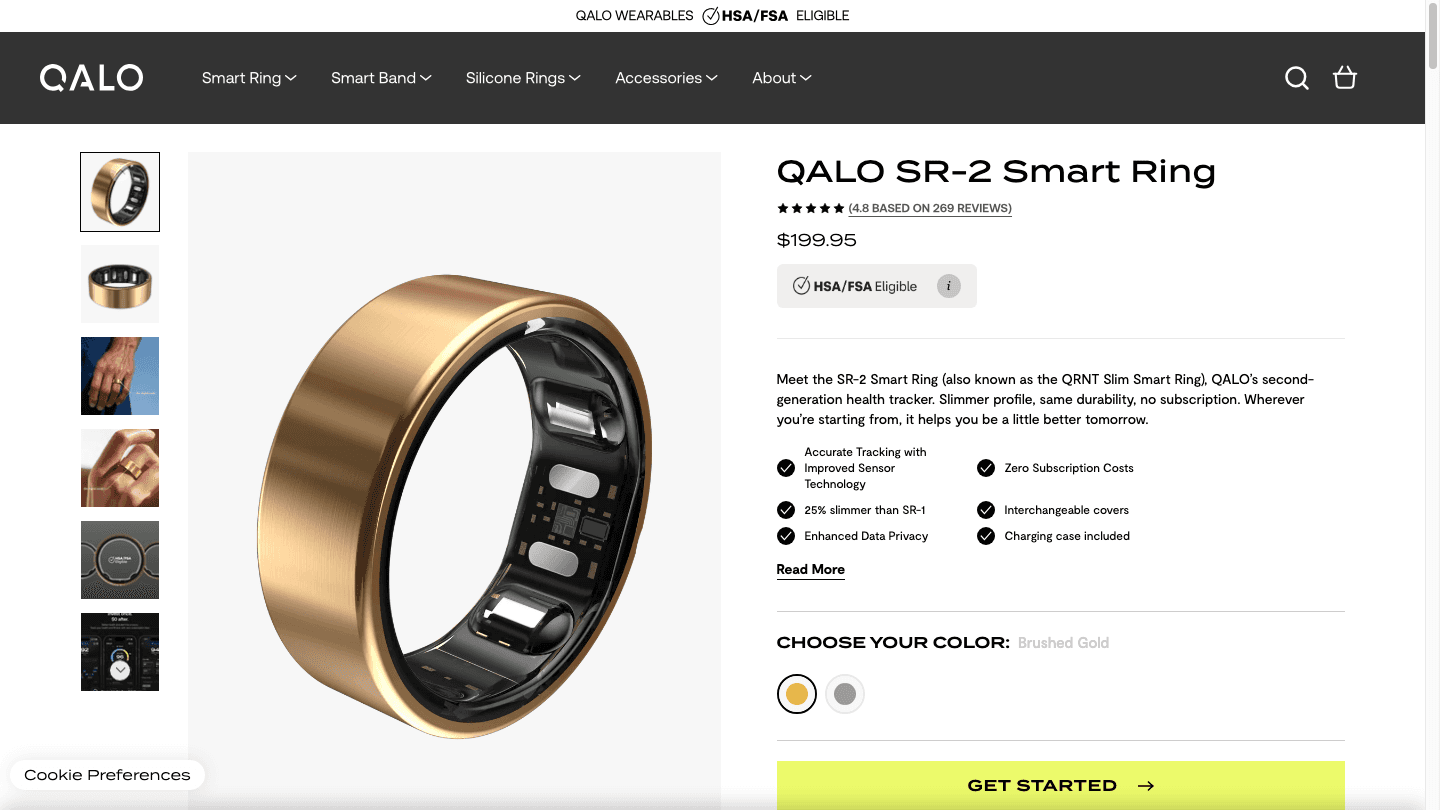
QALO offers two QRNT configurations. The Original (8mm wide) is the chunkier option, with stronger battery life claimed at seven days. The Slim (SR-2, 2.2mm wide) is thinner than an Oura Ring and designed for people who want minimal bulk. Both are titanium alloy with water resistance to 1.5 meters for 30 minutes, which handles handwashing, showering, and most daily water exposure but not prolonged submersion.
The sensor suite includes optical heart rate and HRV tracking, SpO2 blood oxygen, skin temperature, an accelerometer for steps and activity, and a gyroscope. On paper, this matches what the Oura Ring 4 tracks at a lower price and without monthly fees.
QALO explicitly markets to people who work with their hands: first responders, tradespeople, medical professionals, and athletes who can't wear traditional watches on the job. The HSA/FSA eligibility listed on their site reflects this positioning.
Sleep Tracking
This is where smart rings generally outperform wrist-based wearables, and the QRNT is no exception. The finger has more consistent blood flow and less motion artifact than the wrist during sleep, which produces cleaner PPG signals. Light, deep, and REM stages are all tracked, and the app shows stage graphs alongside a readiness-style score each morning.
Nap detection is included, which not every ring supports. The skin temperature deviation data is useful for flagging illness before symptoms appear, similar to what the Fitbit sleep tracker and Oura do. Results align reasonably well with polysomnography comparisons in independent tests, though the app's coaching suggestions are generic rather than personalized.
For a broader look at what to expect from ring-based sleep tracking, see our guide on the best sleep trackers for 2026.
Health Tracking
Heart rate and HRV data are the core of the QRNT's health monitoring. Resting heart rate accuracy is solid for a passive tracker. HRV readings are most reliable at night and during rest, which is how they should be interpreted anyway. The app presents a 7-day HRV trend, which is more useful than any single-morning figure.
SpO2 tracking operates continuously during sleep. Skin temperature deviation is monitored nightly and shows up in a trend chart. For women, the Slim model adds cycle tracking: period prediction and ovulation estimates built from basal temperature and other biometrics, without the need to manually log anything.
What the QRNT doesn't offer: VO2 max estimation, workout-specific metrics beyond step count and general activity, or any form of ECG. It's a passive wellness monitor, not an athletic performance tool. For comparing smart ring options, our guide to smart rings without subscriptions covers the full landscape.
Workout Tracking
Activity tracking is basic. The accelerometer counts steps, estimates calories burned, and detects active periods, but there's no GPS and no sport-specific mode selection. If you go for a run, you get a step count and duration. Distance and pace require your phone.
This is fine for people who treat exercise tracking as secondary to recovery monitoring. If workout analytics matter, a dedicated GPS watch is the right tool regardless of which ring you wear.
Battery Life
QALO rates both models at seven days. Real-world use typically lands at four to five days for the Slim and five to six for the Original, with all-day and all-night tracking active. That's in the same range as the Oura Ring alternatives in this category.
Charging uses a magnetic cradle that snaps onto the ring. It charges fully in about an hour. The cradle design is compact enough to travel with, though losing it means the ring is useless until you find a replacement.
App Experience
The QALO app presents data cleanly. Sleep data, daily readiness, HRV trends, and activity history are all accessible without paywalls. Every feature works from day one, no premium tier required. This is genuinely different from Oura (subscription required for readiness scores and cycle insights) and Fitbit (Premium subscription for advanced sleep breakdown).
The app's weakness is coaching depth. Suggestions like "try to get to bed earlier" or "your stress was high today" don't give you much to act on. The data is there; the interpretation layer is thin. Compare this with Oura's more contextual guidance or Garmin's Training Readiness, and the QRNT's app feels first-generation.
If you want to connect your ring's data to a planning system that actually uses it, Lifestack can build your daily schedule around your readiness signals. It reads HRV and sleep quality data and schedules focused work or recovery time at the right moments instead of pushing you through a fixed calendar.
Sizing Note
Every reviewer who has tested the QRNT says the same thing: size up. The interior sensor bumps reduce effective diameter, and the fit reads tighter than the listed size. Order a ring sizer kit from QALO (free) before committing. Getting the fit wrong affects both comfort and tracking accuracy.
QRNT vs Oura Ring: How It Compares
The Oura Ring 4 costs $349 plus $5.99 per month ($421 in year one). The QRNT Slim is $199.95 with no recurring cost ($199.95 total). Over two years, the gap is roughly $340.
What the Oura does better: more polished app with deeper coaching, VO2 max insights, Natural Cycles integration for contraceptive use, and a longer track record of accuracy validation. What the QRNT does better: no subscription, HSA/FSA eligible, thinner profile on the Slim, and pricing that makes it accessible without ongoing commitment.
The Acer FreeSense Ring and Amazfit Helio Ring occupy similar territory in the no-subscription space. The QRNT's strongest pitch is still the QALO brand trust for people who are already wearing a QALO silicone ring and want to upgrade without switching ecosystems.
Who Should Buy the QALO QRNT?
People who resent subscription fees: The no-monthly-cost model is the single strongest argument for the QRNT. Over two years, you save significantly versus Oura.
Existing QALO customers: If you already trust the brand and want health tracking, this is the natural step up.
Workers who can't wear watches: Medical professionals, tradespeople, and first responders who need a low-profile, durable tracker get a purpose-built option.
Women who want subscription-free cycle tracking: The Slim's built-in cycle prediction without a paywall is a genuine differentiator.
Skip it if you need VO2 max, Natural Cycles integration, advanced workout analytics, or a more mature coaching app. The Samsung Galaxy Ring and Oura Ring 4 are worth the premium for those needs.
Pricing: QRNT Original: $169.95. QRNT Slim (SR-2): $199.95. Both include lifetime app access with no subscription. HSA/FSA eligible.
Frequently Asked Questions
Does the QALO QRNT require a subscription?
No. Both QRNT models include lifetime app access with no monthly or annual fees. Every feature unlocked from day one, no premium tier required.
How does the QALO QRNT compare to the Oura Ring?
The QRNT is significantly cheaper ($169-$199 vs $349 + $5.99/month for Oura). Oura has a more polished app, VO2 max insights, and Natural Cycles integration. The QRNT wins on cost and has a thinner Slim profile. See our full smart rings without subscription guide for a broader comparison.
What size should I order for the QALO QRNT?
Order a ring sizer from QALO before buying. The interior sensor bumps make the ring feel smaller than the listed size, and reviewers consistently recommend sizing up one to two sizes from your normal ring size.
Is the QALO QRNT waterproof?
The QRNT is water resistant to 1.5 meters for up to 30 minutes. It handles handwashing, showering, and rain. It's not rated for swimming laps or prolonged submersion.
What does the QALO QRNT track?
Heart rate, HRV, SpO2 blood oxygen, skin temperature, sleep stages with nap detection, steps, calories, and stress. The Slim also tracks women's health metrics including cycle prediction and ovulation estimates.
What is the battery life of the QALO QRNT?
Rated at seven days, real-world performance is four to six days depending on usage. The Original tends to outlast the Slim by about a day. Full charge takes approximately one hour via magnetic cradle.
The smart ring market has a new entrant worth paying attention to. QALO built its name on silicone rings for people who can't wear metal bands at work or in the gym. The QRNT is their move into health tracking, and it comes with a specific angle: no subscription fees, ever.
In a category where Oura charges $5.99 a month on top of a $349 ring, that positioning matters. The QRNT Original starts at $169.95 and the QRNT Slim (now branded the SR-2) at $199.95, both with lifetime app access included.
The real question is whether the hardware and software can deliver a tracking experience that justifies choosing it over the more established smart rings. This review covers what the QRNT actually does well, where it falls short, and who it makes the most sense for.
Key Takeaways
The QRNT tracks heart rate, HRV, SpO2, skin temperature, sleep stages, steps, and stress with no ongoing subscription cost.
Sleep tracking quality is genuinely good: finger-based PPG sensors produce cleaner signals than wrist-based devices.
Sizing runs small. Independent reviewers consistently recommend going one to two sizes up before ordering.
QALO QRNT Overview
QALO offers two QRNT configurations. The Original (8mm wide) is the chunkier option, with stronger battery life claimed at seven days. The Slim (SR-2, 2.2mm wide) is thinner than an Oura Ring and designed for people who want minimal bulk. Both are titanium alloy with water resistance to 1.5 meters for 30 minutes, which handles handwashing, showering, and most daily water exposure but not prolonged submersion.
The sensor suite includes optical heart rate and HRV tracking, SpO2 blood oxygen, skin temperature, an accelerometer for steps and activity, and a gyroscope. On paper, this matches what the Oura Ring 4 tracks at a lower price and without monthly fees.
QALO explicitly markets to people who work with their hands: first responders, tradespeople, medical professionals, and athletes who can't wear traditional watches on the job. The HSA/FSA eligibility listed on their site reflects this positioning.
Sleep Tracking
This is where smart rings generally outperform wrist-based wearables, and the QRNT is no exception. The finger has more consistent blood flow and less motion artifact than the wrist during sleep, which produces cleaner PPG signals. Light, deep, and REM stages are all tracked, and the app shows stage graphs alongside a readiness-style score each morning.
Nap detection is included, which not every ring supports. The skin temperature deviation data is useful for flagging illness before symptoms appear, similar to what the Fitbit sleep tracker and Oura do. Results align reasonably well with polysomnography comparisons in independent tests, though the app's coaching suggestions are generic rather than personalized.
For a broader look at what to expect from ring-based sleep tracking, see our guide on the best sleep trackers for 2026.
Health Tracking
Heart rate and HRV data are the core of the QRNT's health monitoring. Resting heart rate accuracy is solid for a passive tracker. HRV readings are most reliable at night and during rest, which is how they should be interpreted anyway. The app presents a 7-day HRV trend, which is more useful than any single-morning figure.
SpO2 tracking operates continuously during sleep. Skin temperature deviation is monitored nightly and shows up in a trend chart. For women, the Slim model adds cycle tracking: period prediction and ovulation estimates built from basal temperature and other biometrics, without the need to manually log anything.
What the QRNT doesn't offer: VO2 max estimation, workout-specific metrics beyond step count and general activity, or any form of ECG. It's a passive wellness monitor, not an athletic performance tool. For comparing smart ring options, our guide to smart rings without subscriptions covers the full landscape.
Workout Tracking
Activity tracking is basic. The accelerometer counts steps, estimates calories burned, and detects active periods, but there's no GPS and no sport-specific mode selection. If you go for a run, you get a step count and duration. Distance and pace require your phone.
This is fine for people who treat exercise tracking as secondary to recovery monitoring. If workout analytics matter, a dedicated GPS watch is the right tool regardless of which ring you wear.
Battery Life
QALO rates both models at seven days. Real-world use typically lands at four to five days for the Slim and five to six for the Original, with all-day and all-night tracking active. That's in the same range as the Oura Ring alternatives in this category.
Charging uses a magnetic cradle that snaps onto the ring. It charges fully in about an hour. The cradle design is compact enough to travel with, though losing it means the ring is useless until you find a replacement.
App Experience
The QALO app presents data cleanly. Sleep data, daily readiness, HRV trends, and activity history are all accessible without paywalls. Every feature works from day one, no premium tier required. This is genuinely different from Oura (subscription required for readiness scores and cycle insights) and Fitbit (Premium subscription for advanced sleep breakdown).
The app's weakness is coaching depth. Suggestions like "try to get to bed earlier" or "your stress was high today" don't give you much to act on. The data is there; the interpretation layer is thin. Compare this with Oura's more contextual guidance or Garmin's Training Readiness, and the QRNT's app feels first-generation.
If you want to connect your ring's data to a planning system that actually uses it, Lifestack can build your daily schedule around your readiness signals. It reads HRV and sleep quality data and schedules focused work or recovery time at the right moments instead of pushing you through a fixed calendar.
Sizing Note
Every reviewer who has tested the QRNT says the same thing: size up. The interior sensor bumps reduce effective diameter, and the fit reads tighter than the listed size. Order a ring sizer kit from QALO (free) before committing. Getting the fit wrong affects both comfort and tracking accuracy.
QRNT vs Oura Ring: How It Compares
The Oura Ring 4 costs $349 plus $5.99 per month ($421 in year one). The QRNT Slim is $199.95 with no recurring cost ($199.95 total). Over two years, the gap is roughly $340.
What the Oura does better: more polished app with deeper coaching, VO2 max insights, Natural Cycles integration for contraceptive use, and a longer track record of accuracy validation. What the QRNT does better: no subscription, HSA/FSA eligible, thinner profile on the Slim, and pricing that makes it accessible without ongoing commitment.
The Acer FreeSense Ring and Amazfit Helio Ring occupy similar territory in the no-subscription space. The QRNT's strongest pitch is still the QALO brand trust for people who are already wearing a QALO silicone ring and want to upgrade without switching ecosystems.
Who Should Buy the QALO QRNT?
People who resent subscription fees: The no-monthly-cost model is the single strongest argument for the QRNT. Over two years, you save significantly versus Oura.
Existing QALO customers: If you already trust the brand and want health tracking, this is the natural step up.
Workers who can't wear watches: Medical professionals, tradespeople, and first responders who need a low-profile, durable tracker get a purpose-built option.
Women who want subscription-free cycle tracking: The Slim's built-in cycle prediction without a paywall is a genuine differentiator.
Skip it if you need VO2 max, Natural Cycles integration, advanced workout analytics, or a more mature coaching app. The Samsung Galaxy Ring and Oura Ring 4 are worth the premium for those needs.
Pricing: QRNT Original: $169.95. QRNT Slim (SR-2): $199.95. Both include lifetime app access with no subscription. HSA/FSA eligible.
Frequently Asked Questions
Does the QALO QRNT require a subscription?
No. Both QRNT models include lifetime app access with no monthly or annual fees. Every feature unlocked from day one, no premium tier required.
How does the QALO QRNT compare to the Oura Ring?
The QRNT is significantly cheaper ($169-$199 vs $349 + $5.99/month for Oura). Oura has a more polished app, VO2 max insights, and Natural Cycles integration. The QRNT wins on cost and has a thinner Slim profile. See our full smart rings without subscription guide for a broader comparison.
What size should I order for the QALO QRNT?
Order a ring sizer from QALO before buying. The interior sensor bumps make the ring feel smaller than the listed size, and reviewers consistently recommend sizing up one to two sizes from your normal ring size.
Is the QALO QRNT waterproof?
The QRNT is water resistant to 1.5 meters for up to 30 minutes. It handles handwashing, showering, and rain. It's not rated for swimming laps or prolonged submersion.
What does the QALO QRNT track?
Heart rate, HRV, SpO2 blood oxygen, skin temperature, sleep stages with nap detection, steps, calories, and stress. The Slim also tracks women's health metrics including cycle prediction and ovulation estimates.
What is the battery life of the QALO QRNT?
Rated at seven days, real-world performance is four to six days depending on usage. The Original tends to outlast the Slim by about a day. Full charge takes approximately one hour via magnetic cradle.



FOLLOW ON
FOLLOW ON
FOLLOW ON


Copyright 2026 © Lifestack. All rights reserved
Copyright 2026 © Lifestack. All rights reserved

