
Device
Amazfit Helio Ring Review: Worth It in 2026?
Amazfit Helio Ring Review: Worth It in 2026?

Smart rings have a subscription problem. Oura Ring charges $5.99 per month for full app access, which adds up to $72 per year on top of a $299 ring. The Amazfit Helio Ring takes a different position: $149 to $199 depending on retailer, no subscription, and full access to HRV, sleep tracking, stress monitoring, and readiness scores from day one. For a market built on recurring revenue, that's an unusual choice worth examining closely.
The Helio Ring launched in 2024 and has since dropped significantly in price, with current retail around $150 versus its original $299 MSRP. It's now positioned as the budget-conscious entry into smart ring health tracking, targeting buyers who want continuous biometric monitoring without committing to a monthly fee alongside a hardware purchase.
Here's what the Helio Ring actually delivers, where it cuts corners compared to Oura, and whether the no-subscription value proposition is as strong as it looks.
Key Takeaways
At $149 with no subscription, the Helio Ring offers the best long-term cost of any smart ring on the market: year three of ownership costs nothing in monthly fees, versus $143+ cumulative subscription fees for Oura
The EDA (electrodermal activity) stress sensor is a genuine differentiator, measuring skin conductance to detect emotional arousal in ways optical heart rate sensors can't
Battery life at 2.5-3 days real-world is the biggest practical limitation, requiring more frequent charging than Oura's 5-8 day battery
What Is the Amazfit Helio Ring?

The Helio Ring is a titanium smart ring from Amazfit, the wearable brand under Zepp Health. It's designed for continuous health monitoring: wear it 24 hours a day, including sleep, showering, and swimming (10 ATM water resistance), and the sensors build a running picture of your recovery, stress, and sleep quality.
The ring comes in three sizes: 8, 10, and 12. This limited size range is a meaningful limitation compared to Oura Ring's 8-plus sizing options and the ability to order a sizing kit before committing to a size. Amazfit recommends measuring your finger across multiple times of day, since fingers swell in heat and shrink in cold, and the Helio Ring's tight range means some people may not find a comfortable fit.
The companion app is Zepp, Amazfit's health platform that also supports their smartwatches and fitness trackers. If you already use a Zepp-connected Amazfit watch, the Helio Ring data flows directly into the same unified health dashboard. For new users, the app is functional and clear, if less visually polished than Oura's dedicated interface.
Sensors and Health Tracking
The Helio Ring's sensor array covers the core metrics that matter for recovery and sleep quality:
Optical PPG: Continuous heart rate and HRV monitoring using Amazfit's BioTracker sensor
SpO2: Overnight blood oxygen saturation tracking, flagging potential sleep apnea patterns
Skin temperature: Continuous monitoring used for detecting illness early and supporting female cycle tracking
EDA (electrodermal activity): Measures skin conductance to detect stress and emotional arousal responses
Accelerometer and gyroscope: 3-axis motion detection for activity and sleep position tracking
The EDA sensor is the Helio Ring's most distinctive capability. Electrodermal activity measures how much your skin conducts electricity, which changes with sweat gland activity driven by emotional and physiological stress. This is the same signal used in polygraph tests and clinical stress research. Most consumer health wearables don't include EDA; the Apple Watch Series 4 and later added it for irregular rhythm notifications, and the Fitbit Sense series included it for stress management. Having it in a ring form factor is unusual.
Sleep Tracking
Sleep is the Helio Ring's strongest use case. The ring tracks four sleep stages (light, deep, REM, and awake) continuously overnight, producing a sleep score and a Recovery Index each morning. The sleep stage detection accuracy has been independently tested at around 79%, which is solid for a consumer ring device and comparable to other rings in this price range.
The Sleep Score reflects how well you slept relative to your baseline. The Recovery Index combines sleep data with overnight HRV and resting heart rate to give a morning readiness percentage. On mornings after high-HRV, deep-sleep-heavy nights, you'll typically see high recovery scores that correlate with how alert and capable you feel. For anyone interested in understanding the real cost of short sleep or optimizing restorative sleep, the daily tracking builds useful patterns over weeks.
The Helio Ring also assesses sleep apnea risk using SpO2 data. It doesn't diagnose sleep apnea, but it flags nights when blood oxygen saturation patterns suggest possible respiratory events worth investigating with a doctor. This is a meaningful addition at the $149 price point.
EDA Stress Tracking
The EDA sensor distinguishes the Helio Ring from most smart rings, including Oura Ring 4, which doesn't include this sensor. During the day, the ring monitors for stress spikes detectable through skin conductance changes. In the app, these show up as stress level trends over time, often correlating with busy workdays, difficult conversations, or unexpected deadlines.
In practice, the EDA data is most useful for identifying patterns rather than real-time management. You're more likely to look at your stress graph at the end of the day and notice that Tuesday was physiologically more taxing than it felt, or that your body responded to a specific recurring weekly meeting with consistent stress signals. For people managing anxiety or high-pressure work environments, this feedback can be surprisingly clarifying.
Battery Life
Amazfit advertises 4 days of battery life. Real-world usage with all sensors active, including continuous HRV and skin temperature monitoring, typically lands at 2.5-3 days. This is noticeably shorter than the Oura Ring 4's 5-8 days and requires charging every 2-3 days rather than once a week.
The charging case is magnetic and wireless, reaching full charge in about 1.5-2 hours. The trade-off is that frequent charging creates small gaps in sleep tracking if you forget to charge before bed. Building a midday charging habit (while showering or working at a desk) helps maintain continuous data collection without missing overnight readings.
Amazfit Helio Ring vs Oura Ring
The comparison most buyers will make:
Price: Helio Ring $149 vs Oura Ring 4 at $299-$349 plus $5.99/month subscription
Long-term cost: At 3 years, Helio Ring is roughly $149; Oura Ring is $299-349 plus $215 in subscription fees
Battery: Helio Ring 2.5-3 days vs Oura's 5-8 days
Sleep accuracy: Oura Ring is widely considered the class leader in sleep staging; Helio Ring is competitive but not equivalent
Unique features: Helio Ring has EDA stress tracking; Oura Ring has a more refined app and better size variety
App experience: Oura's app is more polished and dedicated; Zepp serves all Amazfit devices and feels more general-purpose
For first-time smart ring buyers or anyone for whom subscription aversion is a genuine barrier, the Helio Ring wins on total cost. For buyers who prioritize sleep data quality and long battery life above all else, Oura remains the reference standard. If you already track with a RingConn or other budget ring and want to upgrade, the Helio Ring's EDA sensor gives it a capability the others don't have.
Pricing
Current price: $149-$199 depending on retailer (original MSRP was $299)
Subscription: None. All tracking features, app access, and health insights are included with the ring
App: Zepp app is free and available on iOS and Android
HSA/FSA: Check current eligibility, as Amazfit has offered HSA/FSA purchasing options
The no-subscription model is the Helio Ring's most durable competitive advantage. As subscription fatigue grows across consumer tech, a one-time purchase that unlocks all features permanently stands out in a market where Oura, WHOOP, and others build recurring revenue into their models. If you're evaluating sleep tracking tools without a subscription, the Helio Ring is one of very few smart ring options that qualify.
Turning Ring Data into Better Days
The Helio Ring produces a Recovery Index every morning. It's a useful number, but only if your schedule can actually respond to it. A 35% recovery day where you schedule back-to-back high-stakes meetings is a mismatch between your body's state and your calendar's demands.
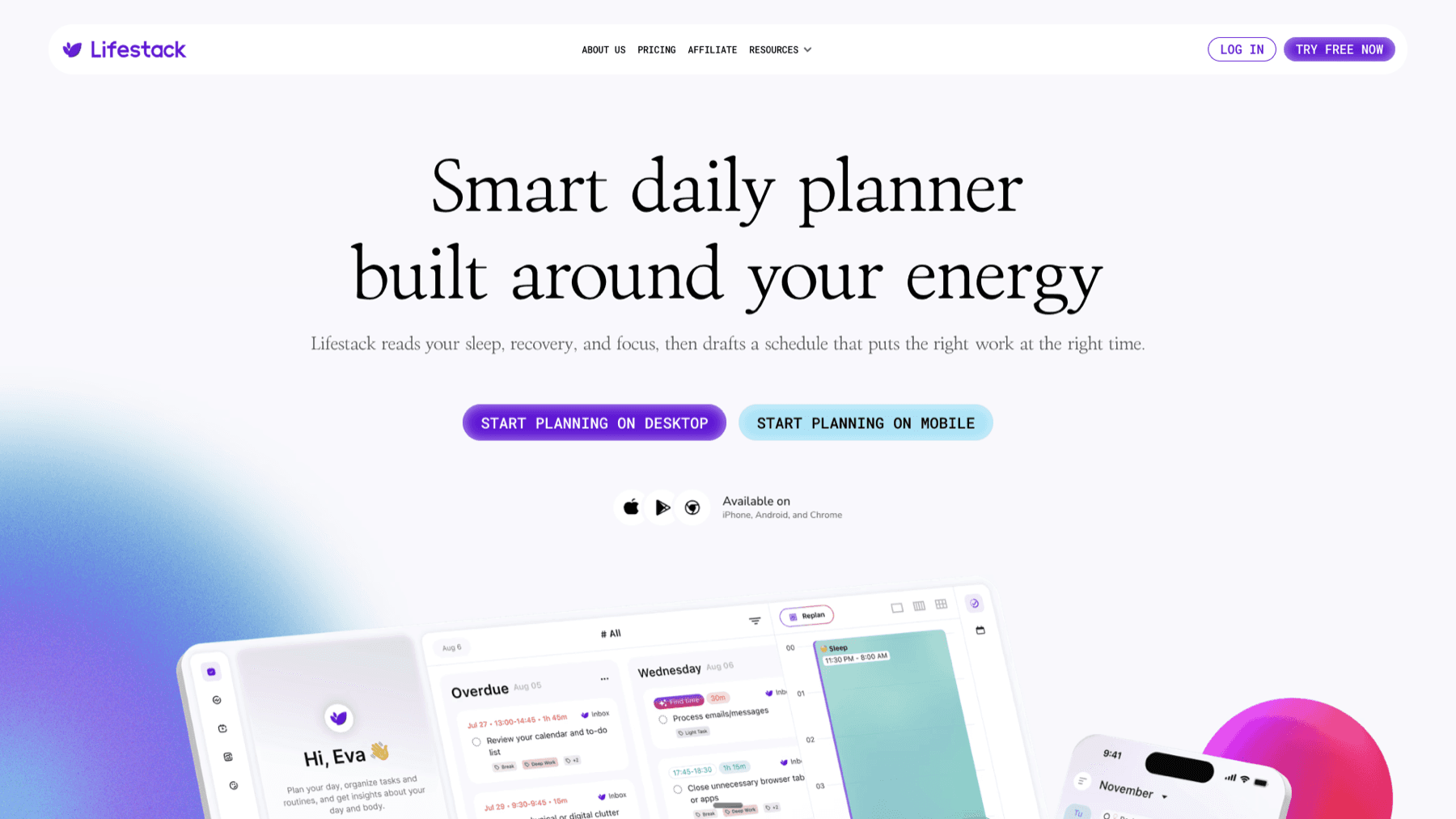
Lifestack is an AI scheduler built around energy-aware planning. Rather than filling every available block uniformly, Lifestack assigns cognitively demanding work to your high-energy windows and routes lighter tasks to your natural dip periods. Pairing a Helio Ring for morning recovery data with Lifestack for scheduling creates a loop: your physiological readiness shapes how your day is structured, not just how you feel about it.
Understanding your circadian rhythm at the resolution a smart ring provides, including HRV trends, sleep stage ratios, and stress signatures across the week, makes the scheduling intelligence more precise. The Helio Ring gives you the data; Lifestack gives you a calendar that acts on it.
Who Should Buy the Amazfit Helio Ring
Subscription-averse buyers: If the idea of a monthly fee for data you're generating on your own body bothers you, the Helio Ring's no-subscription model is the clearest advantage in the smart ring market
Stress-aware users: The EDA sensor gives a stress signal that optical PPG can't provide; if understanding your stress physiology is a priority, this is one of the few wearables that measures it directly
Amazfit ecosystem users: If you already wear an Amazfit watch and use the Zepp app, adding a Helio Ring gives you ring-quality overnight biometrics alongside daytime watch data in a unified platform
Budget-first smart ring buyers: At $149 with no ongoing fees, the barrier to entry is lower than any comparable device
The Helio Ring is a harder sell for buyers who are already committed to Oura and value its sleep accuracy, or for anyone who needs more than 3 sizes to find a good fit. For the specific combination of low total cost and EDA stress tracking in a comfortable ring format, there's currently no direct competitor.
Frequently Asked Questions
Does the Amazfit Helio Ring require a subscription?
No. All health tracking features, sleep analysis, HRV data, EDA stress scores, and Recovery Index access are included with the ring purchase. There is no monthly or annual fee. This is one of the Helio Ring's strongest selling points compared to Oura Ring ($5.99/month) or WHOOP ($199+/year).
How accurate is the Amazfit Helio Ring sleep tracking?
Independent testing has found sleep stage accuracy around 79%, which is competitive for a consumer ring but below Oura Ring's accuracy benchmark. For understanding personal sleep trends over weeks and correlating sleep quality with energy and mood, the accuracy is more than sufficient. For precise medical-grade sleep analysis, consult a sleep specialist.
What sizes does the Amazfit Helio Ring come in?
The Helio Ring comes in sizes 8, 10, and 12 only. This is a significant limitation compared to Oura Ring's 8-plus size options. If you wear a size 7, 9, 11, or 13 ring, the Helio Ring may not be available in a comfortable fit. Amazfit recommends measuring your finger at different times of day to account for swelling.
How does the Helio Ring compare to the Oura Ring?
Oura Ring is the sleep tracking leader with better accuracy, longer battery life (5-8 days vs 2.5-3 days), more size options, and a more polished app. The Helio Ring wins on total cost: $149 one-time vs $299-349 plus $5.99/month for Oura. The Helio Ring also has EDA stress tracking, which Oura doesn't include. Choose Oura for best-in-class sleep data; choose Helio Ring for value and subscription-free ownership.
Is the Amazfit Helio Ring good for women's health tracking?
Yes. The continuous skin temperature monitoring is specifically designed to support menstrual cycle tracking, detecting the temperature shifts that occur around ovulation. The Zepp app includes cycle tracking features that use temperature data to help predict fertile windows and track cycle regularity.
What is EDA in the Amazfit Helio Ring?
EDA stands for electrodermal activity, a measure of how much your skin conducts electricity. Skin conductance changes with sweat gland activity, which is driven by the nervous system's stress response. The EDA sensor in the Helio Ring detects these changes to track stress and emotional arousal throughout the day. It's a physiological stress signal that optical heart rate sensors alone cannot capture.
Smart rings have a subscription problem. Oura Ring charges $5.99 per month for full app access, which adds up to $72 per year on top of a $299 ring. The Amazfit Helio Ring takes a different position: $149 to $199 depending on retailer, no subscription, and full access to HRV, sleep tracking, stress monitoring, and readiness scores from day one. For a market built on recurring revenue, that's an unusual choice worth examining closely.
The Helio Ring launched in 2024 and has since dropped significantly in price, with current retail around $150 versus its original $299 MSRP. It's now positioned as the budget-conscious entry into smart ring health tracking, targeting buyers who want continuous biometric monitoring without committing to a monthly fee alongside a hardware purchase.
Here's what the Helio Ring actually delivers, where it cuts corners compared to Oura, and whether the no-subscription value proposition is as strong as it looks.
Key Takeaways
At $149 with no subscription, the Helio Ring offers the best long-term cost of any smart ring on the market: year three of ownership costs nothing in monthly fees, versus $143+ cumulative subscription fees for Oura
The EDA (electrodermal activity) stress sensor is a genuine differentiator, measuring skin conductance to detect emotional arousal in ways optical heart rate sensors can't
Battery life at 2.5-3 days real-world is the biggest practical limitation, requiring more frequent charging than Oura's 5-8 day battery
What Is the Amazfit Helio Ring?
The Helio Ring is a titanium smart ring from Amazfit, the wearable brand under Zepp Health. It's designed for continuous health monitoring: wear it 24 hours a day, including sleep, showering, and swimming (10 ATM water resistance), and the sensors build a running picture of your recovery, stress, and sleep quality.
The ring comes in three sizes: 8, 10, and 12. This limited size range is a meaningful limitation compared to Oura Ring's 8-plus sizing options and the ability to order a sizing kit before committing to a size. Amazfit recommends measuring your finger across multiple times of day, since fingers swell in heat and shrink in cold, and the Helio Ring's tight range means some people may not find a comfortable fit.
The companion app is Zepp, Amazfit's health platform that also supports their smartwatches and fitness trackers. If you already use a Zepp-connected Amazfit watch, the Helio Ring data flows directly into the same unified health dashboard. For new users, the app is functional and clear, if less visually polished than Oura's dedicated interface.
Sensors and Health Tracking
The Helio Ring's sensor array covers the core metrics that matter for recovery and sleep quality:
Optical PPG: Continuous heart rate and HRV monitoring using Amazfit's BioTracker sensor
SpO2: Overnight blood oxygen saturation tracking, flagging potential sleep apnea patterns
Skin temperature: Continuous monitoring used for detecting illness early and supporting female cycle tracking
EDA (electrodermal activity): Measures skin conductance to detect stress and emotional arousal responses
Accelerometer and gyroscope: 3-axis motion detection for activity and sleep position tracking
The EDA sensor is the Helio Ring's most distinctive capability. Electrodermal activity measures how much your skin conducts electricity, which changes with sweat gland activity driven by emotional and physiological stress. This is the same signal used in polygraph tests and clinical stress research. Most consumer health wearables don't include EDA; the Apple Watch Series 4 and later added it for irregular rhythm notifications, and the Fitbit Sense series included it for stress management. Having it in a ring form factor is unusual.
Sleep Tracking
Sleep is the Helio Ring's strongest use case. The ring tracks four sleep stages (light, deep, REM, and awake) continuously overnight, producing a sleep score and a Recovery Index each morning. The sleep stage detection accuracy has been independently tested at around 79%, which is solid for a consumer ring device and comparable to other rings in this price range.
The Sleep Score reflects how well you slept relative to your baseline. The Recovery Index combines sleep data with overnight HRV and resting heart rate to give a morning readiness percentage. On mornings after high-HRV, deep-sleep-heavy nights, you'll typically see high recovery scores that correlate with how alert and capable you feel. For anyone interested in understanding the real cost of short sleep or optimizing restorative sleep, the daily tracking builds useful patterns over weeks.
The Helio Ring also assesses sleep apnea risk using SpO2 data. It doesn't diagnose sleep apnea, but it flags nights when blood oxygen saturation patterns suggest possible respiratory events worth investigating with a doctor. This is a meaningful addition at the $149 price point.
EDA Stress Tracking
The EDA sensor distinguishes the Helio Ring from most smart rings, including Oura Ring 4, which doesn't include this sensor. During the day, the ring monitors for stress spikes detectable through skin conductance changes. In the app, these show up as stress level trends over time, often correlating with busy workdays, difficult conversations, or unexpected deadlines.
In practice, the EDA data is most useful for identifying patterns rather than real-time management. You're more likely to look at your stress graph at the end of the day and notice that Tuesday was physiologically more taxing than it felt, or that your body responded to a specific recurring weekly meeting with consistent stress signals. For people managing anxiety or high-pressure work environments, this feedback can be surprisingly clarifying.
Battery Life
Amazfit advertises 4 days of battery life. Real-world usage with all sensors active, including continuous HRV and skin temperature monitoring, typically lands at 2.5-3 days. This is noticeably shorter than the Oura Ring 4's 5-8 days and requires charging every 2-3 days rather than once a week.
The charging case is magnetic and wireless, reaching full charge in about 1.5-2 hours. The trade-off is that frequent charging creates small gaps in sleep tracking if you forget to charge before bed. Building a midday charging habit (while showering or working at a desk) helps maintain continuous data collection without missing overnight readings.
Amazfit Helio Ring vs Oura Ring
The comparison most buyers will make:
Price: Helio Ring $149 vs Oura Ring 4 at $299-$349 plus $5.99/month subscription
Long-term cost: At 3 years, Helio Ring is roughly $149; Oura Ring is $299-349 plus $215 in subscription fees
Battery: Helio Ring 2.5-3 days vs Oura's 5-8 days
Sleep accuracy: Oura Ring is widely considered the class leader in sleep staging; Helio Ring is competitive but not equivalent
Unique features: Helio Ring has EDA stress tracking; Oura Ring has a more refined app and better size variety
App experience: Oura's app is more polished and dedicated; Zepp serves all Amazfit devices and feels more general-purpose
For first-time smart ring buyers or anyone for whom subscription aversion is a genuine barrier, the Helio Ring wins on total cost. For buyers who prioritize sleep data quality and long battery life above all else, Oura remains the reference standard. If you already track with a RingConn or other budget ring and want to upgrade, the Helio Ring's EDA sensor gives it a capability the others don't have.
Pricing
Current price: $149-$199 depending on retailer (original MSRP was $299)
Subscription: None. All tracking features, app access, and health insights are included with the ring
App: Zepp app is free and available on iOS and Android
HSA/FSA: Check current eligibility, as Amazfit has offered HSA/FSA purchasing options
The no-subscription model is the Helio Ring's most durable competitive advantage. As subscription fatigue grows across consumer tech, a one-time purchase that unlocks all features permanently stands out in a market where Oura, WHOOP, and others build recurring revenue into their models. If you're evaluating sleep tracking tools without a subscription, the Helio Ring is one of very few smart ring options that qualify.
Turning Ring Data into Better Days
The Helio Ring produces a Recovery Index every morning. It's a useful number, but only if your schedule can actually respond to it. A 35% recovery day where you schedule back-to-back high-stakes meetings is a mismatch between your body's state and your calendar's demands.
Lifestack is an AI scheduler built around energy-aware planning. Rather than filling every available block uniformly, Lifestack assigns cognitively demanding work to your high-energy windows and routes lighter tasks to your natural dip periods. Pairing a Helio Ring for morning recovery data with Lifestack for scheduling creates a loop: your physiological readiness shapes how your day is structured, not just how you feel about it.
Understanding your circadian rhythm at the resolution a smart ring provides, including HRV trends, sleep stage ratios, and stress signatures across the week, makes the scheduling intelligence more precise. The Helio Ring gives you the data; Lifestack gives you a calendar that acts on it.
Who Should Buy the Amazfit Helio Ring
Subscription-averse buyers: If the idea of a monthly fee for data you're generating on your own body bothers you, the Helio Ring's no-subscription model is the clearest advantage in the smart ring market
Stress-aware users: The EDA sensor gives a stress signal that optical PPG can't provide; if understanding your stress physiology is a priority, this is one of the few wearables that measures it directly
Amazfit ecosystem users: If you already wear an Amazfit watch and use the Zepp app, adding a Helio Ring gives you ring-quality overnight biometrics alongside daytime watch data in a unified platform
Budget-first smart ring buyers: At $149 with no ongoing fees, the barrier to entry is lower than any comparable device
The Helio Ring is a harder sell for buyers who are already committed to Oura and value its sleep accuracy, or for anyone who needs more than 3 sizes to find a good fit. For the specific combination of low total cost and EDA stress tracking in a comfortable ring format, there's currently no direct competitor.
Frequently Asked Questions
Does the Amazfit Helio Ring require a subscription?
No. All health tracking features, sleep analysis, HRV data, EDA stress scores, and Recovery Index access are included with the ring purchase. There is no monthly or annual fee. This is one of the Helio Ring's strongest selling points compared to Oura Ring ($5.99/month) or WHOOP ($199+/year).
How accurate is the Amazfit Helio Ring sleep tracking?
Independent testing has found sleep stage accuracy around 79%, which is competitive for a consumer ring but below Oura Ring's accuracy benchmark. For understanding personal sleep trends over weeks and correlating sleep quality with energy and mood, the accuracy is more than sufficient. For precise medical-grade sleep analysis, consult a sleep specialist.
What sizes does the Amazfit Helio Ring come in?
The Helio Ring comes in sizes 8, 10, and 12 only. This is a significant limitation compared to Oura Ring's 8-plus size options. If you wear a size 7, 9, 11, or 13 ring, the Helio Ring may not be available in a comfortable fit. Amazfit recommends measuring your finger at different times of day to account for swelling.
How does the Helio Ring compare to the Oura Ring?
Oura Ring is the sleep tracking leader with better accuracy, longer battery life (5-8 days vs 2.5-3 days), more size options, and a more polished app. The Helio Ring wins on total cost: $149 one-time vs $299-349 plus $5.99/month for Oura. The Helio Ring also has EDA stress tracking, which Oura doesn't include. Choose Oura for best-in-class sleep data; choose Helio Ring for value and subscription-free ownership.
Is the Amazfit Helio Ring good for women's health tracking?
Yes. The continuous skin temperature monitoring is specifically designed to support menstrual cycle tracking, detecting the temperature shifts that occur around ovulation. The Zepp app includes cycle tracking features that use temperature data to help predict fertile windows and track cycle regularity.
What is EDA in the Amazfit Helio Ring?
EDA stands for electrodermal activity, a measure of how much your skin conducts electricity. Skin conductance changes with sweat gland activity, which is driven by the nervous system's stress response. The EDA sensor in the Helio Ring detects these changes to track stress and emotional arousal throughout the day. It's a physiological stress signal that optical heart rate sensors alone cannot capture.



FOLLOW ON
FOLLOW ON
FOLLOW ON


Copyright 2026 © Lifestack. All rights reserved
Copyright 2026 © Lifestack. All rights reserved

