
Tips
Sales Productivity Software: 7 Types That Work in 2026
Sales Productivity Software: 7 Types That Work in 2026

Sales reps spend less time actually selling than most people assume. Studies consistently show that quota-carrying reps spend only about a third of their week in direct selling activities. The rest goes to administrative work, internal meetings, email, data entry, and the overhead of managing a complex pipeline with too many tools that don't talk to each other.
Sales productivity software addresses that gap. Not by making reps work harder, but by cutting the overhead that consumes time they'd otherwise spend with prospects. The category has expanded significantly with AI, and the right combination of tools can meaningfully shift where a rep's hours go.
This guide covers the seven categories of sales productivity software that matter, what each one does, and how to build a stack that actually supports the way salespeople work rather than adding more complexity to manage.
Key Takeaways
Sales reps typically spend only 30 to 35% of their time in direct selling activities. The right tools shift that percentage without increasing total hours.
The most impactful categories are CRM, scheduling/time management, and sales engagement. These three address the biggest drains on productive selling time.
Stacking too many tools creates its own overhead. Start with the categories that address your biggest bottleneck before adding more.
1. CRM Software
A CRM (Customer Relationship Management) system is the foundation of any sales productivity stack. It's where deal data lives, where pipeline health is tracked, and where the history of every prospect interaction is stored. Without a CRM, the team's collective knowledge exists in individual inboxes and notebooks that disappear when people leave.
The CRM category has matured significantly. Salesforce remains the dominant enterprise option with deep customization and a large app ecosystem. HubSpot Sales Hub has built a strong mid-market position, with a free tier that includes contact management and basic pipeline tracking. For smaller teams, Pipedrive offers a clean, deal-focused interface with less setup overhead than enterprise platforms.
The productivity value of a CRM is largely in what it automates: logging calls and emails, tracking deal stages, generating activity reports. A CRM that requires manual data entry for everything is just a more organized spreadsheet. Look for one with automatic activity capture and native integrations with your email and calendar.
2. AI Scheduling and Time Management
The second category is underused by most sales teams: tools that help reps manage when they do what. A full pipeline of opportunities means constant context-switching between prospecting, discovery calls, proposal writing, follow-ups, and internal meetings. Without structure, the urgent always displaces the important.
Lifestack is built specifically for this problem. It reads your task list, your calendar, and your biometric data (sleep quality, HRV, and recovery scores from wearables like Oura Ring or Garmin) and builds a daily schedule that puts high-value work during your best focus windows. For a sales rep, that might mean protecting 9 to 11am for outbound prospecting when focus is highest, and scheduling proposal reviews or CRM updates for the post-lunch period when energy is lower.
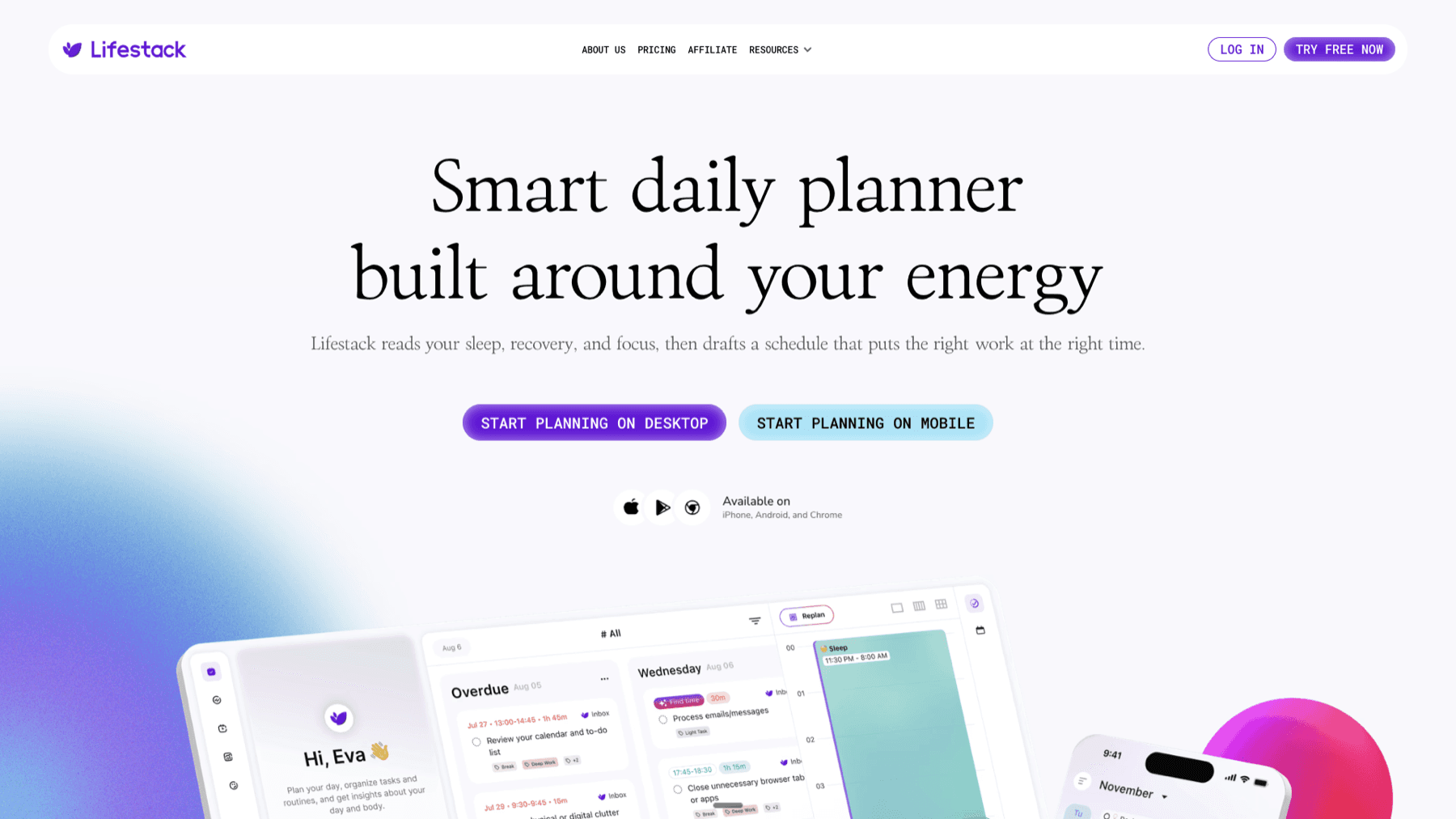
This matters in sales because revenue-generating activities, particularly outbound prospecting and strategic account conversations, require real cognitive presence. Scheduling them during depleted hours, because that's what was available, is a predictable way to underperform. Lifestack costs $7/month or $50/year. For a broader look at AI scheduling options, see the best AI planner apps in 2026 and scheduling tools that protect high-value time.
3. Sales Engagement Platforms
Sales engagement platforms automate and track outreach sequences. Instead of manually sending a prospecting email, waiting a week, sending a LinkedIn connection request, waiting three days, and following up by phone, you build a sequence once and the platform executes it across your prospect list.
Outreach and Salesloft are the category leaders. Both offer multi-channel sequence automation, AI-generated email suggestions, and analytics on what messaging is producing responses. Mixmax is a lighter-weight option that lives inside Gmail and handles sequences, email tracking, and scheduling without requiring a separate platform.
The productivity gain here is in scale and consistency. A rep using an engagement platform can run thoughtful, personalized-looking sequences to hundreds of prospects simultaneously while spending most of their active time on warm conversations rather than cold outreach logistics.
4. Prospecting and Lead Intelligence
Prospecting tools help reps identify the right accounts to target and find the contact information needed to reach them. Time spent researching prospects manually is time not spent talking to them.
Apollo.io is one of the most widely used options in 2026, offering a database of over 270 million contacts with filters for company size, industry, technology stack, and intent signals. ZoomInfo remains the data quality standard for enterprise teams, with a significantly higher price point. LinkedIn Sales Navigator is essential for relationship-based selling and account-based strategies.
The best prospecting tools go beyond contact data. Intent data, signals that a company is actively researching a problem your product solves, can dramatically improve prospecting efficiency by focusing outreach on accounts that are already in buying mode.
5. Meeting Scheduling and Coordination
Back-and-forth scheduling emails are a well-documented productivity drain. When a prospect is ready to talk, friction in the booking process costs conversions. Meeting scheduling tools remove that friction.
Calendly is the most widely used option: share a link, prospects pick a time that works, it lands on your calendar. More advanced options like Chili Piper handle routing logic for inbound leads, ensuring the right rep gets the meeting based on territory, account size, or product interest. For managing internal meeting overhead, these meeting management strategies apply directly to sales team environments.
6. Conversation Intelligence
Conversation intelligence platforms record, transcribe, and analyze sales calls. They surface patterns in what's working, flag deal risks, and give managers visibility into rep performance without sitting in on every call.
Gong is the category leader, analyzing call recordings to identify topics discussed, competitor mentions, talk-to-listen ratios, and coaching opportunities. Chorus by ZoomInfo and Fireflies.ai offer similar capability at different price points.
The individual rep productivity benefit is in call prep and follow-up. Accurate transcripts mean less time on call notes, automatic CRM sync of key information, and searchable records of what was discussed in every previous conversation with an account.
7. Sales Analytics and Forecasting
Most CRMs include basic pipeline reporting, but dedicated analytics tools go further: analyzing win rates by deal size, rep, source, and stage; surfacing forecast risk signals; and helping managers understand where the pipeline is likely to come up short before it's too late to act.
Clari is the established leader in revenue intelligence, using AI to analyze CRM activity patterns and generate rolling forecasts that are more accurate than manual pipeline reviews. Gong's Revenue Intelligence overlaps here, combining call analysis with deal inspection tools.
The productivity angle: analytics tools replace time-consuming manual pipeline reviews with automated insights, freeing managers from weekly "talk me through your deals" conversations and allowing reps to focus on selling rather than reporting.
How to Choose the Right Sales Productivity Stack
Start with your actual bottleneck. If reps are struggling to find enough qualified prospects, start with a prospecting tool. If the pipeline exists but deals are stalling, conversation intelligence and engagement platforms are more relevant. If the team is running hard but feels scattered and burned out, the scheduling and time management category is often the highest-impact addition.
The goal is to spend less time on overhead and more time in high-value selling conversations. More tools don't automatically produce that outcome. Each addition to the stack needs a clear answer to "what specific activity does this replace or reduce?" without that, you're adding management overhead, not reducing it.
For a broader view of how AI tools are changing individual productivity, the best AI productivity tools in 2026 covers the landscape beyond sales-specific software. If you're thinking about time management for high-stakes individual contributor roles, protecting your deep work time applies directly to the hours when prospecting and strategic thinking happen.
Frequently Asked Questions
What is sales productivity software?
Sales productivity software is a category of tools designed to increase the proportion of time salespeople spend in revenue-generating activities (prospecting, discovery calls, closing) relative to administrative overhead (data entry, manual scheduling, email logistics, internal reporting). The category includes CRMs, engagement platforms, prospecting tools, conversation intelligence, meeting scheduling, analytics, and scheduling tools.
What are the most important sales productivity tools?
The highest-impact starting points are typically CRM (foundational), a meeting scheduling tool to eliminate back-and-forth booking friction, and either a sales engagement platform (if outbound volume is the goal) or a scheduling and time management tool (if focus and prioritization are the bottleneck). Conversation intelligence becomes more valuable as call volume and team size grow.
How does AI improve sales productivity?
AI in sales productivity works across several dimensions: generating and personalizing outreach emails, analyzing call recordings for coaching insights, predicting deal risk and forecast accuracy, automating CRM data entry from call transcripts, and, increasingly, building daily schedules that align a rep's best hours with their highest-value activities. The last point, energy-aware scheduling, is where tools like Lifestack are distinct from traditional sales tools.
What software do top sales teams use?
High-performing enterprise sales teams typically run Salesforce or HubSpot as their CRM, Outreach or Salesloft for engagement, Gong or Chorus for conversation intelligence, Clari for forecasting, and a prospecting tool like Apollo.io or ZoomInfo. The stack is tailored to the sales motion: high-velocity transactional teams prioritize automation and speed; enterprise teams prioritize relationship depth and deal visibility.
Is there a free sales productivity tool?
Yes. HubSpot CRM has a genuinely useful free tier that includes contact management, deal tracking, email integration, and basic meeting scheduling. Calendly has a free plan for individual booking links. Apollo.io has a free tier with limited monthly credits. Fireflies.ai offers free call transcription with usage limits. For individual time management, personal time management apps at various price points are worth evaluating alongside sales-specific tools.
Sales reps spend less time actually selling than most people assume. Studies consistently show that quota-carrying reps spend only about a third of their week in direct selling activities. The rest goes to administrative work, internal meetings, email, data entry, and the overhead of managing a complex pipeline with too many tools that don't talk to each other.
Sales productivity software addresses that gap. Not by making reps work harder, but by cutting the overhead that consumes time they'd otherwise spend with prospects. The category has expanded significantly with AI, and the right combination of tools can meaningfully shift where a rep's hours go.
This guide covers the seven categories of sales productivity software that matter, what each one does, and how to build a stack that actually supports the way salespeople work rather than adding more complexity to manage.
Key Takeaways
Sales reps typically spend only 30 to 35% of their time in direct selling activities. The right tools shift that percentage without increasing total hours.
The most impactful categories are CRM, scheduling/time management, and sales engagement. These three address the biggest drains on productive selling time.
Stacking too many tools creates its own overhead. Start with the categories that address your biggest bottleneck before adding more.
1. CRM Software
A CRM (Customer Relationship Management) system is the foundation of any sales productivity stack. It's where deal data lives, where pipeline health is tracked, and where the history of every prospect interaction is stored. Without a CRM, the team's collective knowledge exists in individual inboxes and notebooks that disappear when people leave.
The CRM category has matured significantly. Salesforce remains the dominant enterprise option with deep customization and a large app ecosystem. HubSpot Sales Hub has built a strong mid-market position, with a free tier that includes contact management and basic pipeline tracking. For smaller teams, Pipedrive offers a clean, deal-focused interface with less setup overhead than enterprise platforms.
The productivity value of a CRM is largely in what it automates: logging calls and emails, tracking deal stages, generating activity reports. A CRM that requires manual data entry for everything is just a more organized spreadsheet. Look for one with automatic activity capture and native integrations with your email and calendar.
2. AI Scheduling and Time Management
The second category is underused by most sales teams: tools that help reps manage when they do what. A full pipeline of opportunities means constant context-switching between prospecting, discovery calls, proposal writing, follow-ups, and internal meetings. Without structure, the urgent always displaces the important.
Lifestack is built specifically for this problem. It reads your task list, your calendar, and your biometric data (sleep quality, HRV, and recovery scores from wearables like Oura Ring or Garmin) and builds a daily schedule that puts high-value work during your best focus windows. For a sales rep, that might mean protecting 9 to 11am for outbound prospecting when focus is highest, and scheduling proposal reviews or CRM updates for the post-lunch period when energy is lower.
This matters in sales because revenue-generating activities, particularly outbound prospecting and strategic account conversations, require real cognitive presence. Scheduling them during depleted hours, because that's what was available, is a predictable way to underperform. Lifestack costs $7/month or $50/year. For a broader look at AI scheduling options, see the best AI planner apps in 2026 and scheduling tools that protect high-value time.
3. Sales Engagement Platforms
Sales engagement platforms automate and track outreach sequences. Instead of manually sending a prospecting email, waiting a week, sending a LinkedIn connection request, waiting three days, and following up by phone, you build a sequence once and the platform executes it across your prospect list.
Outreach and Salesloft are the category leaders. Both offer multi-channel sequence automation, AI-generated email suggestions, and analytics on what messaging is producing responses. Mixmax is a lighter-weight option that lives inside Gmail and handles sequences, email tracking, and scheduling without requiring a separate platform.
The productivity gain here is in scale and consistency. A rep using an engagement platform can run thoughtful, personalized-looking sequences to hundreds of prospects simultaneously while spending most of their active time on warm conversations rather than cold outreach logistics.
4. Prospecting and Lead Intelligence
Prospecting tools help reps identify the right accounts to target and find the contact information needed to reach them. Time spent researching prospects manually is time not spent talking to them.
Apollo.io is one of the most widely used options in 2026, offering a database of over 270 million contacts with filters for company size, industry, technology stack, and intent signals. ZoomInfo remains the data quality standard for enterprise teams, with a significantly higher price point. LinkedIn Sales Navigator is essential for relationship-based selling and account-based strategies.
The best prospecting tools go beyond contact data. Intent data, signals that a company is actively researching a problem your product solves, can dramatically improve prospecting efficiency by focusing outreach on accounts that are already in buying mode.
5. Meeting Scheduling and Coordination
Back-and-forth scheduling emails are a well-documented productivity drain. When a prospect is ready to talk, friction in the booking process costs conversions. Meeting scheduling tools remove that friction.
Calendly is the most widely used option: share a link, prospects pick a time that works, it lands on your calendar. More advanced options like Chili Piper handle routing logic for inbound leads, ensuring the right rep gets the meeting based on territory, account size, or product interest. For managing internal meeting overhead, these meeting management strategies apply directly to sales team environments.
6. Conversation Intelligence
Conversation intelligence platforms record, transcribe, and analyze sales calls. They surface patterns in what's working, flag deal risks, and give managers visibility into rep performance without sitting in on every call.
Gong is the category leader, analyzing call recordings to identify topics discussed, competitor mentions, talk-to-listen ratios, and coaching opportunities. Chorus by ZoomInfo and Fireflies.ai offer similar capability at different price points.
The individual rep productivity benefit is in call prep and follow-up. Accurate transcripts mean less time on call notes, automatic CRM sync of key information, and searchable records of what was discussed in every previous conversation with an account.
7. Sales Analytics and Forecasting
Most CRMs include basic pipeline reporting, but dedicated analytics tools go further: analyzing win rates by deal size, rep, source, and stage; surfacing forecast risk signals; and helping managers understand where the pipeline is likely to come up short before it's too late to act.
Clari is the established leader in revenue intelligence, using AI to analyze CRM activity patterns and generate rolling forecasts that are more accurate than manual pipeline reviews. Gong's Revenue Intelligence overlaps here, combining call analysis with deal inspection tools.
The productivity angle: analytics tools replace time-consuming manual pipeline reviews with automated insights, freeing managers from weekly "talk me through your deals" conversations and allowing reps to focus on selling rather than reporting.
How to Choose the Right Sales Productivity Stack
Start with your actual bottleneck. If reps are struggling to find enough qualified prospects, start with a prospecting tool. If the pipeline exists but deals are stalling, conversation intelligence and engagement platforms are more relevant. If the team is running hard but feels scattered and burned out, the scheduling and time management category is often the highest-impact addition.
The goal is to spend less time on overhead and more time in high-value selling conversations. More tools don't automatically produce that outcome. Each addition to the stack needs a clear answer to "what specific activity does this replace or reduce?" without that, you're adding management overhead, not reducing it.
For a broader view of how AI tools are changing individual productivity, the best AI productivity tools in 2026 covers the landscape beyond sales-specific software. If you're thinking about time management for high-stakes individual contributor roles, protecting your deep work time applies directly to the hours when prospecting and strategic thinking happen.
Frequently Asked Questions
What is sales productivity software?
Sales productivity software is a category of tools designed to increase the proportion of time salespeople spend in revenue-generating activities (prospecting, discovery calls, closing) relative to administrative overhead (data entry, manual scheduling, email logistics, internal reporting). The category includes CRMs, engagement platforms, prospecting tools, conversation intelligence, meeting scheduling, analytics, and scheduling tools.
What are the most important sales productivity tools?
The highest-impact starting points are typically CRM (foundational), a meeting scheduling tool to eliminate back-and-forth booking friction, and either a sales engagement platform (if outbound volume is the goal) or a scheduling and time management tool (if focus and prioritization are the bottleneck). Conversation intelligence becomes more valuable as call volume and team size grow.
How does AI improve sales productivity?
AI in sales productivity works across several dimensions: generating and personalizing outreach emails, analyzing call recordings for coaching insights, predicting deal risk and forecast accuracy, automating CRM data entry from call transcripts, and, increasingly, building daily schedules that align a rep's best hours with their highest-value activities. The last point, energy-aware scheduling, is where tools like Lifestack are distinct from traditional sales tools.
What software do top sales teams use?
High-performing enterprise sales teams typically run Salesforce or HubSpot as their CRM, Outreach or Salesloft for engagement, Gong or Chorus for conversation intelligence, Clari for forecasting, and a prospecting tool like Apollo.io or ZoomInfo. The stack is tailored to the sales motion: high-velocity transactional teams prioritize automation and speed; enterprise teams prioritize relationship depth and deal visibility.
Is there a free sales productivity tool?
Yes. HubSpot CRM has a genuinely useful free tier that includes contact management, deal tracking, email integration, and basic meeting scheduling. Calendly has a free plan for individual booking links. Apollo.io has a free tier with limited monthly credits. Fireflies.ai offers free call transcription with usage limits. For individual time management, personal time management apps at various price points are worth evaluating alongside sales-specific tools.



FOLLOW ON
FOLLOW ON
FOLLOW ON


Copyright 2026 © Lifestack. All rights reserved
Copyright 2026 © Lifestack. All rights reserved

