
App
Sleep Reset Reviews: Top 5 Programs Ranked
Sleep Reset Reviews: Top 5 Programs Ranked

Most sleep advice focuses on habits: no screens before bed, consistent wake times, cooler rooms. That advice is real, but it misses something. For a lot of people, the sleep problem is not a bedtime habit problem. It is an all-day problem that shows up at night.
Sleep reset programs range from AI scheduling tools to clinical CBT-I coaching to audio apps that change your brain state within minutes. They address different layers of the same problem: what keeps you awake, how long it takes to fall asleep, and whether you wake up feeling like you actually slept.
We reviewed five programs across those categories, evaluated each on what it actually delivers, and ranked them on real-world impact for the most common sleep problems. Here is what we found.
Key Takeaways
The most effective sleep reset programs address either daytime root causes (cognitive load, energy patterns) or use evidence-based behavioral interventions like CBT-I
Apps that only track sleep or play sounds address symptoms rather than causes, though they work well as part of a broader approach
For ADHD and high-stress users, energy-aware scheduling before bed matters more than wind-down audio alone
Quick Guide: Sleep Reset Programs
1. Lifestack: Best overall for sleep quality improvement through energy-aware daily scheduling
2. The Sleep Reset: Best clinical program for chronic insomnia (CBT-I based)
3. SleepScore: Best for data-driven sleep tracking without a wearable
4. Rise: Best for understanding your circadian rhythm and energy debt
5. Pzizz: Best audio-based sleep reset for falling asleep faster
How We Evaluated
Mechanism: does the program address a root cause or just a symptom
Evidence base: clinical research or validated frameworks behind the approach
Usability: sustainable to use in real life, not just the first week
Value: price relative to measurable sleep improvement
1. Lifestack: Fix Your Day, Fix Your Sleep
Energy-aware AI scheduling that addresses the daytime root causes of poor sleep.
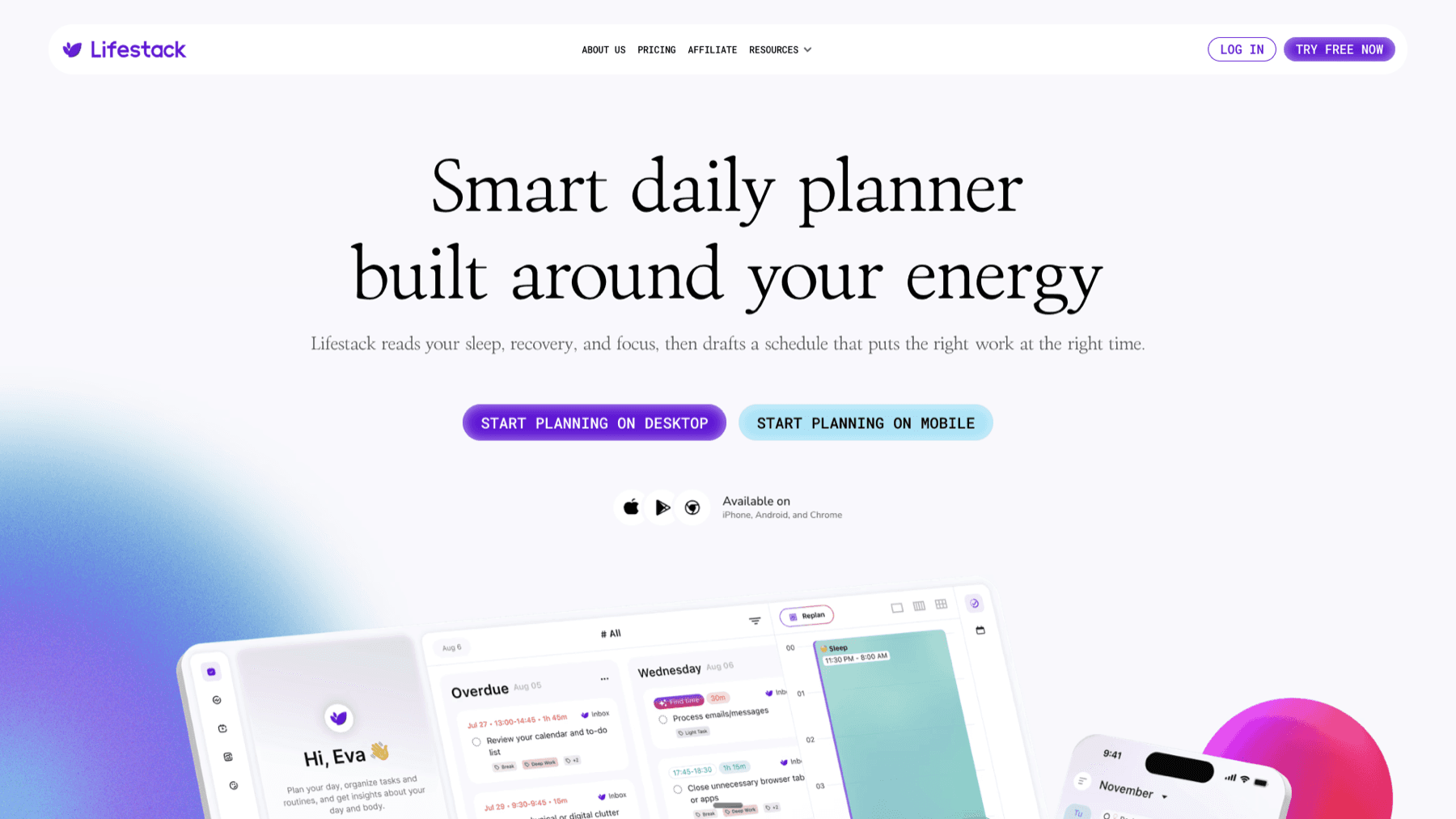
Lifestack does not look like a sleep app, which is exactly why it works for a category of poor sleepers that other apps miss. If your sleep problem is cognitive overload at bedtime, a racing to-do list, or anxiety about tomorrow's schedule, no amount of white noise is going to fix it. Lifestack works by solving those problems during the day.
The app learns your energy patterns and auto-schedules your tasks into the windows where you are most likely to get them done. By the time evening arrives, you have fewer open loops in your head. The energy-based scheduling approach is the key differentiator: it accounts for your natural peaks and troughs rather than forcing deep work into slots where your brain cannot perform. The result is a day that ends with closure instead of unfinished business.
What Works
Addresses the actual cause of many sleep problems, not just the bedtime symptoms
No energy awareness for ADHD or executive-dysfunction users means their days stay chaotic until a tool like this intervenes
Syncs with Google Calendar and Apple Calendar with no setup friction
Dynamic rescheduling keeps your plan realistic when meetings run long or tasks take more time
Limitations
Does not track sleep or provide audio; pairs best with a wind-down habit
Requires subscription after 7-day trial
Pricing: $9.99/month or $49.99/year; 7-day free trial on annual plan; lifetime option at $120
Best for: People whose poor sleep traces back to mental overload, ADHD, or chaotic daily schedules
2. The Sleep Reset: Clinical-Grade CBT-I Coaching
A full digital sleep clinic offering CBT-I therapy and one-on-one coaching for insomnia.
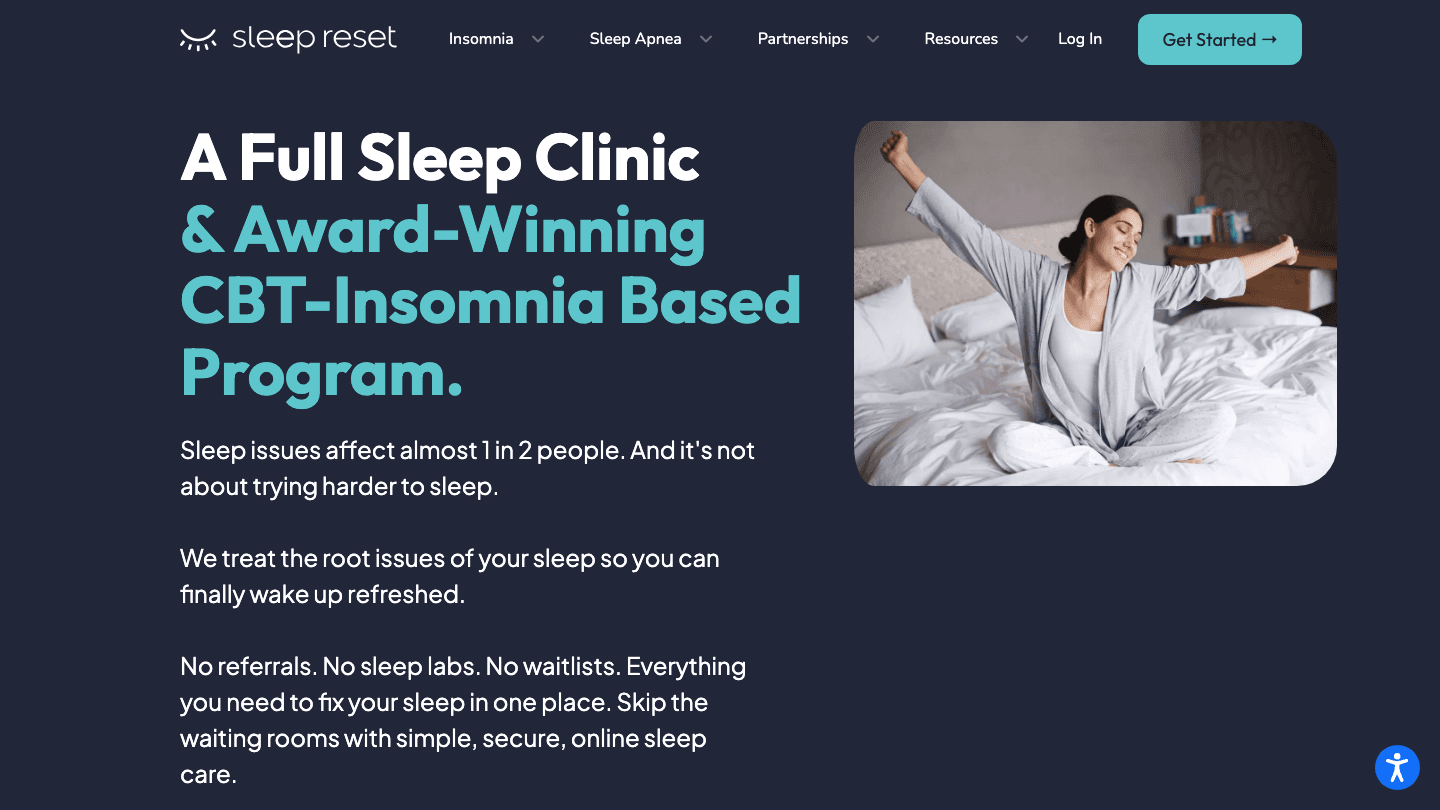
The Sleep Reset is the most clinical option on this list. It operates as a digital sleep clinic: you get a personalized sleep assessment, one-on-one coaching with a licensed sleep professional, and a CBT-I based program that runs 28 days minimum. CBT-I (Cognitive Behavioral Therapy for Insomnia) is the gold standard for treating chronic insomnia, with a stronger evidence base than sleep medication for long-term outcomes.
The program covers both insomnia and sleep apnea, accepts over 100 insurance plans, and takes HSA/FSA payments. That combination makes it one of the more accessible clinical sleep programs available without visiting a sleep lab in person. The tradeoff is cost and commitment: this is a structured program, not a casual app.
What Works
CBT-I is the most evidence-backed intervention for chronic insomnia
One-on-one coaching with licensed sleep professionals
Insurance coverage removes the barrier for many users
Limitations
Requires real commitment (28-day minimum program)
Pricing not publicly listed; requires a consultation to get a quote
More structured than most people want for garden-variety sleep issues
Pricing: Not publicly listed; accepts 100+ insurance plans and HSA/FSA; free clinical assessment available
Best for: People with chronic insomnia, sleep apnea, or who have tried everything else without improvement
3. SleepScore: Data-Driven Sleep Improvement
Wearable-free sleep tracking using sonar technology, backed by 800M+ hours of sleep data.

SleepScore uses patented sonar technology via your phone's speaker and microphone to track sleep stages without requiring a wearable. That is a meaningful distinction for people who do not want to sleep with a ring or watch on. The tracking covers sleep onset time, time in each sleep stage, wake events, and an overall SleepScore that trends over time.
Beyond tracking, the app offers personalized recommendations based on your data and the outcomes of other users with similar profiles. This is where it differentiates itself from a basic sleep log: the coaching layer connects what you did during the day (exercise, caffeine, screen time) to what happened in your sleep that night.
What Works
No wearable required for sleep stage tracking
Large dataset behind recommendations makes suggestions more relevant
Clear trend graphs that show whether your sleep is improving
Limitations
Sonar tracking requires phone to remain on the nightstand, undisturbed
No energy awareness or daytime scheduling features
Premium features require subscription
Pricing: Free to download; premium subscription for advanced analytics and coaching
Best for: Data-oriented people who want to see exactly what is happening in their sleep without wearing a device
4. Rise: Circadian Science for Better Energy and Sleep
Sleep debt tracking and circadian rhythm optimization for people who want to understand their biology.
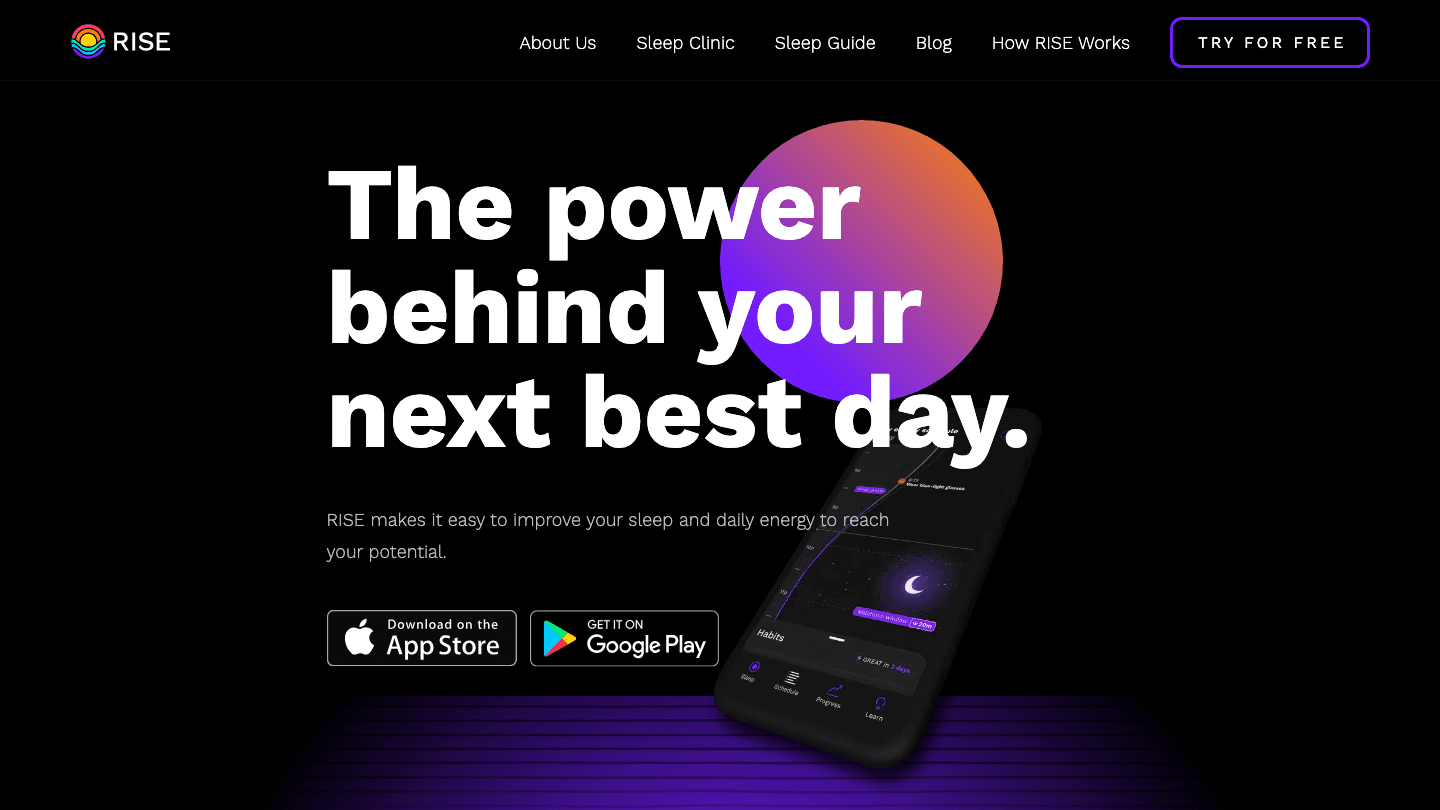
Rise takes a science-first approach to sleep. The core concept is sleep debt: the gap between the sleep your body needs and the sleep it has received over the past two weeks. Rise quantifies that debt, shows you how it affects your energy levels throughout the day, and guides you through reducing it over time.
The circadian energy model it uses is based on published chronobiology research. It shows you when your natural peak performance windows are, when your natural dip occurs, and when your body is biologically ready to sleep. This connects directly to the kind of daily planning approach that protects sleep by scheduling demanding work in the right windows.
What Works
Sleep debt metric gives you a concrete number to improve, not just a vague "sleep more"
Circadian energy predictions are surprisingly accurate for most users
Good integration between sleep data and daytime energy planning
Limitations
No energy-aware task scheduling; you still have to plan your day manually
Free tier is limited; most useful features require subscription
Some users find the sleep debt framing discouraging rather than motivating
Pricing: Free to download; premium subscription for full features
Best for: People who want to understand their circadian biology and see sleep debt quantified
5. Pzizz: Audio-Based Sleep Reset
Psychoacoustic audio that adapts each session to prevent your brain from habituating to the sound.

Pzizz addresses the most immediate part of a sleep reset: getting your brain to disengage at bedtime. Its psychoacoustic audio is designed around the science of sleep onset: frequencies and patterns that guide your brain toward drowsiness without the habituation problem that makes most looping sleep sounds stop working after a few weeks.
The algorithm generates a different audio sequence each session, so there is nothing to tune out. It also includes a voiceover narration track in the sleep module that fades out as you drift off. The app covers sleep, nap, and focus modes, making it useful beyond just the nighttime restorative sleep window.
What Works
Non-repetitive audio stays effective over time (unlike most sleep sound apps)
Separate modes for sleep, nap, and focus
Timer-based so audio does not run all night
Limitations
Does not address daytime root causes of poor sleep
The voiceover narrator style may not suit everyone
Free tier limits session count before prompting upgrade
Pricing: Free to download; premium content via in-app purchase
Best for: People whose main challenge is taking too long to fall asleep once in bed
Which Sleep Reset Program Is Right for You?
Your sleep problem is a chaotic or overloaded day: Lifestack (address the cause)
You have chronic insomnia and nothing else has worked: The Sleep Reset (clinical CBT-I)
You want objective data on your sleep without a wearable: SleepScore
You want to understand your circadian biology and sleep debt: Rise
Your main problem is taking too long to fall asleep: Pzizz
For most people, the best approach uses a combination: Lifestack during the day to close the cognitive loops that cause nighttime anxiety, and Pzizz or a wind-down routine at night to complete the transition. Tracking with SleepScore or Rise shows whether the combination is working.
FAQ
What is a sleep reset?
A sleep reset is a structured intervention designed to improve your sleep quality, duration, or both within a defined period. It can mean a clinical CBT-I program, a scheduling change that reduces cognitive overload before bed, or an audio routine that helps your brain disengage. The best sleep resets address both the daytime behaviors that undermine sleep and the nighttime environment and habits.
Does The Sleep Reset program actually work?
CBT-I, the framework behind The Sleep Reset, is supported by strong clinical evidence. Multiple meta-analyses show it is more effective than sleep medication for chronic insomnia, with effects that persist after the program ends. Individual results vary based on adherence and the specific sleep problem being treated, but the evidence base is solid.
How long does a sleep reset take?
Clinical programs like The Sleep Reset recommend 28 days minimum, which reflects the research showing that behavioral change requires about a month to become durable. App-based approaches like Lifestack, Rise, and SleepScore can show results in one to two weeks, though building stable patterns takes longer. Sleep debt reduction through Rise typically takes several weeks of consistent behavior.
Can a planner app really reset your sleep?
For a specific type of poor sleeper, yes. If your sleep problem manifests as racing thoughts, anxiety about unfinished work, or inability to wind down because your day felt out of control, the problem is daytime cognitive overload, not a nighttime habit. Structured morning and daily routines create the closure that lets your brain disengage at night. Lifestack automates that structure.
What is the difference between sleep tracking and a sleep reset program?
Sleep tracking (SleepScore, Rise) tells you what is happening in your sleep. A sleep reset program actively intervenes to change it. Tracking is useful for understanding your baseline and measuring progress, but it does not improve sleep on its own. The most effective approach combines a tracking tool with an intervention, whether that is CBT-I, energy-aware scheduling, or an audio routine.
Is RISE worth it for sleep improvement?
Rise is worth it for people who want to understand the science behind their energy and sleep cycles. The sleep debt concept is genuinely useful for building a realistic picture of your sleep needs. However, Rise shows you what is happening and when your energy peaks; it does not schedule your day around those peaks automatically. That is where a tool like Lifestack adds what Rise cannot on its own.
Most sleep advice focuses on habits: no screens before bed, consistent wake times, cooler rooms. That advice is real, but it misses something. For a lot of people, the sleep problem is not a bedtime habit problem. It is an all-day problem that shows up at night.
Sleep reset programs range from AI scheduling tools to clinical CBT-I coaching to audio apps that change your brain state within minutes. They address different layers of the same problem: what keeps you awake, how long it takes to fall asleep, and whether you wake up feeling like you actually slept.
We reviewed five programs across those categories, evaluated each on what it actually delivers, and ranked them on real-world impact for the most common sleep problems. Here is what we found.
Key Takeaways
The most effective sleep reset programs address either daytime root causes (cognitive load, energy patterns) or use evidence-based behavioral interventions like CBT-I
Apps that only track sleep or play sounds address symptoms rather than causes, though they work well as part of a broader approach
For ADHD and high-stress users, energy-aware scheduling before bed matters more than wind-down audio alone
Quick Guide: Sleep Reset Programs
1. Lifestack: Best overall for sleep quality improvement through energy-aware daily scheduling
2. The Sleep Reset: Best clinical program for chronic insomnia (CBT-I based)
3. SleepScore: Best for data-driven sleep tracking without a wearable
4. Rise: Best for understanding your circadian rhythm and energy debt
5. Pzizz: Best audio-based sleep reset for falling asleep faster
How We Evaluated
Mechanism: does the program address a root cause or just a symptom
Evidence base: clinical research or validated frameworks behind the approach
Usability: sustainable to use in real life, not just the first week
Value: price relative to measurable sleep improvement
1. Lifestack: Fix Your Day, Fix Your Sleep
Energy-aware AI scheduling that addresses the daytime root causes of poor sleep.
Lifestack does not look like a sleep app, which is exactly why it works for a category of poor sleepers that other apps miss. If your sleep problem is cognitive overload at bedtime, a racing to-do list, or anxiety about tomorrow's schedule, no amount of white noise is going to fix it. Lifestack works by solving those problems during the day.
The app learns your energy patterns and auto-schedules your tasks into the windows where you are most likely to get them done. By the time evening arrives, you have fewer open loops in your head. The energy-based scheduling approach is the key differentiator: it accounts for your natural peaks and troughs rather than forcing deep work into slots where your brain cannot perform. The result is a day that ends with closure instead of unfinished business.
What Works
Addresses the actual cause of many sleep problems, not just the bedtime symptoms
No energy awareness for ADHD or executive-dysfunction users means their days stay chaotic until a tool like this intervenes
Syncs with Google Calendar and Apple Calendar with no setup friction
Dynamic rescheduling keeps your plan realistic when meetings run long or tasks take more time
Limitations
Does not track sleep or provide audio; pairs best with a wind-down habit
Requires subscription after 7-day trial
Pricing: $9.99/month or $49.99/year; 7-day free trial on annual plan; lifetime option at $120
Best for: People whose poor sleep traces back to mental overload, ADHD, or chaotic daily schedules
2. The Sleep Reset: Clinical-Grade CBT-I Coaching
A full digital sleep clinic offering CBT-I therapy and one-on-one coaching for insomnia.
The Sleep Reset is the most clinical option on this list. It operates as a digital sleep clinic: you get a personalized sleep assessment, one-on-one coaching with a licensed sleep professional, and a CBT-I based program that runs 28 days minimum. CBT-I (Cognitive Behavioral Therapy for Insomnia) is the gold standard for treating chronic insomnia, with a stronger evidence base than sleep medication for long-term outcomes.
The program covers both insomnia and sleep apnea, accepts over 100 insurance plans, and takes HSA/FSA payments. That combination makes it one of the more accessible clinical sleep programs available without visiting a sleep lab in person. The tradeoff is cost and commitment: this is a structured program, not a casual app.
What Works
CBT-I is the most evidence-backed intervention for chronic insomnia
One-on-one coaching with licensed sleep professionals
Insurance coverage removes the barrier for many users
Limitations
Requires real commitment (28-day minimum program)
Pricing not publicly listed; requires a consultation to get a quote
More structured than most people want for garden-variety sleep issues
Pricing: Not publicly listed; accepts 100+ insurance plans and HSA/FSA; free clinical assessment available
Best for: People with chronic insomnia, sleep apnea, or who have tried everything else without improvement
3. SleepScore: Data-Driven Sleep Improvement
Wearable-free sleep tracking using sonar technology, backed by 800M+ hours of sleep data.
SleepScore uses patented sonar technology via your phone's speaker and microphone to track sleep stages without requiring a wearable. That is a meaningful distinction for people who do not want to sleep with a ring or watch on. The tracking covers sleep onset time, time in each sleep stage, wake events, and an overall SleepScore that trends over time.
Beyond tracking, the app offers personalized recommendations based on your data and the outcomes of other users with similar profiles. This is where it differentiates itself from a basic sleep log: the coaching layer connects what you did during the day (exercise, caffeine, screen time) to what happened in your sleep that night.
What Works
No wearable required for sleep stage tracking
Large dataset behind recommendations makes suggestions more relevant
Clear trend graphs that show whether your sleep is improving
Limitations
Sonar tracking requires phone to remain on the nightstand, undisturbed
No energy awareness or daytime scheduling features
Premium features require subscription
Pricing: Free to download; premium subscription for advanced analytics and coaching
Best for: Data-oriented people who want to see exactly what is happening in their sleep without wearing a device
4. Rise: Circadian Science for Better Energy and Sleep
Sleep debt tracking and circadian rhythm optimization for people who want to understand their biology.
Rise takes a science-first approach to sleep. The core concept is sleep debt: the gap between the sleep your body needs and the sleep it has received over the past two weeks. Rise quantifies that debt, shows you how it affects your energy levels throughout the day, and guides you through reducing it over time.
The circadian energy model it uses is based on published chronobiology research. It shows you when your natural peak performance windows are, when your natural dip occurs, and when your body is biologically ready to sleep. This connects directly to the kind of daily planning approach that protects sleep by scheduling demanding work in the right windows.
What Works
Sleep debt metric gives you a concrete number to improve, not just a vague "sleep more"
Circadian energy predictions are surprisingly accurate for most users
Good integration between sleep data and daytime energy planning
Limitations
No energy-aware task scheduling; you still have to plan your day manually
Free tier is limited; most useful features require subscription
Some users find the sleep debt framing discouraging rather than motivating
Pricing: Free to download; premium subscription for full features
Best for: People who want to understand their circadian biology and see sleep debt quantified
5. Pzizz: Audio-Based Sleep Reset
Psychoacoustic audio that adapts each session to prevent your brain from habituating to the sound.
Pzizz addresses the most immediate part of a sleep reset: getting your brain to disengage at bedtime. Its psychoacoustic audio is designed around the science of sleep onset: frequencies and patterns that guide your brain toward drowsiness without the habituation problem that makes most looping sleep sounds stop working after a few weeks.
The algorithm generates a different audio sequence each session, so there is nothing to tune out. It also includes a voiceover narration track in the sleep module that fades out as you drift off. The app covers sleep, nap, and focus modes, making it useful beyond just the nighttime restorative sleep window.
What Works
Non-repetitive audio stays effective over time (unlike most sleep sound apps)
Separate modes for sleep, nap, and focus
Timer-based so audio does not run all night
Limitations
Does not address daytime root causes of poor sleep
The voiceover narrator style may not suit everyone
Free tier limits session count before prompting upgrade
Pricing: Free to download; premium content via in-app purchase
Best for: People whose main challenge is taking too long to fall asleep once in bed
Which Sleep Reset Program Is Right for You?
Your sleep problem is a chaotic or overloaded day: Lifestack (address the cause)
You have chronic insomnia and nothing else has worked: The Sleep Reset (clinical CBT-I)
You want objective data on your sleep without a wearable: SleepScore
You want to understand your circadian biology and sleep debt: Rise
Your main problem is taking too long to fall asleep: Pzizz
For most people, the best approach uses a combination: Lifestack during the day to close the cognitive loops that cause nighttime anxiety, and Pzizz or a wind-down routine at night to complete the transition. Tracking with SleepScore or Rise shows whether the combination is working.
FAQ
What is a sleep reset?
A sleep reset is a structured intervention designed to improve your sleep quality, duration, or both within a defined period. It can mean a clinical CBT-I program, a scheduling change that reduces cognitive overload before bed, or an audio routine that helps your brain disengage. The best sleep resets address both the daytime behaviors that undermine sleep and the nighttime environment and habits.
Does The Sleep Reset program actually work?
CBT-I, the framework behind The Sleep Reset, is supported by strong clinical evidence. Multiple meta-analyses show it is more effective than sleep medication for chronic insomnia, with effects that persist after the program ends. Individual results vary based on adherence and the specific sleep problem being treated, but the evidence base is solid.
How long does a sleep reset take?
Clinical programs like The Sleep Reset recommend 28 days minimum, which reflects the research showing that behavioral change requires about a month to become durable. App-based approaches like Lifestack, Rise, and SleepScore can show results in one to two weeks, though building stable patterns takes longer. Sleep debt reduction through Rise typically takes several weeks of consistent behavior.
Can a planner app really reset your sleep?
For a specific type of poor sleeper, yes. If your sleep problem manifests as racing thoughts, anxiety about unfinished work, or inability to wind down because your day felt out of control, the problem is daytime cognitive overload, not a nighttime habit. Structured morning and daily routines create the closure that lets your brain disengage at night. Lifestack automates that structure.
What is the difference between sleep tracking and a sleep reset program?
Sleep tracking (SleepScore, Rise) tells you what is happening in your sleep. A sleep reset program actively intervenes to change it. Tracking is useful for understanding your baseline and measuring progress, but it does not improve sleep on its own. The most effective approach combines a tracking tool with an intervention, whether that is CBT-I, energy-aware scheduling, or an audio routine.
Is RISE worth it for sleep improvement?
Rise is worth it for people who want to understand the science behind their energy and sleep cycles. The sleep debt concept is genuinely useful for building a realistic picture of your sleep needs. However, Rise shows you what is happening and when your energy peaks; it does not schedule your day around those peaks automatically. That is where a tool like Lifestack adds what Rise cannot on its own.



FOLLOW ON
FOLLOW ON
FOLLOW ON


Copyright 2026 © Lifestack. All rights reserved
Copyright 2026 © Lifestack. All rights reserved

