
Tips
Slowing Down: 7 Ways to Do More by Doing Less
Slowing Down: 7 Ways to Do More by Doing Less

There is a version of slowing down that looks like procrastination. And there is a version that is the most strategic thing a high-performer can do. The difference is intention. Slowing down on purpose, at the right moments and in the right ways, does not reduce output. It tends to increase it.
The case for constant acceleration has a compelling surface logic: more hours worked means more accomplished, more speed means faster results, more tasks means more done. But this breaks down in practice. Cognitive research consistently shows that sustained high-output work requires deliberate recovery. Attention is not infinite. Decision quality degrades with fatigue. Creative thinking nearly disappears when the nervous system is in a chronic state of urgency.
Slowing down is not a break from productivity. It is a mechanism of it. The strategies below are not about working less in absolute terms. They are about removing the friction, distraction, and depletion that make effort less effective than it could be.
Key Takeaways
Sustained high performance requires deliberate recovery, not continuous acceleration
Slowing down works best when it is structured: specific rituals at specific points in your day or week
Matching task type to your actual energy level produces better output than pushing through at full speed regardless of readiness
1. Do One Thing at a Time
Multitasking is not a productivity strategy. It is context switching disguised as efficiency. Research on context switching shows that each switch between tasks carries a recovery cost, a period where the brain is partially still processing the previous task. For complex cognitive work, these switching costs add up to meaningful output loss across a day.
Slowing down to do one thing at a time feels slower in the moment. It rarely is. Single-tasking, especially on complex or creative work, tends to produce better results in less total time than the same work split across multiple threads.
The practical application: set a clear next action before you start working, close everything unrelated to that action, and work on it until it's done or until you've reached a natural stopping point. This is not complicated. It just requires resisting the reflex to switch when something else catches your attention.
2. Build Transitions Between Tasks
Moving immediately from one task to the next, with no gap, carries the cognitive state of the previous task into the new one. The frustration from a difficult call bleeds into the analysis work that follows. The half-finished thought from writing stays active while you're supposed to be listening in a meeting.
A transition is any brief ritual that closes one mode of thinking before opening another. It might be two minutes of walking, a brief note capturing where you left off, or simply closing all the tabs from the previous task before opening new ones. The content of the transition matters less than the act of consciously separating one context from the next.
Cal Newport's argument in Slow Productivity makes a related point: working at a natural pace, with appropriate pauses, tends to produce better output over long time horizons than sprint-and-crash cycles. Transitions are how you implement that at the micro level.
3. Take Breaks That Actually Restore
Not all breaks are equal. Scrolling social media between tasks occupies the default mode network in your brain, which is the same network responsible for creative synthesis and insight. A break that keeps that network busy isn't restorative. Neither is a break where you're mentally reviewing your task list or replaying a difficult conversation.
Breaks that restore tend to be low-stimulus and unstructured: a short walk without a podcast, looking out a window, a few minutes with nothing in your hands. NSDR (Non-Sleep Deep Rest) is a structured version of this, combining relaxed breathing with body-scan attention for 10-20 minutes. It measurably reduces cortisol and subjective fatigue.
The Pomodoro Technique builds scheduled breaks into work intervals, which is useful if you tend to push through until you crash. The specific timing matters less than the habit of stopping before you need to.
4. Protect Your Highest-Energy Hours
Most people have a predictable peak window of 2-4 hours where their focus is sharpest, their thinking is clearest, and difficult work feels most manageable. Filling that window with meetings, email, and administrative tasks is one of the most common and costly scheduling mistakes.
Personal energy management starts with identifying when your peak hours occur and protecting them for work that actually requires them. Deep thinking, creative work, complex decisions, and anything requiring sustained concentration belongs in peak hours. Everything else can happen in the hours around them.
This is slowing down in the sense of being selective rather than reactive. You are choosing not to fill every available moment with whatever comes in, in favor of protecting time for the work that matters most.
5. Do a Weekly Review
A weekly review is 20-30 minutes, once a week, to close open loops, update your task list, and decide what actually matters in the coming week. This is the practice most likely to reduce the frantic, reactive quality of work that makes everything feel urgent.
The reason it works: most anxiety about productivity comes from an incomplete capture system. Things that haven't been written down live in working memory, which means some part of your attention is always monitoring them. A regular review clears those open loops and lets your brain stop tracking what doesn't need to be tracked. The weekly review is one of the highest-value slow-down practices available.
During the review: capture anything unfinished from the previous week, review your calendar for the coming week, and identify the three to five things that would make the week a success if they got done. Then structure your schedule around those, rather than building the schedule and hoping the important work fits.
6. Disconnect to Think
Constant connectivity is incompatible with the kind of slow, associative thinking that generates original ideas. The interruption doesn't have to be received to be disruptive. Knowing a notification might arrive is enough to keep part of your attention on alert.
Deliberately disconnecting, even for short periods, restores the conditions for genuine thinking. The research on deep focus is clear: uninterrupted work produces qualitatively different (and better) output than the same hours filled with micro-interruptions. This applies to knowledge work, creative work, and strategic thinking.
A simple implementation: one period per day, ideally during your peak hours, where notifications are off, the browser is closed to everything except the task, and you work without checking anything. Start with 60 minutes if 90 feels like too much. The objective is to create conditions where your thinking can deepen rather than staying shallow and reactive.
7. Match Your Schedule to Your Energy
The most sustainable version of slowing down is not a mindset shift or a one-time ritual. It is a system that automatically adjusts your schedule based on your actual readiness rather than assuming you perform identically every day.
Your energy level varies based on sleep quality, recovery, exercise, stress, and dozens of other factors. An energy calendar that adapts to those fluctuations lets you do demanding work when you're genuinely equipped to do it well, and lighter work when you're not. This reduces the grind of pushing through at low capacity, which is both inefficient and depleting.
Lifestack reads sleep and recovery data from wearables like Oura Ring, Apple Watch, Garmin, and WHOOP, then automatically schedules your tasks according to your energy patterns. On a high-recovery day, focus blocks land during your actual cognitive peak. On a low-recovery day, the schedule adjusts rather than demanding the same output. This is the practical implementation of slowing down: not doing less overall, but doing the right things at the right times.
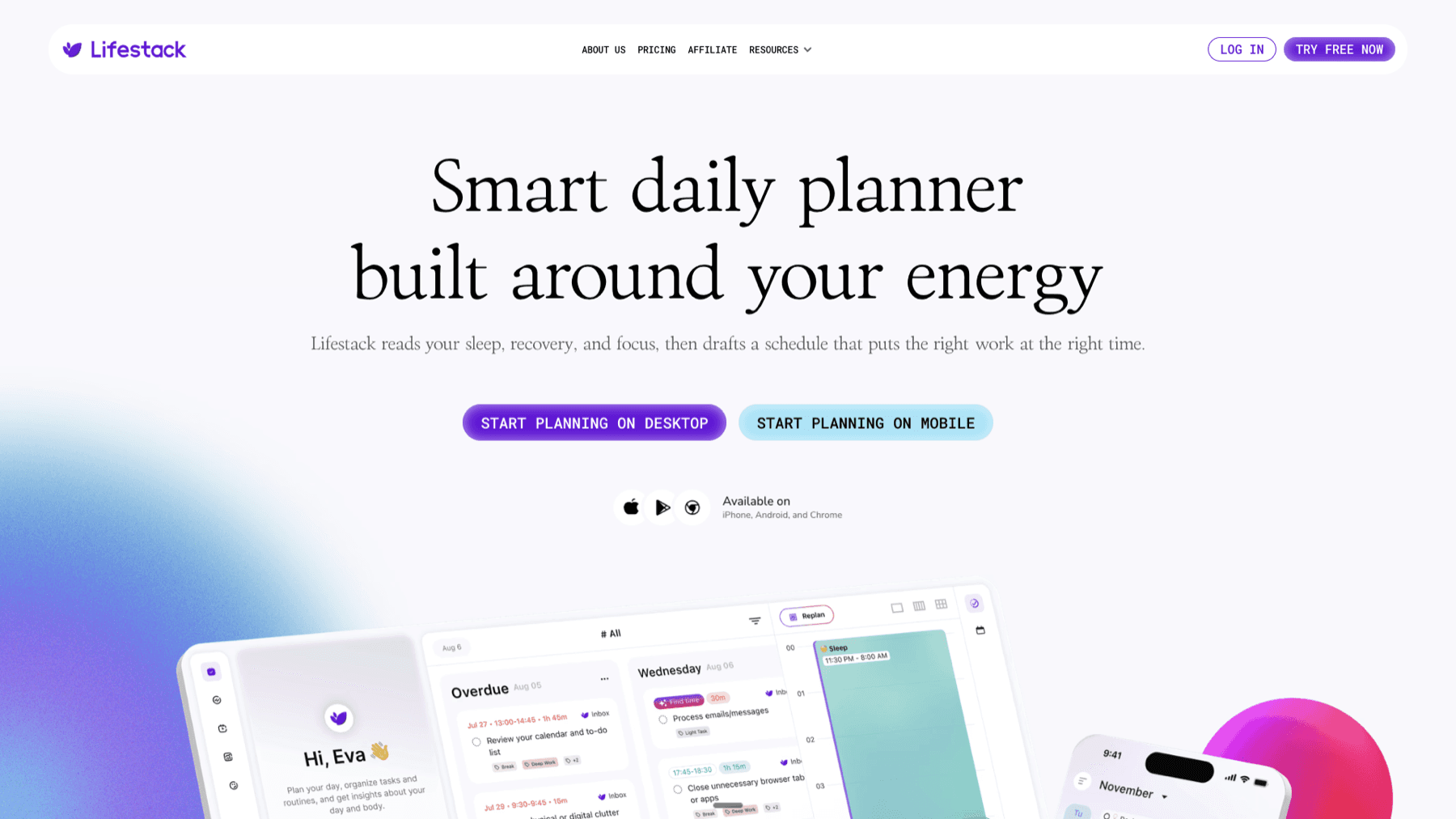
Lifestack is $7/month or $50/year, with a 7-day free trial on the annual plan. Available on iOS and Android with a Chrome extension.
Frequently Asked Questions
Does slowing down actually make you more productive?
For most knowledge workers, yes. The gains from deeper focus, better decision quality, and reduced errors typically outweigh any reduction in raw hours of work. The diminishing returns on additional hours are well documented, particularly for creative and complex cognitive tasks.
What is the best way to start slowing down?
Pick one change rather than overhauling everything at once. The highest-impact starting point for most people is protecting a 60-90 minute block each day for single-tasking on their most important work, with notifications off. This alone tends to produce noticeable gains in both output quality and subjective sense of control.
How do I slow down when my job is inherently reactive?
Reactive jobs require accepting that some interruption is unavoidable. The goal is to create protected windows, however short, where you are not reactive. Even 45 minutes of uninterrupted time in the morning, before email is opened, can shift the quality of a day's work. Sustainable productivity in reactive roles is about managing the ratio of deep to shallow work, not eliminating reactivity.
Is slowing down the same as lazy thinking?
No. Lazy thinking is the absence of thinking. Slowing down is the deliberate creation of conditions where thinking can be sustained and deep rather than shallow and fragmented. They produce opposite results: slowing down generally increases the quality and originality of output.
How does slowing down relate to burnout?
Burnout is the endpoint of sustained output without sufficient recovery. Slowing down, particularly through rest, transitions, and brain clearing practices, builds recovery into the work cycle rather than deferring it until after a crash. It is both a prevention strategy and an early-stage treatment.
There is a version of slowing down that looks like procrastination. And there is a version that is the most strategic thing a high-performer can do. The difference is intention. Slowing down on purpose, at the right moments and in the right ways, does not reduce output. It tends to increase it.
The case for constant acceleration has a compelling surface logic: more hours worked means more accomplished, more speed means faster results, more tasks means more done. But this breaks down in practice. Cognitive research consistently shows that sustained high-output work requires deliberate recovery. Attention is not infinite. Decision quality degrades with fatigue. Creative thinking nearly disappears when the nervous system is in a chronic state of urgency.
Slowing down is not a break from productivity. It is a mechanism of it. The strategies below are not about working less in absolute terms. They are about removing the friction, distraction, and depletion that make effort less effective than it could be.
Key Takeaways
Sustained high performance requires deliberate recovery, not continuous acceleration
Slowing down works best when it is structured: specific rituals at specific points in your day or week
Matching task type to your actual energy level produces better output than pushing through at full speed regardless of readiness
1. Do One Thing at a Time
Multitasking is not a productivity strategy. It is context switching disguised as efficiency. Research on context switching shows that each switch between tasks carries a recovery cost, a period where the brain is partially still processing the previous task. For complex cognitive work, these switching costs add up to meaningful output loss across a day.
Slowing down to do one thing at a time feels slower in the moment. It rarely is. Single-tasking, especially on complex or creative work, tends to produce better results in less total time than the same work split across multiple threads.
The practical application: set a clear next action before you start working, close everything unrelated to that action, and work on it until it's done or until you've reached a natural stopping point. This is not complicated. It just requires resisting the reflex to switch when something else catches your attention.
2. Build Transitions Between Tasks
Moving immediately from one task to the next, with no gap, carries the cognitive state of the previous task into the new one. The frustration from a difficult call bleeds into the analysis work that follows. The half-finished thought from writing stays active while you're supposed to be listening in a meeting.
A transition is any brief ritual that closes one mode of thinking before opening another. It might be two minutes of walking, a brief note capturing where you left off, or simply closing all the tabs from the previous task before opening new ones. The content of the transition matters less than the act of consciously separating one context from the next.
Cal Newport's argument in Slow Productivity makes a related point: working at a natural pace, with appropriate pauses, tends to produce better output over long time horizons than sprint-and-crash cycles. Transitions are how you implement that at the micro level.
3. Take Breaks That Actually Restore
Not all breaks are equal. Scrolling social media between tasks occupies the default mode network in your brain, which is the same network responsible for creative synthesis and insight. A break that keeps that network busy isn't restorative. Neither is a break where you're mentally reviewing your task list or replaying a difficult conversation.
Breaks that restore tend to be low-stimulus and unstructured: a short walk without a podcast, looking out a window, a few minutes with nothing in your hands. NSDR (Non-Sleep Deep Rest) is a structured version of this, combining relaxed breathing with body-scan attention for 10-20 minutes. It measurably reduces cortisol and subjective fatigue.
The Pomodoro Technique builds scheduled breaks into work intervals, which is useful if you tend to push through until you crash. The specific timing matters less than the habit of stopping before you need to.
4. Protect Your Highest-Energy Hours
Most people have a predictable peak window of 2-4 hours where their focus is sharpest, their thinking is clearest, and difficult work feels most manageable. Filling that window with meetings, email, and administrative tasks is one of the most common and costly scheduling mistakes.
Personal energy management starts with identifying when your peak hours occur and protecting them for work that actually requires them. Deep thinking, creative work, complex decisions, and anything requiring sustained concentration belongs in peak hours. Everything else can happen in the hours around them.
This is slowing down in the sense of being selective rather than reactive. You are choosing not to fill every available moment with whatever comes in, in favor of protecting time for the work that matters most.
5. Do a Weekly Review
A weekly review is 20-30 minutes, once a week, to close open loops, update your task list, and decide what actually matters in the coming week. This is the practice most likely to reduce the frantic, reactive quality of work that makes everything feel urgent.
The reason it works: most anxiety about productivity comes from an incomplete capture system. Things that haven't been written down live in working memory, which means some part of your attention is always monitoring them. A regular review clears those open loops and lets your brain stop tracking what doesn't need to be tracked. The weekly review is one of the highest-value slow-down practices available.
During the review: capture anything unfinished from the previous week, review your calendar for the coming week, and identify the three to five things that would make the week a success if they got done. Then structure your schedule around those, rather than building the schedule and hoping the important work fits.
6. Disconnect to Think
Constant connectivity is incompatible with the kind of slow, associative thinking that generates original ideas. The interruption doesn't have to be received to be disruptive. Knowing a notification might arrive is enough to keep part of your attention on alert.
Deliberately disconnecting, even for short periods, restores the conditions for genuine thinking. The research on deep focus is clear: uninterrupted work produces qualitatively different (and better) output than the same hours filled with micro-interruptions. This applies to knowledge work, creative work, and strategic thinking.
A simple implementation: one period per day, ideally during your peak hours, where notifications are off, the browser is closed to everything except the task, and you work without checking anything. Start with 60 minutes if 90 feels like too much. The objective is to create conditions where your thinking can deepen rather than staying shallow and reactive.
7. Match Your Schedule to Your Energy
The most sustainable version of slowing down is not a mindset shift or a one-time ritual. It is a system that automatically adjusts your schedule based on your actual readiness rather than assuming you perform identically every day.
Your energy level varies based on sleep quality, recovery, exercise, stress, and dozens of other factors. An energy calendar that adapts to those fluctuations lets you do demanding work when you're genuinely equipped to do it well, and lighter work when you're not. This reduces the grind of pushing through at low capacity, which is both inefficient and depleting.
Lifestack reads sleep and recovery data from wearables like Oura Ring, Apple Watch, Garmin, and WHOOP, then automatically schedules your tasks according to your energy patterns. On a high-recovery day, focus blocks land during your actual cognitive peak. On a low-recovery day, the schedule adjusts rather than demanding the same output. This is the practical implementation of slowing down: not doing less overall, but doing the right things at the right times.
Lifestack is $7/month or $50/year, with a 7-day free trial on the annual plan. Available on iOS and Android with a Chrome extension.
Frequently Asked Questions
Does slowing down actually make you more productive?
For most knowledge workers, yes. The gains from deeper focus, better decision quality, and reduced errors typically outweigh any reduction in raw hours of work. The diminishing returns on additional hours are well documented, particularly for creative and complex cognitive tasks.
What is the best way to start slowing down?
Pick one change rather than overhauling everything at once. The highest-impact starting point for most people is protecting a 60-90 minute block each day for single-tasking on their most important work, with notifications off. This alone tends to produce noticeable gains in both output quality and subjective sense of control.
How do I slow down when my job is inherently reactive?
Reactive jobs require accepting that some interruption is unavoidable. The goal is to create protected windows, however short, where you are not reactive. Even 45 minutes of uninterrupted time in the morning, before email is opened, can shift the quality of a day's work. Sustainable productivity in reactive roles is about managing the ratio of deep to shallow work, not eliminating reactivity.
Is slowing down the same as lazy thinking?
No. Lazy thinking is the absence of thinking. Slowing down is the deliberate creation of conditions where thinking can be sustained and deep rather than shallow and fragmented. They produce opposite results: slowing down generally increases the quality and originality of output.
How does slowing down relate to burnout?
Burnout is the endpoint of sustained output without sufficient recovery. Slowing down, particularly through rest, transitions, and brain clearing practices, builds recovery into the work cycle rather than deferring it until after a crash. It is both a prevention strategy and an early-stage treatment.



FOLLOW ON
FOLLOW ON
FOLLOW ON


Copyright 2026 © Lifestack. All rights reserved
Copyright 2026 © Lifestack. All rights reserved

