
Tips
Stop Putting Things Off: 7 Practical Strategies
Stop Putting Things Off: 7 Practical Strategies

Putting things off feels like a choice. In the moment, it rarely feels like avoidance. There is something else to check first, a better time coming up, a reason to wait until you are more ready. Then the deadline arrives and you are sprinting.
Most advice about procrastination treats it as a discipline problem: you need more willpower, better habits, stricter deadlines. But research on why people put things off tells a different story. Procrastination is primarily an emotional regulation problem, not a time management one. You are not avoiding the task; you are avoiding how the task makes you feel.
That distinction changes what actually works. This guide covers seven practical strategies that address the real reasons people delay, not the surface-level symptoms. If you have ever wondered why you cannot focus even when you genuinely want to, the answer is often here.
Key Takeaways
Procrastination is an emotional response to anxiety, boredom, or uncertainty, not a character flaw
The most effective strategies reduce friction and remove the need for willpower, rather than demanding more of it
Matching tasks to your actual energy state is more reliable than forcing productivity at arbitrary times
Why We Keep Putting Things Off
Understanding what happens when you procrastinate makes it easier to intervene. Most tasks get put off for one of three reasons: the task feels unclear (you do not know how to start), the task feels unpleasant (it is boring, difficult, or anxiety-provoking), or you are waiting for the right feeling to arrive before beginning.
The third pattern is the trap most people do not recognize. Motivation follows action; it does not precede it. Waiting until you feel ready guarantees you will keep waiting.
Research by Dr. Timothy Pychyl at Carleton University found that procrastination is not primarily about saving time. People put things off to save themselves from negative emotions in the short term. The work feels uncomfortable, so the brain files it under "later." Knowing that is happening lets you work around it instead of blaming yourself for it.
1. Start Smaller Than You Think
The most reliable way to break the procrastination cycle is to make the starting action laughably small. Not "write the report" but "open the document." Not "work out" but "put on running shoes." The goal is to shrink the distance between intention and action to almost nothing.
The two-minute rule captures this at its simplest: if starting a task takes less than two minutes, do it now. The deeper principle applies to bigger tasks as well. If you are putting something off, the starting action is probably still too large. Break it down until the first step feels almost too easy to skip.
Once you are moving, inertia takes over. The resistance to starting is almost always larger than the resistance to continuing.
2. Match Tasks to Your Energy State
One of the most underrated reasons people put things off is that they are trying to do the wrong kind of work at the wrong time. Scheduling a deep analytical task for 4pm on a Friday is asking for procrastination, not testing willpower.
Cognitive capacity genuinely fluctuates throughout the day. Personal energy management research shows most people have two to three hours of peak cognitive performance per day, usually in the morning, and that demanding creative or analytical work outside those windows produces more avoidance, more errors, and worse output.
Shifting from a "when is this due?" scheduling model to a "when am I actually capable of this?" model addresses procrastination at its source. That is the premise behind energy-based planning, and the difference it makes is more significant than most productivity advice acknowledges.
3. Use Time Pressure, Not Willpower
Parkinson's Law: work expands to fill the time available. The inverse is useful too: give a task less time and it often gets done faster. Artificial time pressure creates focus that open-ended to-do lists never produce.
The Pomodoro technique works exactly on this principle: 25 minutes of focused work, then a short break. The time limit lowers the psychological cost of starting ("I only have to do this for 25 minutes") and creates a natural stopping point. For tasks you are dreading, knowing there is an end point makes starting far easier than staring at an open block of "work time."
A visible countdown timer on your desk reinforces this. The physicality of a ticking clock makes the time constraint feel real in a way that calendar blocks do not.
4. Design Your Environment to Remove Friction
The environment you work in either supports or fights your intention to start. Notifications, open browser tabs, a cluttered desk, and a phone face-up within reach all create small friction points that compound into avoidance.
The design principle is simple: make the thing you should do the easiest thing to do. This means closing every tab unrelated to the current task before you sit down, keeping your workspace clear of competing stimuli, and using tools that block distractions rather than asking you to resist them through will alone.
If stopping to do something else takes less effort than continuing the task at hand, your environment is working against you. That is a setup problem, not a discipline problem.
5. Make the Next Action Crystal Clear
Vague tasks are almost impossible to start. "Finish project" sits on a list for weeks. "Write the executive summary, first draft, three paragraphs" gets done.
Every item on your to-do list should be a specific physical step you can take in a single sitting. If you cannot describe the task in those terms, you need to clarify it before you can do it. "Plan the event" is not an action. "Email venue to confirm capacity" is.
When you sit down to work, knowing exactly what you are doing eliminates the "I do not know where to start" stall that sends people to their inbox, their phone, or anywhere else instead.
6. Separate the Unpleasant from the Impossible
A lot of procrastination is a signal about the task, not about you. If you keep avoiding one particular thing, ask which category it falls into: is it unpleasant (you know how to do it but you dislike doing it), or is it genuinely unclear (you are not sure what doing it correctly even looks like)?
Unpleasant tasks respond well to time pressure, environmental design, and pairing (doing them alongside something that feels good, like music or a good coffee). Unclear tasks need clarification first: breaking them down, asking a question, or doing a small exploratory step before the real work begins.
Treating an unclear task as an unpleasant one (by pushing harder) usually backfires. The right intervention depends on the right diagnosis.
7. Build a Weekly Review Habit
Procrastination often accumulates not because any single task is too hard, but because the overall picture is murky. You carry a vague sense of things being avoided without a clear inventory of what they are or why they keep getting pushed.
A short weekly review (20 to 30 minutes at the end of each week) clears that fog. You process anything that did not get done, decide whether to reschedule or drop it, and set up the coming week so Monday has a clear starting point instead of a blank page and ambient dread.
The review habit also surfaces patterns. If the same item keeps rolling over, that is a signal: the task is unclear, unduly unpleasant, or genuinely lower priority than you believe it is. Each of those has a different fix.
Best Tool for Stopping Procrastination
Most procrastination apps focus on blocking distractions or tracking time. Those are useful in isolation, but they do not address the energy-mismatch problem that drives a large portion of everyday avoidance.
Lifestack approaches it differently. It reads your sleep data, HRV, and energy patterns from wearables, then schedules your tasks for times in your day when you are actually capable of focused work. Instead of putting "write report" on Thursday at 3pm because a slot is open, Lifestack knows your energy state at 3pm and schedules cognitively demanding work for when you are sharp.
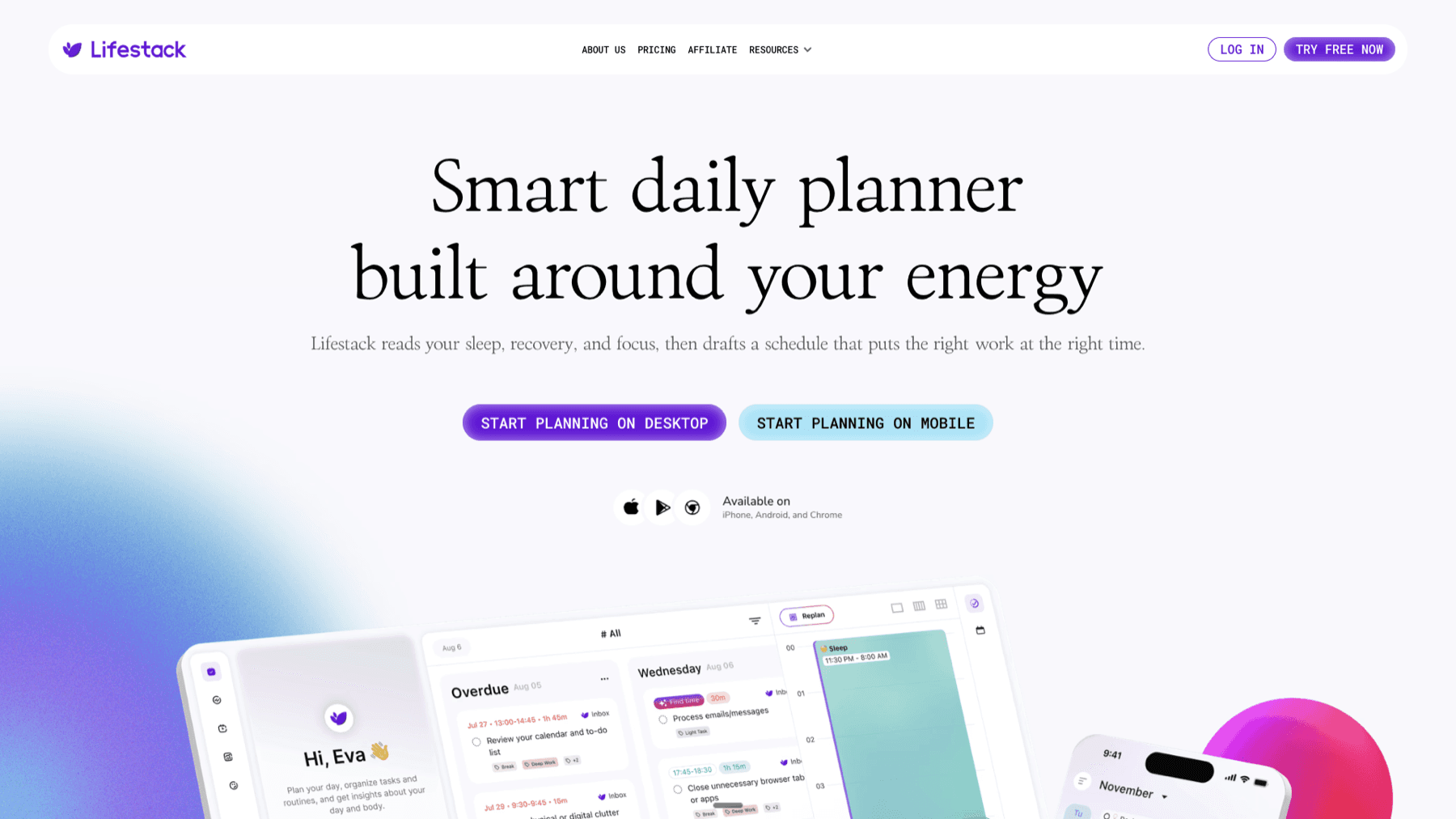
For people who find themselves consistently struggling to stay on task at certain times of day, the issue is often scheduling rather than willpower. Lifestack addresses that without requiring you to track your own patterns manually or redesign your entire system from scratch.
Lifestack costs $7/month or $50/year and is available on iOS, Android, and as a Chrome extension.
Frequently Asked Questions
Why do I keep putting things off even when I want to do them?
Even when you genuinely intend to do something, procrastination can follow if the task feels unclear, unpleasant, or anxiety-provoking. Your brain defaults to short-term emotional relief over long-term goals. Identifying which of those three is driving the delay is the first step to working around it.
What is the fastest way to stop putting things off?
Making the starting action as small as possible is the quickest lever. Instead of "do the task," identify the smallest possible first step and do only that. Starting is the hardest part. Once you are in motion, continuing is far easier than stopping.
Does putting things off mean I am lazy?
No. Research consistently shows that procrastination is primarily an emotional regulation strategy, not a sign of laziness or low motivation. High-achieving, highly motivated people procrastinate regularly. The difference is usually task clarity and emotional association, not work ethic.
How do I stop putting things off at work?
The most practical steps: break every task into a specific next action, block focus time and protect it from meetings, and align your most demanding work with your natural peak energy hours. If you are consistently avoiding one type of work, check whether the task is specific enough to start.
Does it get easier to stop putting things off over time?
Yes, particularly if you address environment and scheduling factors rather than relying on willpower. Building consistent starting rituals (same time, same place, same signal) reduces the friction of beginning. Over time, starting becomes less of a decision and more of a default behavior.
Can apps really help with procrastination?
Some do, in specific ways. Distraction blockers reduce environmental friction. Time-tracking tools create accountability. Energy-aware schedulers like Lifestack tackle the scheduling mismatch that drives a lot of avoidance. No app removes the need to start, but the right one makes starting considerably less effortful.
Putting things off feels like a choice. In the moment, it rarely feels like avoidance. There is something else to check first, a better time coming up, a reason to wait until you are more ready. Then the deadline arrives and you are sprinting.
Most advice about procrastination treats it as a discipline problem: you need more willpower, better habits, stricter deadlines. But research on why people put things off tells a different story. Procrastination is primarily an emotional regulation problem, not a time management one. You are not avoiding the task; you are avoiding how the task makes you feel.
That distinction changes what actually works. This guide covers seven practical strategies that address the real reasons people delay, not the surface-level symptoms. If you have ever wondered why you cannot focus even when you genuinely want to, the answer is often here.
Key Takeaways
Procrastination is an emotional response to anxiety, boredom, or uncertainty, not a character flaw
The most effective strategies reduce friction and remove the need for willpower, rather than demanding more of it
Matching tasks to your actual energy state is more reliable than forcing productivity at arbitrary times
Why We Keep Putting Things Off
Understanding what happens when you procrastinate makes it easier to intervene. Most tasks get put off for one of three reasons: the task feels unclear (you do not know how to start), the task feels unpleasant (it is boring, difficult, or anxiety-provoking), or you are waiting for the right feeling to arrive before beginning.
The third pattern is the trap most people do not recognize. Motivation follows action; it does not precede it. Waiting until you feel ready guarantees you will keep waiting.
Research by Dr. Timothy Pychyl at Carleton University found that procrastination is not primarily about saving time. People put things off to save themselves from negative emotions in the short term. The work feels uncomfortable, so the brain files it under "later." Knowing that is happening lets you work around it instead of blaming yourself for it.
1. Start Smaller Than You Think
The most reliable way to break the procrastination cycle is to make the starting action laughably small. Not "write the report" but "open the document." Not "work out" but "put on running shoes." The goal is to shrink the distance between intention and action to almost nothing.
The two-minute rule captures this at its simplest: if starting a task takes less than two minutes, do it now. The deeper principle applies to bigger tasks as well. If you are putting something off, the starting action is probably still too large. Break it down until the first step feels almost too easy to skip.
Once you are moving, inertia takes over. The resistance to starting is almost always larger than the resistance to continuing.
2. Match Tasks to Your Energy State
One of the most underrated reasons people put things off is that they are trying to do the wrong kind of work at the wrong time. Scheduling a deep analytical task for 4pm on a Friday is asking for procrastination, not testing willpower.
Cognitive capacity genuinely fluctuates throughout the day. Personal energy management research shows most people have two to three hours of peak cognitive performance per day, usually in the morning, and that demanding creative or analytical work outside those windows produces more avoidance, more errors, and worse output.
Shifting from a "when is this due?" scheduling model to a "when am I actually capable of this?" model addresses procrastination at its source. That is the premise behind energy-based planning, and the difference it makes is more significant than most productivity advice acknowledges.
3. Use Time Pressure, Not Willpower
Parkinson's Law: work expands to fill the time available. The inverse is useful too: give a task less time and it often gets done faster. Artificial time pressure creates focus that open-ended to-do lists never produce.
The Pomodoro technique works exactly on this principle: 25 minutes of focused work, then a short break. The time limit lowers the psychological cost of starting ("I only have to do this for 25 minutes") and creates a natural stopping point. For tasks you are dreading, knowing there is an end point makes starting far easier than staring at an open block of "work time."
A visible countdown timer on your desk reinforces this. The physicality of a ticking clock makes the time constraint feel real in a way that calendar blocks do not.
4. Design Your Environment to Remove Friction
The environment you work in either supports or fights your intention to start. Notifications, open browser tabs, a cluttered desk, and a phone face-up within reach all create small friction points that compound into avoidance.
The design principle is simple: make the thing you should do the easiest thing to do. This means closing every tab unrelated to the current task before you sit down, keeping your workspace clear of competing stimuli, and using tools that block distractions rather than asking you to resist them through will alone.
If stopping to do something else takes less effort than continuing the task at hand, your environment is working against you. That is a setup problem, not a discipline problem.
5. Make the Next Action Crystal Clear
Vague tasks are almost impossible to start. "Finish project" sits on a list for weeks. "Write the executive summary, first draft, three paragraphs" gets done.
Every item on your to-do list should be a specific physical step you can take in a single sitting. If you cannot describe the task in those terms, you need to clarify it before you can do it. "Plan the event" is not an action. "Email venue to confirm capacity" is.
When you sit down to work, knowing exactly what you are doing eliminates the "I do not know where to start" stall that sends people to their inbox, their phone, or anywhere else instead.
6. Separate the Unpleasant from the Impossible
A lot of procrastination is a signal about the task, not about you. If you keep avoiding one particular thing, ask which category it falls into: is it unpleasant (you know how to do it but you dislike doing it), or is it genuinely unclear (you are not sure what doing it correctly even looks like)?
Unpleasant tasks respond well to time pressure, environmental design, and pairing (doing them alongside something that feels good, like music or a good coffee). Unclear tasks need clarification first: breaking them down, asking a question, or doing a small exploratory step before the real work begins.
Treating an unclear task as an unpleasant one (by pushing harder) usually backfires. The right intervention depends on the right diagnosis.
7. Build a Weekly Review Habit
Procrastination often accumulates not because any single task is too hard, but because the overall picture is murky. You carry a vague sense of things being avoided without a clear inventory of what they are or why they keep getting pushed.
A short weekly review (20 to 30 minutes at the end of each week) clears that fog. You process anything that did not get done, decide whether to reschedule or drop it, and set up the coming week so Monday has a clear starting point instead of a blank page and ambient dread.
The review habit also surfaces patterns. If the same item keeps rolling over, that is a signal: the task is unclear, unduly unpleasant, or genuinely lower priority than you believe it is. Each of those has a different fix.
Best Tool for Stopping Procrastination
Most procrastination apps focus on blocking distractions or tracking time. Those are useful in isolation, but they do not address the energy-mismatch problem that drives a large portion of everyday avoidance.
Lifestack approaches it differently. It reads your sleep data, HRV, and energy patterns from wearables, then schedules your tasks for times in your day when you are actually capable of focused work. Instead of putting "write report" on Thursday at 3pm because a slot is open, Lifestack knows your energy state at 3pm and schedules cognitively demanding work for when you are sharp.
For people who find themselves consistently struggling to stay on task at certain times of day, the issue is often scheduling rather than willpower. Lifestack addresses that without requiring you to track your own patterns manually or redesign your entire system from scratch.
Lifestack costs $7/month or $50/year and is available on iOS, Android, and as a Chrome extension.
Frequently Asked Questions
Why do I keep putting things off even when I want to do them?
Even when you genuinely intend to do something, procrastination can follow if the task feels unclear, unpleasant, or anxiety-provoking. Your brain defaults to short-term emotional relief over long-term goals. Identifying which of those three is driving the delay is the first step to working around it.
What is the fastest way to stop putting things off?
Making the starting action as small as possible is the quickest lever. Instead of "do the task," identify the smallest possible first step and do only that. Starting is the hardest part. Once you are in motion, continuing is far easier than stopping.
Does putting things off mean I am lazy?
No. Research consistently shows that procrastination is primarily an emotional regulation strategy, not a sign of laziness or low motivation. High-achieving, highly motivated people procrastinate regularly. The difference is usually task clarity and emotional association, not work ethic.
How do I stop putting things off at work?
The most practical steps: break every task into a specific next action, block focus time and protect it from meetings, and align your most demanding work with your natural peak energy hours. If you are consistently avoiding one type of work, check whether the task is specific enough to start.
Does it get easier to stop putting things off over time?
Yes, particularly if you address environment and scheduling factors rather than relying on willpower. Building consistent starting rituals (same time, same place, same signal) reduces the friction of beginning. Over time, starting becomes less of a decision and more of a default behavior.
Can apps really help with procrastination?
Some do, in specific ways. Distraction blockers reduce environmental friction. Time-tracking tools create accountability. Energy-aware schedulers like Lifestack tackle the scheduling mismatch that drives a lot of avoidance. No app removes the need to start, but the right one makes starting considerably less effortful.



FOLLOW ON
FOLLOW ON
FOLLOW ON


Copyright 2026 © Lifestack. All rights reserved
Copyright 2026 © Lifestack. All rights reserved

