
Tips
ADHD Food Hacks: 8 Tips for Eating Better
ADHD Food Hacks: 8 Tips for Eating Better

Food is one of the most reliably difficult parts of daily life with ADHD. It's not a willpower problem. It's not laziness. The specific executive function demands of meal planning touch almost every area where ADHD creates friction: initiating tasks, making decisions under uncertainty, managing time across a day, and following through on intentions when your attention has moved somewhere else entirely.
Most meal planning advice assumes a neurotypical starting point. Plan for the week on Sunday. Follow a grocery list. Cook three nights a week. For brains that struggle with task initiation and decision fatigue, this kind of system collapses the moment real life creates friction. The plan that worked last week stops working when one thing goes differently.
These eight ADHD food hacks aren't about willpower or discipline. They're about designing your food environment and schedule to work with how your brain actually operates. Some of them require a bit of setup. All of them are designed to reduce the moment-to-moment cognitive cost of eating.
Key Takeaways
The biggest ADHD food challenge isn't nutrition knowledge. It's decision fatigue and task initiation at the moment when you need to eat but lack the mental resources to figure out what or how.
Reduce friction at the point of need rather than front-loading decisions at meal planning time. The easier a good option is to access, the more likely it gets chosen.
Food hyperfixation is a real ADHD pattern. Working with it rather than against it is usually more sustainable than forcing variety.
1. Build a Burnout Box for Zero-Decision Meals
Designate one shelf in your pantry (or a section of your fridge) as the burnout box. Stock it exclusively with foods you genuinely like that require no decision-making to prepare. Protein shakes, tuna packets, peanut butter, rice cakes, pre-portioned nuts, instant oats, canned soup. The criterion isn't nutritional perfection. It's that you will actually eat it when your brain is completely depleted.
The burnout box solves a specific problem: the gap between "I need to eat" and "I cannot figure out what to eat or cook right now." Without a dedicated fallback, that gap often ends in skipping meals or making poor impulse decisions. The box removes the decision entirely.
Restock it as part of grocery shopping rather than when you realize it's empty. Empty burnout boxes fail at exactly the moments they're needed most.
2. Batch Cook on Your Highest-Energy Days
Cooking when you're depleted is one of the hardest things to do with ADHD. Cooking when you have energy is actually enjoyable. The insight is to stop treating cooking as a daily obligation and start treating it as a task with an optimal energy window.
Identify your one or two highest-energy days of the week (usually correlates with good sleep and lower task load). On those days, batch cook. Double a recipe. Make a big pot of grain. Roast a tray of vegetables. Cook a protein in bulk. The food is available for three to four days without requiring any decision-making or initiation at meal time.
This is the same principle behind batching for low-energy productivity applied to food. Matching the demanding task (cooking) to the high-energy window, and then benefiting on all the lower-energy days that follow.
3. Prioritize Visibility Over Organization
Out of sight is genuinely out of mind for ADHD brains. The standard organizational advice of putting things away neatly in containers behind cabinet doors is exactly backwards for how ADHD food management works.
Put food in clear containers at eye level. Keep fruit on the counter, not in the crisper drawer. Leave the peanut butter on the counter. If you use a fridge, position the healthy defaults at the front of the top shelf where they're seen immediately when the door opens. The goal is that the easy, good option is literally the first thing you see.
This also applies to the freezer. Labeling frozen batch-cooked meals with masking tape and a marker (name + date) takes 30 seconds and dramatically increases the likelihood of using them. Unlabeled mystery containers get ignored.
4. Use a Three-Part Meal Formula
One of the reasons meal planning fails for ADHD is that open-ended questions like "what should I have for lunch?" require too much cognitive overhead. A simple formula removes that overhead without requiring you to follow a strict meal plan.
The three-part formula: choose one protein, one carbohydrate, and one vegetable. That's the decision tree. Chicken, rice, broccoli. Eggs, toast, tomatoes. Tuna, crackers, cucumber. You're not choosing from an infinite menu. You're choosing within a constraint that makes the decision much faster.
For people who do better with even less structure, reduce it to two parts: protein and whatever is most visible. The goal is getting a nutritionally functional meal without burning cognitive resources on the decision itself.
5. Work With Food Hyperfixation, Not Against It
Many ADHD adults go through phases of eating the same meal repeatedly for days or weeks. This is a known pattern tied to hyperfocus and dopamine-seeking behavior. The standard advice ("eat more variety") often creates shame without changing the behavior.
A more practical approach: when you're in a food hyperfixation phase, optimize what you're eating rather than fighting what you want. If you're going to eat the same thing every day for three weeks, make it a version that includes a protein, a vegetable, and a carbohydrate. Add a vitamin if you're genuinely concerned about micronutrients. The phase will pass.
Fighting food hyperfixation tends to result in avoiding eating altogether when the fixation food isn't available. That outcome is worse than the nutritional imperfection of eating the same meal repeatedly.
6. Reduce Grocery Decision Fatigue
Grocery shopping is a major executive function load. You're navigating a complex environment, making dozens of sequential decisions, managing a list, and often doing it when energy is already low. A few ADHD-specific adjustments make a significant difference.
Keep a running grocery list that accumulates throughout the week rather than composing it from scratch before each trip. Voice-to-text works well for this ("add pasta to shopping list") and removes the barrier of needing to remember to write things down. A brain dump approach before shopping helps: spend two minutes writing everything you might possibly need before filtering down to what you actually need.
Order the same core staples every week without reconsidering them. Eggs, milk, protein of choice, core vegetables. These are automatic purchases that don't require decision energy. Only deliberate choices go on the variable list.
7. Schedule Eating Like Any Other Appointment
ADHD brains are notoriously bad at internal hunger signaling. Time blindness and hyperfocus mean meals get skipped not because you chose to skip them, but because you simply didn't notice several hours had passed. You look up at 3pm and realize you haven't eaten since breakfast.
Scheduled meal reminders solve this. The key is making them hard to ignore and pre-decided. "Eat lunch at 12:30" with a notification is more effective than a vague intention to eat when hungry. Pair the reminder with a default option from your burnout box and the decision is already made by the time the reminder fires.
Lifestack is useful here because it can schedule eating reminders in the context of your actual day rather than at fixed times regardless of what's happening. If your calendar shows back-to-back meetings from 12 to 2, it will suggest moving your lunch reminder to 11:45 rather than firing at noon when you're mid-meeting. The scheduling adapts to your energy patterns and existing commitments.
Best Tool for ADHD Meal Planning
For ADHD productivity, the best tools are the ones that reduce decision overhead rather than adding more structure to manage. Lifestack takes your existing calendar and task list and builds a daily schedule around your energy state, fitting low-decision tasks into low-energy windows and protecting high-focus time for demanding work.
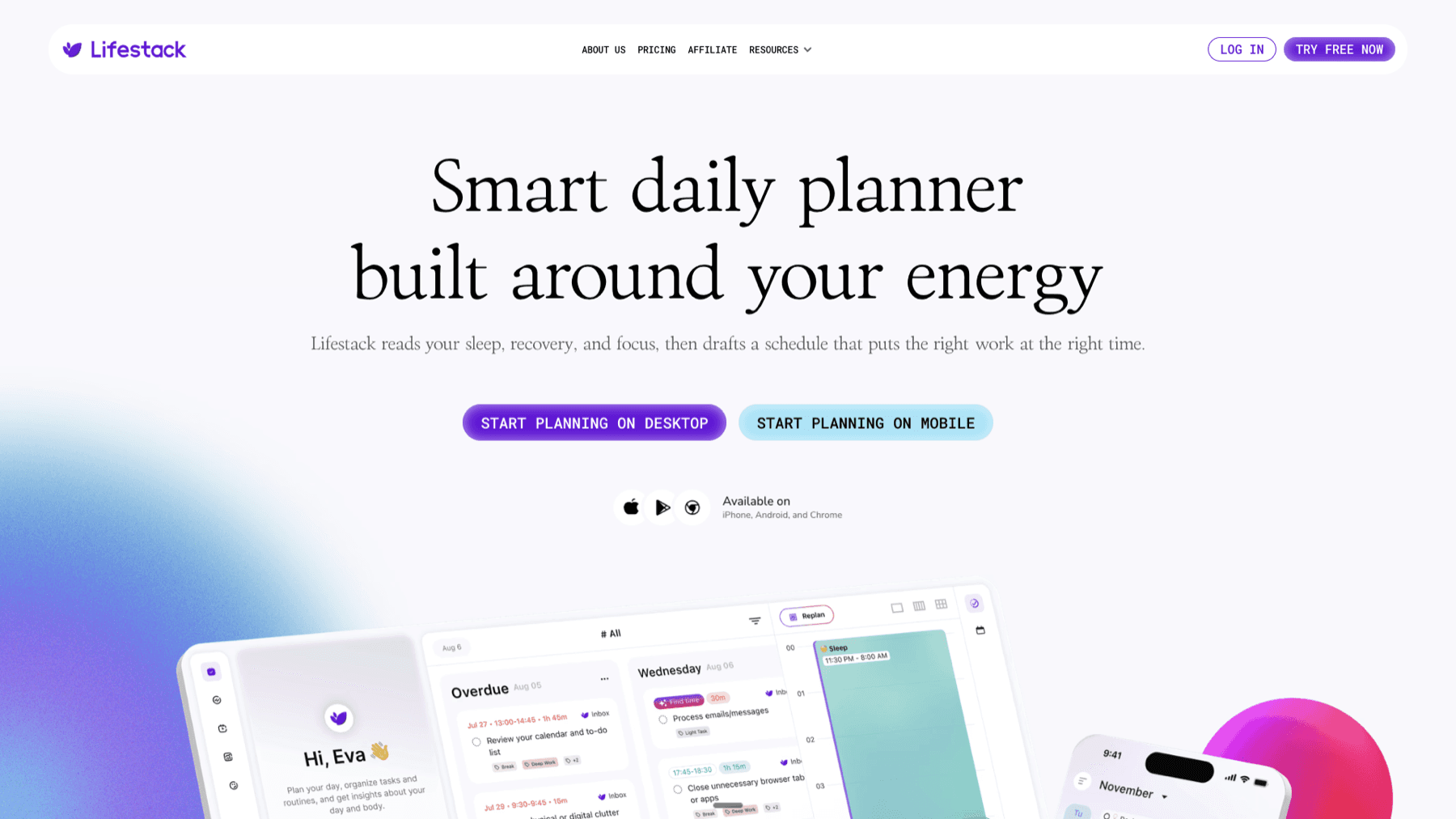
For eating specifically, you can add meals and eating breaks as recurring tasks that Lifestack slots into your day intelligently. On days when your health data shows lower energy (poor sleep, high recovery demand), the app can surface the burnout-box mindset automatically by protecting your lower-energy blocks from being filled with demanding tasks, leaving you mental capacity to actually make food.
Lifestack costs $7/month or $50/year, with a 7-day free trial on the annual plan.
Frequently Asked Questions
Why do people with ADHD struggle with food?
ADHD creates difficulty with several of the skills required for consistent healthy eating: planning ahead, initiating tasks, managing time across a day, and making decisions when depleted. Energy management is also harder because ADHD brains often have less predictable energy patterns. These aren't character flaws. They're the practical downstream effects of executive function differences.
What should an ADHD person eat?
The basic nutritional guidance isn't different from anyone else: adequate protein, complex carbohydrates, vegetables, healthy fats, and sufficient calories. What changes is the delivery system. The foods that work best for ADHD adults are often those that are easy to prepare, easy to access, and don't require significant decision-making at the moment of eating. High-protein, low-prep foods (eggs, canned fish, Greek yogurt, nuts) are often practical defaults.
What is ADHD food hyperfixation?
Food hyperfixation is the tendency for ADHD adults to eat the same meal repeatedly for extended periods, often linked to the dopamine-seeking patterns that drive hyperfocus in other domains. The brain finds a food that delivers reliable sensory reward and returns to it repeatedly. Most people cycle through these phases over weeks or months. Working with the pattern rather than fighting it is usually more practical than forcing variety.
How do I meal plan with ADHD?
Simpler is better. A loose rotation of five to seven meals you reliably enjoy, a weekly grocery trip to keep basics stocked, and batch cooking on high-energy days covers most of the need. Avoid building complex systems that require consistent follow-through. The system that works during a hard week is the one worth keeping. If you find task paralysis stopping you from starting meal prep, break it down: open the fridge and find one ingredient. That's step one.
What snacks are good for ADHD brains?
Snacks that require no preparation and provide protein and/or fat tend to work best because they're satisfying without requiring a decision or cooking at a low-energy moment. Practical options: almonds or mixed nuts, string cheese, peanut butter packets, hard-boiled eggs kept ready in the fridge, protein bars, Greek yogurt, and fruit that requires no cutting (bananas, apples, grapes). The key is that they're pre-positioned in visible, accessible spots.
Food is one of the most reliably difficult parts of daily life with ADHD. It's not a willpower problem. It's not laziness. The specific executive function demands of meal planning touch almost every area where ADHD creates friction: initiating tasks, making decisions under uncertainty, managing time across a day, and following through on intentions when your attention has moved somewhere else entirely.
Most meal planning advice assumes a neurotypical starting point. Plan for the week on Sunday. Follow a grocery list. Cook three nights a week. For brains that struggle with task initiation and decision fatigue, this kind of system collapses the moment real life creates friction. The plan that worked last week stops working when one thing goes differently.
These eight ADHD food hacks aren't about willpower or discipline. They're about designing your food environment and schedule to work with how your brain actually operates. Some of them require a bit of setup. All of them are designed to reduce the moment-to-moment cognitive cost of eating.
Key Takeaways
The biggest ADHD food challenge isn't nutrition knowledge. It's decision fatigue and task initiation at the moment when you need to eat but lack the mental resources to figure out what or how.
Reduce friction at the point of need rather than front-loading decisions at meal planning time. The easier a good option is to access, the more likely it gets chosen.
Food hyperfixation is a real ADHD pattern. Working with it rather than against it is usually more sustainable than forcing variety.
1. Build a Burnout Box for Zero-Decision Meals
Designate one shelf in your pantry (or a section of your fridge) as the burnout box. Stock it exclusively with foods you genuinely like that require no decision-making to prepare. Protein shakes, tuna packets, peanut butter, rice cakes, pre-portioned nuts, instant oats, canned soup. The criterion isn't nutritional perfection. It's that you will actually eat it when your brain is completely depleted.
The burnout box solves a specific problem: the gap between "I need to eat" and "I cannot figure out what to eat or cook right now." Without a dedicated fallback, that gap often ends in skipping meals or making poor impulse decisions. The box removes the decision entirely.
Restock it as part of grocery shopping rather than when you realize it's empty. Empty burnout boxes fail at exactly the moments they're needed most.
2. Batch Cook on Your Highest-Energy Days
Cooking when you're depleted is one of the hardest things to do with ADHD. Cooking when you have energy is actually enjoyable. The insight is to stop treating cooking as a daily obligation and start treating it as a task with an optimal energy window.
Identify your one or two highest-energy days of the week (usually correlates with good sleep and lower task load). On those days, batch cook. Double a recipe. Make a big pot of grain. Roast a tray of vegetables. Cook a protein in bulk. The food is available for three to four days without requiring any decision-making or initiation at meal time.
This is the same principle behind batching for low-energy productivity applied to food. Matching the demanding task (cooking) to the high-energy window, and then benefiting on all the lower-energy days that follow.
3. Prioritize Visibility Over Organization
Out of sight is genuinely out of mind for ADHD brains. The standard organizational advice of putting things away neatly in containers behind cabinet doors is exactly backwards for how ADHD food management works.
Put food in clear containers at eye level. Keep fruit on the counter, not in the crisper drawer. Leave the peanut butter on the counter. If you use a fridge, position the healthy defaults at the front of the top shelf where they're seen immediately when the door opens. The goal is that the easy, good option is literally the first thing you see.
This also applies to the freezer. Labeling frozen batch-cooked meals with masking tape and a marker (name + date) takes 30 seconds and dramatically increases the likelihood of using them. Unlabeled mystery containers get ignored.
4. Use a Three-Part Meal Formula
One of the reasons meal planning fails for ADHD is that open-ended questions like "what should I have for lunch?" require too much cognitive overhead. A simple formula removes that overhead without requiring you to follow a strict meal plan.
The three-part formula: choose one protein, one carbohydrate, and one vegetable. That's the decision tree. Chicken, rice, broccoli. Eggs, toast, tomatoes. Tuna, crackers, cucumber. You're not choosing from an infinite menu. You're choosing within a constraint that makes the decision much faster.
For people who do better with even less structure, reduce it to two parts: protein and whatever is most visible. The goal is getting a nutritionally functional meal without burning cognitive resources on the decision itself.
5. Work With Food Hyperfixation, Not Against It
Many ADHD adults go through phases of eating the same meal repeatedly for days or weeks. This is a known pattern tied to hyperfocus and dopamine-seeking behavior. The standard advice ("eat more variety") often creates shame without changing the behavior.
A more practical approach: when you're in a food hyperfixation phase, optimize what you're eating rather than fighting what you want. If you're going to eat the same thing every day for three weeks, make it a version that includes a protein, a vegetable, and a carbohydrate. Add a vitamin if you're genuinely concerned about micronutrients. The phase will pass.
Fighting food hyperfixation tends to result in avoiding eating altogether when the fixation food isn't available. That outcome is worse than the nutritional imperfection of eating the same meal repeatedly.
6. Reduce Grocery Decision Fatigue
Grocery shopping is a major executive function load. You're navigating a complex environment, making dozens of sequential decisions, managing a list, and often doing it when energy is already low. A few ADHD-specific adjustments make a significant difference.
Keep a running grocery list that accumulates throughout the week rather than composing it from scratch before each trip. Voice-to-text works well for this ("add pasta to shopping list") and removes the barrier of needing to remember to write things down. A brain dump approach before shopping helps: spend two minutes writing everything you might possibly need before filtering down to what you actually need.
Order the same core staples every week without reconsidering them. Eggs, milk, protein of choice, core vegetables. These are automatic purchases that don't require decision energy. Only deliberate choices go on the variable list.
7. Schedule Eating Like Any Other Appointment
ADHD brains are notoriously bad at internal hunger signaling. Time blindness and hyperfocus mean meals get skipped not because you chose to skip them, but because you simply didn't notice several hours had passed. You look up at 3pm and realize you haven't eaten since breakfast.
Scheduled meal reminders solve this. The key is making them hard to ignore and pre-decided. "Eat lunch at 12:30" with a notification is more effective than a vague intention to eat when hungry. Pair the reminder with a default option from your burnout box and the decision is already made by the time the reminder fires.
Lifestack is useful here because it can schedule eating reminders in the context of your actual day rather than at fixed times regardless of what's happening. If your calendar shows back-to-back meetings from 12 to 2, it will suggest moving your lunch reminder to 11:45 rather than firing at noon when you're mid-meeting. The scheduling adapts to your energy patterns and existing commitments.
Best Tool for ADHD Meal Planning
For ADHD productivity, the best tools are the ones that reduce decision overhead rather than adding more structure to manage. Lifestack takes your existing calendar and task list and builds a daily schedule around your energy state, fitting low-decision tasks into low-energy windows and protecting high-focus time for demanding work.
For eating specifically, you can add meals and eating breaks as recurring tasks that Lifestack slots into your day intelligently. On days when your health data shows lower energy (poor sleep, high recovery demand), the app can surface the burnout-box mindset automatically by protecting your lower-energy blocks from being filled with demanding tasks, leaving you mental capacity to actually make food.
Lifestack costs $7/month or $50/year, with a 7-day free trial on the annual plan.
Frequently Asked Questions
Why do people with ADHD struggle with food?
ADHD creates difficulty with several of the skills required for consistent healthy eating: planning ahead, initiating tasks, managing time across a day, and making decisions when depleted. Energy management is also harder because ADHD brains often have less predictable energy patterns. These aren't character flaws. They're the practical downstream effects of executive function differences.
What should an ADHD person eat?
The basic nutritional guidance isn't different from anyone else: adequate protein, complex carbohydrates, vegetables, healthy fats, and sufficient calories. What changes is the delivery system. The foods that work best for ADHD adults are often those that are easy to prepare, easy to access, and don't require significant decision-making at the moment of eating. High-protein, low-prep foods (eggs, canned fish, Greek yogurt, nuts) are often practical defaults.
What is ADHD food hyperfixation?
Food hyperfixation is the tendency for ADHD adults to eat the same meal repeatedly for extended periods, often linked to the dopamine-seeking patterns that drive hyperfocus in other domains. The brain finds a food that delivers reliable sensory reward and returns to it repeatedly. Most people cycle through these phases over weeks or months. Working with the pattern rather than fighting it is usually more practical than forcing variety.
How do I meal plan with ADHD?
Simpler is better. A loose rotation of five to seven meals you reliably enjoy, a weekly grocery trip to keep basics stocked, and batch cooking on high-energy days covers most of the need. Avoid building complex systems that require consistent follow-through. The system that works during a hard week is the one worth keeping. If you find task paralysis stopping you from starting meal prep, break it down: open the fridge and find one ingredient. That's step one.
What snacks are good for ADHD brains?
Snacks that require no preparation and provide protein and/or fat tend to work best because they're satisfying without requiring a decision or cooking at a low-energy moment. Practical options: almonds or mixed nuts, string cheese, peanut butter packets, hard-boiled eggs kept ready in the fridge, protein bars, Greek yogurt, and fruit that requires no cutting (bananas, apples, grapes). The key is that they're pre-positioned in visible, accessible spots.



FOLLOW ON
FOLLOW ON
FOLLOW ON


Copyright 2026 © Lifestack. All rights reserved
Copyright 2026 © Lifestack. All rights reserved

