
Device
COROS Pace 3 Review: Is It Worth It?
COROS Pace 3 Review: Is It Worth It?

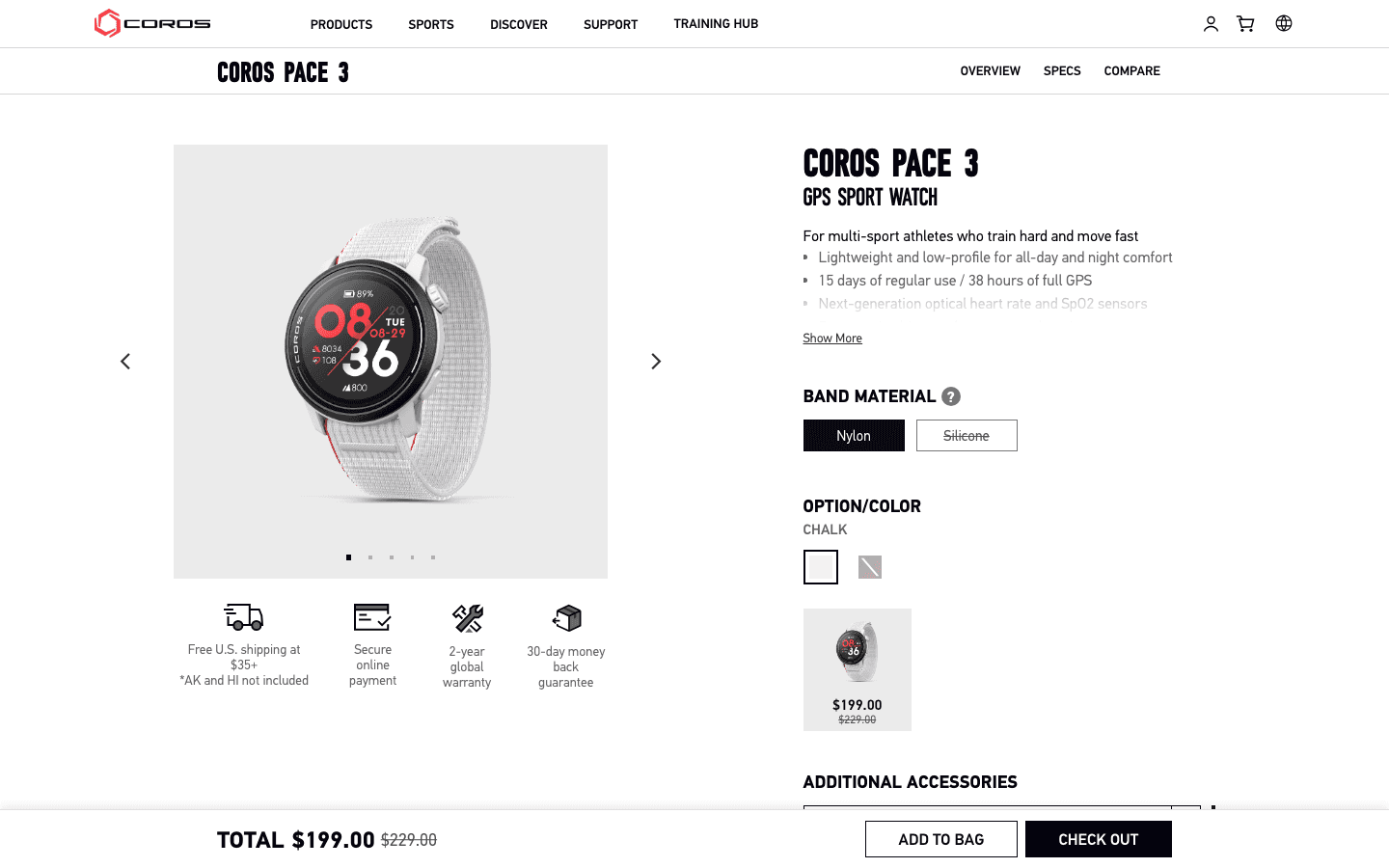
The COROS Pace 3 launched in September 2023 promising to do the impossible: pack dual-frequency GPS, a 38-hour battery, and running power metrics into a watch that weighs 30 grams and costs $229. For serious runners who had been eyeing Garmin's territory without Garmin's price tag, this was a genuine alternative worth testing.
After months of use across road runs, trail outings, and swim sessions, this review covers what actually holds up and what the marketing glosses over. The Pace 3 has since been discounted to around $199 as stock clears, making the value calculus even more interesting.
One note upfront: COROS quietly discontinued the Pace 3 in February 2026. That does not mean you should not buy it. It means pricing has dropped, stock is finite, and COROS's support window will eventually close. For most runners, a sub-$200 price for this hardware is a compelling deal.
Key Takeaways
At 30 grams with a nylon band, the Pace 3 is the lightest dual-frequency GPS watch on the market at its price point.
EvoLab's training load, recovery, and race predictor analytics rival what you get from watches costing $100 more.
No AMOLED screen, no onboard maps, and no streaming music are the real trade-offs you need to accept.
Specs at a Glance
Price: $199 (was $229)
Weight: 30g (nylon band) / 39g (silicone band)
Display: 1.2-inch MIP transflective touchscreen, always-on, 260x260 px
GPS: Dual-frequency (GPS, GLONASS, Galileo, BeiDou, QZSS)
Battery: 38 hours GPS, 17 days daily use, 25 hours all-systems
Sensors: Optical HR (5 LED), SpO2, barometric altimeter, accelerometer, gyroscope, compass
Water resistance: 5 ATM
Music: Offline storage and playback via Bluetooth headphones
Integrations: Strava, TrainingPeaks, Stryd, Apple Health
Design and Display
Thirty grams is not a spec. It is a feeling. First time you put the Pace 3 on, you genuinely forget it is there within minutes. The nylon band sits flat against the wrist, the watch face is slim at 11.7mm, and there is no rubbing or shifting during long efforts. Runners who have dealt with the cumulative fatigue of a heavy GPS watch for a marathon will appreciate this immediately.
The 1.2-inch MIP display is readable in direct sunlight, which is the point. It is not beautiful. It does not have the rich contrast of Garmin's AMOLED options or the Apple Watch Ultra's always-on display. What it has is visibility in every light condition without the battery penalty. Runners who train outdoors across dawn to dusk will never squint at this screen.
The touchscreen works but the two side buttons do most of the heavy lifting during workouts. That is by design: gloves, sweat, and rain all compromise touchscreens, and COROS leans on physical inputs for core activity controls.
GPS Accuracy
Dual-frequency GPS is the headline feature upgrade over the Pace 2, and it delivers. In dense urban environments where single-frequency watches regularly drift 10 to 15 percent off true distance, the Pace 3 tracks within 1 to 2 percent. On trail runs with canopy cover, the track stays cleaner with less shortcutting around switchbacks.
The barometric altimeter gives you accurate elevation gain without the wild swings you get from GPS-based elevation alone. After a trail run with 1,200 feet of climbing, the altimeter read within 30 feet of the known course elevation. That kind of accuracy matters for pace-by-grade calculations and for EvoLab's training load scoring.
The Pace 3 supports all five major GNSS constellations. In practice, locking on takes under 15 seconds from cold start and typically under 5 seconds after that during a training block. COROS's app lets you download satellite data for the week ahead, which speeds this up further.
Battery Life
Thirty-eight hours of continuous GPS is the number that matters. In testing, a standard GPS mode run of 4 hours left 84 percent battery remaining, consistent with COROS's 76 percent remaining after 10 hours claim. For most runners, a marathon effort uses roughly 10 percent of total GPS capacity.
Ultramarathon runners will care most about this: the Pace 3 handles 50K to 100K distances on a single charge without stress. That is a meaningful differentiation from Apple Watch or Fitbit at this price point.
Daily use tracking at 17 days means you can wear it continuously through a full training week without worrying about charging mid-taper. Charge it on a rest day and you are sorted for the next two weeks.
Training Analytics: EvoLab
EvoLab is COROS's proprietary training analytics layer, and it is the strongest reason to choose this watch over cheaper alternatives. It tracks your training load, recovery time, aerobic capacity progression, base fitness score, and race predictor. None of these require a premium subscription. They run on the watch and sync to the COROS app for free.
The recovery score updates overnight and correlates well with how you actually feel. If EvoLab says you need 48 hours of recovery after a long run, you probably need 48 hours. The algorithm weights training load against recent sleep, pace variation, and heart rate data rather than just activity duration.
Running power from the wrist is available without a footpod. It is not Stryd-accurate, but it is usable for pacing in wind and on variable terrain where pace alone misleads. Combined with VO2 max tracking, the Pace 3 gives you a genuinely complete picture of your aerobic development over time.
Heart rate variability (HRV) is recorded nightly. The trend data over weeks is more useful than any single morning reading. If your HRV drops three consecutive days, EvoLab flags high training stress and suggests you recalibrate your week. Paired with tools that support HRV tracking, the Pace 3 gives you enough data to train by feel AND by numbers simultaneously.
Health Tracking
Sleep tracking on the Pace 3 captures awake, REM, light, and deep sleep stages. The breakdown is useful for identifying nights where you got six hours of fragmented sleep versus six hours of solid sleep. These look the same on a step-counter app; they do not look the same on the Pace 3.
SpO2 monitoring works on demand and during sleep. For athletes training at altitude, it provides useful trend data on acclimatization. For sea-level runners, it is a secondary metric that mainly surfaces during illness or deep fatigue.
The watch tracks 20+ sport modes including running, cycling, open water swim, pool swim, strength, and most winter sports. Open water swimming uses GPS plus optical HR without additional accessories, which is a meaningful convenience for triathletes who would otherwise need a separate device.
Music and Smart Features
Offline music storage lets you load tracks directly to the watch and play them via Bluetooth headphones. No phone required. You can sync playlists from your phone to the watch through the COROS app before a run. The transfer is slow, which is the main complaint: loading a full playlist for a long run takes several minutes.
What the watch does not have: streaming. Spotify, Apple Music, and Tidal require your phone to be nearby. If you want to leave your phone at home on long runs, you are limited to whatever you pre-loaded. For most runners doing 5K to half marathon distances, pre-loaded playlists are fine. For ultramarathon efforts, it becomes a real planning task.
Smart notifications work for calls and texts but there is no response capability from the watch. The notifications are a reminder, not a communication tool.
Plan Smarter Around Your Training

The Pace 3 gives you recovery and training load data. Acting on it requires planning. That is where Lifestack fits into a serious training life.
Lifestack's energy-based scheduling maps your daily calendar around when you are actually sharp, not when your calendar happens to have a slot. For athletes, this means hard training sessions land in your genuine peak windows rather than getting squeezed into recovery windows when EvoLab is already flagging high fatigue.
If you are running three quality sessions a week alongside work, the combination of EvoLab for training load and Lifestack for daily scheduling means your hard days stay hard and your recovery days stay easy. That is the basic pattern most recreational athletes fail to maintain. Lifestack makes it structural rather than aspirational. Pricing starts at $7/month or $50/year, with a 7-day free trial on the annual plan.
For more on pairing apps with your COROS device, see the best apps to use with COROS.
Limitations Worth Knowing
No onboard maps. Breadcrumb navigation is available, but you cannot download full topographic maps to the watch. If you get off-route, you know to turn around. You cannot navigate around the problem.
No AMOLED display. The MIP screen is readable but not beautiful. If you care about the watch as a daily wear piece, this matters more than it does mid-run.
No streaming music. Pre-loaded audio only without your phone nearby.
Discontinued. COROS stopped production in February 2026. Stock is available at discounted prices but support and firmware updates will wind down eventually.
MIP resolution. 260x260 pixels is functional but noticeably pixelated on graph displays compared to higher-resolution panels on competing watches.
How It Compares
The natural comparison is the Garmin Forerunner 165, which sits at a similar price point. The Forerunner 165 has an AMOLED display and Garmin's broader ecosystem, but its battery life at 19 hours GPS trails the Pace 3 significantly. For marathon runners and ultramarathoners, the Pace 3 wins on endurance. For daily smartwatch experience, the Forerunner 165 is more polished.
The broader COROS vs Garmin question comes down to ecosystem versus hardware. Garmin's Connect IQ platform and training marketplace have a decade of development behind them. COROS's EvoLab is more focused and arguably easier to act on. Casual runners benefit from Garmin's breadth; serious runners who want clean analytics often prefer COROS's approach.
Who Should Buy the COROS Pace 3?
Ultramarathon and marathon runners who need 38-hour GPS and cannot charge mid-race.
Lightweight build enthusiasts who find heavier watches fatiguing on long efforts.
Data-driven athletes who want EvoLab's training load and race predictor analytics without a premium subscription.
Budget-conscious runners who want dual-frequency GPS accuracy at under $200.
Skip it if you want onboard maps, an AMOLED display, streaming music, or a long support lifecycle from a current-production device.
Final Verdict
The COROS Pace 3 earns its reputation as one of the best-value running watches ever made. At $199 with dual-frequency GPS, 38-hour battery, running power from the wrist, and EvoLab analytics all included, the hardware-to-price ratio is hard to beat.
The MIP display, absent onboard maps, and discontinued status are real limitations. But for a runner who prioritizes accuracy, battery, and weight over smart features, the Pace 3 delivers exactly what it promises at a price that has only gotten better since launch.
Frequently Asked Questions
Is the COROS Pace 3 still worth buying in 2026?
Yes, for runners focused on GPS accuracy, battery life, and training analytics. The discontinuation means a lower price and finite stock, but the hardware and EvoLab software remain strong for endurance athletes.
How accurate is COROS Pace 3 GPS?
Very accurate. Dual-frequency GPS with support for five GNSS constellations places it among the most accurate GPS watches at any price. Urban canyon and canopy testing shows 1 to 2 percent distance drift, compared to 10 to 15 percent on older single-frequency hardware.
Does the COROS Pace 3 track sleep?
Yes. It records awake, REM, light, and deep sleep stages nightly. The data syncs to the COROS app and feeds into EvoLab's recovery score calculation.
Can you use the COROS Pace 3 for swimming?
Yes. It is rated 5 ATM and supports both pool and open water swim modes. Open water swimming uses GPS plus optical HR tracking.
What apps work with the COROS Pace 3?
The Pace 3 integrates with Strava, TrainingPeaks, Stryd, and Apple Health. For daily planning around your training load, Lifestack pairs well with COROS to help you schedule work and recovery around your energy patterns.
How does COROS Pace 3 battery life compare to Garmin?
The Pace 3's 38-hour GPS battery outperforms most Garmin watches in its price range. The Garmin Forerunner 165 offers 19 hours GPS. You would need to step up to the Garmin Fenix or Enduro line to match the Pace 3's endurance capacity.
The COROS Pace 3 launched in September 2023 promising to do the impossible: pack dual-frequency GPS, a 38-hour battery, and running power metrics into a watch that weighs 30 grams and costs $229. For serious runners who had been eyeing Garmin's territory without Garmin's price tag, this was a genuine alternative worth testing.
After months of use across road runs, trail outings, and swim sessions, this review covers what actually holds up and what the marketing glosses over. The Pace 3 has since been discounted to around $199 as stock clears, making the value calculus even more interesting.
One note upfront: COROS quietly discontinued the Pace 3 in February 2026. That does not mean you should not buy it. It means pricing has dropped, stock is finite, and COROS's support window will eventually close. For most runners, a sub-$200 price for this hardware is a compelling deal.
Key Takeaways
At 30 grams with a nylon band, the Pace 3 is the lightest dual-frequency GPS watch on the market at its price point.
EvoLab's training load, recovery, and race predictor analytics rival what you get from watches costing $100 more.
No AMOLED screen, no onboard maps, and no streaming music are the real trade-offs you need to accept.
Specs at a Glance
Price: $199 (was $229)
Weight: 30g (nylon band) / 39g (silicone band)
Display: 1.2-inch MIP transflective touchscreen, always-on, 260x260 px
GPS: Dual-frequency (GPS, GLONASS, Galileo, BeiDou, QZSS)
Battery: 38 hours GPS, 17 days daily use, 25 hours all-systems
Sensors: Optical HR (5 LED), SpO2, barometric altimeter, accelerometer, gyroscope, compass
Water resistance: 5 ATM
Music: Offline storage and playback via Bluetooth headphones
Integrations: Strava, TrainingPeaks, Stryd, Apple Health
Design and Display
Thirty grams is not a spec. It is a feeling. First time you put the Pace 3 on, you genuinely forget it is there within minutes. The nylon band sits flat against the wrist, the watch face is slim at 11.7mm, and there is no rubbing or shifting during long efforts. Runners who have dealt with the cumulative fatigue of a heavy GPS watch for a marathon will appreciate this immediately.
The 1.2-inch MIP display is readable in direct sunlight, which is the point. It is not beautiful. It does not have the rich contrast of Garmin's AMOLED options or the Apple Watch Ultra's always-on display. What it has is visibility in every light condition without the battery penalty. Runners who train outdoors across dawn to dusk will never squint at this screen.
The touchscreen works but the two side buttons do most of the heavy lifting during workouts. That is by design: gloves, sweat, and rain all compromise touchscreens, and COROS leans on physical inputs for core activity controls.
GPS Accuracy
Dual-frequency GPS is the headline feature upgrade over the Pace 2, and it delivers. In dense urban environments where single-frequency watches regularly drift 10 to 15 percent off true distance, the Pace 3 tracks within 1 to 2 percent. On trail runs with canopy cover, the track stays cleaner with less shortcutting around switchbacks.
The barometric altimeter gives you accurate elevation gain without the wild swings you get from GPS-based elevation alone. After a trail run with 1,200 feet of climbing, the altimeter read within 30 feet of the known course elevation. That kind of accuracy matters for pace-by-grade calculations and for EvoLab's training load scoring.
The Pace 3 supports all five major GNSS constellations. In practice, locking on takes under 15 seconds from cold start and typically under 5 seconds after that during a training block. COROS's app lets you download satellite data for the week ahead, which speeds this up further.
Battery Life
Thirty-eight hours of continuous GPS is the number that matters. In testing, a standard GPS mode run of 4 hours left 84 percent battery remaining, consistent with COROS's 76 percent remaining after 10 hours claim. For most runners, a marathon effort uses roughly 10 percent of total GPS capacity.
Ultramarathon runners will care most about this: the Pace 3 handles 50K to 100K distances on a single charge without stress. That is a meaningful differentiation from Apple Watch or Fitbit at this price point.
Daily use tracking at 17 days means you can wear it continuously through a full training week without worrying about charging mid-taper. Charge it on a rest day and you are sorted for the next two weeks.
Training Analytics: EvoLab
EvoLab is COROS's proprietary training analytics layer, and it is the strongest reason to choose this watch over cheaper alternatives. It tracks your training load, recovery time, aerobic capacity progression, base fitness score, and race predictor. None of these require a premium subscription. They run on the watch and sync to the COROS app for free.
The recovery score updates overnight and correlates well with how you actually feel. If EvoLab says you need 48 hours of recovery after a long run, you probably need 48 hours. The algorithm weights training load against recent sleep, pace variation, and heart rate data rather than just activity duration.
Running power from the wrist is available without a footpod. It is not Stryd-accurate, but it is usable for pacing in wind and on variable terrain where pace alone misleads. Combined with VO2 max tracking, the Pace 3 gives you a genuinely complete picture of your aerobic development over time.
Heart rate variability (HRV) is recorded nightly. The trend data over weeks is more useful than any single morning reading. If your HRV drops three consecutive days, EvoLab flags high training stress and suggests you recalibrate your week. Paired with tools that support HRV tracking, the Pace 3 gives you enough data to train by feel AND by numbers simultaneously.
Health Tracking
Sleep tracking on the Pace 3 captures awake, REM, light, and deep sleep stages. The breakdown is useful for identifying nights where you got six hours of fragmented sleep versus six hours of solid sleep. These look the same on a step-counter app; they do not look the same on the Pace 3.
SpO2 monitoring works on demand and during sleep. For athletes training at altitude, it provides useful trend data on acclimatization. For sea-level runners, it is a secondary metric that mainly surfaces during illness or deep fatigue.
The watch tracks 20+ sport modes including running, cycling, open water swim, pool swim, strength, and most winter sports. Open water swimming uses GPS plus optical HR without additional accessories, which is a meaningful convenience for triathletes who would otherwise need a separate device.
Music and Smart Features
Offline music storage lets you load tracks directly to the watch and play them via Bluetooth headphones. No phone required. You can sync playlists from your phone to the watch through the COROS app before a run. The transfer is slow, which is the main complaint: loading a full playlist for a long run takes several minutes.
What the watch does not have: streaming. Spotify, Apple Music, and Tidal require your phone to be nearby. If you want to leave your phone at home on long runs, you are limited to whatever you pre-loaded. For most runners doing 5K to half marathon distances, pre-loaded playlists are fine. For ultramarathon efforts, it becomes a real planning task.
Smart notifications work for calls and texts but there is no response capability from the watch. The notifications are a reminder, not a communication tool.
Plan Smarter Around Your Training
The Pace 3 gives you recovery and training load data. Acting on it requires planning. That is where Lifestack fits into a serious training life.
Lifestack's energy-based scheduling maps your daily calendar around when you are actually sharp, not when your calendar happens to have a slot. For athletes, this means hard training sessions land in your genuine peak windows rather than getting squeezed into recovery windows when EvoLab is already flagging high fatigue.
If you are running three quality sessions a week alongside work, the combination of EvoLab for training load and Lifestack for daily scheduling means your hard days stay hard and your recovery days stay easy. That is the basic pattern most recreational athletes fail to maintain. Lifestack makes it structural rather than aspirational. Pricing starts at $7/month or $50/year, with a 7-day free trial on the annual plan.
For more on pairing apps with your COROS device, see the best apps to use with COROS.
Limitations Worth Knowing
No onboard maps. Breadcrumb navigation is available, but you cannot download full topographic maps to the watch. If you get off-route, you know to turn around. You cannot navigate around the problem.
No AMOLED display. The MIP screen is readable but not beautiful. If you care about the watch as a daily wear piece, this matters more than it does mid-run.
No streaming music. Pre-loaded audio only without your phone nearby.
Discontinued. COROS stopped production in February 2026. Stock is available at discounted prices but support and firmware updates will wind down eventually.
MIP resolution. 260x260 pixels is functional but noticeably pixelated on graph displays compared to higher-resolution panels on competing watches.
How It Compares
The natural comparison is the Garmin Forerunner 165, which sits at a similar price point. The Forerunner 165 has an AMOLED display and Garmin's broader ecosystem, but its battery life at 19 hours GPS trails the Pace 3 significantly. For marathon runners and ultramarathoners, the Pace 3 wins on endurance. For daily smartwatch experience, the Forerunner 165 is more polished.
The broader COROS vs Garmin question comes down to ecosystem versus hardware. Garmin's Connect IQ platform and training marketplace have a decade of development behind them. COROS's EvoLab is more focused and arguably easier to act on. Casual runners benefit from Garmin's breadth; serious runners who want clean analytics often prefer COROS's approach.
Who Should Buy the COROS Pace 3?
Ultramarathon and marathon runners who need 38-hour GPS and cannot charge mid-race.
Lightweight build enthusiasts who find heavier watches fatiguing on long efforts.
Data-driven athletes who want EvoLab's training load and race predictor analytics without a premium subscription.
Budget-conscious runners who want dual-frequency GPS accuracy at under $200.
Skip it if you want onboard maps, an AMOLED display, streaming music, or a long support lifecycle from a current-production device.
Final Verdict
The COROS Pace 3 earns its reputation as one of the best-value running watches ever made. At $199 with dual-frequency GPS, 38-hour battery, running power from the wrist, and EvoLab analytics all included, the hardware-to-price ratio is hard to beat.
The MIP display, absent onboard maps, and discontinued status are real limitations. But for a runner who prioritizes accuracy, battery, and weight over smart features, the Pace 3 delivers exactly what it promises at a price that has only gotten better since launch.
Frequently Asked Questions
Is the COROS Pace 3 still worth buying in 2026?
Yes, for runners focused on GPS accuracy, battery life, and training analytics. The discontinuation means a lower price and finite stock, but the hardware and EvoLab software remain strong for endurance athletes.
How accurate is COROS Pace 3 GPS?
Very accurate. Dual-frequency GPS with support for five GNSS constellations places it among the most accurate GPS watches at any price. Urban canyon and canopy testing shows 1 to 2 percent distance drift, compared to 10 to 15 percent on older single-frequency hardware.
Does the COROS Pace 3 track sleep?
Yes. It records awake, REM, light, and deep sleep stages nightly. The data syncs to the COROS app and feeds into EvoLab's recovery score calculation.
Can you use the COROS Pace 3 for swimming?
Yes. It is rated 5 ATM and supports both pool and open water swim modes. Open water swimming uses GPS plus optical HR tracking.
What apps work with the COROS Pace 3?
The Pace 3 integrates with Strava, TrainingPeaks, Stryd, and Apple Health. For daily planning around your training load, Lifestack pairs well with COROS to help you schedule work and recovery around your energy patterns.
How does COROS Pace 3 battery life compare to Garmin?
The Pace 3's 38-hour GPS battery outperforms most Garmin watches in its price range. The Garmin Forerunner 165 offers 19 hours GPS. You would need to step up to the Garmin Fenix or Enduro line to match the Pace 3's endurance capacity.



FOLLOW ON
FOLLOW ON
FOLLOW ON


Copyright 2026 © Lifestack. All rights reserved
Copyright 2026 © Lifestack. All rights reserved

