
Device
Fitbit Air Review: WHOOP Alternative Without Subscription
Fitbit Air Review: WHOOP Alternative Without Subscription

Google launched the Fitbit Air in May 2026 as its first screenless fitness tracker, positioned directly against WHOOP as a subscription-free alternative. At $99 with no mandatory monthly fee, it is the most affordable entry into that category by a significant margin.
After two weeks of concurrent testing alongside an Oura Ring 4 and WHOOP 5.0, the Fitbit Air holds up well for what it is: a lightweight, comfortable health sensor focused on sleep, recovery, and daily activity. It is not a smartwatch, does not have GPS, and is not trying to replace your Garmin. What it does well is deliver consistent sleep and heart rate data without the hardware or subscription cost of competing screenless trackers.
Key Takeaways
At $99 with no subscription required, the Fitbit Air undercuts WHOOP's $199/year entry tier by a wide margin for basic sleep and recovery tracking
Sleep duration accuracy matches Oura Ring closely in testing; sleep stage classification diverges more, particularly on deep sleep estimates
Auto workout detection works well for cardio; strength training requires manual logging
Specs and Pricing
Price: $99 (Standard); $129.99 (Stephen Curry Special Edition)
Weight: 12 grams with band
Battery life: Up to 7 days; 5-minute fast charge gives a full day of use
Water resistance: 50 meters
Sensors: Optical heart rate (PPG), SpO2, skin temperature, accelerometer
Display: None (screenless)
GPS: None (phone GPS available during connected workouts)
App: Google Health (free); Google Health Premium ($9.99/month or $99/year, 3 months included free)
Subscription required: No
Design and Comfort
The Fitbit Air is shaped like a small pebble worn on the inside of your wrist, secured by a textile Performance Loop band. At 12 grams total, it is nearly undetectable during sleep. This is the category it is most directly designed for: overnight wear where most fitness trackers start to feel heavy or intrusive after the first hour.
There are no buttons on the unit. Interactions happen through a single tap (which triggers the SmartWake vibration alarm when set) or through the phone app. If you are used to glancing at your wrist for time or notifications, this will be an adjustment. The Fitbit Air is a pure health sensor, not a companion device.
Build quality is solid for the price. The textile band is machine washable and comes in several colors. Replacement bands cost $34.99 for silicone active styles and $49.99 for fabric options.
Sleep Tracking
Sleep is the Fitbit Air's strongest feature. In two weeks of concurrent testing, total sleep duration matched the Oura Ring 4 within about 13 minutes on average. REM sleep estimates aligned closely with Oura on multiple nights. Deep sleep readings ran roughly one-third higher than Oura's estimates, which is a known variance in wrist-based optical sensors compared to ring sensors.
The skin temperature sensor adds overnight body temperature variation monitoring, which is particularly useful for detecting illness before symptoms appear and for tracking the hormonal patterns that influence recovery in women. This was previously only available in Fitbit's higher-priced devices.
For a deeper look at how Fitbit's sleep algorithms work across the product line, the Fitbit sleep tracker guide covers the methodology and accuracy context in detail.
Heart Rate and HRV
Resting heart rate tracking matched competing devices within approximately three beats per minute across the testing period. During steady-state cardio like running and cycling, heart rate followed well. During strength training and grip-heavy movements, readings showed the motion artifact limitations common to all wrist optical sensors.
HRV data appears in the Google Health app as a weekly trend rather than a daily score. This is a philosophical difference from WHOOP's nightly recovery approach: Google Health smooths data across seven days to show directional trends, while WHOOP reacts aggressively to each night's HRV reading. Neither is objectively better; they answer different questions. For a direct comparison of how the two platforms interpret recovery data, see the WHOOP vs Fitbit comparison.
For users who want HRV-focused daily readiness scoring, the best HRV tracker guide compares the Fitbit Air against Oura, WHOOP, and Garmin on this specific metric.
Workout Detection
Automatic workout detection works reliably for sustained cardio: running, cycling, and brisk walking register automatically with minimal misfire. The device uses heart rate elevation plus accelerometer data to classify activity type and duration.
Strength training does not auto-detect. Lifting sessions with rest periods between sets do not trigger the "sustained high heart rate" threshold the Air uses for automatic recognition. You need to manually log strength workouts in the Google Health app before or after the session. This is a real limitation for gym-focused users.
Phone GPS is available for outdoor runs and rides when you carry your phone, which adds distance and pace data. The tracker alone does not record GPS.
The Google Health App
The Google Health app replaces the legacy Fitbit app and consolidates health data from the Air, Pixel Watch, and other connected devices. The redesign is functional but still feels like a work in progress. Core metrics require more taps to reach than in the previous Fitbit experience, and the Health Coach feature (which provides personalized recommendations) pushes toward the Premium subscription tier more than necessary for basic users.
The free tier covers sleep summaries, heart rate history, activity logs, and basic HRV trends. Google Health Premium adds AI-backed health insights, deeper recovery analysis, and the Health Coach. Three months of Premium are included free with the Air. After that, $9.99/month or $99/year.
Fitbit Air vs WHOOP 5.0
The comparison most buyers are making: both are screenless wrist-worn health sensors without GPS. The key differences:
Price: Fitbit Air = $99 one-time. WHOOP 5.0 starts at $199/year (subscription).
Battery: Fitbit Air = 7 days. WHOOP 5.0 = 14 days.
Recovery scoring: WHOOP provides a daily recovery score reacting to each night's data. Google Health smooths over weekly trends.
Workout data: WHOOP provides strain scores and detailed workout heart rate curves. Fitbit Air covers cardio duration and auto-detection only.
GPS: Neither has built-in GPS.
For casual users who want sleep and basic recovery data without recurring fees, the Fitbit Air is the better financial decision by a large margin. For athletes who want daily strain-versus-recovery scoring and are training seriously, WHOOP's deeper analytics justify the annual cost.
For the full range of screenless fitness trackers available in 2026, the comparison guide covers every major option.
Best App to Pair With Fitbit Air
Google Health handles the raw data well. What it does not do is turn that data into a smarter daily schedule.
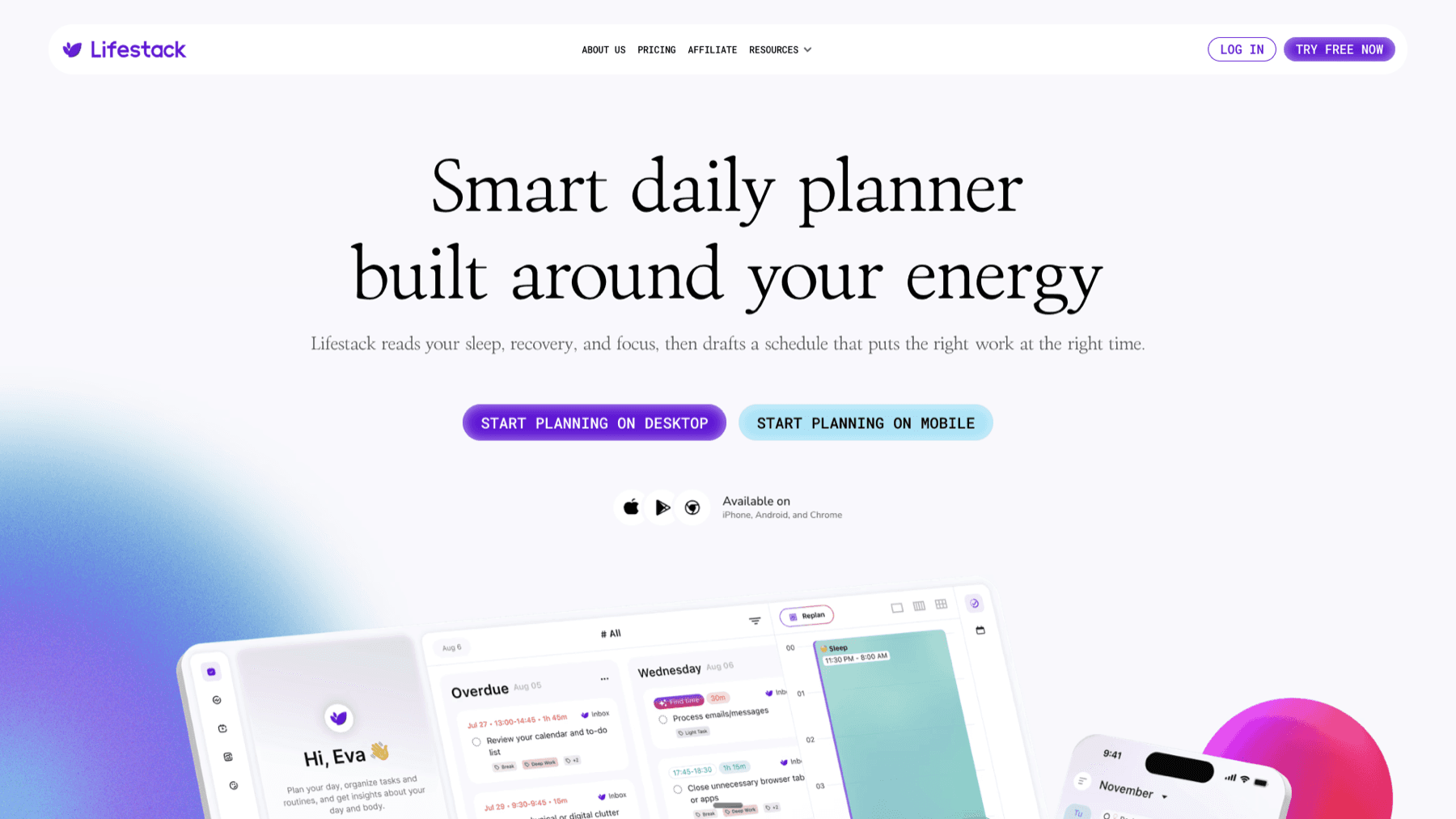
Lifestack connects to your health data to build a daily plan around your actual energy and recovery state. On mornings when your overnight HRV trend is low, Lifestack shifts demanding cognitive work to better windows. On high-recovery days, it front-loads deep work while your focus is strongest. It is the step that makes passive health data actively useful for how you structure your day.
Learn how energy-based scheduling works with wearable data. Lifestack is $49.99/year with a 7-day free trial, or $120 as a one-time lifetime purchase.
Frequently Asked Questions
Is the Fitbit Air worth buying?
For users who want screenless health tracking without a subscription, yes. At $99 with no mandatory monthly fee, it delivers reliable sleep and heart rate data at the lowest cost in its category. Athletes who need daily strain tracking or detailed workout metrics will want to look at WHOOP instead.
Does the Fitbit Air require a subscription?
No. The Google Health app is free and includes sleep summaries, heart rate data, HRV trends, and activity tracking. Google Health Premium ($9.99/month or $99/year) adds AI-backed coaching and deeper analysis. Three months of Premium are included free with purchase.
Does the Fitbit Air have GPS?
No. The Fitbit Air does not have built-in GPS. It uses your phone's GPS during connected outdoor workouts when you carry your phone. Standalone GPS tracking is not available.
How accurate is Fitbit Air sleep tracking?
Total sleep duration is accurate, matching Oura Ring 4 within about 13 minutes in concurrent testing. Sleep stage classification (REM, deep, light) varies from ring-based sensors, particularly on deep sleep estimates. For trend-based analysis over weeks, accuracy is reliable enough to be useful.
How does the Fitbit Air compare to the Fitbit Charge 6?
The Fitbit Charge 6 has a display, built-in GPS, and more workout features. The Air is lighter, cheaper, and focused purely on health sensing without smartwatch functionality. If you want a screen and GPS, the Charge 6 is the better fit.
Google launched the Fitbit Air in May 2026 as its first screenless fitness tracker, positioned directly against WHOOP as a subscription-free alternative. At $99 with no mandatory monthly fee, it is the most affordable entry into that category by a significant margin.
After two weeks of concurrent testing alongside an Oura Ring 4 and WHOOP 5.0, the Fitbit Air holds up well for what it is: a lightweight, comfortable health sensor focused on sleep, recovery, and daily activity. It is not a smartwatch, does not have GPS, and is not trying to replace your Garmin. What it does well is deliver consistent sleep and heart rate data without the hardware or subscription cost of competing screenless trackers.
Key Takeaways
At $99 with no subscription required, the Fitbit Air undercuts WHOOP's $199/year entry tier by a wide margin for basic sleep and recovery tracking
Sleep duration accuracy matches Oura Ring closely in testing; sleep stage classification diverges more, particularly on deep sleep estimates
Auto workout detection works well for cardio; strength training requires manual logging
Specs and Pricing
Price: $99 (Standard); $129.99 (Stephen Curry Special Edition)
Weight: 12 grams with band
Battery life: Up to 7 days; 5-minute fast charge gives a full day of use
Water resistance: 50 meters
Sensors: Optical heart rate (PPG), SpO2, skin temperature, accelerometer
Display: None (screenless)
GPS: None (phone GPS available during connected workouts)
App: Google Health (free); Google Health Premium ($9.99/month or $99/year, 3 months included free)
Subscription required: No
Design and Comfort
The Fitbit Air is shaped like a small pebble worn on the inside of your wrist, secured by a textile Performance Loop band. At 12 grams total, it is nearly undetectable during sleep. This is the category it is most directly designed for: overnight wear where most fitness trackers start to feel heavy or intrusive after the first hour.
There are no buttons on the unit. Interactions happen through a single tap (which triggers the SmartWake vibration alarm when set) or through the phone app. If you are used to glancing at your wrist for time or notifications, this will be an adjustment. The Fitbit Air is a pure health sensor, not a companion device.
Build quality is solid for the price. The textile band is machine washable and comes in several colors. Replacement bands cost $34.99 for silicone active styles and $49.99 for fabric options.
Sleep Tracking
Sleep is the Fitbit Air's strongest feature. In two weeks of concurrent testing, total sleep duration matched the Oura Ring 4 within about 13 minutes on average. REM sleep estimates aligned closely with Oura on multiple nights. Deep sleep readings ran roughly one-third higher than Oura's estimates, which is a known variance in wrist-based optical sensors compared to ring sensors.
The skin temperature sensor adds overnight body temperature variation monitoring, which is particularly useful for detecting illness before symptoms appear and for tracking the hormonal patterns that influence recovery in women. This was previously only available in Fitbit's higher-priced devices.
For a deeper look at how Fitbit's sleep algorithms work across the product line, the Fitbit sleep tracker guide covers the methodology and accuracy context in detail.
Heart Rate and HRV
Resting heart rate tracking matched competing devices within approximately three beats per minute across the testing period. During steady-state cardio like running and cycling, heart rate followed well. During strength training and grip-heavy movements, readings showed the motion artifact limitations common to all wrist optical sensors.
HRV data appears in the Google Health app as a weekly trend rather than a daily score. This is a philosophical difference from WHOOP's nightly recovery approach: Google Health smooths data across seven days to show directional trends, while WHOOP reacts aggressively to each night's HRV reading. Neither is objectively better; they answer different questions. For a direct comparison of how the two platforms interpret recovery data, see the WHOOP vs Fitbit comparison.
For users who want HRV-focused daily readiness scoring, the best HRV tracker guide compares the Fitbit Air against Oura, WHOOP, and Garmin on this specific metric.
Workout Detection
Automatic workout detection works reliably for sustained cardio: running, cycling, and brisk walking register automatically with minimal misfire. The device uses heart rate elevation plus accelerometer data to classify activity type and duration.
Strength training does not auto-detect. Lifting sessions with rest periods between sets do not trigger the "sustained high heart rate" threshold the Air uses for automatic recognition. You need to manually log strength workouts in the Google Health app before or after the session. This is a real limitation for gym-focused users.
Phone GPS is available for outdoor runs and rides when you carry your phone, which adds distance and pace data. The tracker alone does not record GPS.
The Google Health App
The Google Health app replaces the legacy Fitbit app and consolidates health data from the Air, Pixel Watch, and other connected devices. The redesign is functional but still feels like a work in progress. Core metrics require more taps to reach than in the previous Fitbit experience, and the Health Coach feature (which provides personalized recommendations) pushes toward the Premium subscription tier more than necessary for basic users.
The free tier covers sleep summaries, heart rate history, activity logs, and basic HRV trends. Google Health Premium adds AI-backed health insights, deeper recovery analysis, and the Health Coach. Three months of Premium are included free with the Air. After that, $9.99/month or $99/year.
Fitbit Air vs WHOOP 5.0
The comparison most buyers are making: both are screenless wrist-worn health sensors without GPS. The key differences:
Price: Fitbit Air = $99 one-time. WHOOP 5.0 starts at $199/year (subscription).
Battery: Fitbit Air = 7 days. WHOOP 5.0 = 14 days.
Recovery scoring: WHOOP provides a daily recovery score reacting to each night's data. Google Health smooths over weekly trends.
Workout data: WHOOP provides strain scores and detailed workout heart rate curves. Fitbit Air covers cardio duration and auto-detection only.
GPS: Neither has built-in GPS.
For casual users who want sleep and basic recovery data without recurring fees, the Fitbit Air is the better financial decision by a large margin. For athletes who want daily strain-versus-recovery scoring and are training seriously, WHOOP's deeper analytics justify the annual cost.
For the full range of screenless fitness trackers available in 2026, the comparison guide covers every major option.
Best App to Pair With Fitbit Air
Google Health handles the raw data well. What it does not do is turn that data into a smarter daily schedule.
Lifestack connects to your health data to build a daily plan around your actual energy and recovery state. On mornings when your overnight HRV trend is low, Lifestack shifts demanding cognitive work to better windows. On high-recovery days, it front-loads deep work while your focus is strongest. It is the step that makes passive health data actively useful for how you structure your day.
Learn how energy-based scheduling works with wearable data. Lifestack is $49.99/year with a 7-day free trial, or $120 as a one-time lifetime purchase.
Frequently Asked Questions
Is the Fitbit Air worth buying?
For users who want screenless health tracking without a subscription, yes. At $99 with no mandatory monthly fee, it delivers reliable sleep and heart rate data at the lowest cost in its category. Athletes who need daily strain tracking or detailed workout metrics will want to look at WHOOP instead.
Does the Fitbit Air require a subscription?
No. The Google Health app is free and includes sleep summaries, heart rate data, HRV trends, and activity tracking. Google Health Premium ($9.99/month or $99/year) adds AI-backed coaching and deeper analysis. Three months of Premium are included free with purchase.
Does the Fitbit Air have GPS?
No. The Fitbit Air does not have built-in GPS. It uses your phone's GPS during connected outdoor workouts when you carry your phone. Standalone GPS tracking is not available.
How accurate is Fitbit Air sleep tracking?
Total sleep duration is accurate, matching Oura Ring 4 within about 13 minutes in concurrent testing. Sleep stage classification (REM, deep, light) varies from ring-based sensors, particularly on deep sleep estimates. For trend-based analysis over weeks, accuracy is reliable enough to be useful.
How does the Fitbit Air compare to the Fitbit Charge 6?
The Fitbit Charge 6 has a display, built-in GPS, and more workout features. The Air is lighter, cheaper, and focused purely on health sensing without smartwatch functionality. If you want a screen and GPS, the Charge 6 is the better fit.



FOLLOW ON
FOLLOW ON
FOLLOW ON


Copyright 2026 © Lifestack. All rights reserved
Copyright 2026 © Lifestack. All rights reserved

