
Device
Fitbit Charge 6 Review: Is It Worth It?
Fitbit Charge 6 Review: Is It Worth It?

The Fitbit Charge 6 arrived as the first Fitbit to fully commit to Google's ecosystem. Under Google's ownership, Fitbit added YouTube Music controls, Google Maps turn-by-turn navigation on the tracker's display, and Google Wallet contactless payments to what was already one of the best-selling fitness trackers in the world. The result is a device that sits between a basic fitness band and a full smartwatch and does most things well at a price that has dropped to around $99.
This review covers the complete Charge 6 experience, including the features that require a Fitbit Premium subscription and the honest assessment of where it falls short versus the competition.
Key Takeaways
The Charge 6 is the best fitness tracker Fitbit has made, with built-in GPS, ECG, and EDA stress sensing at a discounted price of around $99.
The Daily Readiness Score and Sleep Profile require a Fitbit Premium subscription ($9.99/month or $79.99/year), which is the hidden cost most reviews undersell.
Google integration is useful for Android users and awkward for iPhone users. Whether this matters depends entirely on your phone.
Specs at a Glance
Price: $159.95 MSRP, currently ~$99 at most retailers
Display: 1.04-inch AMOLED touchscreen
Battery: 7 days typical, 5 days with Always-On Display
GPS: Built-in multi-path GPS
Sensors: Optical HR (continuous), SpO2, EDA (electrodermal activity/stress), skin temperature, ECG
Sports modes: 40+
Water resistance: 5 ATM (50 meters)
Google features: Google Maps navigation, YouTube Music controls, Google Wallet
Subscription: Fitbit Premium $9.99/month or $79.99/year for Daily Readiness Score, Sleep Profile, and coaching content
Design and Display
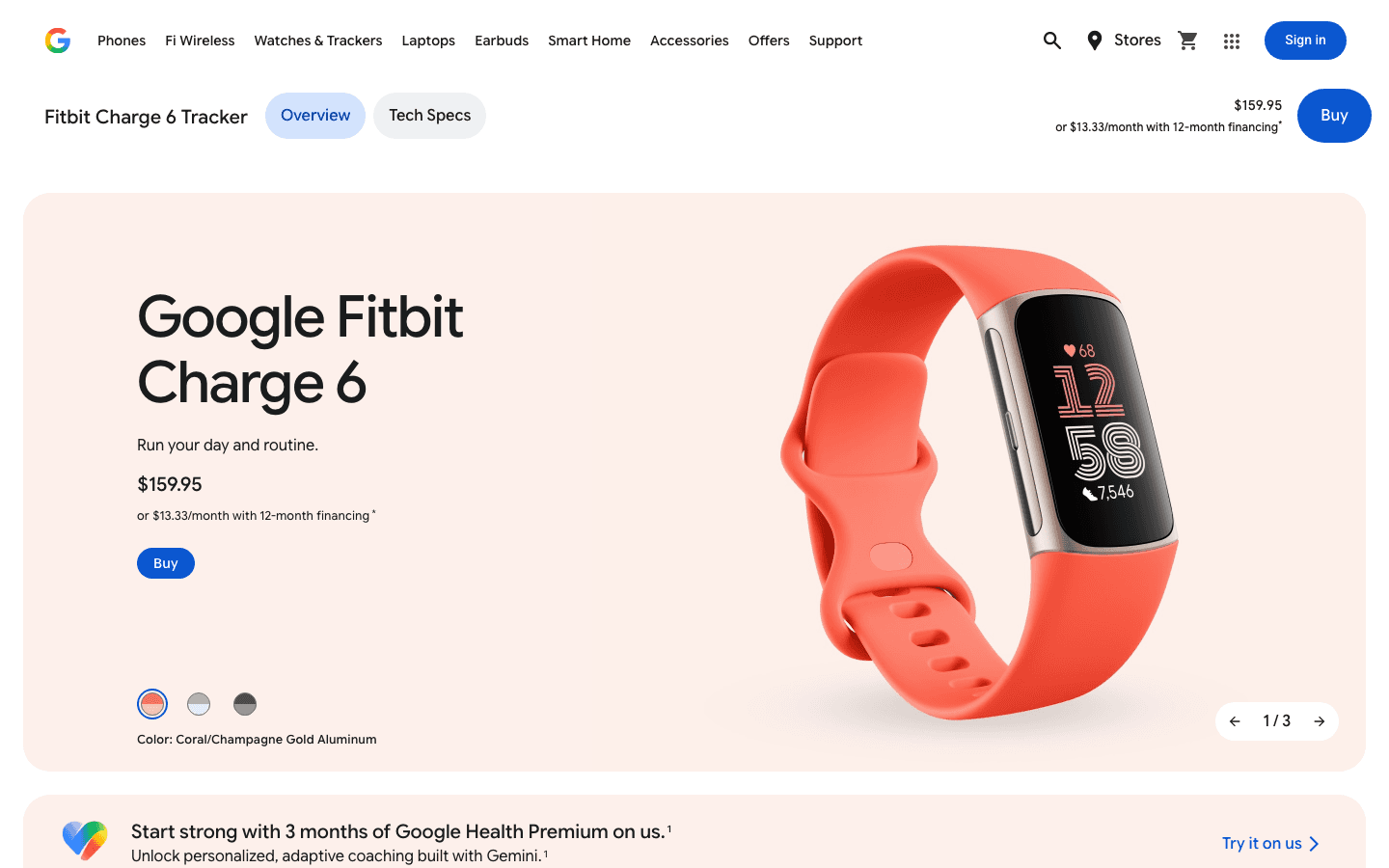
The Charge 6 is a band, not a watch. The aluminum case is slim and low-profile, the AMOLED screen is bright and responsive, and the haptic side button replaced the physical button from the Charge 5. The side button took some adjustment for users who owned previous Charge models, but it keeps the case thinner.
Battery life at 7 days is the sweet spot between Apple Watch (1-2 days) and dedicated running watches (2+ weeks). You can wear it continuously through a week of workouts, sleep tracking, and daytime use without needing to charge during a gym session or overnight.
The band comes in multiple colors with third-party band options widely available. The proprietary Fitbit connector is a limitation versus devices that use standard 20mm straps, but the official Fitbit band lineup covers most use cases.
GPS and Activity Tracking
Built-in GPS is the upgrade that matters most over the Charge 5. The Charge 5 used connected GPS (requiring your phone to be nearby), which is a real limitation for runners who want to leave their phone behind. The Charge 6 locks GPS quickly and tracks distance accurately on road runs, though less precisely than multi-band GPS hardware at higher price points.
With over 40 sport modes including running, cycling, swimming, strength, yoga, and interval training, the tracking breadth is solid for casual to moderate athletes. Each GPS activity captures pace, distance, heart rate zones, and calories. The Activity Zone Minutes metric ties daily movement to target heart rate zones rather than just step count, which is a more meaningful metric for fitness outcomes.
Health Tracking: EDA, ECG, and Sleep
The EDA (electrodermal activity) sensor measures skin conductance changes that correlate with stress arousal. The Charge 6 runs both on-demand EDA scans (a 2-minute mindfulness session where you hold your finger on the side sensor) and background tracking. The stress management score combines EDA data with heart rate variability and sleep metrics.
ECG recording gives you a 30-second strip that can detect atrial fibrillation patterns. The feature is FDA-cleared and works better here than on many budget devices because Fitbit has more longitudinal data behind its algorithm. It is not a replacement for a cardiologist, but it is a useful early-detection tool.
Sleep tracking records stages (awake, light, deep, REM), sleep duration, and produces a daily sleep score. The Sleep Profile feature, which gives you a deeper monthly analysis including an animal archetype that reflects your sleep patterns (Tortoise, Giraffe, etc.), is Premium-only. For HRV tracking, Fitbit's HRV data is measured nightly but displayed as a simple range rather than a detailed trend graph, which is less actionable than what WHOOP or Oura provide.
Daily Readiness Score and Premium
The Daily Readiness Score is the Fitbit feature most comparable to WHOOP's recovery score or Garmin's Training Readiness. It combines HRV status, recent activity, and sleep quality into a 0-100 score with exercise intensity recommendations. It is also entirely paywalled behind Fitbit Premium.
At $9.99/month ($119.88/year) or $79.99/year, Premium adds readiness scoring, sleep profile, stress management tools, 40-plus guided workout programs, and mindfulness content. Whether the subscription is worth it depends on how much you use the coaching content beyond the basic tracking data.
Without Premium, you get the raw data (sleep stages, HRV, stress score) but lose the synthesis and recommendations. For users who just want step count, sleep hours, and workout tracking, the free app is adequate. For users who want actionable health guidance, Premium is practically required.
Google Integration
For Android users and particularly Pixel phone users, the Google integration adds genuine utility. Google Maps turn-by-turn directions on the tracker display is useful for urban runners who want navigation without taking out their phone. YouTube Music controls work well for pause, skip, and volume. Google Wallet contactless payments work at most NFC terminals.
For iPhone users, the Google Maps integration does not work (it requires the Google Maps app, which uses Apple Maps directions on iOS). YouTube Music controls work only if you use YouTube Music rather than Spotify or Apple Music. Google Wallet is not available on iOS. The Charge 6 functions as a standard fitness tracker for iPhone users, without most of the Google-specific features that differentiate it from the Charge 5.
Fitbit's iPhone compatibility covers the full picture of what works and what does not for iOS users considering the Charge 6.
Planning Around Your Readiness Data

The Daily Readiness Score tells you whether to push hard or ease off. Acting on that information within a real schedule is where most users get stuck. A readiness score of 78 is useful data. Knowing where in your actual workday to place your workout, your hardest focus blocks, and your recovery work requires a planning layer that Fitbit does not provide.
Lifestack's energy-based scheduling fills that gap. It maps your tasks and workouts to the times when you are genuinely sharp, so high-readiness days get hard effort at the right times and low-readiness days get structured recovery instead of an overloaded schedule. For Fitbit users who want to connect their health data to better daily planning, the best apps to use with Fitbit covers how Lifestack and other tools extend what the Charge 6 data can drive. Lifestack starts at $7/month or $50/year with a 7-day free trial on the annual plan.
Learn more about Lifestack and how energy-based scheduling works in practice alongside fitness tracking data.
How It Compares
Against the Fitbit Inspire 3: The Inspire 3 is cheaper at $79.95 and has the same sleep and heart rate tracking, but lacks built-in GPS and ECG. If you always run with your phone, the Inspire 3 saves $80 without meaningfully worse health tracking. If you run without your phone or want ECG, the Charge 6 is the right choice.
Against the Amazfit Active 2 at $99: The Amazfit has a larger AMOLED display, 160-plus sport modes, and no subscription required for its analytics platform. Its HRV and readiness data is less mature than Fitbit's, but the hardware is comparable. For Android users who want Google integration, Charge 6 wins. For anyone else, the Amazfit is strong competition at the same price.
Who Should Buy the Fitbit Charge 6?
Android and Pixel users who want Google Maps, YouTube Music, and Google Wallet built into a fitness tracker.
Casual athletes doing 3 to 5 workouts per week across mixed activities who want GPS without a full smartwatch.
Health-focused users who want ECG, EDA stress sensing, and sleep profiling in a slim, comfortable band.
Fitbit ecosystem users who already have Premium or want to extend existing longitudinal health data.
Skip it if you use an iPhone and primarily care about Google features, if you need 10-plus hours of GPS battery for long-course events, or if you want training analytics depth comparable to Garmin or COROS.
Frequently Asked Questions
Does the Fitbit Charge 6 have GPS?
Yes. The Charge 6 has built-in GPS, a significant upgrade from the Charge 5's connected GPS (which required your phone). You can run, cycle, or hike without your phone and still get accurate distance and pace data.
Does Fitbit Charge 6 work with iPhone?
Yes for basic features: heart rate, sleep tracking, step counting, GPS workouts, and sleep stages all work with iPhone. Google-specific features (Maps navigation, YouTube Music, Google Wallet) do not work on iOS. The core health tracking is fully functional regardless of phone.
Is Fitbit Premium required for Charge 6?
Not required, but meaningful features are gated behind it. The Daily Readiness Score, Sleep Profile, guided workouts, and stress management tools all require Fitbit Premium at $9.99/month or $79.99/year. Basic tracking (steps, heart rate, sleep stages, workout data) is free.
How long does the Fitbit Charge 6 battery last?
Seven days in typical use with standard settings. GPS-active workouts drain the battery faster. A one-hour GPS run uses roughly 3 to 5 percent of battery life, so most users see 7-day battery life as accurate with one GPS workout per day.
Is the Fitbit Charge 6 ECG accurate?
The ECG feature is FDA-cleared for detecting atrial fibrillation. It generates a 30-second reading that can be shared with your doctor as a PDF. Like all consumer ECG devices, it is a screening tool rather than a clinical device. A positive AFib reading should prompt consultation with a healthcare provider, not self-diagnosis.
The Fitbit Charge 6 arrived as the first Fitbit to fully commit to Google's ecosystem. Under Google's ownership, Fitbit added YouTube Music controls, Google Maps turn-by-turn navigation on the tracker's display, and Google Wallet contactless payments to what was already one of the best-selling fitness trackers in the world. The result is a device that sits between a basic fitness band and a full smartwatch and does most things well at a price that has dropped to around $99.
This review covers the complete Charge 6 experience, including the features that require a Fitbit Premium subscription and the honest assessment of where it falls short versus the competition.
Key Takeaways
The Charge 6 is the best fitness tracker Fitbit has made, with built-in GPS, ECG, and EDA stress sensing at a discounted price of around $99.
The Daily Readiness Score and Sleep Profile require a Fitbit Premium subscription ($9.99/month or $79.99/year), which is the hidden cost most reviews undersell.
Google integration is useful for Android users and awkward for iPhone users. Whether this matters depends entirely on your phone.
Specs at a Glance
Price: $159.95 MSRP, currently ~$99 at most retailers
Display: 1.04-inch AMOLED touchscreen
Battery: 7 days typical, 5 days with Always-On Display
GPS: Built-in multi-path GPS
Sensors: Optical HR (continuous), SpO2, EDA (electrodermal activity/stress), skin temperature, ECG
Sports modes: 40+
Water resistance: 5 ATM (50 meters)
Google features: Google Maps navigation, YouTube Music controls, Google Wallet
Subscription: Fitbit Premium $9.99/month or $79.99/year for Daily Readiness Score, Sleep Profile, and coaching content
Design and Display
The Charge 6 is a band, not a watch. The aluminum case is slim and low-profile, the AMOLED screen is bright and responsive, and the haptic side button replaced the physical button from the Charge 5. The side button took some adjustment for users who owned previous Charge models, but it keeps the case thinner.
Battery life at 7 days is the sweet spot between Apple Watch (1-2 days) and dedicated running watches (2+ weeks). You can wear it continuously through a week of workouts, sleep tracking, and daytime use without needing to charge during a gym session or overnight.
The band comes in multiple colors with third-party band options widely available. The proprietary Fitbit connector is a limitation versus devices that use standard 20mm straps, but the official Fitbit band lineup covers most use cases.
GPS and Activity Tracking
Built-in GPS is the upgrade that matters most over the Charge 5. The Charge 5 used connected GPS (requiring your phone to be nearby), which is a real limitation for runners who want to leave their phone behind. The Charge 6 locks GPS quickly and tracks distance accurately on road runs, though less precisely than multi-band GPS hardware at higher price points.
With over 40 sport modes including running, cycling, swimming, strength, yoga, and interval training, the tracking breadth is solid for casual to moderate athletes. Each GPS activity captures pace, distance, heart rate zones, and calories. The Activity Zone Minutes metric ties daily movement to target heart rate zones rather than just step count, which is a more meaningful metric for fitness outcomes.
Health Tracking: EDA, ECG, and Sleep
The EDA (electrodermal activity) sensor measures skin conductance changes that correlate with stress arousal. The Charge 6 runs both on-demand EDA scans (a 2-minute mindfulness session where you hold your finger on the side sensor) and background tracking. The stress management score combines EDA data with heart rate variability and sleep metrics.
ECG recording gives you a 30-second strip that can detect atrial fibrillation patterns. The feature is FDA-cleared and works better here than on many budget devices because Fitbit has more longitudinal data behind its algorithm. It is not a replacement for a cardiologist, but it is a useful early-detection tool.
Sleep tracking records stages (awake, light, deep, REM), sleep duration, and produces a daily sleep score. The Sleep Profile feature, which gives you a deeper monthly analysis including an animal archetype that reflects your sleep patterns (Tortoise, Giraffe, etc.), is Premium-only. For HRV tracking, Fitbit's HRV data is measured nightly but displayed as a simple range rather than a detailed trend graph, which is less actionable than what WHOOP or Oura provide.
Daily Readiness Score and Premium
The Daily Readiness Score is the Fitbit feature most comparable to WHOOP's recovery score or Garmin's Training Readiness. It combines HRV status, recent activity, and sleep quality into a 0-100 score with exercise intensity recommendations. It is also entirely paywalled behind Fitbit Premium.
At $9.99/month ($119.88/year) or $79.99/year, Premium adds readiness scoring, sleep profile, stress management tools, 40-plus guided workout programs, and mindfulness content. Whether the subscription is worth it depends on how much you use the coaching content beyond the basic tracking data.
Without Premium, you get the raw data (sleep stages, HRV, stress score) but lose the synthesis and recommendations. For users who just want step count, sleep hours, and workout tracking, the free app is adequate. For users who want actionable health guidance, Premium is practically required.
Google Integration
For Android users and particularly Pixel phone users, the Google integration adds genuine utility. Google Maps turn-by-turn directions on the tracker display is useful for urban runners who want navigation without taking out their phone. YouTube Music controls work well for pause, skip, and volume. Google Wallet contactless payments work at most NFC terminals.
For iPhone users, the Google Maps integration does not work (it requires the Google Maps app, which uses Apple Maps directions on iOS). YouTube Music controls work only if you use YouTube Music rather than Spotify or Apple Music. Google Wallet is not available on iOS. The Charge 6 functions as a standard fitness tracker for iPhone users, without most of the Google-specific features that differentiate it from the Charge 5.
Fitbit's iPhone compatibility covers the full picture of what works and what does not for iOS users considering the Charge 6.
Planning Around Your Readiness Data
The Daily Readiness Score tells you whether to push hard or ease off. Acting on that information within a real schedule is where most users get stuck. A readiness score of 78 is useful data. Knowing where in your actual workday to place your workout, your hardest focus blocks, and your recovery work requires a planning layer that Fitbit does not provide.
Lifestack's energy-based scheduling fills that gap. It maps your tasks and workouts to the times when you are genuinely sharp, so high-readiness days get hard effort at the right times and low-readiness days get structured recovery instead of an overloaded schedule. For Fitbit users who want to connect their health data to better daily planning, the best apps to use with Fitbit covers how Lifestack and other tools extend what the Charge 6 data can drive. Lifestack starts at $7/month or $50/year with a 7-day free trial on the annual plan.
Learn more about Lifestack and how energy-based scheduling works in practice alongside fitness tracking data.
How It Compares
Against the Fitbit Inspire 3: The Inspire 3 is cheaper at $79.95 and has the same sleep and heart rate tracking, but lacks built-in GPS and ECG. If you always run with your phone, the Inspire 3 saves $80 without meaningfully worse health tracking. If you run without your phone or want ECG, the Charge 6 is the right choice.
Against the Amazfit Active 2 at $99: The Amazfit has a larger AMOLED display, 160-plus sport modes, and no subscription required for its analytics platform. Its HRV and readiness data is less mature than Fitbit's, but the hardware is comparable. For Android users who want Google integration, Charge 6 wins. For anyone else, the Amazfit is strong competition at the same price.
Who Should Buy the Fitbit Charge 6?
Android and Pixel users who want Google Maps, YouTube Music, and Google Wallet built into a fitness tracker.
Casual athletes doing 3 to 5 workouts per week across mixed activities who want GPS without a full smartwatch.
Health-focused users who want ECG, EDA stress sensing, and sleep profiling in a slim, comfortable band.
Fitbit ecosystem users who already have Premium or want to extend existing longitudinal health data.
Skip it if you use an iPhone and primarily care about Google features, if you need 10-plus hours of GPS battery for long-course events, or if you want training analytics depth comparable to Garmin or COROS.
Frequently Asked Questions
Does the Fitbit Charge 6 have GPS?
Yes. The Charge 6 has built-in GPS, a significant upgrade from the Charge 5's connected GPS (which required your phone). You can run, cycle, or hike without your phone and still get accurate distance and pace data.
Does Fitbit Charge 6 work with iPhone?
Yes for basic features: heart rate, sleep tracking, step counting, GPS workouts, and sleep stages all work with iPhone. Google-specific features (Maps navigation, YouTube Music, Google Wallet) do not work on iOS. The core health tracking is fully functional regardless of phone.
Is Fitbit Premium required for Charge 6?
Not required, but meaningful features are gated behind it. The Daily Readiness Score, Sleep Profile, guided workouts, and stress management tools all require Fitbit Premium at $9.99/month or $79.99/year. Basic tracking (steps, heart rate, sleep stages, workout data) is free.
How long does the Fitbit Charge 6 battery last?
Seven days in typical use with standard settings. GPS-active workouts drain the battery faster. A one-hour GPS run uses roughly 3 to 5 percent of battery life, so most users see 7-day battery life as accurate with one GPS workout per day.
Is the Fitbit Charge 6 ECG accurate?
The ECG feature is FDA-cleared for detecting atrial fibrillation. It generates a 30-second reading that can be shared with your doctor as a PDF. Like all consumer ECG devices, it is a screening tool rather than a clinical device. A positive AFib reading should prompt consultation with a healthcare provider, not self-diagnosis.



FOLLOW ON
FOLLOW ON
FOLLOW ON


Copyright 2026 © Lifestack. All rights reserved
Copyright 2026 © Lifestack. All rights reserved

