
Device
Does Fitbit Work With iPhone? A Simple Guide
Does Fitbit Work With iPhone? A Simple Guide

Yes. Fitbit works with iPhone. Every current Fitbit device pairs with iPhone through the Google Health app (formerly the Fitbit app), available free on the App Store. Your iPhone needs to run iOS 16.4 or later, which covers every iPhone model from the iPhone 8 onward.
The Fitbit-iPhone pairing has been solid since Fitbit's early days, and Google has continued to maintain iOS support following its acquisition of Fitbit in 2021. As of 2026, the app is called Google Health on iOS, but it functions exactly the same as the Fitbit app did and remains the primary hub for your activity, sleep, and health data.
This guide covers the setup process, what features work on iPhone, and a few limitations worth knowing before you buy.
Key Takeaways
Fitbit works with iPhone on iOS 16.4 or later. The Google Health app (formerly Fitbit app) is free on the App Store.
All core features work on iPhone: activity tracking, sleep data, heart rate, step count, and workout summaries.
Fitbit does not integrate as deeply with Apple Health as native Apple Watch does, but data can be exported to Apple Health through the app.
What You Need to Use Fitbit With iPhone
An iPhone running iOS 16.4 or later (iPhone 8 or newer)
The Google Health app, available free on the App Store (search "Google Health" or "Fitbit")
A Google account (free) to create or log into your Fitbit profile
Bluetooth enabled on your iPhone during initial setup and for syncing
No additional hardware or paid subscription is required for basic functionality. Fitbit Premium is an optional $9.99/month subscription that adds sleep analysis details, wellness reports, guided programs, and a deeper health metrics dashboard. Most users do not need Premium to get useful data from their device.
How to Set Up Fitbit With iPhone
Step 1: Download the Google Health app from the App Store on your iPhone.
Step 2: Open the app and sign in with your Google account, or create a Fitbit account if you do not have one.
Step 3: Tap your profile icon, then select "Set up a device."
Step 4: Select your Fitbit model from the list and follow the on-screen pairing instructions.
Step 5: Make sure your iPhone's Bluetooth is on. The app will detect the Fitbit and prompt you to confirm a code displayed on the device.
Step 6: Once paired, your Fitbit will sync automatically whenever you open the Google Health app or when your iPhone is nearby.
The initial setup takes 5-10 minutes. After pairing, the app syncs in the background automatically. Most syncs complete within a minute of opening the app.
What Features Work on iPhone
The short version: everything works. There is no meaningful feature gap between Fitbit on iPhone versus Fitbit on Android for most users.
Step count and daily activity: Full data, syncing continuously throughout the day
Sleep tracking: Full sleep stage data, sleep score, time in bed vs. time asleep
Heart rate: Continuous all-day heart rate and resting heart rate trends
Exercise and workout summaries: All workout modes with GPS (on GPS-enabled models)
SpO2 (blood oxygen): Available on devices with the sensor
Notifications: Call, text, and app notifications can be pushed to your Fitbit from your iPhone
Smart features: Alarms, timers, weather (on Fitbit smartwatches like the Sense and Versa series)
One limitation worth noting: Fitbit Wallet and contactless payments are not available on iPhone-paired devices. This feature requires Android. It is the most common functionality gap between the two platforms.
Does Fitbit Sync With Apple Health?
Yes, but not by default. To send Fitbit data to Apple Health, you need to enable the connection manually:
Open the Google Health app
Tap your profile icon, then go to Health Settings
Select "Sync to Apple Health" and enable it
Choose which data types to share (steps, heart rate, sleep, etc.)
Once connected, Fitbit data flows into Apple Health and can appear in the Health app alongside data from your iPhone and any other connected devices. This is useful if you use multiple health apps or want a consolidated view of all your health data in one place.
The sync is one-directional: Fitbit data goes into Apple Health, but Apple Health data does not flow back into the Google Health app.
Fitbit vs Apple Watch on iPhone: What to Consider
Apple Watch is designed to work with iPhone and integrates more deeply with iOS than Fitbit does. If you are already deep in the Apple ecosystem (Apple Health, Siri, Apple Pay, iMessage from your wrist), Apple Watch removes friction that Fitbit adds. The best Apple Watch apps also connect directly to the iPhone features Fitbit cannot access.
Fitbit's advantages over Apple Watch on iPhone:
Battery life: Most Fitbit trackers last 5-7 days or more. Apple Watch lasts roughly 18-24 hours.
Price: Fitbit entry-level trackers cost significantly less than any Apple Watch.
Sleep tracking design: Fitbit trackers are lighter and easier to sleep with than Apple Watch.
Simplicity: If you want steps, sleep, and heart rate without app management overhead, a basic Fitbit is less complex than Apple Watch.
If recovery tracking depth matters to you, the Oura Ring is another option with strong iPhone compatibility and particularly detailed sleep and readiness data.
Using Fitbit Health Data to Plan Your Day With Lifestack
Fitbit tracks how well your body recovered overnight through its Sleep Score and daily readiness metrics. That information is useful, but most people do not act on it in any structured way. They check the score, note that they slept poorly, and then plan their day exactly as they would have regardless.
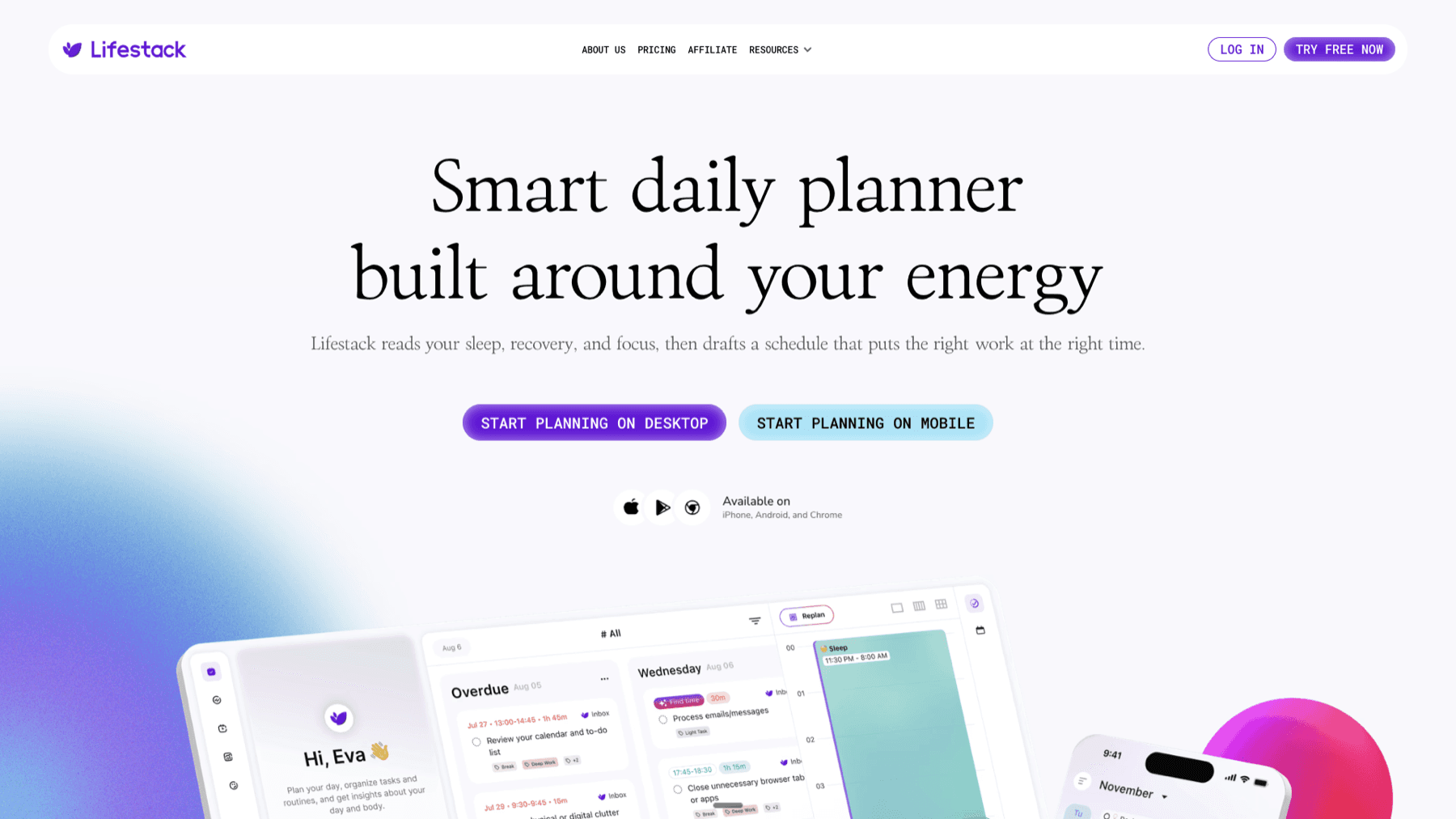
Lifestack is an AI daily planner that schedules your tasks around your energy levels and available hours rather than just your calendar. On a morning when your recovery data signals low energy, Lifestack places lower-stakes tasks in the slots where you would normally attempt your hardest work. On a high-readiness day, creative and demanding tasks get the protected time they need.
Lifestack does not currently connect directly to Fitbit or Apple Health. It uses its own energy modeling based on your task history and calendar patterns. But the underlying logic is the same: matching your work to your actual energy level produces better output than treating all hours as equivalent. For more on applying circadian rhythm insights to your daily schedule, see our related guides. Lifestack is available on iOS and Android, starting at $7/month or $50/year.
Frequently Asked Questions
Does Fitbit work with iPhone without Android?
Yes. Fitbit is fully supported on iPhone. You do not need an Android device. The Google Health app (formerly Fitbit app) is available free on the App Store and covers all core Fitbit features on iPhone.
What version of iOS does Fitbit require?
The Google Health app requires iOS 16.4 or later as of 2026. This covers iPhone 8 and all newer models. Older iPhones running iOS 15 may be able to use older versions of the Fitbit app, but current app updates require iOS 16.4 or above.
Why won't my Fitbit connect to my iPhone?
The most common causes are: Bluetooth is off on your iPhone, the Google Health app does not have Bluetooth permission (check Settings, Privacy, Bluetooth on your iPhone), or the Fitbit is still paired to a previous device. Try unpairing the Fitbit from its previous device first, then re-pairing fresh with your iPhone through the Google Health app setup flow.
Does Fitbit Wallet work with iPhone?
No. Fitbit Pay (contactless payments) is not available when Fitbit is paired to an iPhone. This feature requires Android and a Google Pay setup. iPhone users can use Apple Pay on Apple Watch for contactless payments.
Is the Fitbit app free on iPhone?
Yes. The Google Health app is free to download and use. Fitbit Premium is an optional paid tier at $9.99/month that unlocks detailed sleep analysis, wellness reports, and health trend insights. Most basic tracking features (steps, sleep, heart rate, workouts) are available without Premium.
Yes. Fitbit works with iPhone. Every current Fitbit device pairs with iPhone through the Google Health app (formerly the Fitbit app), available free on the App Store. Your iPhone needs to run iOS 16.4 or later, which covers every iPhone model from the iPhone 8 onward.
The Fitbit-iPhone pairing has been solid since Fitbit's early days, and Google has continued to maintain iOS support following its acquisition of Fitbit in 2021. As of 2026, the app is called Google Health on iOS, but it functions exactly the same as the Fitbit app did and remains the primary hub for your activity, sleep, and health data.
This guide covers the setup process, what features work on iPhone, and a few limitations worth knowing before you buy.
Key Takeaways
Fitbit works with iPhone on iOS 16.4 or later. The Google Health app (formerly Fitbit app) is free on the App Store.
All core features work on iPhone: activity tracking, sleep data, heart rate, step count, and workout summaries.
Fitbit does not integrate as deeply with Apple Health as native Apple Watch does, but data can be exported to Apple Health through the app.
What You Need to Use Fitbit With iPhone
An iPhone running iOS 16.4 or later (iPhone 8 or newer)
The Google Health app, available free on the App Store (search "Google Health" or "Fitbit")
A Google account (free) to create or log into your Fitbit profile
Bluetooth enabled on your iPhone during initial setup and for syncing
No additional hardware or paid subscription is required for basic functionality. Fitbit Premium is an optional $9.99/month subscription that adds sleep analysis details, wellness reports, guided programs, and a deeper health metrics dashboard. Most users do not need Premium to get useful data from their device.
How to Set Up Fitbit With iPhone
Step 1: Download the Google Health app from the App Store on your iPhone.
Step 2: Open the app and sign in with your Google account, or create a Fitbit account if you do not have one.
Step 3: Tap your profile icon, then select "Set up a device."
Step 4: Select your Fitbit model from the list and follow the on-screen pairing instructions.
Step 5: Make sure your iPhone's Bluetooth is on. The app will detect the Fitbit and prompt you to confirm a code displayed on the device.
Step 6: Once paired, your Fitbit will sync automatically whenever you open the Google Health app or when your iPhone is nearby.
The initial setup takes 5-10 minutes. After pairing, the app syncs in the background automatically. Most syncs complete within a minute of opening the app.
What Features Work on iPhone
The short version: everything works. There is no meaningful feature gap between Fitbit on iPhone versus Fitbit on Android for most users.
Step count and daily activity: Full data, syncing continuously throughout the day
Sleep tracking: Full sleep stage data, sleep score, time in bed vs. time asleep
Heart rate: Continuous all-day heart rate and resting heart rate trends
Exercise and workout summaries: All workout modes with GPS (on GPS-enabled models)
SpO2 (blood oxygen): Available on devices with the sensor
Notifications: Call, text, and app notifications can be pushed to your Fitbit from your iPhone
Smart features: Alarms, timers, weather (on Fitbit smartwatches like the Sense and Versa series)
One limitation worth noting: Fitbit Wallet and contactless payments are not available on iPhone-paired devices. This feature requires Android. It is the most common functionality gap between the two platforms.
Does Fitbit Sync With Apple Health?
Yes, but not by default. To send Fitbit data to Apple Health, you need to enable the connection manually:
Open the Google Health app
Tap your profile icon, then go to Health Settings
Select "Sync to Apple Health" and enable it
Choose which data types to share (steps, heart rate, sleep, etc.)
Once connected, Fitbit data flows into Apple Health and can appear in the Health app alongside data from your iPhone and any other connected devices. This is useful if you use multiple health apps or want a consolidated view of all your health data in one place.
The sync is one-directional: Fitbit data goes into Apple Health, but Apple Health data does not flow back into the Google Health app.
Fitbit vs Apple Watch on iPhone: What to Consider
Apple Watch is designed to work with iPhone and integrates more deeply with iOS than Fitbit does. If you are already deep in the Apple ecosystem (Apple Health, Siri, Apple Pay, iMessage from your wrist), Apple Watch removes friction that Fitbit adds. The best Apple Watch apps also connect directly to the iPhone features Fitbit cannot access.
Fitbit's advantages over Apple Watch on iPhone:
Battery life: Most Fitbit trackers last 5-7 days or more. Apple Watch lasts roughly 18-24 hours.
Price: Fitbit entry-level trackers cost significantly less than any Apple Watch.
Sleep tracking design: Fitbit trackers are lighter and easier to sleep with than Apple Watch.
Simplicity: If you want steps, sleep, and heart rate without app management overhead, a basic Fitbit is less complex than Apple Watch.
If recovery tracking depth matters to you, the Oura Ring is another option with strong iPhone compatibility and particularly detailed sleep and readiness data.
Using Fitbit Health Data to Plan Your Day With Lifestack
Fitbit tracks how well your body recovered overnight through its Sleep Score and daily readiness metrics. That information is useful, but most people do not act on it in any structured way. They check the score, note that they slept poorly, and then plan their day exactly as they would have regardless.
Lifestack is an AI daily planner that schedules your tasks around your energy levels and available hours rather than just your calendar. On a morning when your recovery data signals low energy, Lifestack places lower-stakes tasks in the slots where you would normally attempt your hardest work. On a high-readiness day, creative and demanding tasks get the protected time they need.
Lifestack does not currently connect directly to Fitbit or Apple Health. It uses its own energy modeling based on your task history and calendar patterns. But the underlying logic is the same: matching your work to your actual energy level produces better output than treating all hours as equivalent. For more on applying circadian rhythm insights to your daily schedule, see our related guides. Lifestack is available on iOS and Android, starting at $7/month or $50/year.
Frequently Asked Questions
Does Fitbit work with iPhone without Android?
Yes. Fitbit is fully supported on iPhone. You do not need an Android device. The Google Health app (formerly Fitbit app) is available free on the App Store and covers all core Fitbit features on iPhone.
What version of iOS does Fitbit require?
The Google Health app requires iOS 16.4 or later as of 2026. This covers iPhone 8 and all newer models. Older iPhones running iOS 15 may be able to use older versions of the Fitbit app, but current app updates require iOS 16.4 or above.
Why won't my Fitbit connect to my iPhone?
The most common causes are: Bluetooth is off on your iPhone, the Google Health app does not have Bluetooth permission (check Settings, Privacy, Bluetooth on your iPhone), or the Fitbit is still paired to a previous device. Try unpairing the Fitbit from its previous device first, then re-pairing fresh with your iPhone through the Google Health app setup flow.
Does Fitbit Wallet work with iPhone?
No. Fitbit Pay (contactless payments) is not available when Fitbit is paired to an iPhone. This feature requires Android and a Google Pay setup. iPhone users can use Apple Pay on Apple Watch for contactless payments.
Is the Fitbit app free on iPhone?
Yes. The Google Health app is free to download and use. Fitbit Premium is an optional paid tier at $9.99/month that unlocks detailed sleep analysis, wellness reports, and health trend insights. Most basic tracking features (steps, sleep, heart rate, workouts) are available without Premium.



FOLLOW ON
FOLLOW ON
FOLLOW ON


Copyright 2026 © Lifestack. All rights reserved
Copyright 2026 © Lifestack. All rights reserved

