
Device
Best Screenless Fitness Trackers in 2026
Best Screenless Fitness Trackers in 2026

A screenless fitness tracker does what every smartwatch promises but rarely delivers: genuine around-the-clock health data without the distraction of a screen. No notifications. No quick-check reflex. Just passive, continuous monitoring of the metrics that actually matter for recovery, performance, and long-term health.
The market has matured fast. Smart rings in particular have become the dominant form factor, with several brands now offering hardware that rivals clinical-grade sensors for sleep staging, HRV tracking, and stress monitoring. A few wrist bands also compete here, most notably WHOOP, which has always prioritized recovery data over display real estate.
This guide compares the five best screenless fitness trackers available in 2026, covering what each does well, where it falls short, and who it's built for. Prices and features are current as of publication.
Key Takeaways
Smart rings are the leading screenless fitness tracker category in 2026, offering clinical-quality sleep and HRV data in a low-profile form factor that you can wear 24/7.
Subscription models vary significantly: Oura Ring requires a monthly membership, while Ultrahuman, RingConn, and Opove offer all features at a one-time price.
The data a screenless tracker collects only changes your behavior if you act on it. Pairing your device with an energy-aware planning app like Lifestack closes that gap.
What to Look for in a Screenless Fitness Tracker
Before picking a device, decide what you're actually trying to track. Sleep staging accuracy matters more than step count for most people interested in recovery. HRV trends tell you more about readiness than resting heart rate alone. Subscription cost becomes a major factor over two to three years of ownership.
Sensor quality: PPG for heart rate and HRV, temperature for circadian rhythm insights, accelerometer for movement and sleep staging
Battery life: Anything under 4 days means charging during daytime hours, which disrupts continuous monitoring
Subscription model: Ongoing fees add up. A $199 ring with a $6/month subscription costs more than a $349 ring with no subscription within two years
App quality: The hardware is only as useful as the software interpreting the data. Look for trend analysis, not just daily snapshots
1. Oura Ring 4
Best overall screenless fitness tracker for most people.
The Oura Ring 4 is the most established name in smart ring health tracking, and it earns that position through genuine sensor accuracy and one of the more sophisticated apps on the market. Sleep staging, HRV, body temperature, and activity data all feed into daily Readiness, Sleep, and Activity scores that give you an actionable picture of how recovered you actually are. Step tracking is also included, though that's rarely why people buy it.
What works well: Sleep staging accuracy, HRV trend analysis, temperature-based period prediction for women, excellent app with historical data
Limitations: Requires a monthly membership ($5.99/month or $69.99/year) on top of the ring purchase. The ring itself starts at $299
Battery life: 5-8 days
Best for: Anyone who wants the most mature ecosystem and is comfortable paying the ongoing membership fee
See our dedicated guide on Oura Ring pricing for a full breakdown of what the membership includes.
2. WHOOP 5.0
Best screenless fitness tracker for performance athletes and recovery-focused users.
WHOOP takes a different approach. The hardware is a wrist band rather than a ring, and it's included free with your membership. WHOOP's core metrics are Strain (how hard you pushed) and Recovery (how ready you are), calculated from HRV, resting heart rate, and sleep quality. The device tracks 24/7 and recharges via a battery pack worn over it, so you never need to take it off.
The membership model means you're comparing ongoing costs rather than upfront price. At roughly $239/year, you're paying for hardware, data, and app access together. The recovery scoring methodology is particularly strong for training athletes who need precise readiness data.
What works well: Recovery scoring, continuous HRV measurement, no need to remove for charging, performance coaching features
Limitations: Subscription-only model means no data access if you cancel. Wrist band is less discreet than a ring
Battery life: 4-5 days (charges without removal)
Best for: Athletes who train hard and need precise recovery guidance
3. Ultrahuman Ring AIR
Best screenless fitness tracker with no subscription.
The Ultrahuman Ring AIR at $349 with no recurring fees is the cleanest value proposition in the category if you plan to keep the device for more than two years. All data, including sleep staging, HRV, body temperature, and activity, is accessible indefinitely through the Ultrahuman app at no ongoing cost. The ring itself is lightweight, water-resistant to 100m, and available in six colors across sizes 5-14.
The app surfaces a "Movement Index" for activity, "Recovery Score" for readiness, and "Sleep Score" for the previous night. Historical data trends are available, which is where continuous monitoring pays off over weeks and months of use.
What works well: No subscription, broad size range, solid sleep and HRV accuracy, competitive pricing vs Oura over the long term
Limitations: App and algorithm maturity is behind Oura. Some users find recovery coaching less specific than WHOOP
Battery life: 4-6 days
Best for: People who want a premium smart ring without a recurring monthly cost
4. RingConn Gen 2
Best battery life and best sleep apnea detection in a screenless ring.
The RingConn Gen 2 stands out on two metrics: battery life (10-12 days on a charge, the longest in the category) and FDA-cleared sleep apnea detection with 90.7% reported accuracy. At $299 with no subscription, it covers the full range of expected smart ring features: sleep staging, HRV, stress tracking, blood oxygen, skin temperature, and cycle tracking for women.
The titanium construction weighs just 2 grams, which makes it genuinely comfortable for extended wear including sleep. The HRV monitoring runs continuously, giving you trend data rather than just nightly snapshots.
What works well: Longest battery life in the category, sleep apnea detection, no subscription, lightweight build
Limitations: Less brand recognition than Oura, app ecosystem is smaller
Battery life: 10-12 days
Best for: People who prioritize not thinking about charging, or who suspect sleep apnea and want passive screening
5. Opove O Ring
Best value screenless fitness tracker for health tracking beginners.
At $199.99 with no subscription, the Opove O Ring is the most affordable way into continuous HRV and stress tracking. It monitors heart rate, HRV, stress levels, sleep, blood oxygen, body temperature, and cycle insights through the Opove app, with hourly stress trend updates throughout the day. The titanium band weighs 3.1-3.59 grams and is water-resistant to 5 ATM.
The app experience is functional rather than sophisticated. You get daily trend data and recovery tips, but the depth of analysis is shallower than Oura or WHOOP. For someone new to health tracking who wants to see whether the data changes their behavior before committing to a more expensive device, it's a strong starting point.
What works well: Lowest price in the category, no subscription, solid 24/7 HRV and stress tracking, easy to use app
Limitations: Less advanced analysis than premium options, smaller community and support ecosystem
Battery life: 5-8 days
Best for: First-time smart ring buyers, people who want core HRV tracking without premium pricing
Which Screenless Fitness Tracker Is Right for You?
Best overall with best app: Oura Ring 4 (factor in the membership cost)
Best for athletes and training load: WHOOP 5.0 (subscription-based, device included)
Best no-subscription ring: Ultrahuman Ring AIR at $349
Best battery life: RingConn Gen 2 at $299, 10-12 days
Best price: Opove O Ring at $199.99
For a broader comparison across screened and screenless wearables: see our full wearable device comparison
Best App to Pair With Your Screenless Tracker
A screenless fitness tracker gives you data. What you do with it is a different question. Most people check their sleep score, find it interesting, and then proceed with the same schedule they had yesterday regardless of what the ring is telling them.
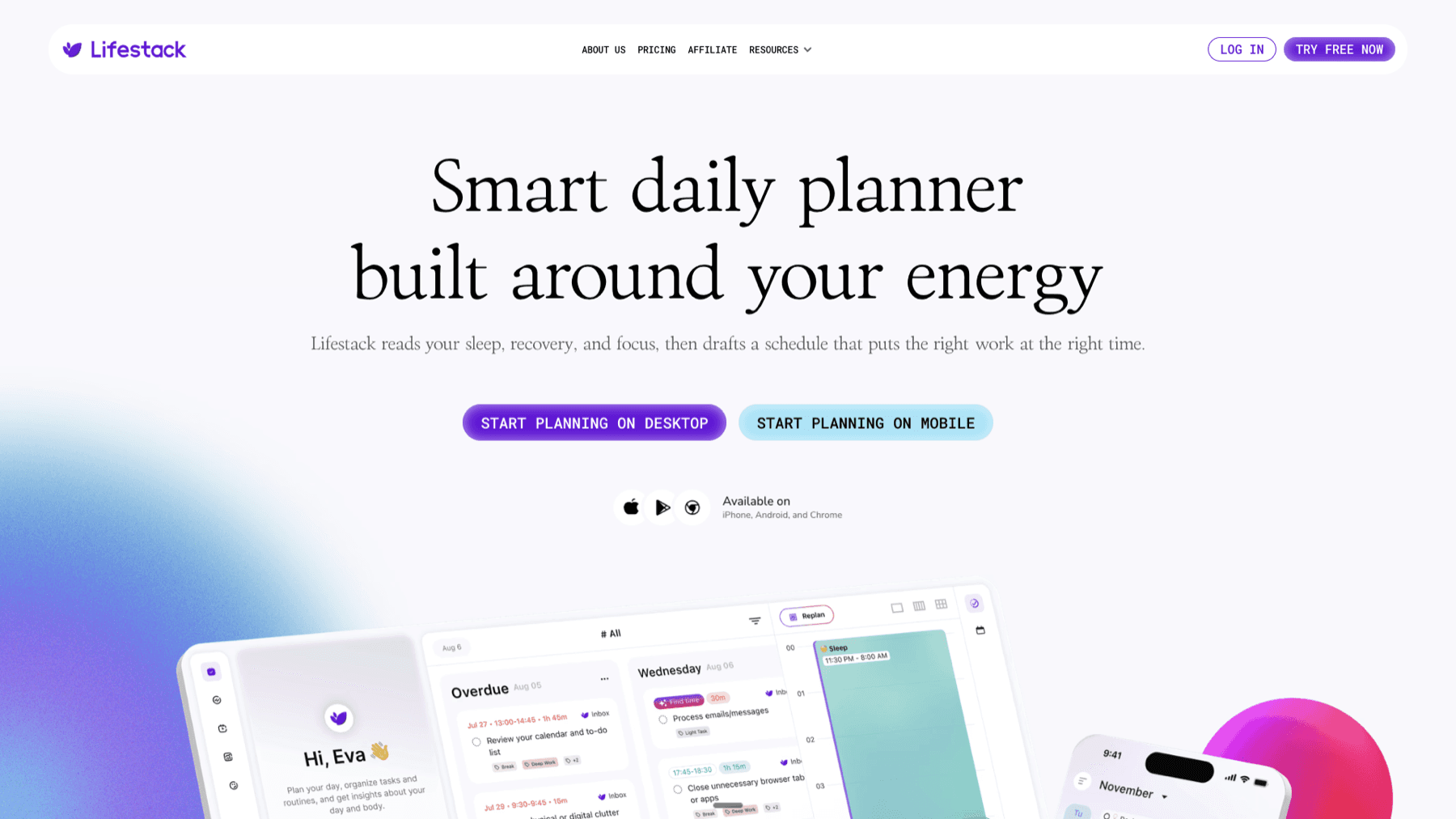
Lifestack is designed to close this gap. It reads your sleep, recovery, and energy patterns and builds your daily task schedule around your actual readiness. When your tracker shows a low recovery day, Lifestack routes demanding cognitive work away from your morning and front-loads it with lower-stake tasks. When you're fully recovered, your peak focus work gets scheduled during your biological high point. That's energy-based scheduling in practice, and it's what makes wearable data actually change how you work instead of just measuring it.
See how the approach works with a dedicated tracker in our Oura and Lifestack optimization guide, and how to get the most from the best apps to pair with Oura Ring. The same principles apply across any screenless tracker. Lifestack is $7/month, $50/year, or $120 as a lifetime purchase.
Frequently Asked Questions
What is a screenless fitness tracker?
A screenless fitness tracker is a wearable health device with no built-in display. Instead of showing data on your wrist, it sends metrics to a companion smartphone app. Smart rings (Oura, Ultrahuman, RingConn, Opove) and the WHOOP band are the most common examples. Without a screen, they're less distracting and more comfortable for continuous wear including sleep.
Are smart rings as accurate as smartwatches for health tracking?
For sleep staging and HRV, smart rings are generally comparable to and sometimes better than smartwatches. The ring position on the finger provides cleaner PPG signal for heart rate variability than the wrist, where muscle movement creates more noise. For GPS and workout tracking, smartwatches are clearly superior since smart rings lack GPS. The best choice depends on what you're primarily tracking.
Which screenless fitness tracker has the best HRV tracking?
Oura Ring 4 and WHOOP 5.0 are both well-regarded for HRV tracking accuracy and the quality of trend analysis in their respective apps. RingConn Gen 2 also offers continuous HRV monitoring with no subscription. For first-time users, any of these will give you more useful HRV trend data than you'll know what to do with in the first month.
Do screenless fitness trackers require a subscription?
Some do, some don't. Oura Ring requires a membership ($5.99/month or $69.99/year) to access full data and insights. WHOOP is subscription-only (hardware included). Ultrahuman Ring AIR, RingConn Gen 2, and Opove O Ring all include full data access at no ongoing cost. Over a two-year period, this difference can exceed $140 compared to a no-subscription ring.
Can I wear a screenless fitness tracker to sleep?
Yes, and that's one of their primary advantages over smartwatches. Smart rings in particular are designed for overnight wear: they're lightweight, have no sharp edges, and don't light up or buzz in ways that disturb sleep. The overnight HRV and sleep staging data they collect is often the most valuable health insight they provide.
A screenless fitness tracker does what every smartwatch promises but rarely delivers: genuine around-the-clock health data without the distraction of a screen. No notifications. No quick-check reflex. Just passive, continuous monitoring of the metrics that actually matter for recovery, performance, and long-term health.
The market has matured fast. Smart rings in particular have become the dominant form factor, with several brands now offering hardware that rivals clinical-grade sensors for sleep staging, HRV tracking, and stress monitoring. A few wrist bands also compete here, most notably WHOOP, which has always prioritized recovery data over display real estate.
This guide compares the five best screenless fitness trackers available in 2026, covering what each does well, where it falls short, and who it's built for. Prices and features are current as of publication.
Key Takeaways
Smart rings are the leading screenless fitness tracker category in 2026, offering clinical-quality sleep and HRV data in a low-profile form factor that you can wear 24/7.
Subscription models vary significantly: Oura Ring requires a monthly membership, while Ultrahuman, RingConn, and Opove offer all features at a one-time price.
The data a screenless tracker collects only changes your behavior if you act on it. Pairing your device with an energy-aware planning app like Lifestack closes that gap.
What to Look for in a Screenless Fitness Tracker
Before picking a device, decide what you're actually trying to track. Sleep staging accuracy matters more than step count for most people interested in recovery. HRV trends tell you more about readiness than resting heart rate alone. Subscription cost becomes a major factor over two to three years of ownership.
Sensor quality: PPG for heart rate and HRV, temperature for circadian rhythm insights, accelerometer for movement and sleep staging
Battery life: Anything under 4 days means charging during daytime hours, which disrupts continuous monitoring
Subscription model: Ongoing fees add up. A $199 ring with a $6/month subscription costs more than a $349 ring with no subscription within two years
App quality: The hardware is only as useful as the software interpreting the data. Look for trend analysis, not just daily snapshots
1. Oura Ring 4
Best overall screenless fitness tracker for most people.
The Oura Ring 4 is the most established name in smart ring health tracking, and it earns that position through genuine sensor accuracy and one of the more sophisticated apps on the market. Sleep staging, HRV, body temperature, and activity data all feed into daily Readiness, Sleep, and Activity scores that give you an actionable picture of how recovered you actually are. Step tracking is also included, though that's rarely why people buy it.
What works well: Sleep staging accuracy, HRV trend analysis, temperature-based period prediction for women, excellent app with historical data
Limitations: Requires a monthly membership ($5.99/month or $69.99/year) on top of the ring purchase. The ring itself starts at $299
Battery life: 5-8 days
Best for: Anyone who wants the most mature ecosystem and is comfortable paying the ongoing membership fee
See our dedicated guide on Oura Ring pricing for a full breakdown of what the membership includes.
2. WHOOP 5.0
Best screenless fitness tracker for performance athletes and recovery-focused users.
WHOOP takes a different approach. The hardware is a wrist band rather than a ring, and it's included free with your membership. WHOOP's core metrics are Strain (how hard you pushed) and Recovery (how ready you are), calculated from HRV, resting heart rate, and sleep quality. The device tracks 24/7 and recharges via a battery pack worn over it, so you never need to take it off.
The membership model means you're comparing ongoing costs rather than upfront price. At roughly $239/year, you're paying for hardware, data, and app access together. The recovery scoring methodology is particularly strong for training athletes who need precise readiness data.
What works well: Recovery scoring, continuous HRV measurement, no need to remove for charging, performance coaching features
Limitations: Subscription-only model means no data access if you cancel. Wrist band is less discreet than a ring
Battery life: 4-5 days (charges without removal)
Best for: Athletes who train hard and need precise recovery guidance
3. Ultrahuman Ring AIR
Best screenless fitness tracker with no subscription.
The Ultrahuman Ring AIR at $349 with no recurring fees is the cleanest value proposition in the category if you plan to keep the device for more than two years. All data, including sleep staging, HRV, body temperature, and activity, is accessible indefinitely through the Ultrahuman app at no ongoing cost. The ring itself is lightweight, water-resistant to 100m, and available in six colors across sizes 5-14.
The app surfaces a "Movement Index" for activity, "Recovery Score" for readiness, and "Sleep Score" for the previous night. Historical data trends are available, which is where continuous monitoring pays off over weeks and months of use.
What works well: No subscription, broad size range, solid sleep and HRV accuracy, competitive pricing vs Oura over the long term
Limitations: App and algorithm maturity is behind Oura. Some users find recovery coaching less specific than WHOOP
Battery life: 4-6 days
Best for: People who want a premium smart ring without a recurring monthly cost
4. RingConn Gen 2
Best battery life and best sleep apnea detection in a screenless ring.
The RingConn Gen 2 stands out on two metrics: battery life (10-12 days on a charge, the longest in the category) and FDA-cleared sleep apnea detection with 90.7% reported accuracy. At $299 with no subscription, it covers the full range of expected smart ring features: sleep staging, HRV, stress tracking, blood oxygen, skin temperature, and cycle tracking for women.
The titanium construction weighs just 2 grams, which makes it genuinely comfortable for extended wear including sleep. The HRV monitoring runs continuously, giving you trend data rather than just nightly snapshots.
What works well: Longest battery life in the category, sleep apnea detection, no subscription, lightweight build
Limitations: Less brand recognition than Oura, app ecosystem is smaller
Battery life: 10-12 days
Best for: People who prioritize not thinking about charging, or who suspect sleep apnea and want passive screening
5. Opove O Ring
Best value screenless fitness tracker for health tracking beginners.
At $199.99 with no subscription, the Opove O Ring is the most affordable way into continuous HRV and stress tracking. It monitors heart rate, HRV, stress levels, sleep, blood oxygen, body temperature, and cycle insights through the Opove app, with hourly stress trend updates throughout the day. The titanium band weighs 3.1-3.59 grams and is water-resistant to 5 ATM.
The app experience is functional rather than sophisticated. You get daily trend data and recovery tips, but the depth of analysis is shallower than Oura or WHOOP. For someone new to health tracking who wants to see whether the data changes their behavior before committing to a more expensive device, it's a strong starting point.
What works well: Lowest price in the category, no subscription, solid 24/7 HRV and stress tracking, easy to use app
Limitations: Less advanced analysis than premium options, smaller community and support ecosystem
Battery life: 5-8 days
Best for: First-time smart ring buyers, people who want core HRV tracking without premium pricing
Which Screenless Fitness Tracker Is Right for You?
Best overall with best app: Oura Ring 4 (factor in the membership cost)
Best for athletes and training load: WHOOP 5.0 (subscription-based, device included)
Best no-subscription ring: Ultrahuman Ring AIR at $349
Best battery life: RingConn Gen 2 at $299, 10-12 days
Best price: Opove O Ring at $199.99
For a broader comparison across screened and screenless wearables: see our full wearable device comparison
Best App to Pair With Your Screenless Tracker
A screenless fitness tracker gives you data. What you do with it is a different question. Most people check their sleep score, find it interesting, and then proceed with the same schedule they had yesterday regardless of what the ring is telling them.
Lifestack is designed to close this gap. It reads your sleep, recovery, and energy patterns and builds your daily task schedule around your actual readiness. When your tracker shows a low recovery day, Lifestack routes demanding cognitive work away from your morning and front-loads it with lower-stake tasks. When you're fully recovered, your peak focus work gets scheduled during your biological high point. That's energy-based scheduling in practice, and it's what makes wearable data actually change how you work instead of just measuring it.
See how the approach works with a dedicated tracker in our Oura and Lifestack optimization guide, and how to get the most from the best apps to pair with Oura Ring. The same principles apply across any screenless tracker. Lifestack is $7/month, $50/year, or $120 as a lifetime purchase.
Frequently Asked Questions
What is a screenless fitness tracker?
A screenless fitness tracker is a wearable health device with no built-in display. Instead of showing data on your wrist, it sends metrics to a companion smartphone app. Smart rings (Oura, Ultrahuman, RingConn, Opove) and the WHOOP band are the most common examples. Without a screen, they're less distracting and more comfortable for continuous wear including sleep.
Are smart rings as accurate as smartwatches for health tracking?
For sleep staging and HRV, smart rings are generally comparable to and sometimes better than smartwatches. The ring position on the finger provides cleaner PPG signal for heart rate variability than the wrist, where muscle movement creates more noise. For GPS and workout tracking, smartwatches are clearly superior since smart rings lack GPS. The best choice depends on what you're primarily tracking.
Which screenless fitness tracker has the best HRV tracking?
Oura Ring 4 and WHOOP 5.0 are both well-regarded for HRV tracking accuracy and the quality of trend analysis in their respective apps. RingConn Gen 2 also offers continuous HRV monitoring with no subscription. For first-time users, any of these will give you more useful HRV trend data than you'll know what to do with in the first month.
Do screenless fitness trackers require a subscription?
Some do, some don't. Oura Ring requires a membership ($5.99/month or $69.99/year) to access full data and insights. WHOOP is subscription-only (hardware included). Ultrahuman Ring AIR, RingConn Gen 2, and Opove O Ring all include full data access at no ongoing cost. Over a two-year period, this difference can exceed $140 compared to a no-subscription ring.
Can I wear a screenless fitness tracker to sleep?
Yes, and that's one of their primary advantages over smartwatches. Smart rings in particular are designed for overnight wear: they're lightweight, have no sharp edges, and don't light up or buzz in ways that disturb sleep. The overnight HRV and sleep staging data they collect is often the most valuable health insight they provide.



FOLLOW ON
FOLLOW ON
FOLLOW ON


Copyright 2026 © Lifestack. All rights reserved
Copyright 2026 © Lifestack. All rights reserved

