
App
Hume Band vs WHOOP
Hume Band vs WHOOP

Hume Band vs WHOOP: The Core Difference
Two screenless wristbands. Both track your recovery. Both monitor heart rate variability. But the moment you start comparing Hume Band and WHOOP side by side, you realize they are solving completely different problems.
WHOOP was built for athletes who want to know if they should train hard or hold back today. Its entire framework revolves around Strain (how hard you pushed) and Recovery (how ready your body is). It has been adopted by Olympic teams, NFL players, and serious gym-goers who treat every metric as a coaching cue.
Hume Band takes the opposite angle. Its flagship metrics are Metabolic Capacity and Metabolic Momentum, designed to show you not just how recovered you are today, but how fast your body is aging. It is built for people who care more about living longer than running a faster 5K.
Neither one is objectively better. The right choice comes down to your goals. This comparison covers everything that matters: tracking accuracy, app experience, subscription model, battery life, and who each wearable is actually for.
Key Takeaways
WHOOP is the stronger choice for performance athletes who live by recovery scores and want ECG, VO2 Max, and real-time strain coaching.
Hume Band wins on value for longevity-focused users: one-time hardware cost, no mandatory subscription, and unique biological age tracking.
Both lack GPS and a screen, but Hume Band's extended battery life significantly outlasts WHOOP's 4 to 5 day charge window in real-world use.
Quick Verdict
Hume Band: Best for longevity-focused users who want to track biological age, metabolic health, and recovery without a monthly fee.
WHOOP: Best for performance athletes who want detailed strain and recovery coaching, ECG, and a data-rich app ecosystem.
Hume Band 2.0 Overview
The longevity wearable that owns your data outright.
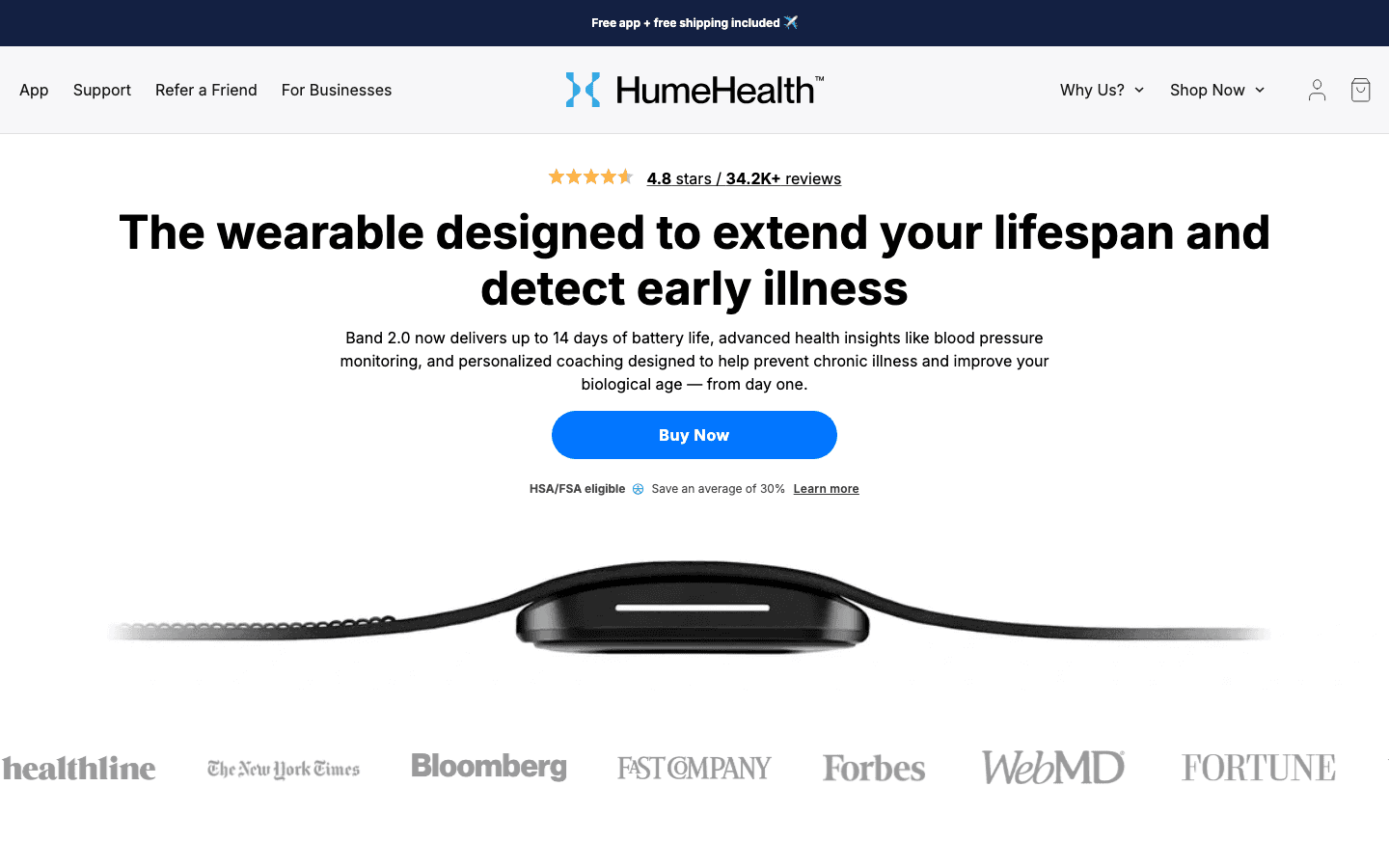
Hume Band 2.0 launched as a direct counter to the subscription-everything model that WHOOP popularized. You buy the band once for $267 and you get the full app with core tracking included. There is an optional Premium tier at $8.99/month for AI coaching reports and deeper trend analysis, but nothing is gated if you skip it.
The standout metric is Metabolic Momentum, which tracks the velocity of your biological aging. Pair that with Metabolic Capacity (how efficiently your body converts energy), and you get a health picture that goes beyond today's recovery score into long-term trajectory. Blood pressure trend insights are new in the 2.0 hardware, though the company is careful to call them wellness trends rather than clinical measurements.
Biological age and Metabolic Momentum tracking
HRV, SpO2, sleep staging, skin temperature, strain, recovery
Blood pressure trend insights (2.0 hardware)
IP68 water resistance
Up to 14-day battery (realistic: 7-10 days)
No mandatory subscription
What Works:
One-time hardware cost removes year-over-year subscription drag
Long battery means fewer charging interruptions mid-sleep-cycle
Longevity framing reduces anxiety around single-day score dips
Limitations:
Optical HR lags during heavy compound lifts
No GPS, no ECG, no VO2 Max estimate
Smaller user community than WHOOP; less peer-reviewed accuracy research
Pricing: $267 one-time (hardware + free core app). Optional Premium: $8.99/month for AI reports.
Best for: Users prioritizing longevity, metabolic health, and avoiding ongoing subscription costs.
WHOOP 5.0 Overview
The performance recovery system used by elite athletes worldwide.
WHOOP ships no hardware upfront at retail. You pay a membership and the band ships with it. The 5.0 generation brought three subscription tiers: WHOOP One at $199/year, WHOOP Peak at $239/year (adds wireless PowerPack and stress monitoring), and WHOOP Life at $359/year with the MG medical-grade hardware that includes ECG and AFib detection.
The core loop is daily Strain and Recovery scores, built on continuous heart rate and HRV data captured at 26 Hz. The coaching tab gives you concrete guidance: train hard, take it easy, or add a second workout. For athletes who want data to drive training decisions, this is the most refined system available in a screenless wearable. Our guide on what your recovery score means gives more context on using these numbers effectively.
Strain and Recovery coaching with daily readiness score
HRV, heart rate (26 Hz), SpO2, skin temperature, sleep staging
ECG and AFib detection (Life/MG tier only)
VO2 Max estimate, healthspan score, stress monitor
14-day battery on WHOOP 5.0
Large accessory ecosystem; waterproof to 10 meters
What Works:
The most athlete-validated recovery framework on the market
High 26 Hz sensor sampling rate improves workout-time accuracy
Strong community and peer comparison features
Limitations:
Mandatory subscription; hardware costs mount year after year
No longevity or biological age metrics
ECG and AFib locked to the top-tier plan at $359/year
No GPS
Pricing: One $199/yr, Peak $239/yr, Life $359/yr. Full breakdown in our guide on WHOOP membership cost. For alternatives, see the best WHOOP competitors.
Best for: Performance athletes with structured training who want data-backed coaching every cycle.
Head-to-Head Comparison
Here is how the two wearables stack up across the metrics that matter:
Subscription model: Hume Band wins for budget-conscious buyers. $267 one-time vs WHOOP's $199-$359 annually. Over 3 years, WHOOP One runs roughly $600; Hume Band runs $267 plus optional Premium if you want it.
Battery life: Hume Band. Realistic 7-10 days vs WHOOP 5.0's 4-5 days in practice. Fewer mid-sleep-cycle charging gaps.
Athletic recovery coaching: WHOOP clearly. The Strain and Recovery framework is more granular and sports-validated. See also Athlytic vs WHOOP for an app-based alternative on Apple Watch.
Longevity tracking: Hume Band by default. WHOOP has no biological age or metabolic trajectory metrics.
HRV accuracy: WHOOP's 26 Hz sampling rate gives it an edge, especially during workouts. For reference ranges, see our HRV chart by age and guide to RMSSD and HRV metrics.
Sleep tracking: Roughly equal. Both capture staging, SpO2, and temperature. WHOOP's Sleep Coach is slightly more actionable for performance planning.
Advanced sensors: WHOOP Life wins with ECG and AFib. Hume's blood pressure insights are trend-based wellness data, not clinical-grade readings.
Waterproofing: WHOOP wins at 10M vs Hume's IP68 (1M, 2 hours). Details in our post on WHOOP waterproofing.
Which Should You Choose?
Choose Hume Band if your core question is "how is my body aging over time?" You want a wearable that tracks long-term metabolic trajectory, you prefer paying once over a recurring subscription, and you do not need ECG or VO2 Max. The extended battery life is a genuine quality-of-life win for nightly sleep tracking.
Choose WHOOP if your core question is "should I train hard today?" You have structured training blocks and want the most validated recovery coaching available in a screenless form factor. If you are weighing the Life tier for ECG, also compare it against the Oura Ring 4 which offers similar health sensors at a different price point.
A useful framing: WHOOP users check their app before every workout. Hume Band users check theirs to see how their decade is going.
One Thing Both Miss
Neither wearable connects your recovery data to your actual schedule. Lifestack does that: it reads your energy levels and auto-schedules your tasks around when you will genuinely have the capacity to do them. Whether you train by WHOOP's Strain scores or track Hume's metabolic momentum, Lifestack translates those signals into a plan that fits your day.
Frequently Asked Questions
Is Hume Band better than WHOOP for general health tracking?
For general health rather than athletic performance, Hume Band is the stronger choice. Its biological age and metabolic momentum metrics give a long-term perspective that WHOOP's strain and recovery framework does not cover. It also costs less over time with no mandatory subscription.
Can you use Hume Band without a subscription?
Yes. Core tracking (HRV, sleep, recovery, metabolic metrics) is included free with the hardware. The optional Premium tier at $8.99/month adds AI coaching reports and advanced trend analysis. Unlike WHOOP, nothing essential is locked behind the paywall.
Does WHOOP work for non-athletes?
Yes, though it is optimized for structured training. Non-athletes still benefit from sleep staging, HRV trends, and stress monitoring. WHOOP One at $199/year is the most accessible entry point. That said, if you do not train regularly, many of the Strain coaching features will not apply to your lifestyle.
How accurate is Hume Band's heart rate tracking?
At rest and during low-intensity activity, accuracy is solid. During heavy compound lifts, optical wrist HR typically lags by a few beats per minute. This is a limitation shared by most wrist-based wearables. For precise workout heart rate, a chest strap still outperforms any wristband.
What is Hume Band's Metabolic Momentum?
Metabolic Momentum is Hume's metric for the rate at which your body is aging at the cellular level. It uses HRV, sleep quality, activity, and temperature patterns to estimate whether your biological age is trending younger or older over time. Think of it as a speedometer for aging rather than just a snapshot of today's readiness.
Does WHOOP track steps?
Yes, though WHOOP does not emphasize steps as a primary metric. It focuses on Strain intensity over raw step count. Details in our guide on does WHOOP track steps. If step-counting matters to you, our screenless fitness tracker comparison covers more options.
Hume Band vs WHOOP: The Core Difference
Two screenless wristbands. Both track your recovery. Both monitor heart rate variability. But the moment you start comparing Hume Band and WHOOP side by side, you realize they are solving completely different problems.
WHOOP was built for athletes who want to know if they should train hard or hold back today. Its entire framework revolves around Strain (how hard you pushed) and Recovery (how ready your body is). It has been adopted by Olympic teams, NFL players, and serious gym-goers who treat every metric as a coaching cue.
Hume Band takes the opposite angle. Its flagship metrics are Metabolic Capacity and Metabolic Momentum, designed to show you not just how recovered you are today, but how fast your body is aging. It is built for people who care more about living longer than running a faster 5K.
Neither one is objectively better. The right choice comes down to your goals. This comparison covers everything that matters: tracking accuracy, app experience, subscription model, battery life, and who each wearable is actually for.
Key Takeaways
WHOOP is the stronger choice for performance athletes who live by recovery scores and want ECG, VO2 Max, and real-time strain coaching.
Hume Band wins on value for longevity-focused users: one-time hardware cost, no mandatory subscription, and unique biological age tracking.
Both lack GPS and a screen, but Hume Band's extended battery life significantly outlasts WHOOP's 4 to 5 day charge window in real-world use.
Quick Verdict
Hume Band: Best for longevity-focused users who want to track biological age, metabolic health, and recovery without a monthly fee.
WHOOP: Best for performance athletes who want detailed strain and recovery coaching, ECG, and a data-rich app ecosystem.
Hume Band 2.0 Overview
The longevity wearable that owns your data outright.
Hume Band 2.0 launched as a direct counter to the subscription-everything model that WHOOP popularized. You buy the band once for $267 and you get the full app with core tracking included. There is an optional Premium tier at $8.99/month for AI coaching reports and deeper trend analysis, but nothing is gated if you skip it.
The standout metric is Metabolic Momentum, which tracks the velocity of your biological aging. Pair that with Metabolic Capacity (how efficiently your body converts energy), and you get a health picture that goes beyond today's recovery score into long-term trajectory. Blood pressure trend insights are new in the 2.0 hardware, though the company is careful to call them wellness trends rather than clinical measurements.
Biological age and Metabolic Momentum tracking
HRV, SpO2, sleep staging, skin temperature, strain, recovery
Blood pressure trend insights (2.0 hardware)
IP68 water resistance
Up to 14-day battery (realistic: 7-10 days)
No mandatory subscription
What Works:
One-time hardware cost removes year-over-year subscription drag
Long battery means fewer charging interruptions mid-sleep-cycle
Longevity framing reduces anxiety around single-day score dips
Limitations:
Optical HR lags during heavy compound lifts
No GPS, no ECG, no VO2 Max estimate
Smaller user community than WHOOP; less peer-reviewed accuracy research
Pricing: $267 one-time (hardware + free core app). Optional Premium: $8.99/month for AI reports.
Best for: Users prioritizing longevity, metabolic health, and avoiding ongoing subscription costs.
WHOOP 5.0 Overview
The performance recovery system used by elite athletes worldwide.
WHOOP ships no hardware upfront at retail. You pay a membership and the band ships with it. The 5.0 generation brought three subscription tiers: WHOOP One at $199/year, WHOOP Peak at $239/year (adds wireless PowerPack and stress monitoring), and WHOOP Life at $359/year with the MG medical-grade hardware that includes ECG and AFib detection.
The core loop is daily Strain and Recovery scores, built on continuous heart rate and HRV data captured at 26 Hz. The coaching tab gives you concrete guidance: train hard, take it easy, or add a second workout. For athletes who want data to drive training decisions, this is the most refined system available in a screenless wearable. Our guide on what your recovery score means gives more context on using these numbers effectively.
Strain and Recovery coaching with daily readiness score
HRV, heart rate (26 Hz), SpO2, skin temperature, sleep staging
ECG and AFib detection (Life/MG tier only)
VO2 Max estimate, healthspan score, stress monitor
14-day battery on WHOOP 5.0
Large accessory ecosystem; waterproof to 10 meters
What Works:
The most athlete-validated recovery framework on the market
High 26 Hz sensor sampling rate improves workout-time accuracy
Strong community and peer comparison features
Limitations:
Mandatory subscription; hardware costs mount year after year
No longevity or biological age metrics
ECG and AFib locked to the top-tier plan at $359/year
No GPS
Pricing: One $199/yr, Peak $239/yr, Life $359/yr. Full breakdown in our guide on WHOOP membership cost. For alternatives, see the best WHOOP competitors.
Best for: Performance athletes with structured training who want data-backed coaching every cycle.
Head-to-Head Comparison
Here is how the two wearables stack up across the metrics that matter:
Subscription model: Hume Band wins for budget-conscious buyers. $267 one-time vs WHOOP's $199-$359 annually. Over 3 years, WHOOP One runs roughly $600; Hume Band runs $267 plus optional Premium if you want it.
Battery life: Hume Band. Realistic 7-10 days vs WHOOP 5.0's 4-5 days in practice. Fewer mid-sleep-cycle charging gaps.
Athletic recovery coaching: WHOOP clearly. The Strain and Recovery framework is more granular and sports-validated. See also Athlytic vs WHOOP for an app-based alternative on Apple Watch.
Longevity tracking: Hume Band by default. WHOOP has no biological age or metabolic trajectory metrics.
HRV accuracy: WHOOP's 26 Hz sampling rate gives it an edge, especially during workouts. For reference ranges, see our HRV chart by age and guide to RMSSD and HRV metrics.
Sleep tracking: Roughly equal. Both capture staging, SpO2, and temperature. WHOOP's Sleep Coach is slightly more actionable for performance planning.
Advanced sensors: WHOOP Life wins with ECG and AFib. Hume's blood pressure insights are trend-based wellness data, not clinical-grade readings.
Waterproofing: WHOOP wins at 10M vs Hume's IP68 (1M, 2 hours). Details in our post on WHOOP waterproofing.
Which Should You Choose?
Choose Hume Band if your core question is "how is my body aging over time?" You want a wearable that tracks long-term metabolic trajectory, you prefer paying once over a recurring subscription, and you do not need ECG or VO2 Max. The extended battery life is a genuine quality-of-life win for nightly sleep tracking.
Choose WHOOP if your core question is "should I train hard today?" You have structured training blocks and want the most validated recovery coaching available in a screenless form factor. If you are weighing the Life tier for ECG, also compare it against the Oura Ring 4 which offers similar health sensors at a different price point.
A useful framing: WHOOP users check their app before every workout. Hume Band users check theirs to see how their decade is going.
One Thing Both Miss
Neither wearable connects your recovery data to your actual schedule. Lifestack does that: it reads your energy levels and auto-schedules your tasks around when you will genuinely have the capacity to do them. Whether you train by WHOOP's Strain scores or track Hume's metabolic momentum, Lifestack translates those signals into a plan that fits your day.
Frequently Asked Questions
Is Hume Band better than WHOOP for general health tracking?
For general health rather than athletic performance, Hume Band is the stronger choice. Its biological age and metabolic momentum metrics give a long-term perspective that WHOOP's strain and recovery framework does not cover. It also costs less over time with no mandatory subscription.
Can you use Hume Band without a subscription?
Yes. Core tracking (HRV, sleep, recovery, metabolic metrics) is included free with the hardware. The optional Premium tier at $8.99/month adds AI coaching reports and advanced trend analysis. Unlike WHOOP, nothing essential is locked behind the paywall.
Does WHOOP work for non-athletes?
Yes, though it is optimized for structured training. Non-athletes still benefit from sleep staging, HRV trends, and stress monitoring. WHOOP One at $199/year is the most accessible entry point. That said, if you do not train regularly, many of the Strain coaching features will not apply to your lifestyle.
How accurate is Hume Band's heart rate tracking?
At rest and during low-intensity activity, accuracy is solid. During heavy compound lifts, optical wrist HR typically lags by a few beats per minute. This is a limitation shared by most wrist-based wearables. For precise workout heart rate, a chest strap still outperforms any wristband.
What is Hume Band's Metabolic Momentum?
Metabolic Momentum is Hume's metric for the rate at which your body is aging at the cellular level. It uses HRV, sleep quality, activity, and temperature patterns to estimate whether your biological age is trending younger or older over time. Think of it as a speedometer for aging rather than just a snapshot of today's readiness.
Does WHOOP track steps?
Yes, though WHOOP does not emphasize steps as a primary metric. It focuses on Strain intensity over raw step count. Details in our guide on does WHOOP track steps. If step-counting matters to you, our screenless fitness tracker comparison covers more options.



FOLLOW ON
FOLLOW ON
FOLLOW ON


Copyright 2026 © Lifestack. All rights reserved
Copyright 2026 © Lifestack. All rights reserved

