
Device
Fitbit Air vs WHOOP: Which Tracker Is Worth It?
Fitbit Air vs WHOOP: Which Tracker Is Worth It?

Two screenless fitness trackers occupy the same niche but take completely different approaches to getting you there. The Fitbit Air (Google's $99.99 screenless band) is built around accessibility: no display, no subscription required for core features, and a lightweight form that disappears on your wrist. WHOOP is built around depth: a subscription model that includes the hardware, a coaching layer with Training and Sleep Coach, and an established track record among serious athletes.
The question of which to choose mostly comes down to how much you're willing to pay and what kind of data you want back. Over $350 cheaper in year one, the Fitbit Air is a genuinely compelling option for casual users. WHOOP has earned its following for a reason. Here's how they actually compare.
Key Takeaways
The Fitbit Air costs $99.99 with no required subscription. WHOOP starts at $199/year with the hardware included in the membership price.
WHOOP's heart rate accuracy during high-intensity exercise is currently better than the Fitbit Air's. For casual users and sleep tracking, the gap is smaller.
Google's AI coaching integration in the Fitbit app is more contextual and accessible. WHOOP's coaching is more detailed but requires more active engagement.
Quick Verdict
Fitbit Air: Best for casual fitness tracking, sleep monitoring, and anyone who refuses to pay a subscription. The Google Health app's AI coaching is a genuine advantage.
WHOOP: Best for serious athletes who train consistently and want granular recovery data, strain tracking, and accurate heart rate during intense workouts.
Fitbit Air Overview
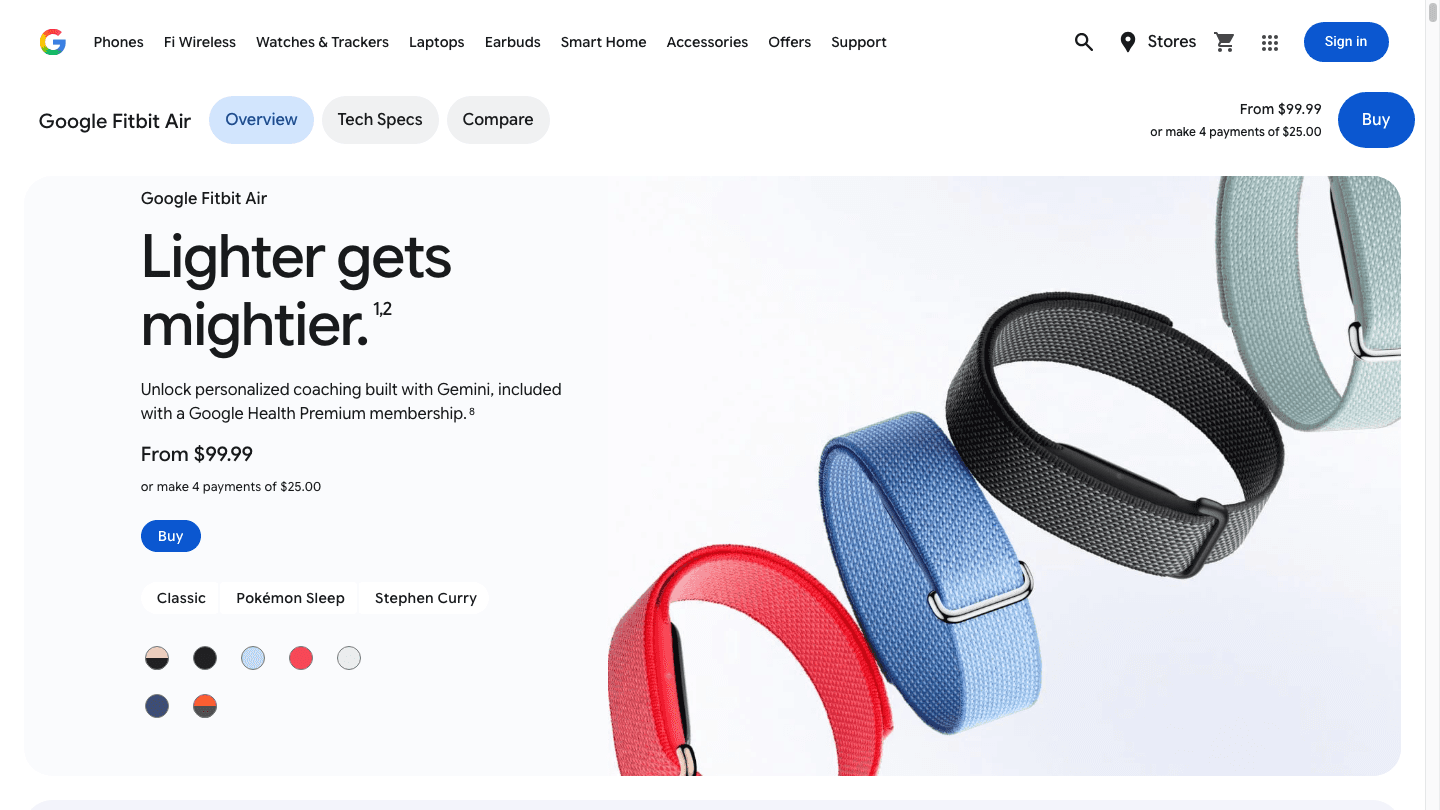
The Fitbit Air is Google's entry into the screenless tracker category. The pod-and-band design weighs 5.2g without the band (12g total with the Classic band), making it the lightest tracker in this space by a meaningful margin. It's essentially invisible during wear, which matters for sleep and round-the-clock tracking.
Sensors include optical heart rate, SpO2, skin temperature deviation, and an accelerometer for activity and sleep stage detection. AFib rhythm alerts are included for users 22 and older. Battery life is rated at seven days with fast-charge support: five minutes gives you one full day of use.
The Fitbit app (now Google Health) handles data interpretation. AI coaching surfaces insights throughout the app rather than as a separate feature. Core features, including sleep stages, daily readiness, and HRV tracking, work without a subscription. Google Health Premium ($9.99/month or $99/year) adds deeper trend analysis and personalized guidance. Three months of Premium are included with purchase.
What the Fitbit Air Does Well
Lowest upfront cost in the screenless tracker category at $99.99
No subscription required for core health tracking
Lightest form factor in the category (5.2g pod)
Google AI coaching woven throughout the app, not siloed
AFib rhythm alerts without additional subscription
7-day battery with 5-minute fast charge
Where It Falls Short
Heart rate accuracy during HIIT and high-intensity intervals lags behind WHOOP
Thinner design creates more light leakage at the sensor, affecting optical accuracy
No GPS (relies on phone for route tracking)
Nap detection data can take hours to process
Pricing: Fitbit Air: $99.99 (Classic Loop), $129.99 (Curry Edition). Google Health Premium: $9.99/month or $99/year (3 months included free).
Best for: Casual users, sleep-focused trackers, and anyone who wants passive health data without recurring fees.
WHOOP 5.0 Overview

WHOOP operates on a membership model. The hardware ships free with any active subscription: WHOOP One ($199/year, ~$25/month) for core tracking, WHOOP Peak ($239/year) for Sleep Coach and Strain Coach, and WHOOP Life ($359/year) which ships the medical-grade WHOOP MG with ECG and blood pressure insights instead of the standard 5.0.
The WHOOP 5.0 itself is a 14-day battery tracker with IP68 water resistance, 145+ activity detection, and an algorithm built specifically around recovery and strain optimization. The strain metric quantifies how hard your cardiovascular system worked during the day, while recovery scores each morning synthesize HRV, resting heart rate, sleep quality, and recent strain into a daily readiness signal.
Accuracy is WHOOP's strongest argument. The optical sensor placement and algorithm have been validated in multiple third-party studies. During cycling, interval runs, and strength sessions, WHOOP's heart rate readings are consistently more reliable than most wrist-based alternatives. For more details, see our guide on WHOOP HRV tracking and the best apps to use with WHOOP.
What WHOOP Does Well
Best-in-class heart rate accuracy during high-intensity exercise
14-day battery life with a slide-on charging puck (charge while wearing)
Strain and recovery framework built specifically for training periodization
Community features and coach sharing for team environments
WHOOP Life tier adds ECG and blood pressure insights via WHOOP MG
Where It Falls Short
Subscription cost: $199-$359/year with no path to own the hardware outright
Active engagement required to get value from coaching features
No GPS, no screen, no Bluetooth audio
Canceling the subscription means the tracker stops working
Pricing: WHOOP One: $199/year. WHOOP Peak: $239/year. WHOOP Life (WHOOP MG): $359/year. All tiers include hardware. See our breakdown of WHOOP membership costs for the full comparison.
Best for: Athletes who train consistently and want granular recovery data to guide training decisions.
Head-to-Head: Fitbit Air vs WHOOP
Pricing Over Time
Year one: Fitbit Air costs $99.99 vs WHOOP at $199-$359. By year two, assuming you keep both subscriptions: Fitbit Air users who stay free spend $99.99 total, while WHOOP users spend $398-$718 over two years. The cost difference widens over time. If you'd pay for Google Health Premium, the two-year cost rises to about $298 for Fitbit Air vs $398+ for WHOOP.
The calculation shifts if you need WHOOP's training-specific features. For casual users, the Fitbit Air's savings are hard to ignore. For athletes using WHOOP to train smarter, the cost may justify itself in injury prevention and performance gains.
Sleep Tracking
Both devices track sleep stages and give a morning readiness score. WHOOP's Sleep Coach provides recommendations on optimal bedtime and wake time based on your performance calendar. The Fitbit Air's sleep data is accurate at the macro level (total sleep, rough stage breakdown) with detailed analysis available in Google Health.
For sleep-focused users, both are good options. WHOOP's coaching layer adds more actionable guidance. The Fitbit Air's Google AI integration means insights surface contextually rather than requiring you to dig into a separate coaching section. See our comparison of WHOOP sleep tracking and the Fitbit sleep tracker for deeper analysis.
Workout Accuracy
WHOOP wins here. The difference is most pronounced during high-intensity intervals and the start of vigorous exercise. The Fitbit Air's thinner form creates more optical interference; some workouts showed heart rate readings 20-40 bpm off versus WHOOP in side-by-side testing. For steady-state cardio and moderate-intensity workouts, the gap narrows significantly.
Recovery Data
WHOOP's strain and recovery metrics are more sophisticated and better validated. The Fitbit Air provides a daily readiness score but doesn't have the training-load awareness that WHOOP brings. For athletes periodizing their training around recovery, WHOOP's framework is the more complete tool.
Which Should You Choose?
Choose Fitbit Air if: You want passive health tracking without a subscription commitment, you're a casual exerciser or walker, you prioritize sleep monitoring and stress tracking over workout precision, or cost is a primary concern.
Choose WHOOP if: You train multiple times per week, you use training load and recovery data to make training decisions, or workout heart rate accuracy matters to you. Also consider WHOOP Life if you want ECG and blood pressure monitoring in the subscription.
For a broader comparison between Fitbit and other platforms, see our WHOOP vs Fitbit comparison and our guide to the best sleep trackers for 2026. If you're deciding between screenless trackers and traditional smartwatches, our wearable comparison guide covers all the major options.
Whichever tracker you choose, the data is only as useful as what you do with it. Lifestack takes your sleep and recovery scores from Fitbit or WHOOP and schedules your day around them, blocking focus time when your readiness is high and protecting recovery when it's low.
Frequently Asked Questions
Is the Fitbit Air a WHOOP competitor?
Yes. The Fitbit Air is explicitly positioned as a WHOOP alternative: it's a screenless fitness band focused on sleep, HRV, and recovery data. The key differences are price ($99.99 vs $199+/year subscription), workout accuracy (WHOOP currently leads), and AI coaching integration (Fitbit Air's Google-powered approach is more accessible).
Does the Fitbit Air require a subscription?
No. Core features including sleep tracking, heart rate, HRV, SpO2, and daily readiness work without a subscription. Google Health Premium ($9.99/month) adds advanced trend analysis and personalized guidance. Three months of Premium are included with purchase.
How much does WHOOP cost per month?
WHOOP One is $199/year ($16.58/month when paid annually), WHOOP Peak is $239/year ($19.92/month), and WHOOP Life is $359/year ($29.92/month). The hardware is included in the membership. See our full breakdown of WHOOP membership pricing.
Which has better sleep tracking, Fitbit Air or WHOOP?
Both are accurate for general sleep stage detection. WHOOP's Sleep Coach provides more actionable recommendations tied to your training schedule. The Fitbit Air's Google AI integration surfaces insights without requiring you to navigate to a separate coaching section. Either is a strong choice for sleep-first users.
Can you cancel WHOOP and keep using it?
No. The WHOOP hardware requires an active membership to function. Canceling the subscription stops the tracker. See our guide on how to cancel WHOOP membership for the details.
Two screenless fitness trackers occupy the same niche but take completely different approaches to getting you there. The Fitbit Air (Google's $99.99 screenless band) is built around accessibility: no display, no subscription required for core features, and a lightweight form that disappears on your wrist. WHOOP is built around depth: a subscription model that includes the hardware, a coaching layer with Training and Sleep Coach, and an established track record among serious athletes.
The question of which to choose mostly comes down to how much you're willing to pay and what kind of data you want back. Over $350 cheaper in year one, the Fitbit Air is a genuinely compelling option for casual users. WHOOP has earned its following for a reason. Here's how they actually compare.
Key Takeaways
The Fitbit Air costs $99.99 with no required subscription. WHOOP starts at $199/year with the hardware included in the membership price.
WHOOP's heart rate accuracy during high-intensity exercise is currently better than the Fitbit Air's. For casual users and sleep tracking, the gap is smaller.
Google's AI coaching integration in the Fitbit app is more contextual and accessible. WHOOP's coaching is more detailed but requires more active engagement.
Quick Verdict
Fitbit Air: Best for casual fitness tracking, sleep monitoring, and anyone who refuses to pay a subscription. The Google Health app's AI coaching is a genuine advantage.
WHOOP: Best for serious athletes who train consistently and want granular recovery data, strain tracking, and accurate heart rate during intense workouts.
Fitbit Air Overview
The Fitbit Air is Google's entry into the screenless tracker category. The pod-and-band design weighs 5.2g without the band (12g total with the Classic band), making it the lightest tracker in this space by a meaningful margin. It's essentially invisible during wear, which matters for sleep and round-the-clock tracking.
Sensors include optical heart rate, SpO2, skin temperature deviation, and an accelerometer for activity and sleep stage detection. AFib rhythm alerts are included for users 22 and older. Battery life is rated at seven days with fast-charge support: five minutes gives you one full day of use.
The Fitbit app (now Google Health) handles data interpretation. AI coaching surfaces insights throughout the app rather than as a separate feature. Core features, including sleep stages, daily readiness, and HRV tracking, work without a subscription. Google Health Premium ($9.99/month or $99/year) adds deeper trend analysis and personalized guidance. Three months of Premium are included with purchase.
What the Fitbit Air Does Well
Lowest upfront cost in the screenless tracker category at $99.99
No subscription required for core health tracking
Lightest form factor in the category (5.2g pod)
Google AI coaching woven throughout the app, not siloed
AFib rhythm alerts without additional subscription
7-day battery with 5-minute fast charge
Where It Falls Short
Heart rate accuracy during HIIT and high-intensity intervals lags behind WHOOP
Thinner design creates more light leakage at the sensor, affecting optical accuracy
No GPS (relies on phone for route tracking)
Nap detection data can take hours to process
Pricing: Fitbit Air: $99.99 (Classic Loop), $129.99 (Curry Edition). Google Health Premium: $9.99/month or $99/year (3 months included free).
Best for: Casual users, sleep-focused trackers, and anyone who wants passive health data without recurring fees.
WHOOP 5.0 Overview
WHOOP operates on a membership model. The hardware ships free with any active subscription: WHOOP One ($199/year, ~$25/month) for core tracking, WHOOP Peak ($239/year) for Sleep Coach and Strain Coach, and WHOOP Life ($359/year) which ships the medical-grade WHOOP MG with ECG and blood pressure insights instead of the standard 5.0.
The WHOOP 5.0 itself is a 14-day battery tracker with IP68 water resistance, 145+ activity detection, and an algorithm built specifically around recovery and strain optimization. The strain metric quantifies how hard your cardiovascular system worked during the day, while recovery scores each morning synthesize HRV, resting heart rate, sleep quality, and recent strain into a daily readiness signal.
Accuracy is WHOOP's strongest argument. The optical sensor placement and algorithm have been validated in multiple third-party studies. During cycling, interval runs, and strength sessions, WHOOP's heart rate readings are consistently more reliable than most wrist-based alternatives. For more details, see our guide on WHOOP HRV tracking and the best apps to use with WHOOP.
What WHOOP Does Well
Best-in-class heart rate accuracy during high-intensity exercise
14-day battery life with a slide-on charging puck (charge while wearing)
Strain and recovery framework built specifically for training periodization
Community features and coach sharing for team environments
WHOOP Life tier adds ECG and blood pressure insights via WHOOP MG
Where It Falls Short
Subscription cost: $199-$359/year with no path to own the hardware outright
Active engagement required to get value from coaching features
No GPS, no screen, no Bluetooth audio
Canceling the subscription means the tracker stops working
Pricing: WHOOP One: $199/year. WHOOP Peak: $239/year. WHOOP Life (WHOOP MG): $359/year. All tiers include hardware. See our breakdown of WHOOP membership costs for the full comparison.
Best for: Athletes who train consistently and want granular recovery data to guide training decisions.
Head-to-Head: Fitbit Air vs WHOOP
Pricing Over Time
Year one: Fitbit Air costs $99.99 vs WHOOP at $199-$359. By year two, assuming you keep both subscriptions: Fitbit Air users who stay free spend $99.99 total, while WHOOP users spend $398-$718 over two years. The cost difference widens over time. If you'd pay for Google Health Premium, the two-year cost rises to about $298 for Fitbit Air vs $398+ for WHOOP.
The calculation shifts if you need WHOOP's training-specific features. For casual users, the Fitbit Air's savings are hard to ignore. For athletes using WHOOP to train smarter, the cost may justify itself in injury prevention and performance gains.
Sleep Tracking
Both devices track sleep stages and give a morning readiness score. WHOOP's Sleep Coach provides recommendations on optimal bedtime and wake time based on your performance calendar. The Fitbit Air's sleep data is accurate at the macro level (total sleep, rough stage breakdown) with detailed analysis available in Google Health.
For sleep-focused users, both are good options. WHOOP's coaching layer adds more actionable guidance. The Fitbit Air's Google AI integration means insights surface contextually rather than requiring you to dig into a separate coaching section. See our comparison of WHOOP sleep tracking and the Fitbit sleep tracker for deeper analysis.
Workout Accuracy
WHOOP wins here. The difference is most pronounced during high-intensity intervals and the start of vigorous exercise. The Fitbit Air's thinner form creates more optical interference; some workouts showed heart rate readings 20-40 bpm off versus WHOOP in side-by-side testing. For steady-state cardio and moderate-intensity workouts, the gap narrows significantly.
Recovery Data
WHOOP's strain and recovery metrics are more sophisticated and better validated. The Fitbit Air provides a daily readiness score but doesn't have the training-load awareness that WHOOP brings. For athletes periodizing their training around recovery, WHOOP's framework is the more complete tool.
Which Should You Choose?
Choose Fitbit Air if: You want passive health tracking without a subscription commitment, you're a casual exerciser or walker, you prioritize sleep monitoring and stress tracking over workout precision, or cost is a primary concern.
Choose WHOOP if: You train multiple times per week, you use training load and recovery data to make training decisions, or workout heart rate accuracy matters to you. Also consider WHOOP Life if you want ECG and blood pressure monitoring in the subscription.
For a broader comparison between Fitbit and other platforms, see our WHOOP vs Fitbit comparison and our guide to the best sleep trackers for 2026. If you're deciding between screenless trackers and traditional smartwatches, our wearable comparison guide covers all the major options.
Whichever tracker you choose, the data is only as useful as what you do with it. Lifestack takes your sleep and recovery scores from Fitbit or WHOOP and schedules your day around them, blocking focus time when your readiness is high and protecting recovery when it's low.
Frequently Asked Questions
Is the Fitbit Air a WHOOP competitor?
Yes. The Fitbit Air is explicitly positioned as a WHOOP alternative: it's a screenless fitness band focused on sleep, HRV, and recovery data. The key differences are price ($99.99 vs $199+/year subscription), workout accuracy (WHOOP currently leads), and AI coaching integration (Fitbit Air's Google-powered approach is more accessible).
Does the Fitbit Air require a subscription?
No. Core features including sleep tracking, heart rate, HRV, SpO2, and daily readiness work without a subscription. Google Health Premium ($9.99/month) adds advanced trend analysis and personalized guidance. Three months of Premium are included with purchase.
How much does WHOOP cost per month?
WHOOP One is $199/year ($16.58/month when paid annually), WHOOP Peak is $239/year ($19.92/month), and WHOOP Life is $359/year ($29.92/month). The hardware is included in the membership. See our full breakdown of WHOOP membership pricing.
Which has better sleep tracking, Fitbit Air or WHOOP?
Both are accurate for general sleep stage detection. WHOOP's Sleep Coach provides more actionable recommendations tied to your training schedule. The Fitbit Air's Google AI integration surfaces insights without requiring you to navigate to a separate coaching section. Either is a strong choice for sleep-first users.
Can you cancel WHOOP and keep using it?
No. The WHOOP hardware requires an active membership to function. Canceling the subscription stops the tracker. See our guide on how to cancel WHOOP membership for the details.



FOLLOW ON
FOLLOW ON
FOLLOW ON


Copyright 2026 © Lifestack. All rights reserved
Copyright 2026 © Lifestack. All rights reserved

