
Device
Fitbit Versa 4 Review: Still Worth It in 2026?
Fitbit Versa 4 Review: Still Worth It in 2026?

The Fitbit Versa 4 launched in 2022 at $229.95 and has since settled into a reliable spot in the $150-180 range, making it one of the more affordable fitness smartwatches with built-in GPS. It's now owned by Google, which added Google Wallet and Google Maps navigation alongside the existing Fitbit health platform. The result is a watch that bridges Fitbit's strong fitness tracking with just enough Google ecosystem integration to stand out from the crowded mid-range field.
In testing, the Versa 4 holds up well as a daily fitness companion. The 1.58-inch AMOLED display is clear and responsive, sleep tracking is accurate, and the Google Wallet tap-to-pay works reliably. The friction comes from the Fitbit Premium paywall, which gates some of the most useful insights behind an $9.99/month subscription, and from GPS accuracy that's good but not great under tree cover.
This review covers everything you need to decide if the Versa 4 fits your needs in 2026, including who it's still a smart buy for and where it falls short compared to newer alternatives.
Key Takeaways
The Fitbit Versa 4 delivers solid daily fitness tracking, built-in GPS, 6-day battery, and Google Wallet for $159.95. Its health platform is beginner-friendly but some features require Fitbit Premium ($9.99/month).
Sleep tracking is a standout, with detailed sleep stage breakdown, Sleep Score, and temperature deviation tracking included free. Most users find this alone worth the investment.
The Versa 4 lacks ECG (available on the Fitbit Sense 2), has limited third-party app support, and GPS accuracy drops noticeably under heavy tree cover.
Design and Display
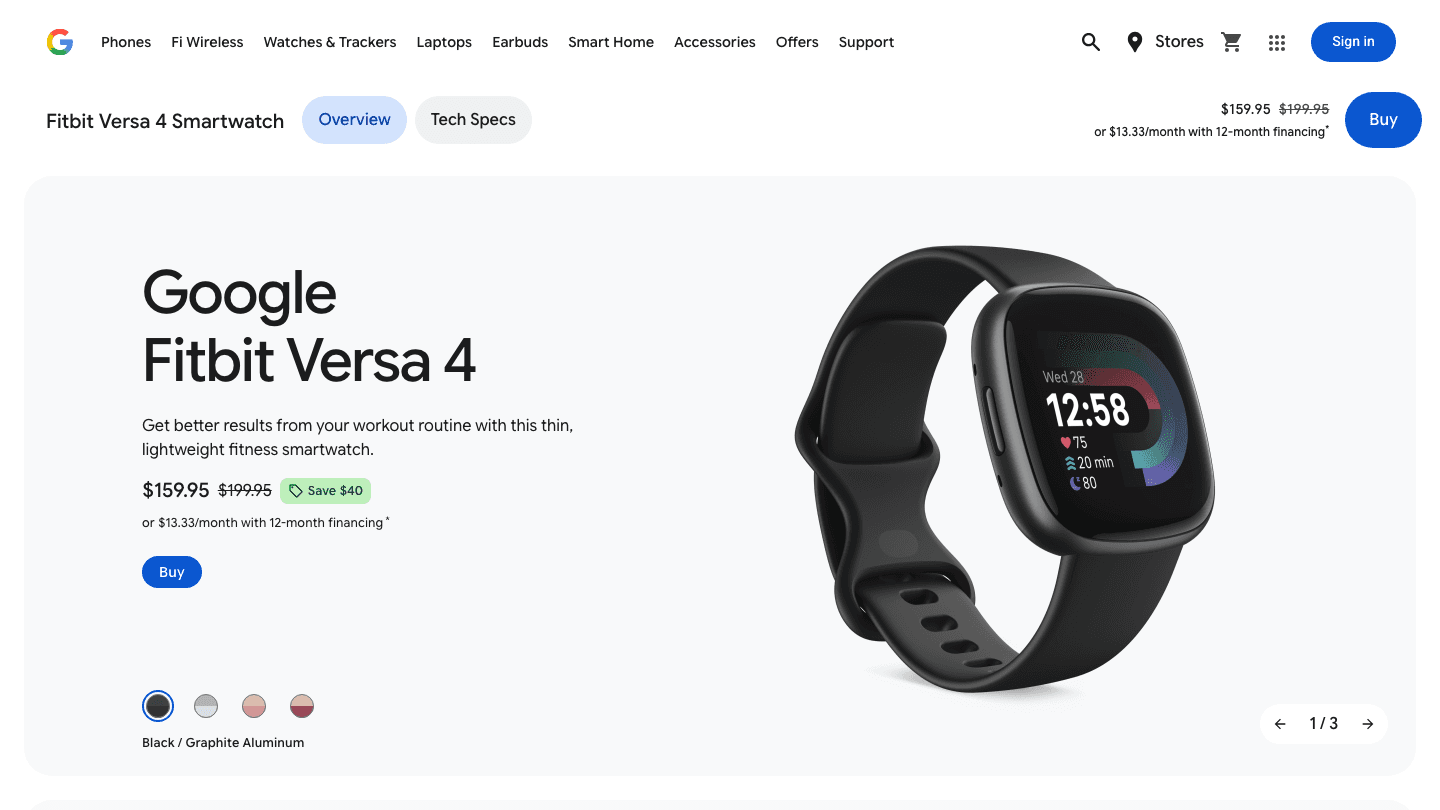
The Versa 4's design is clean and understated. The square AMOLED display at 1.58 inches (336x336 resolution) looks vivid indoors and holds up well in normal outdoor light. It's not the brightest watch on the market at this price, but it's readable for the vast majority of daily use. The aluminum case is available in four color combinations, and the lightweight build at 38g (without band) means it's comfortable to wear all day and overnight.
The physical button on the left side serves as the main navigation control alongside touchscreen swipes and taps. The interface is clean and intuitive, with a home screen customizable via Fitbit's clock face library. It charges via a proprietary magnetic clip rather than USB-C, which remains a frustration, though the fast-charge feature does give a full day of battery from 12 minutes of charging.
Health and Fitness Tracking
Fitbit's health platform is where the Versa 4 earns its reputation. The core metrics (Active Zone Minutes, Daily Readiness Score, heart rate zones, and step count) are accurate and well-presented in the Fitbit app. The watch tracks 40+ exercise modes automatically or manually, and swimming is covered up to 50 meters water resistance.
Specific sensors include 24/7 optical heart rate, SpO2, skin temperature variation (relative to your personal baseline), and EDA (electrodermal activity) for a spot-check stress measurement. There's no ECG here; if ECG is essential, the Fitbit Sense 2 is the Fitbit option at a higher price. For a direct comparison, see our Fitbit Sense 2 review.
GPS tracking works through built-in hardware, not phone-connected GPS. Routes trace accurately for road running and walking in open environments. Under dense tree cover, you'll see occasional drift, which is typical for mid-range GPS watches. Running pace and distance are reliable enough for training, though not at the accuracy level of dedicated running watches like the Garmin Forerunner series.
Sleep Tracking
Sleep tracking is the Versa 4's best feature. The watch auto-detects sleep, records time in light, deep, and REM stages, and generates a Sleep Score each morning (0-100). The SpO2 monitoring runs overnight to flag potential blood oxygen drops, and skin temperature deviation from your personal baseline can indicate illness or recovery stress.
You don't need Fitbit Premium for the core sleep data, which puts it ahead of some competitors that paywall sleep stages. The free tier gives you the full nightly breakdown, bedtime reminders, and historical charts. Premium adds Sleep Profile (a monthly analysis of your sleep animal type) and more detailed trend analysis, but the free tier is genuinely useful on its own. If you're comparing sleep tracking quality to other wearables, see how different approaches stack up in our guide to free sleep apps and trackers.
Battery Life
Fitbit rates the Versa 4 at 6 days of battery in smartwatch mode, and real-world testing lands around 5-6 days with normal use (sleep tracking on, GPS off, HR monitoring always on). Enable GPS for every workout and battery life drops significantly, to around 3-4 days with 30-45 minutes of daily GPS use.
For most people, a Sunday-to-Saturday charging schedule works. The 12-minute fast-charge to a day's worth of battery is a practical feature when you forget to charge and need to get out the door.
Google Integration and Smart Features
Since Google acquired Fitbit, the Versa 4 added Google Wallet for tap-to-pay at NFC terminals, and Google Maps turn-by-turn navigation (with phone required for mapping). Both work well. Google Assistant is available alongside Amazon Alexa for voice commands, though voice response requires your phone to be nearby.
The smart features stop there. The Versa 4 doesn't run Google Wear OS and has no third-party app store. No Spotify, no Strava widget, no third-party watch faces with live data. The clock face library is Fitbit's own selection. If you want a fully open smartwatch ecosystem, this isn't the watch. If you want a fitness tracker with smart payment and navigation built in, it covers that.
Fitbit Premium: Worth It?
Fitbit Premium costs $9.99/month or $79.99/year and unlocks Daily Readiness Score, mindfulness sessions, additional guided workouts, and advanced sleep and health trend analysis. Here's the honest breakdown:
Daily Readiness Score is useful if you train consistently; it's a single morning number showing whether to push or recover
Advanced sleep analysis (Sleep Profile, monthly sleep animal breakdown) is interesting but not essential
Guided mindfulness and workout programs are high quality for beginners
If you don't exercise regularly or don't care about advanced trends, the free tier covers everything you need
Premium is worth it for consistent athletes who want the readiness score and more structured workout guidance. For casual users, the free Fitbit experience is genuinely complete.
What We Like
6-day battery covers a full week on a single charge
Sleep tracking accuracy and detail is among the best in this price range
Google Wallet integration works smoothly for contactless payments
Lightweight, comfortable design at 38g for all-day and overnight wear
Fast charge feature is genuinely useful for morning-rush charging
What Could Be Better
No ECG; the Fitbit Sense 2 has it and costs about $30-40 more
GPS accuracy drops noticeably under tree cover for trail running
Proprietary magnetic charger instead of USB-C
No third-party app store limits what you can add to the watch
Some useful features require the $9.99/month Fitbit Premium subscription
Who Should Buy the Fitbit Versa 4
The Versa 4 is the right watch for someone who wants a comfortable, long-lasting fitness tracker with solid sleep data and contactless payments, and doesn't need ECG, advanced running metrics, or third-party apps. At $159.95, it delivers more features than most fitness bands and more comfort than most entry-level GPS watches.
Skip it if you're a serious runner (look at Garmin's Forerunner line), if you need ECG capability (get the Fitbit Sense 2 or a Garmin Venu), or if you want an open smartwatch ecosystem (consider Wear OS options or the Apple Watch SE). For a comparison of how Fitbit stacks up against dedicated recovery trackers, see our Whoop vs Fitbit breakdown.
A Smarter Layer on Top of Your Fitness Data
The Versa 4's Daily Readiness Score and sleep data tell you how recovered you are each morning. The harder part is actually planning your day differently based on that number. Lifestack is an AI scheduler that adjusts your daily task load around your energy levels, scheduling deep work when you're sharp and lighter tasks when you're not. It's the planning layer that turns Fitbit's readiness signal into an adjusted schedule. See how energy-aware scheduling works in practice alongside any fitness tracker.
Frequently Asked Questions
Is the Fitbit Versa 4 still worth buying in 2026?
Yes, at $159.95 it remains a solid pick for everyday fitness and sleep tracking with built-in GPS and Google Wallet. It's not cutting-edge, but the core health tracking is accurate, the battery lasts a week, and it's comfortable to wear all day. If you primarily want a fitness tracker with sleep data, it holds up well.
Does the Fitbit Versa 4 have GPS?
Yes. The Versa 4 has built-in GPS, which means it tracks outdoor workouts without needing your phone nearby. GPS accuracy is good for road running and walking; it's less reliable under dense tree cover or in urban canyons compared to watches with dual-band GPS.
What is the difference between Fitbit Versa 4 and Sense 2?
The Fitbit Sense 2 adds ECG, a continuous EDA sensor (vs. the Versa 4's spot-check), and a slightly larger display. The Versa 4 is typically $30-40 cheaper. If ECG monitoring matters to you, get the Sense 2. If it doesn't, the Versa 4 covers the same fitness tracking and sleep data at a lower price.
How long does the Fitbit Versa 4 battery last?
Up to 6 days in normal smartwatch mode. With daily GPS workouts of 30-45 minutes, expect 3-4 days. The fast-charge feature delivers a full day's charge in 12 minutes, which helps if you forget to charge.
Does the Fitbit Versa 4 work with iPhone?
Yes. The Versa 4 is compatible with both iOS and Android. iPhone users get most features, though some functions (like replying to messages by voice) work better on Android. Google Wallet is supported on both platforms for contactless payments.
Does Fitbit Versa 4 track sleep automatically?
Yes. The Versa 4 automatically detects when you fall asleep and wakes, logging sleep stages (light, deep, REM), sleep duration, and blood oxygen levels throughout the night. You get a Sleep Score each morning in the Fitbit app without needing to start any session manually.
The Fitbit Versa 4 launched in 2022 at $229.95 and has since settled into a reliable spot in the $150-180 range, making it one of the more affordable fitness smartwatches with built-in GPS. It's now owned by Google, which added Google Wallet and Google Maps navigation alongside the existing Fitbit health platform. The result is a watch that bridges Fitbit's strong fitness tracking with just enough Google ecosystem integration to stand out from the crowded mid-range field.
In testing, the Versa 4 holds up well as a daily fitness companion. The 1.58-inch AMOLED display is clear and responsive, sleep tracking is accurate, and the Google Wallet tap-to-pay works reliably. The friction comes from the Fitbit Premium paywall, which gates some of the most useful insights behind an $9.99/month subscription, and from GPS accuracy that's good but not great under tree cover.
This review covers everything you need to decide if the Versa 4 fits your needs in 2026, including who it's still a smart buy for and where it falls short compared to newer alternatives.
Key Takeaways
The Fitbit Versa 4 delivers solid daily fitness tracking, built-in GPS, 6-day battery, and Google Wallet for $159.95. Its health platform is beginner-friendly but some features require Fitbit Premium ($9.99/month).
Sleep tracking is a standout, with detailed sleep stage breakdown, Sleep Score, and temperature deviation tracking included free. Most users find this alone worth the investment.
The Versa 4 lacks ECG (available on the Fitbit Sense 2), has limited third-party app support, and GPS accuracy drops noticeably under heavy tree cover.
Design and Display
The Versa 4's design is clean and understated. The square AMOLED display at 1.58 inches (336x336 resolution) looks vivid indoors and holds up well in normal outdoor light. It's not the brightest watch on the market at this price, but it's readable for the vast majority of daily use. The aluminum case is available in four color combinations, and the lightweight build at 38g (without band) means it's comfortable to wear all day and overnight.
The physical button on the left side serves as the main navigation control alongside touchscreen swipes and taps. The interface is clean and intuitive, with a home screen customizable via Fitbit's clock face library. It charges via a proprietary magnetic clip rather than USB-C, which remains a frustration, though the fast-charge feature does give a full day of battery from 12 minutes of charging.
Health and Fitness Tracking
Fitbit's health platform is where the Versa 4 earns its reputation. The core metrics (Active Zone Minutes, Daily Readiness Score, heart rate zones, and step count) are accurate and well-presented in the Fitbit app. The watch tracks 40+ exercise modes automatically or manually, and swimming is covered up to 50 meters water resistance.
Specific sensors include 24/7 optical heart rate, SpO2, skin temperature variation (relative to your personal baseline), and EDA (electrodermal activity) for a spot-check stress measurement. There's no ECG here; if ECG is essential, the Fitbit Sense 2 is the Fitbit option at a higher price. For a direct comparison, see our Fitbit Sense 2 review.
GPS tracking works through built-in hardware, not phone-connected GPS. Routes trace accurately for road running and walking in open environments. Under dense tree cover, you'll see occasional drift, which is typical for mid-range GPS watches. Running pace and distance are reliable enough for training, though not at the accuracy level of dedicated running watches like the Garmin Forerunner series.
Sleep Tracking
Sleep tracking is the Versa 4's best feature. The watch auto-detects sleep, records time in light, deep, and REM stages, and generates a Sleep Score each morning (0-100). The SpO2 monitoring runs overnight to flag potential blood oxygen drops, and skin temperature deviation from your personal baseline can indicate illness or recovery stress.
You don't need Fitbit Premium for the core sleep data, which puts it ahead of some competitors that paywall sleep stages. The free tier gives you the full nightly breakdown, bedtime reminders, and historical charts. Premium adds Sleep Profile (a monthly analysis of your sleep animal type) and more detailed trend analysis, but the free tier is genuinely useful on its own. If you're comparing sleep tracking quality to other wearables, see how different approaches stack up in our guide to free sleep apps and trackers.
Battery Life
Fitbit rates the Versa 4 at 6 days of battery in smartwatch mode, and real-world testing lands around 5-6 days with normal use (sleep tracking on, GPS off, HR monitoring always on). Enable GPS for every workout and battery life drops significantly, to around 3-4 days with 30-45 minutes of daily GPS use.
For most people, a Sunday-to-Saturday charging schedule works. The 12-minute fast-charge to a day's worth of battery is a practical feature when you forget to charge and need to get out the door.
Google Integration and Smart Features
Since Google acquired Fitbit, the Versa 4 added Google Wallet for tap-to-pay at NFC terminals, and Google Maps turn-by-turn navigation (with phone required for mapping). Both work well. Google Assistant is available alongside Amazon Alexa for voice commands, though voice response requires your phone to be nearby.
The smart features stop there. The Versa 4 doesn't run Google Wear OS and has no third-party app store. No Spotify, no Strava widget, no third-party watch faces with live data. The clock face library is Fitbit's own selection. If you want a fully open smartwatch ecosystem, this isn't the watch. If you want a fitness tracker with smart payment and navigation built in, it covers that.
Fitbit Premium: Worth It?
Fitbit Premium costs $9.99/month or $79.99/year and unlocks Daily Readiness Score, mindfulness sessions, additional guided workouts, and advanced sleep and health trend analysis. Here's the honest breakdown:
Daily Readiness Score is useful if you train consistently; it's a single morning number showing whether to push or recover
Advanced sleep analysis (Sleep Profile, monthly sleep animal breakdown) is interesting but not essential
Guided mindfulness and workout programs are high quality for beginners
If you don't exercise regularly or don't care about advanced trends, the free tier covers everything you need
Premium is worth it for consistent athletes who want the readiness score and more structured workout guidance. For casual users, the free Fitbit experience is genuinely complete.
What We Like
6-day battery covers a full week on a single charge
Sleep tracking accuracy and detail is among the best in this price range
Google Wallet integration works smoothly for contactless payments
Lightweight, comfortable design at 38g for all-day and overnight wear
Fast charge feature is genuinely useful for morning-rush charging
What Could Be Better
No ECG; the Fitbit Sense 2 has it and costs about $30-40 more
GPS accuracy drops noticeably under tree cover for trail running
Proprietary magnetic charger instead of USB-C
No third-party app store limits what you can add to the watch
Some useful features require the $9.99/month Fitbit Premium subscription
Who Should Buy the Fitbit Versa 4
The Versa 4 is the right watch for someone who wants a comfortable, long-lasting fitness tracker with solid sleep data and contactless payments, and doesn't need ECG, advanced running metrics, or third-party apps. At $159.95, it delivers more features than most fitness bands and more comfort than most entry-level GPS watches.
Skip it if you're a serious runner (look at Garmin's Forerunner line), if you need ECG capability (get the Fitbit Sense 2 or a Garmin Venu), or if you want an open smartwatch ecosystem (consider Wear OS options or the Apple Watch SE). For a comparison of how Fitbit stacks up against dedicated recovery trackers, see our Whoop vs Fitbit breakdown.
A Smarter Layer on Top of Your Fitness Data
The Versa 4's Daily Readiness Score and sleep data tell you how recovered you are each morning. The harder part is actually planning your day differently based on that number. Lifestack is an AI scheduler that adjusts your daily task load around your energy levels, scheduling deep work when you're sharp and lighter tasks when you're not. It's the planning layer that turns Fitbit's readiness signal into an adjusted schedule. See how energy-aware scheduling works in practice alongside any fitness tracker.
Frequently Asked Questions
Is the Fitbit Versa 4 still worth buying in 2026?
Yes, at $159.95 it remains a solid pick for everyday fitness and sleep tracking with built-in GPS and Google Wallet. It's not cutting-edge, but the core health tracking is accurate, the battery lasts a week, and it's comfortable to wear all day. If you primarily want a fitness tracker with sleep data, it holds up well.
Does the Fitbit Versa 4 have GPS?
Yes. The Versa 4 has built-in GPS, which means it tracks outdoor workouts without needing your phone nearby. GPS accuracy is good for road running and walking; it's less reliable under dense tree cover or in urban canyons compared to watches with dual-band GPS.
What is the difference between Fitbit Versa 4 and Sense 2?
The Fitbit Sense 2 adds ECG, a continuous EDA sensor (vs. the Versa 4's spot-check), and a slightly larger display. The Versa 4 is typically $30-40 cheaper. If ECG monitoring matters to you, get the Sense 2. If it doesn't, the Versa 4 covers the same fitness tracking and sleep data at a lower price.
How long does the Fitbit Versa 4 battery last?
Up to 6 days in normal smartwatch mode. With daily GPS workouts of 30-45 minutes, expect 3-4 days. The fast-charge feature delivers a full day's charge in 12 minutes, which helps if you forget to charge.
Does the Fitbit Versa 4 work with iPhone?
Yes. The Versa 4 is compatible with both iOS and Android. iPhone users get most features, though some functions (like replying to messages by voice) work better on Android. Google Wallet is supported on both platforms for contactless payments.
Does Fitbit Versa 4 track sleep automatically?
Yes. The Versa 4 automatically detects when you fall asleep and wakes, logging sleep stages (light, deep, REM), sleep duration, and blood oxygen levels throughout the night. You get a Sleep Score each morning in the Fitbit app without needing to start any session manually.



FOLLOW ON
FOLLOW ON
FOLLOW ON


Copyright 2026 © Lifestack. All rights reserved
Copyright 2026 © Lifestack. All rights reserved

