
Device
Fitbit Sense 2 Review: Is It Worth It in 2026?
Fitbit Sense 2 Review: Is It Worth It in 2026?

The Fitbit Sense 2 arrived in 2022 as the brand's most health-focused smartwatch. Google, which acquired Fitbit in 2021, made a deliberate bet: strip out smartwatch complexity and double down on sensors. What you get is a device with some of the most capable health hardware in its price bracket paired with some of the most stripped-down software.
In 2026, the Sense 2 has aged into an interesting position. It's still on sale from Google at $249.95. No successor has replaced it. Google confirmed no new Sense or Versa models are coming, making the Sense 2 the last of its line. That shapes the buying decision differently than it did at launch.
If you're shopping for a health-focused wearable under $300 with strong sleep tracking, continuous stress monitoring, and an ECG sensor, the Sense 2 still makes a credible case. If you want app support, music controls, or precision workout tracking, it doesn't.
This review is based on extended daily use, covering health accuracy, sleep quality, workout tracking, and the real-world limitations that don't show up in spec sheets.
Key Takeaways
The Fitbit Sense 2 has the best continuous stress sensor on any sub-$300 watch: the EDA (electrodermal activity) sensor tracks physiological stress responses all day, not just on-demand.
Sleep tracking is genuinely useful, with detailed stage breakdowns, a Sleep Score, and skin temperature deviation alerts.
The watch has no third-party apps, no music storage, and limited smartwatch functionality. Google chose to make it a health device, not a smart device.
Quick Verdict
Buy it if: You care most about sleep tracking, stress monitoring, and ECG. The Sense 2 does these better than most watches at this price.
Skip it if: You want app support, music, or precise workout tracking. For that, look at the Fitbit Charge 6 (better GPS, more sport modes) or the Garmin side of the market.
Design and Display
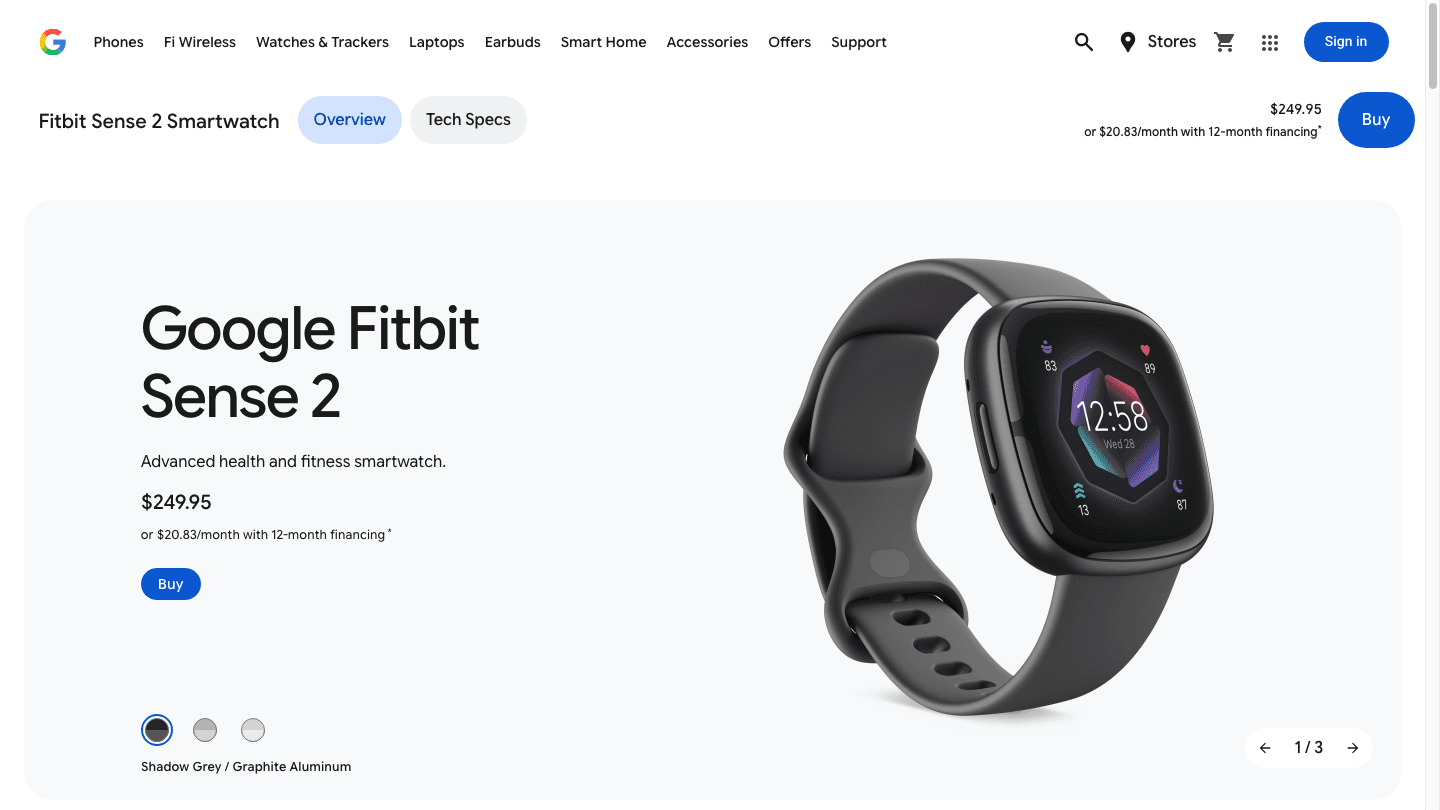
The Sense 2 is noticeably lighter and slimmer than the original Sense. At 40.5mm and around 40 grams with the band, it sits comfortably on smaller wrists. The 1.58-inch AMOLED display runs at 336x336 pixels, which is sharp enough for a watch face and readable in most lighting conditions. It dims in low light and can be set to always-on, though that cuts battery life roughly in half.
The case is aluminum with Corning Gorilla Glass 3 protecting the screen. The physical button on the left side (replacing the capacitive button from the original Sense) is a meaningful improvement for usability. Band swaps use a proprietary connector, so you're limited to Fitbit and compatible third-party bands.
What Works
Lightweight and comfortable enough for 24/7 wear, including sleep
Sharp AMOLED display with decent brightness outdoors
Physical button is far more reliable than the capacitive predecessor
Water resistance to 50 meters covers swimming and showering
What Doesn't
Proprietary charging cable is easy to lose
Band connectors are plastic and less premium-feeling than the original Sense
No always-on by default; takes a wrist raise to activate
Health Tracking
This is where the Sense 2 genuinely differentiates. Three sensors stand out: the EDA stress sensor, the ECG app, and skin temperature tracking.
The EDA (electrodermal activity) sensor measures small electrical changes on your skin that correlate with stress responses. On the original Sense, you had to hold your palm on the watch for a few minutes to get a reading. The Sense 2 does this continuously, which is a real upgrade. Fitbit calls the all-day output "Body Response" and surfaces it alongside heart rate and other signals in the app.
The ECG app takes a 30-second reading when you place two fingers on the stainless steel corners of the watch. It classifies results as normal sinus rhythm or possible atrial fibrillation. The accuracy is FDA-cleared for AFib detection in users 22 and older. It's not a diagnostic tool, but it's a useful screening mechanism for irregular rhythm detection.
Skin temperature deviation tracks how much your body temperature varies from your personal baseline across the night. Combined with SpO2 blood oxygen monitoring and heart rate variability, these night-time readings can flag potential illness or recovery issues before you consciously feel off.
For more on what the Fitbit HRV reading means and how accurate it is, see our breakdown of Fitbit heart rate variability tracking.
Limitations
Full access to EDA trends, skin temp data, and advanced sleep analysis requires Fitbit Premium ($9.99/month or $79.99/year)
ECG and heart alerts are only available for users 22 and older
Heart rate accuracy degrades noticeably during the first few minutes of intense exercise
Blood pressure monitoring is not available (the hardware doesn't support it)
Sleep Tracking
Sleep is where the Fitbit ecosystem still leads the mid-range market. The Sense 2 tracks light, deep, and REM sleep stages and generates a Sleep Score each morning based on duration, quality, and restoration. The score is easy to understand and consistent enough to be a reliable indicator of recovery.
Skin temperature deviation and SpO2 readings add context. Nights where your temperature spikes or your blood oxygen dips tend to show up as lower Sleep Scores, and Fitbit flags these clearly in the app. For women, the temperature data also feeds into menstrual health tracking and cycle predictions.
Our in-depth analysis of the Fitbit sleep tracker and Fitbit Sleep Score goes into more detail on methodology and accuracy.
One area where the Sense 2 trails competitors like WHOOP is in recovery recommendations. The Fitbit app gives you your score and some context, but it doesn't build a readiness-based recommendation engine the way WHOOP or Garmin's Training Readiness does.
Workout Tracking
The Sense 2 covers 20 exercise modes and handles common activities well: walking, running, cycling, swimming, and yoga. GPS is built-in (no need to bring your phone), and route tracking works reasonably well for outdoor runs in open conditions.
The problems show up during high-intensity efforts. Heart rate accuracy during HIIT, interval training, or the first minutes of vigorous cardio can be unreliable. This isn't unique to the Sense 2, but it's more pronounced than on competitors with more sophisticated optical sensors. If heart rate zones during intervals matter to your training, the Sense 2 will frustrate you.
There are no advanced metrics: no VO2 max estimation, no training load tracking, no recovery time suggestions tied to workouts. The Sense 2 counts reps and floors climbed, logs calories burned, and tells you your heart rate. That's it. For a comparison of Fitbit workout tracking versus dedicated GPS watches, see our Garmin vs Fitbit comparison.
Battery Life
Fitbit rates the Sense 2 at six-plus days of battery life, and in real use it reliably hits five to six days with the always-on display off and GPS use kept light. A 12-minute charge delivers a full day of use, which matters when you forget to charge before bed.
If you use always-on display or GPS daily, expect three to four days. Still above average for a full-sensor smartwatch.
Smart Features and Software
This is where Google's product strategy creates real friction. The Sense 2 has Fitbit Pay (NFC), so contactless payments work. Notifications from your phone come through. You can set alarms and use timers. That's roughly the extent of the smart functionality.
There's no app store, no third-party apps, no music storage, no Spotify. Google removed ConnectIQ support from Fitbit devices, which means the ecosystem is entirely controlled by Fitbit. If an app isn't built in, you can't get it on the Sense 2.
Works with both Android and iPhone, though setup and features are somewhat richer on Android. The Fitbit app itself is clean, data is clearly presented, and the interface hasn't changed much since launch. You can pair third-party apps (Strava syncs, for example) but only for data export, not on-device.
For tools that extend what the Sense 2 can do, see our guide to the best apps to use with Fitbit.
Who Should Buy the Fitbit Sense 2?
Health-focused users who prioritize sleep and stress: The EDA sensor and sleep tracking are genuinely best-in-class at this price. If these are your primary needs and you don't care about apps or workout analytics, the Sense 2 delivers.
Anyone who wants AFib screening: The FDA-cleared ECG app is a meaningful health feature. For people with a family history of atrial fibrillation or irregular heart rhythm concerns, this alone can justify the purchase.
Light exercisers or walkers: If most of your activity is walking, yoga, or casual cycling, the Sense 2 tracks these accurately. You won't hit its workout accuracy limitations.
Skip it if you train seriously, want app extensibility, or care about music. The Fitbit Charge 6 has better workout tracking in a smaller form factor. The Fitbit Versa 4 covers similar ground at a similar price. Our best sleep trackers for 2026 guide covers alternatives if sleep is your primary use case.
If you're pairing the Sense 2 with a planning system, Lifestack can build your daily schedule around your Fitbit data. It reads your sleep score and stress signals and schedules focused work and recovery blocks at times when your body is actually ready for them.
Pricing: Fitbit Sense 2: $249.95 from the Google Store. Fitbit Premium (for advanced health analysis): $9.99/month or $79.99/year. The watch comes with six months of Premium included.
Frequently Asked Questions
Is the Fitbit Sense 2 worth buying in 2026?
Yes, for health-focused users who prioritize sleep tracking, continuous stress monitoring, and ECG. No, if you want a full smartwatch with apps and music. The Sense 2 remains the best device at this price for passive health data collection, but it's deliberately not a general-purpose smartwatch.
Does the Fitbit Sense 2 track stress continuously?
Yes. The Sense 2 uses its EDA (electrodermal activity) sensor to continuously monitor body responses linked to stress throughout the day. This is a step up from the original Sense, which required an on-demand palm-hold to get a reading.
Does the Fitbit Sense 2 have GPS?
Yes. The Sense 2 has built-in GPS, so you don't need your phone for outdoor activity tracking. Route accuracy is solid for running and cycling in open conditions.
Is Fitbit Premium required for the Sense 2?
Not for basic tracking. Sleep stages, heart rate, SpO2, and step tracking are free. Advanced features like EDA trend analysis, detailed sleep breakdown, and the Daily Readiness Score require Fitbit Premium ($9.99/month). The watch ships with six months of Premium free.
Does the Fitbit Sense 2 work with iPhone?
Yes. The Sense 2 works with both Android and iPhone via the Fitbit app. Notifications, calls, and health data sync on both platforms. Some features, like Google Wallet integration, are Android-only. For more, see our guide on Fitbit not tracking sleep and other common issues.
Will there be a Fitbit Sense 3?
No. Google has confirmed that no new Sense or Versa models are in development. The Sense 2 is the last of the line. The company's smartwatch focus has shifted to the Pixel Watch series.
The Fitbit Sense 2 arrived in 2022 as the brand's most health-focused smartwatch. Google, which acquired Fitbit in 2021, made a deliberate bet: strip out smartwatch complexity and double down on sensors. What you get is a device with some of the most capable health hardware in its price bracket paired with some of the most stripped-down software.
In 2026, the Sense 2 has aged into an interesting position. It's still on sale from Google at $249.95. No successor has replaced it. Google confirmed no new Sense or Versa models are coming, making the Sense 2 the last of its line. That shapes the buying decision differently than it did at launch.
If you're shopping for a health-focused wearable under $300 with strong sleep tracking, continuous stress monitoring, and an ECG sensor, the Sense 2 still makes a credible case. If you want app support, music controls, or precision workout tracking, it doesn't.
This review is based on extended daily use, covering health accuracy, sleep quality, workout tracking, and the real-world limitations that don't show up in spec sheets.
Key Takeaways
The Fitbit Sense 2 has the best continuous stress sensor on any sub-$300 watch: the EDA (electrodermal activity) sensor tracks physiological stress responses all day, not just on-demand.
Sleep tracking is genuinely useful, with detailed stage breakdowns, a Sleep Score, and skin temperature deviation alerts.
The watch has no third-party apps, no music storage, and limited smartwatch functionality. Google chose to make it a health device, not a smart device.
Quick Verdict
Buy it if: You care most about sleep tracking, stress monitoring, and ECG. The Sense 2 does these better than most watches at this price.
Skip it if: You want app support, music, or precise workout tracking. For that, look at the Fitbit Charge 6 (better GPS, more sport modes) or the Garmin side of the market.
Design and Display
The Sense 2 is noticeably lighter and slimmer than the original Sense. At 40.5mm and around 40 grams with the band, it sits comfortably on smaller wrists. The 1.58-inch AMOLED display runs at 336x336 pixels, which is sharp enough for a watch face and readable in most lighting conditions. It dims in low light and can be set to always-on, though that cuts battery life roughly in half.
The case is aluminum with Corning Gorilla Glass 3 protecting the screen. The physical button on the left side (replacing the capacitive button from the original Sense) is a meaningful improvement for usability. Band swaps use a proprietary connector, so you're limited to Fitbit and compatible third-party bands.
What Works
Lightweight and comfortable enough for 24/7 wear, including sleep
Sharp AMOLED display with decent brightness outdoors
Physical button is far more reliable than the capacitive predecessor
Water resistance to 50 meters covers swimming and showering
What Doesn't
Proprietary charging cable is easy to lose
Band connectors are plastic and less premium-feeling than the original Sense
No always-on by default; takes a wrist raise to activate
Health Tracking
This is where the Sense 2 genuinely differentiates. Three sensors stand out: the EDA stress sensor, the ECG app, and skin temperature tracking.
The EDA (electrodermal activity) sensor measures small electrical changes on your skin that correlate with stress responses. On the original Sense, you had to hold your palm on the watch for a few minutes to get a reading. The Sense 2 does this continuously, which is a real upgrade. Fitbit calls the all-day output "Body Response" and surfaces it alongside heart rate and other signals in the app.
The ECG app takes a 30-second reading when you place two fingers on the stainless steel corners of the watch. It classifies results as normal sinus rhythm or possible atrial fibrillation. The accuracy is FDA-cleared for AFib detection in users 22 and older. It's not a diagnostic tool, but it's a useful screening mechanism for irregular rhythm detection.
Skin temperature deviation tracks how much your body temperature varies from your personal baseline across the night. Combined with SpO2 blood oxygen monitoring and heart rate variability, these night-time readings can flag potential illness or recovery issues before you consciously feel off.
For more on what the Fitbit HRV reading means and how accurate it is, see our breakdown of Fitbit heart rate variability tracking.
Limitations
Full access to EDA trends, skin temp data, and advanced sleep analysis requires Fitbit Premium ($9.99/month or $79.99/year)
ECG and heart alerts are only available for users 22 and older
Heart rate accuracy degrades noticeably during the first few minutes of intense exercise
Blood pressure monitoring is not available (the hardware doesn't support it)
Sleep Tracking
Sleep is where the Fitbit ecosystem still leads the mid-range market. The Sense 2 tracks light, deep, and REM sleep stages and generates a Sleep Score each morning based on duration, quality, and restoration. The score is easy to understand and consistent enough to be a reliable indicator of recovery.
Skin temperature deviation and SpO2 readings add context. Nights where your temperature spikes or your blood oxygen dips tend to show up as lower Sleep Scores, and Fitbit flags these clearly in the app. For women, the temperature data also feeds into menstrual health tracking and cycle predictions.
Our in-depth analysis of the Fitbit sleep tracker and Fitbit Sleep Score goes into more detail on methodology and accuracy.
One area where the Sense 2 trails competitors like WHOOP is in recovery recommendations. The Fitbit app gives you your score and some context, but it doesn't build a readiness-based recommendation engine the way WHOOP or Garmin's Training Readiness does.
Workout Tracking
The Sense 2 covers 20 exercise modes and handles common activities well: walking, running, cycling, swimming, and yoga. GPS is built-in (no need to bring your phone), and route tracking works reasonably well for outdoor runs in open conditions.
The problems show up during high-intensity efforts. Heart rate accuracy during HIIT, interval training, or the first minutes of vigorous cardio can be unreliable. This isn't unique to the Sense 2, but it's more pronounced than on competitors with more sophisticated optical sensors. If heart rate zones during intervals matter to your training, the Sense 2 will frustrate you.
There are no advanced metrics: no VO2 max estimation, no training load tracking, no recovery time suggestions tied to workouts. The Sense 2 counts reps and floors climbed, logs calories burned, and tells you your heart rate. That's it. For a comparison of Fitbit workout tracking versus dedicated GPS watches, see our Garmin vs Fitbit comparison.
Battery Life
Fitbit rates the Sense 2 at six-plus days of battery life, and in real use it reliably hits five to six days with the always-on display off and GPS use kept light. A 12-minute charge delivers a full day of use, which matters when you forget to charge before bed.
If you use always-on display or GPS daily, expect three to four days. Still above average for a full-sensor smartwatch.
Smart Features and Software
This is where Google's product strategy creates real friction. The Sense 2 has Fitbit Pay (NFC), so contactless payments work. Notifications from your phone come through. You can set alarms and use timers. That's roughly the extent of the smart functionality.
There's no app store, no third-party apps, no music storage, no Spotify. Google removed ConnectIQ support from Fitbit devices, which means the ecosystem is entirely controlled by Fitbit. If an app isn't built in, you can't get it on the Sense 2.
Works with both Android and iPhone, though setup and features are somewhat richer on Android. The Fitbit app itself is clean, data is clearly presented, and the interface hasn't changed much since launch. You can pair third-party apps (Strava syncs, for example) but only for data export, not on-device.
For tools that extend what the Sense 2 can do, see our guide to the best apps to use with Fitbit.
Who Should Buy the Fitbit Sense 2?
Health-focused users who prioritize sleep and stress: The EDA sensor and sleep tracking are genuinely best-in-class at this price. If these are your primary needs and you don't care about apps or workout analytics, the Sense 2 delivers.
Anyone who wants AFib screening: The FDA-cleared ECG app is a meaningful health feature. For people with a family history of atrial fibrillation or irregular heart rhythm concerns, this alone can justify the purchase.
Light exercisers or walkers: If most of your activity is walking, yoga, or casual cycling, the Sense 2 tracks these accurately. You won't hit its workout accuracy limitations.
Skip it if you train seriously, want app extensibility, or care about music. The Fitbit Charge 6 has better workout tracking in a smaller form factor. The Fitbit Versa 4 covers similar ground at a similar price. Our best sleep trackers for 2026 guide covers alternatives if sleep is your primary use case.
If you're pairing the Sense 2 with a planning system, Lifestack can build your daily schedule around your Fitbit data. It reads your sleep score and stress signals and schedules focused work and recovery blocks at times when your body is actually ready for them.
Pricing: Fitbit Sense 2: $249.95 from the Google Store. Fitbit Premium (for advanced health analysis): $9.99/month or $79.99/year. The watch comes with six months of Premium included.
Frequently Asked Questions
Is the Fitbit Sense 2 worth buying in 2026?
Yes, for health-focused users who prioritize sleep tracking, continuous stress monitoring, and ECG. No, if you want a full smartwatch with apps and music. The Sense 2 remains the best device at this price for passive health data collection, but it's deliberately not a general-purpose smartwatch.
Does the Fitbit Sense 2 track stress continuously?
Yes. The Sense 2 uses its EDA (electrodermal activity) sensor to continuously monitor body responses linked to stress throughout the day. This is a step up from the original Sense, which required an on-demand palm-hold to get a reading.
Does the Fitbit Sense 2 have GPS?
Yes. The Sense 2 has built-in GPS, so you don't need your phone for outdoor activity tracking. Route accuracy is solid for running and cycling in open conditions.
Is Fitbit Premium required for the Sense 2?
Not for basic tracking. Sleep stages, heart rate, SpO2, and step tracking are free. Advanced features like EDA trend analysis, detailed sleep breakdown, and the Daily Readiness Score require Fitbit Premium ($9.99/month). The watch ships with six months of Premium free.
Does the Fitbit Sense 2 work with iPhone?
Yes. The Sense 2 works with both Android and iPhone via the Fitbit app. Notifications, calls, and health data sync on both platforms. Some features, like Google Wallet integration, are Android-only. For more, see our guide on Fitbit not tracking sleep and other common issues.
Will there be a Fitbit Sense 3?
No. Google has confirmed that no new Sense or Versa models are in development. The Sense 2 is the last of the line. The company's smartwatch focus has shifted to the Pixel Watch series.



FOLLOW ON
FOLLOW ON
FOLLOW ON


Copyright 2026 © Lifestack. All rights reserved
Copyright 2026 © Lifestack. All rights reserved

