
Tips
Focusmate Virtual Coworking: Does It Actually Work?
Focusmate Virtual Coworking: Does It Actually Work?

Focusmate is a virtual coworking platform where you book 25 or 50-minute sessions with a stranger online. You both show up via video, state what you are working on, then get to work in silence. When the timer ends, you check in briefly and go on with your day.
It sounds deceptively simple. For a lot of people, especially those who struggle with procrastination, remote work isolation, or focus challenges, it is one of the most effective productivity tools available. The research behind it is more interesting than the product description suggests.
This guide covers what Focusmate is, why the body doubling effect works, who gets the most from it, and how to structure your sessions to actually get things done.
Key Takeaways
Focusmate uses body doubling, a technique where working near another person increases task completion rates
The free tier gives you three sessions per week; Plus is $8/month and removes that limit
Virtual coworking works best when you pair it with intentional scheduling, so your sessions land during your natural energy peaks
What Is Focusmate and How Does It Work
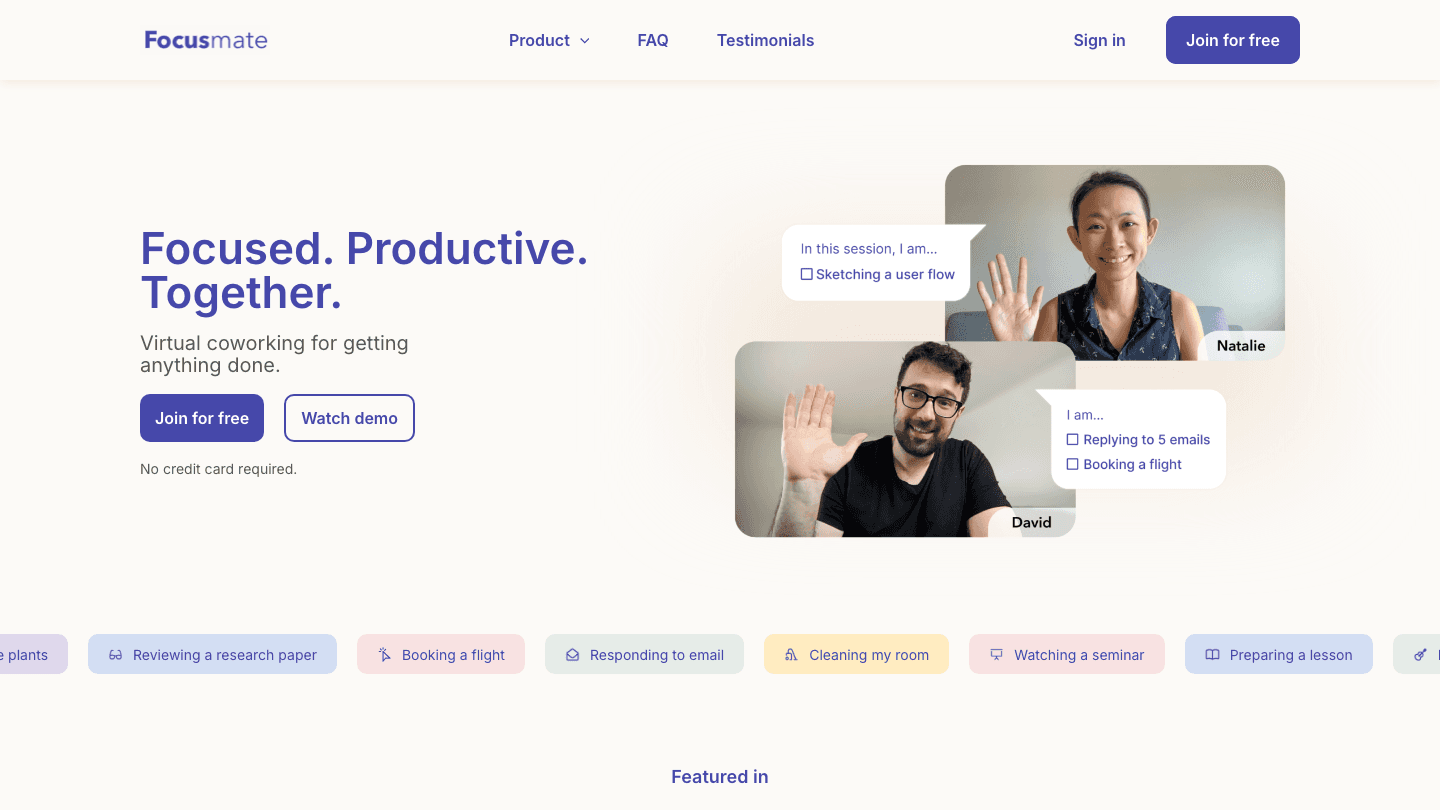
Focusmate matches you with a partner for a focused work session. You choose a 25 or 50-minute slot, get matched with someone else who booked the same time, and join the video call. The format is simple: introduce yourself and name one task you will complete, work in silence with your camera on, then do a brief check-in at the end.
The video component is important. Unlike playing a podcast in the background or working at a coffee shop, Focusmate creates social accountability. Someone is watching you work. Or more precisely, someone is there and you know it, which changes how your brain approaches the task in front of you.
Sessions run around the clock. You can book same-day or in advance. The platform has a community of people in many time zones, so odd hours are usually covered. There is no requirement to know your partner, keep in touch, or do anything outside the session.
The Science Behind Body Doubling
Body doubling is the practice of working near another person, not necessarily with them, but in their presence. It has been studied as a focus aid for people with ADHD and has shown up in productivity research more broadly. The mechanism is not fully understood, but several theories explain it.
One is external accountability: having a witness to your work creates mild social pressure that counteracts procrastination. Another is that the presence of another person activates the part of the brain associated with task initiation, which is often dysregulated in ADHD and in people who struggle to start tasks cold.
A third explanation is simpler: when someone else is watching, context-switching feels costly. You do not want to be seen scrolling your phone. That friction reduces the pull of distraction without requiring willpower. For more on building focus through systems rather than willpower, see our guide to task management for ADHD.
Who Benefits Most from Virtual Coworking
Focusmate is well-suited for remote workers who find solitary home office work draining or distracting. The social element replicates some of what you get from a busy coffee shop or open-plan office without the noise or commute.
People with ADHD consistently report Focusmate as one of the most effective tools in their stack. The external accountability structure replaces some of the internal executive function that ADHD makes unreliable. See our ADHD productivity hacks guide for related strategies that work alongside virtual coworking.
Writers, researchers, and anyone with creative work that requires long uninterrupted blocks also benefit. The 25 or 50-minute structure forces you to commit to a task before the session starts, which removes the low-grade anxiety of open-ended work time. Freelancers working alone especially tend to find it useful for the same reason an office provides ambient social presence without requiring actual interaction.
How to Get the Most from a Focusmate Session
Choose one specific task before you book. "Work on the report" is too vague. "Write the introduction section of the report" gives your brain a clear target and makes the check-in at the end meaningful.
Book sessions during your highest-energy windows. Body doubling helps with initiation and follow-through, but it does not create energy from nothing. A Focusmate session at 3pm when you are crashing will produce less than one at 10am when you are sharp. Managing your personal energy and scheduling sessions around your natural peaks is how you compound the benefit.
Do not over-schedule. Two or three sessions per day is generally more sustainable than back-to-back blocks. Your brain needs recovery time between focused work periods, and stacking too many accountability sessions can make the whole practice feel like an obligation rather than a tool.
Focusmate Pricing: Free vs Plus
The free plan gives you three sessions per week, which is enough to try the platform and see if it works for you. No credit card required. Most people who use Focusmate seriously end up wanting more than three sessions a week, which is where Plus comes in.
Focusmate Plus costs $8/month billed annually or $12/month billed monthly. It removes the weekly session limit. That is the only difference. There are no advanced features behind a paywall. If three sessions per week is enough for your workflow, the free tier is a legitimate long-term option.
For context, most comparable body doubling or accountability services start at $20-40/month. Focusmate's pricing is unusually accessible for what it delivers, which is part of why it has accumulated a large and active user base.
Using Lifestack and Focusmate Together
Focusmate tells you when to focus. It does not tell you when in your day to book those sessions. That is where Lifestack comes in. Lifestack reads your sleep quality, heart rate trends, and energy data from your wearable and builds an energy-aware daily schedule around your actual peaks and dips.
In practice, this means Lifestack identifies when your focus capacity is likely to be highest each day, and you book your Focusmate sessions into those windows. A session at the right time produces noticeably better output than the same session when your energy calendar is at a low point. The two tools solve different problems: Focusmate handles the accountability layer, Lifestack handles the scheduling intelligence.

Frequently Asked Questions
Is Focusmate worth it?
For remote workers, freelancers, and people with ADHD or procrastination tendencies, yes. The body doubling effect is well-documented and Focusmate delivers it consistently. The free tier is worth trying for a week before deciding whether to upgrade. It either clicks for you or it does not, usually within the first few sessions.
Does Focusmate work for ADHD?
Yes. Body doubling is one of the most commonly cited effective strategies for ADHD task initiation and follow-through. Virtual body doubling via Focusmate replicates a lot of what makes in-person work at a library or coffee shop effective for people with ADHD. Pair it with the other strategies in our guide to focus with ADHD.
Can I use Focusmate if I am an introvert?
Yes. Sessions are mostly silent. You introduce yourself, state your task, work, check in briefly at the end. That is the extent of the social interaction. Many introverts report preferring Focusmate to actual coworking spaces for exactly this reason: you get the presence effect without sustained social interaction.
What should I work on during Focusmate sessions?
Tasks that require sustained focus and are easy to procrastinate on. Writing, deep reading, email backlog, administrative work, or any project where the starting barrier is high. Focusmate is less useful for creative brainstorming or tasks requiring constant collaboration. For managing a large task backlog, see our guide to working under time constraints.
How is Focusmate different from just working at a coffee shop?
Focusmate adds accountability that a coffee shop cannot. At a coffee shop, you are anonymous. On Focusmate, you have committed to a specific task with a specific person who expects you to complete it. That social contract is what drives the focus effect. It also works at 6am or 11pm, which coffee shops do not.
Are there Focusmate alternatives?
Yes. Flow Club, Caveday, and Ultraworking all offer virtual coworking or body doubling sessions. Some are group-based rather than one-on-one. The right choice depends on whether you prefer a matched partner or an open coworking room. Focusmate's one-on-one model and free tier make it the most accessible starting point. For broader focus tools, see our guide to the best deep work tracker apps.
Focusmate is a virtual coworking platform where you book 25 or 50-minute sessions with a stranger online. You both show up via video, state what you are working on, then get to work in silence. When the timer ends, you check in briefly and go on with your day.
It sounds deceptively simple. For a lot of people, especially those who struggle with procrastination, remote work isolation, or focus challenges, it is one of the most effective productivity tools available. The research behind it is more interesting than the product description suggests.
This guide covers what Focusmate is, why the body doubling effect works, who gets the most from it, and how to structure your sessions to actually get things done.
Key Takeaways
Focusmate uses body doubling, a technique where working near another person increases task completion rates
The free tier gives you three sessions per week; Plus is $8/month and removes that limit
Virtual coworking works best when you pair it with intentional scheduling, so your sessions land during your natural energy peaks
What Is Focusmate and How Does It Work
Focusmate matches you with a partner for a focused work session. You choose a 25 or 50-minute slot, get matched with someone else who booked the same time, and join the video call. The format is simple: introduce yourself and name one task you will complete, work in silence with your camera on, then do a brief check-in at the end.
The video component is important. Unlike playing a podcast in the background or working at a coffee shop, Focusmate creates social accountability. Someone is watching you work. Or more precisely, someone is there and you know it, which changes how your brain approaches the task in front of you.
Sessions run around the clock. You can book same-day or in advance. The platform has a community of people in many time zones, so odd hours are usually covered. There is no requirement to know your partner, keep in touch, or do anything outside the session.
The Science Behind Body Doubling
Body doubling is the practice of working near another person, not necessarily with them, but in their presence. It has been studied as a focus aid for people with ADHD and has shown up in productivity research more broadly. The mechanism is not fully understood, but several theories explain it.
One is external accountability: having a witness to your work creates mild social pressure that counteracts procrastination. Another is that the presence of another person activates the part of the brain associated with task initiation, which is often dysregulated in ADHD and in people who struggle to start tasks cold.
A third explanation is simpler: when someone else is watching, context-switching feels costly. You do not want to be seen scrolling your phone. That friction reduces the pull of distraction without requiring willpower. For more on building focus through systems rather than willpower, see our guide to task management for ADHD.
Who Benefits Most from Virtual Coworking
Focusmate is well-suited for remote workers who find solitary home office work draining or distracting. The social element replicates some of what you get from a busy coffee shop or open-plan office without the noise or commute.
People with ADHD consistently report Focusmate as one of the most effective tools in their stack. The external accountability structure replaces some of the internal executive function that ADHD makes unreliable. See our ADHD productivity hacks guide for related strategies that work alongside virtual coworking.
Writers, researchers, and anyone with creative work that requires long uninterrupted blocks also benefit. The 25 or 50-minute structure forces you to commit to a task before the session starts, which removes the low-grade anxiety of open-ended work time. Freelancers working alone especially tend to find it useful for the same reason an office provides ambient social presence without requiring actual interaction.
How to Get the Most from a Focusmate Session
Choose one specific task before you book. "Work on the report" is too vague. "Write the introduction section of the report" gives your brain a clear target and makes the check-in at the end meaningful.
Book sessions during your highest-energy windows. Body doubling helps with initiation and follow-through, but it does not create energy from nothing. A Focusmate session at 3pm when you are crashing will produce less than one at 10am when you are sharp. Managing your personal energy and scheduling sessions around your natural peaks is how you compound the benefit.
Do not over-schedule. Two or three sessions per day is generally more sustainable than back-to-back blocks. Your brain needs recovery time between focused work periods, and stacking too many accountability sessions can make the whole practice feel like an obligation rather than a tool.
Focusmate Pricing: Free vs Plus
The free plan gives you three sessions per week, which is enough to try the platform and see if it works for you. No credit card required. Most people who use Focusmate seriously end up wanting more than three sessions a week, which is where Plus comes in.
Focusmate Plus costs $8/month billed annually or $12/month billed monthly. It removes the weekly session limit. That is the only difference. There are no advanced features behind a paywall. If three sessions per week is enough for your workflow, the free tier is a legitimate long-term option.
For context, most comparable body doubling or accountability services start at $20-40/month. Focusmate's pricing is unusually accessible for what it delivers, which is part of why it has accumulated a large and active user base.
Using Lifestack and Focusmate Together
Focusmate tells you when to focus. It does not tell you when in your day to book those sessions. That is where Lifestack comes in. Lifestack reads your sleep quality, heart rate trends, and energy data from your wearable and builds an energy-aware daily schedule around your actual peaks and dips.
In practice, this means Lifestack identifies when your focus capacity is likely to be highest each day, and you book your Focusmate sessions into those windows. A session at the right time produces noticeably better output than the same session when your energy calendar is at a low point. The two tools solve different problems: Focusmate handles the accountability layer, Lifestack handles the scheduling intelligence.
Frequently Asked Questions
Is Focusmate worth it?
For remote workers, freelancers, and people with ADHD or procrastination tendencies, yes. The body doubling effect is well-documented and Focusmate delivers it consistently. The free tier is worth trying for a week before deciding whether to upgrade. It either clicks for you or it does not, usually within the first few sessions.
Does Focusmate work for ADHD?
Yes. Body doubling is one of the most commonly cited effective strategies for ADHD task initiation and follow-through. Virtual body doubling via Focusmate replicates a lot of what makes in-person work at a library or coffee shop effective for people with ADHD. Pair it with the other strategies in our guide to focus with ADHD.
Can I use Focusmate if I am an introvert?
Yes. Sessions are mostly silent. You introduce yourself, state your task, work, check in briefly at the end. That is the extent of the social interaction. Many introverts report preferring Focusmate to actual coworking spaces for exactly this reason: you get the presence effect without sustained social interaction.
What should I work on during Focusmate sessions?
Tasks that require sustained focus and are easy to procrastinate on. Writing, deep reading, email backlog, administrative work, or any project where the starting barrier is high. Focusmate is less useful for creative brainstorming or tasks requiring constant collaboration. For managing a large task backlog, see our guide to working under time constraints.
How is Focusmate different from just working at a coffee shop?
Focusmate adds accountability that a coffee shop cannot. At a coffee shop, you are anonymous. On Focusmate, you have committed to a specific task with a specific person who expects you to complete it. That social contract is what drives the focus effect. It also works at 6am or 11pm, which coffee shops do not.
Are there Focusmate alternatives?
Yes. Flow Club, Caveday, and Ultraworking all offer virtual coworking or body doubling sessions. Some are group-based rather than one-on-one. The right choice depends on whether you prefer a matched partner or an open coworking room. Focusmate's one-on-one model and free tier make it the most accessible starting point. For broader focus tools, see our guide to the best deep work tracker apps.



FOLLOW ON
FOLLOW ON
FOLLOW ON


Copyright 2026 © Lifestack. All rights reserved
Copyright 2026 © Lifestack. All rights reserved

