
Device
Garmin Instinct 2 vs 3: Which Is Worth It?
Garmin Instinct 2 vs 3: Which Is Worth It?

The Garmin Instinct line has always had a clear identity: rugged GPS watches built for people who actually go outside. The Instinct 2 earned its place as a capable, no-fuss outdoor watch with impressive battery life. The Instinct 3 arrived in early 2025 with a genuinely new display option, better GPS, and a longer feature list.
But the upgrade isn't free. If you already own an Instinct 2 or are shopping between the two, the question is whether the Instinct 3's additions are worth paying for. The answer depends a lot on which Instinct 3 variant you're comparing against which Instinct 2.
This comparison focuses on the most popular configurations: the Instinct 2 Solar (45mm) versus the Instinct 3 AMOLED (45mm). Both are built for outdoor adventure, run on the same Garmin platform, and share a core mission. What separates them is how Garmin chose to modernize the formula.
We tested both and dug into the specs, battery figures, and real-world GPS performance. Here's what actually changed.
Key Takeaways
The Instinct 3 AMOLED adds a full-color display, multi-band GPS, an LED flashlight, Garmin Pay, and music storage. The Instinct 2 has none of these.
The Instinct 2 Solar gets better battery life in pure smartwatch mode (28 days vs 18 days), especially if you're off-grid for long stretches.
At current prices, the Instinct 3 AMOLED starts at $349.99, actually less than the Instinct 2 Solar at $399.99, making the upgrade decision easier than it used to be.
Quick Verdict
Garmin Instinct 2 Solar: Best for multi-week expeditions and users who prioritize maximum battery life over display quality.
Garmin Instinct 3 AMOLED: Best for everyday outdoor use, trail running, and anyone who wants a full-color display without leaving the Instinct family.
Garmin Instinct 2 Overview

The Instinct 2 launched in 2022 as an update to Garmin's most rugged smartwatch line. It kept the fiber-reinforced polymer case and MIL-STD-810 durability rating, added a new 40mm size option (the 2S), and introduced solar charging to the standard Instinct lineup for the first time. It runs on Garmin's well-established platform with support for running, cycling, hiking, swimming, and about 50 sport modes total.
What made the Instinct 2 stand out was battery life. The Solar version is rated for 28 days in smartwatch mode and up to 150 hours in max battery mode with solar. For backcountry trips, week-long bikepacking routes, or anyone who goes stretches without access to power, that figure matters. The GPS itself is solid (multi-GNSS: GPS, GLONASS, Galileo), though it predates Garmin's SatIQ multi-band technology.
The display is a 176x176 monochrome MIP panel. It's always-on, highly readable in direct sunlight, and uses very little power. It is not color. For people coming from a phone or a color smartwatch, the screen is an adjustment. For people who prefer function over form in a field watch, it's a non-issue.
What the Instinct 2 Does Well
Best-in-class battery life, especially in Solar variants
MIL-STD-810 durability and 10 ATM water resistance
Lightweight and trim at 45mm with a slim profile
Reliable GPS tracking across multi-GNSS constellations
Excellent sunlight readability on the MIP display
Where It Falls Short
No color display (the monochrome panel shows its age next to newer watches)
No multi-band GPS or SatIQ: less accurate in challenging terrain
No LED flashlight on the standard or Solar models
No Garmin Pay for contactless payments
No onboard music storage or Spotify support
Only 32MB of onboard memory vs 128MB on the Instinct 3
Pricing: Garmin Instinct 2 Solar (45mm): $399.99. The non-solar Instinct 2 has been discontinued but is available from third-party sellers at lower prices.
Best for: Long-distance trekkers, expedition hikers, and anyone who needs a GPS watch that lasts weeks between charges.
Garmin Instinct 3 Overview
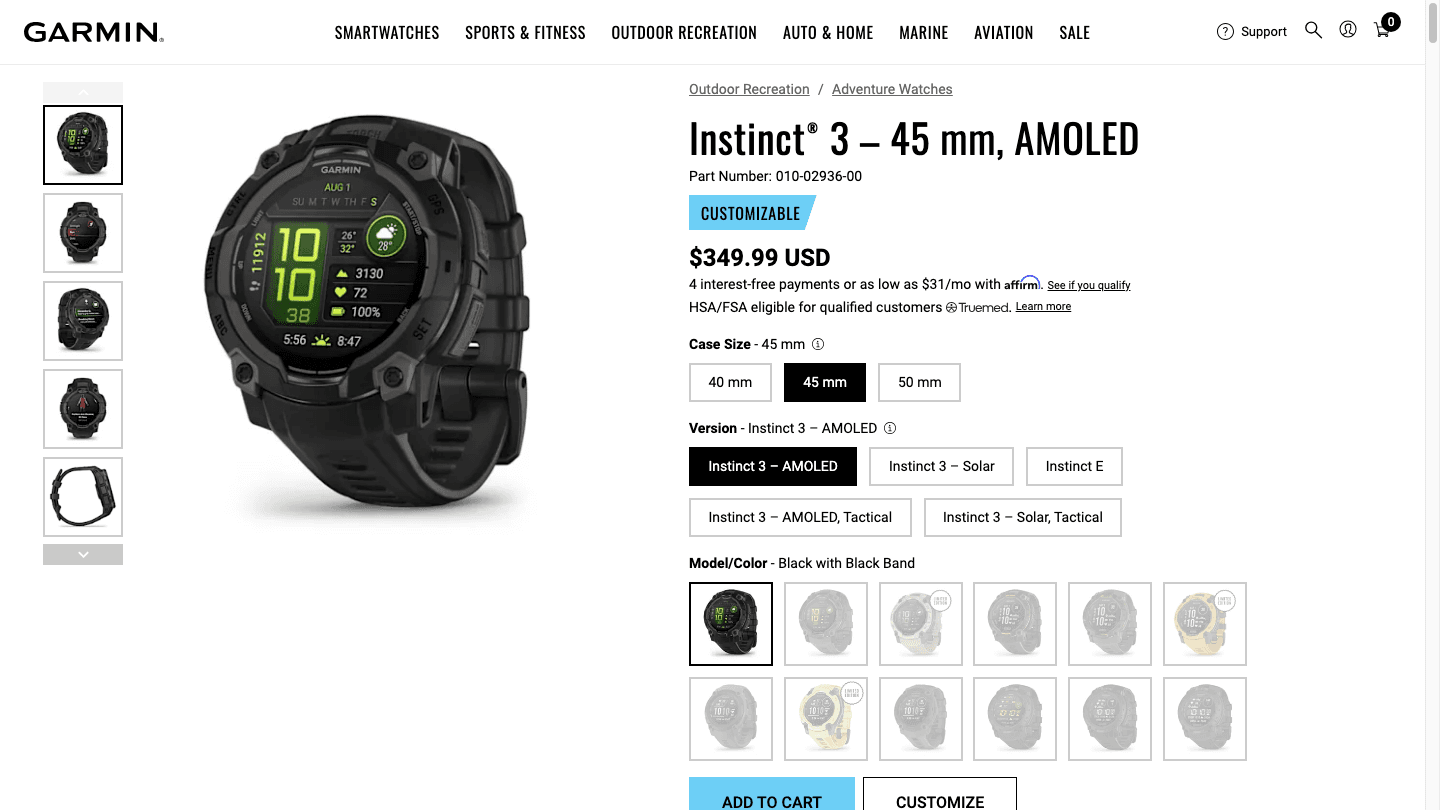
The Instinct 3 launched at CES 2025 with the most significant hardware revision the Instinct line has seen. The headline addition is the AMOLED display option: a 390x390 full-color panel with a metal-reinforced bezel replacing the fiber-reinforced polymer frame of the Instinct 2. Garmin also kept the MIP Solar option for battery-focused users, so the Instinct 3 is really two product lines under one name.
Beyond the screen, Garmin added multi-band GPS with SatIQ, which automatically selects the best satellite constellation and frequency for your environment. In dense tree cover, urban canyons, or canyon terrain, the Instinct 3 tracks noticeably more accurately. The onboard LED flashlight (available on all Instinct 3 sizes) is new, and genuinely useful at camp or on early-morning runs. Garmin Pay for contactless payments is another addition that didn't exist on the Instinct 2.
The Instinct 3 also brings more training intelligence. You get Training Readiness (which aggregates sleep, HRV, recovery load, and stress), HRV status tracking, nap detection, body age assessment, and Garmin Messenger. The sport mode count expanded from around 50 to 100+. Onboard memory jumped from 32MB to 128MB, which is where music storage and Spotify download support live.
What the Instinct 3 Does Well
Full-color AMOLED display (390x390): a genuine leap over the Instinct 2's monochrome panel
Multi-band GPS with SatIQ for better tracking in complex terrain
LED flashlight on all case sizes including 45mm
Garmin Pay for tap-to-pay at the trailhead or coffee shop
Spotify and music storage, up to 500 songs onboard
Training Readiness, HRV status, nap tracking, and body age
100+ sport modes vs ~50 on the Instinct 2
Metal-reinforced bezel and 128MB memory
Where It Falls Short
AMOLED battery life (18 days smartwatch mode) trails the Instinct 2 Solar's 28 days
The Solar variant covers the battery gap but lacks the AMOLED display
Slightly higher profile than the Instinct 2 at the same 45mm diameter
Pricing: Instinct 3 AMOLED 45mm: $349.99. Instinct 3 AMOLED 50mm: $449.99. Instinct 3 Solar 45mm: $399.99. Instinct 3 Solar 50mm: $449.99.
Best for: Outdoor athletes who want a modern display, precise GPS, and training intelligence without moving up to a Fenix.
Head-to-Head: Instinct 2 vs Instinct 3
Display
This is the biggest difference. The Instinct 2 uses a 176x176 monochrome MIP display, always-on and sunlight-readable, but no color. The Instinct 3 AMOLED offers a 390x390 full-color display that's vivid indoors and readable in most outdoor conditions. Garmin also kept an MIP Solar option in the Instinct 3 lineup for those who want the extended battery and don't need color.
If display quality matters to you at all, the Instinct 3 AMOLED is a different category of device. If you want maximum sunlight readability and power efficiency, both the Instinct 2 Solar and Instinct 3 Solar deliver similar MIP experiences.
GPS Accuracy
The Instinct 3 adds multi-band GPS with SatIQ. In open terrain, the difference vs the Instinct 2's standard GPS is small. In forests, steep-walled canyons, or cities, multi-band GPS can meaningfully improve track accuracy. For trail runners who loop under tree canopy or alpine hikers in narrow valleys, this upgrade matters. For road runners or open-water swimmers, either watch is accurate enough.
You can read more about how Garmin tracks different metrics in our full Garmin Instinct 3 review and our breakdown of how accurate Garmin calorie burn figures actually are.
Battery Life
The Instinct 2 Solar wins here for pure duration. Rated at 28 days in smartwatch mode and up to 150 hours in max battery mode, it's the better choice for multi-week off-grid trips. The Instinct 3 AMOLED drops to 18 days in smartwatch mode, still excellent for most users, but a real gap for expedition use.
If battery is your main concern, the Instinct 3 Solar is the answer: it matches the Instinct 2 Solar's duration while adding most of the Instinct 3's other improvements (multi-band GPS, flashlight, Garmin Pay). You give up the AMOLED display, but you keep the power advantage.
Training Features
The Instinct 3 is meaningfully smarter. Training Readiness aggregates HRV, sleep quality, recovery load, and stress into a daily readiness score. Garmin's Body Battery feature appears on both watches, but the Instinct 3 layers in HRV status, nap detection, and body age assessment. If you're using your watch to inform training decisions, the Instinct 3 gives you more to work with.
The Instinct 2 has solid health tracking (heart rate, SpO2, sleep score, stress monitoring), but it predates Garmin's push into deeper training analytics.
Value
This is where the current market situation is surprising. The Instinct 3 AMOLED 45mm now lists at $349.99, less than the Instinct 2 Solar at $399.99. That pricing inverts what you'd expect: more features at a lower price. The Instinct 2 Solar still makes sense if you specifically need 28-day battery life, but the value equation has shifted toward the Instinct 3.
Which Should You Choose?
Choose the Instinct 2 Solar if: You're planning multi-week expeditions where charging isn't possible, you prefer a monochrome always-on display for maximum sunlight readability, or you're finding the Instinct 2 Solar at a steep discount.
Choose the Instinct 3 AMOLED if: You want a full-color display, more precise GPS, a built-in flashlight, Garmin Pay, or music. At $349.99, it's currently the better value for most outdoor athletes.
Choose the Instinct 3 Solar if: You want the Instinct 3's GPS and feature upgrades but need the extended 24-32 day battery life. You trade the AMOLED display for the MIP Solar panel.
For context on where the Instinct fits in Garmin's lineup, our Garmin watch comparison guide covers the full range from Forerunner to Fenix. If you're coming from another platform, we've also compared Garmin vs Apple Watch and Garmin vs Fitbit.
One thing neither watch does well is help you actually act on the data they collect. If you're pairing wearable insights with calendar planning (scheduling workouts around your recovery scores, blocking recovery time after hard efforts), Lifestack connects your energy and recovery data to your actual schedule. It reads your Garmin Body Battery and builds your day around your real readiness, not just what fits in a calendar block.
Frequently Asked Questions
Is the Garmin Instinct 3 worth upgrading from the Instinct 2?
Yes, for most users. The Instinct 3 AMOLED costs less than the Instinct 2 Solar at current prices, adds a full-color display, multi-band GPS, Garmin Pay, a flashlight, and music storage. The only reason to stay on the Instinct 2 is if you specifically need 28+ days of battery life.
Does the Garmin Instinct 3 have Garmin Pay?
Yes. Garmin Pay is available on all Instinct 3 models (AMOLED and Solar). The Instinct 2 did not include Garmin Pay.
What is the battery life difference between the Instinct 2 and Instinct 3?
The Instinct 2 Solar lasts up to 28 days in smartwatch mode. The Instinct 3 AMOLED lasts up to 18 days. The Instinct 3 Solar bridges the gap at 24-32 days depending on solar conditions. In GPS mode, both the Instinct 2 and Instinct 3 last around 30-32 hours.
Does the Garmin Instinct 3 have multi-band GPS?
Yes. The Instinct 3 adds multi-band GPS with SatIQ: Garmin's technology for automatically selecting the best satellite constellation and frequency. The Instinct 2 uses standard multi-GNSS (GPS, GLONASS, Galileo) without multi-band support.
Can the Garmin Instinct 3 store music?
Yes. The Instinct 3's 128MB of memory (vs 32MB on the Instinct 2) supports onboard music storage and Spotify downloads. You can listen to music during workouts without your phone.
Are Garmin Instinct watches waterproof?
Both the Instinct 2 and Instinct 3 are water-rated to 10 ATM (100 meters). That covers swimming, snorkeling, and water sports. They are not rated for scuba diving. Our guide on whether Garmin watches are waterproof covers the ratings in detail. For sleep tracking, see how the Garmin sleep tracker works and whether Garmin not tracking sleep is a common issue. To get the most from either watch, check out the best apps to use with Garmin.
The Garmin Instinct line has always had a clear identity: rugged GPS watches built for people who actually go outside. The Instinct 2 earned its place as a capable, no-fuss outdoor watch with impressive battery life. The Instinct 3 arrived in early 2025 with a genuinely new display option, better GPS, and a longer feature list.
But the upgrade isn't free. If you already own an Instinct 2 or are shopping between the two, the question is whether the Instinct 3's additions are worth paying for. The answer depends a lot on which Instinct 3 variant you're comparing against which Instinct 2.
This comparison focuses on the most popular configurations: the Instinct 2 Solar (45mm) versus the Instinct 3 AMOLED (45mm). Both are built for outdoor adventure, run on the same Garmin platform, and share a core mission. What separates them is how Garmin chose to modernize the formula.
We tested both and dug into the specs, battery figures, and real-world GPS performance. Here's what actually changed.
Key Takeaways
The Instinct 3 AMOLED adds a full-color display, multi-band GPS, an LED flashlight, Garmin Pay, and music storage. The Instinct 2 has none of these.
The Instinct 2 Solar gets better battery life in pure smartwatch mode (28 days vs 18 days), especially if you're off-grid for long stretches.
At current prices, the Instinct 3 AMOLED starts at $349.99, actually less than the Instinct 2 Solar at $399.99, making the upgrade decision easier than it used to be.
Quick Verdict
Garmin Instinct 2 Solar: Best for multi-week expeditions and users who prioritize maximum battery life over display quality.
Garmin Instinct 3 AMOLED: Best for everyday outdoor use, trail running, and anyone who wants a full-color display without leaving the Instinct family.
Garmin Instinct 2 Overview
The Instinct 2 launched in 2022 as an update to Garmin's most rugged smartwatch line. It kept the fiber-reinforced polymer case and MIL-STD-810 durability rating, added a new 40mm size option (the 2S), and introduced solar charging to the standard Instinct lineup for the first time. It runs on Garmin's well-established platform with support for running, cycling, hiking, swimming, and about 50 sport modes total.
What made the Instinct 2 stand out was battery life. The Solar version is rated for 28 days in smartwatch mode and up to 150 hours in max battery mode with solar. For backcountry trips, week-long bikepacking routes, or anyone who goes stretches without access to power, that figure matters. The GPS itself is solid (multi-GNSS: GPS, GLONASS, Galileo), though it predates Garmin's SatIQ multi-band technology.
The display is a 176x176 monochrome MIP panel. It's always-on, highly readable in direct sunlight, and uses very little power. It is not color. For people coming from a phone or a color smartwatch, the screen is an adjustment. For people who prefer function over form in a field watch, it's a non-issue.
What the Instinct 2 Does Well
Best-in-class battery life, especially in Solar variants
MIL-STD-810 durability and 10 ATM water resistance
Lightweight and trim at 45mm with a slim profile
Reliable GPS tracking across multi-GNSS constellations
Excellent sunlight readability on the MIP display
Where It Falls Short
No color display (the monochrome panel shows its age next to newer watches)
No multi-band GPS or SatIQ: less accurate in challenging terrain
No LED flashlight on the standard or Solar models
No Garmin Pay for contactless payments
No onboard music storage or Spotify support
Only 32MB of onboard memory vs 128MB on the Instinct 3
Pricing: Garmin Instinct 2 Solar (45mm): $399.99. The non-solar Instinct 2 has been discontinued but is available from third-party sellers at lower prices.
Best for: Long-distance trekkers, expedition hikers, and anyone who needs a GPS watch that lasts weeks between charges.
Garmin Instinct 3 Overview
The Instinct 3 launched at CES 2025 with the most significant hardware revision the Instinct line has seen. The headline addition is the AMOLED display option: a 390x390 full-color panel with a metal-reinforced bezel replacing the fiber-reinforced polymer frame of the Instinct 2. Garmin also kept the MIP Solar option for battery-focused users, so the Instinct 3 is really two product lines under one name.
Beyond the screen, Garmin added multi-band GPS with SatIQ, which automatically selects the best satellite constellation and frequency for your environment. In dense tree cover, urban canyons, or canyon terrain, the Instinct 3 tracks noticeably more accurately. The onboard LED flashlight (available on all Instinct 3 sizes) is new, and genuinely useful at camp or on early-morning runs. Garmin Pay for contactless payments is another addition that didn't exist on the Instinct 2.
The Instinct 3 also brings more training intelligence. You get Training Readiness (which aggregates sleep, HRV, recovery load, and stress), HRV status tracking, nap detection, body age assessment, and Garmin Messenger. The sport mode count expanded from around 50 to 100+. Onboard memory jumped from 32MB to 128MB, which is where music storage and Spotify download support live.
What the Instinct 3 Does Well
Full-color AMOLED display (390x390): a genuine leap over the Instinct 2's monochrome panel
Multi-band GPS with SatIQ for better tracking in complex terrain
LED flashlight on all case sizes including 45mm
Garmin Pay for tap-to-pay at the trailhead or coffee shop
Spotify and music storage, up to 500 songs onboard
Training Readiness, HRV status, nap tracking, and body age
100+ sport modes vs ~50 on the Instinct 2
Metal-reinforced bezel and 128MB memory
Where It Falls Short
AMOLED battery life (18 days smartwatch mode) trails the Instinct 2 Solar's 28 days
The Solar variant covers the battery gap but lacks the AMOLED display
Slightly higher profile than the Instinct 2 at the same 45mm diameter
Pricing: Instinct 3 AMOLED 45mm: $349.99. Instinct 3 AMOLED 50mm: $449.99. Instinct 3 Solar 45mm: $399.99. Instinct 3 Solar 50mm: $449.99.
Best for: Outdoor athletes who want a modern display, precise GPS, and training intelligence without moving up to a Fenix.
Head-to-Head: Instinct 2 vs Instinct 3
Display
This is the biggest difference. The Instinct 2 uses a 176x176 monochrome MIP display, always-on and sunlight-readable, but no color. The Instinct 3 AMOLED offers a 390x390 full-color display that's vivid indoors and readable in most outdoor conditions. Garmin also kept an MIP Solar option in the Instinct 3 lineup for those who want the extended battery and don't need color.
If display quality matters to you at all, the Instinct 3 AMOLED is a different category of device. If you want maximum sunlight readability and power efficiency, both the Instinct 2 Solar and Instinct 3 Solar deliver similar MIP experiences.
GPS Accuracy
The Instinct 3 adds multi-band GPS with SatIQ. In open terrain, the difference vs the Instinct 2's standard GPS is small. In forests, steep-walled canyons, or cities, multi-band GPS can meaningfully improve track accuracy. For trail runners who loop under tree canopy or alpine hikers in narrow valleys, this upgrade matters. For road runners or open-water swimmers, either watch is accurate enough.
You can read more about how Garmin tracks different metrics in our full Garmin Instinct 3 review and our breakdown of how accurate Garmin calorie burn figures actually are.
Battery Life
The Instinct 2 Solar wins here for pure duration. Rated at 28 days in smartwatch mode and up to 150 hours in max battery mode, it's the better choice for multi-week off-grid trips. The Instinct 3 AMOLED drops to 18 days in smartwatch mode, still excellent for most users, but a real gap for expedition use.
If battery is your main concern, the Instinct 3 Solar is the answer: it matches the Instinct 2 Solar's duration while adding most of the Instinct 3's other improvements (multi-band GPS, flashlight, Garmin Pay). You give up the AMOLED display, but you keep the power advantage.
Training Features
The Instinct 3 is meaningfully smarter. Training Readiness aggregates HRV, sleep quality, recovery load, and stress into a daily readiness score. Garmin's Body Battery feature appears on both watches, but the Instinct 3 layers in HRV status, nap detection, and body age assessment. If you're using your watch to inform training decisions, the Instinct 3 gives you more to work with.
The Instinct 2 has solid health tracking (heart rate, SpO2, sleep score, stress monitoring), but it predates Garmin's push into deeper training analytics.
Value
This is where the current market situation is surprising. The Instinct 3 AMOLED 45mm now lists at $349.99, less than the Instinct 2 Solar at $399.99. That pricing inverts what you'd expect: more features at a lower price. The Instinct 2 Solar still makes sense if you specifically need 28-day battery life, but the value equation has shifted toward the Instinct 3.
Which Should You Choose?
Choose the Instinct 2 Solar if: You're planning multi-week expeditions where charging isn't possible, you prefer a monochrome always-on display for maximum sunlight readability, or you're finding the Instinct 2 Solar at a steep discount.
Choose the Instinct 3 AMOLED if: You want a full-color display, more precise GPS, a built-in flashlight, Garmin Pay, or music. At $349.99, it's currently the better value for most outdoor athletes.
Choose the Instinct 3 Solar if: You want the Instinct 3's GPS and feature upgrades but need the extended 24-32 day battery life. You trade the AMOLED display for the MIP Solar panel.
For context on where the Instinct fits in Garmin's lineup, our Garmin watch comparison guide covers the full range from Forerunner to Fenix. If you're coming from another platform, we've also compared Garmin vs Apple Watch and Garmin vs Fitbit.
One thing neither watch does well is help you actually act on the data they collect. If you're pairing wearable insights with calendar planning (scheduling workouts around your recovery scores, blocking recovery time after hard efforts), Lifestack connects your energy and recovery data to your actual schedule. It reads your Garmin Body Battery and builds your day around your real readiness, not just what fits in a calendar block.
Frequently Asked Questions
Is the Garmin Instinct 3 worth upgrading from the Instinct 2?
Yes, for most users. The Instinct 3 AMOLED costs less than the Instinct 2 Solar at current prices, adds a full-color display, multi-band GPS, Garmin Pay, a flashlight, and music storage. The only reason to stay on the Instinct 2 is if you specifically need 28+ days of battery life.
Does the Garmin Instinct 3 have Garmin Pay?
Yes. Garmin Pay is available on all Instinct 3 models (AMOLED and Solar). The Instinct 2 did not include Garmin Pay.
What is the battery life difference between the Instinct 2 and Instinct 3?
The Instinct 2 Solar lasts up to 28 days in smartwatch mode. The Instinct 3 AMOLED lasts up to 18 days. The Instinct 3 Solar bridges the gap at 24-32 days depending on solar conditions. In GPS mode, both the Instinct 2 and Instinct 3 last around 30-32 hours.
Does the Garmin Instinct 3 have multi-band GPS?
Yes. The Instinct 3 adds multi-band GPS with SatIQ: Garmin's technology for automatically selecting the best satellite constellation and frequency. The Instinct 2 uses standard multi-GNSS (GPS, GLONASS, Galileo) without multi-band support.
Can the Garmin Instinct 3 store music?
Yes. The Instinct 3's 128MB of memory (vs 32MB on the Instinct 2) supports onboard music storage and Spotify downloads. You can listen to music during workouts without your phone.
Are Garmin Instinct watches waterproof?
Both the Instinct 2 and Instinct 3 are water-rated to 10 ATM (100 meters). That covers swimming, snorkeling, and water sports. They are not rated for scuba diving. Our guide on whether Garmin watches are waterproof covers the ratings in detail. For sleep tracking, see how the Garmin sleep tracker works and whether Garmin not tracking sleep is a common issue. To get the most from either watch, check out the best apps to use with Garmin.



FOLLOW ON
FOLLOW ON
FOLLOW ON


Copyright 2026 © Lifestack. All rights reserved
Copyright 2026 © Lifestack. All rights reserved

