
Device
Garmin Instinct E Review: Worth It at $249?
Garmin Instinct E Review: Worth It at $249?

The Garmin Instinct E starts at $249.99 and makes a straightforward promise: rugged outdoor GPS watch, Garmin's Body Battery and health tracking, MIL-STD-810H toughness, 16-day battery, and no frills that push the price up. It is the most affordable entry into Garmin's outdoor Instinct lineup, and it deliberately trades a few premium features for that lower price tag.
The question anyone considering it needs to answer is simple: what did Garmin cut to get to $249.99, and do those cuts matter for how you plan to use it? This review goes through exactly that, including a direct comparison with the Instinct 3 at $499, so you know what the extra $250 actually buys.
After daily wear, trail runs, and hikes with the Instinct E, here is an honest read on who it is built for and where it shows its budget origins.
Key Takeaways
At $249.99, the Instinct E delivers genuine Garmin build quality, Body Battery readiness tracking, and long battery life at the lowest price in the Instinct family.
The trade-offs are real: no multi-band GPS, no solar charging, no LED flashlight, and an all-polycarbonate case instead of metal.
For casual hikers, everyday athletes, and anyone who wants Garmin's health ecosystem without the Fenix price tag, the Instinct E is a strong buy. Serious outdoor navigators who need precision GPS in challenging terrain will want to step up.
Quick Verdict
The Garmin Instinct E is the right watch for people who want reliable health tracking, long battery life, and Garmin's ecosystem at an accessible price. It is not the right watch for athletes who need best-in-class GPS accuracy, solar top-up charging for multi-week expeditions, or the full feature depth of the Instinct 3. Know your use case before deciding.
Design and Build
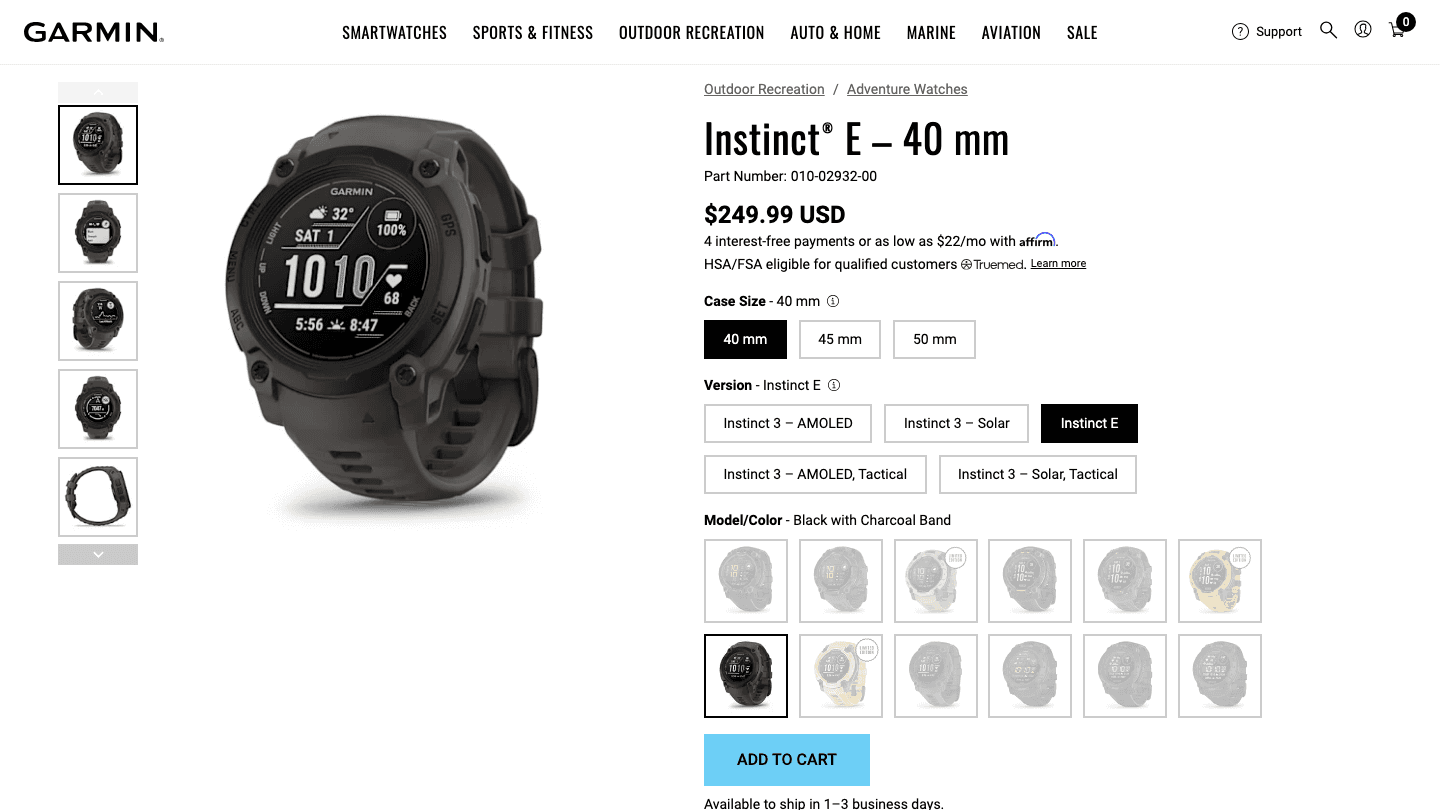
The Instinct E comes in two sizes: 40mm and 45mm (listed as 50mm with the larger bezel). Both are built to MIL-STD-810H standards for shock, vibration, temperature, and water resistance, with a 10 ATM water rating. In practice, the watch feels like what it is: a tough daily driver that does not worry about scratches or rain.
The case is entirely polycarbonate. That is the main aesthetic trade-off versus the Instinct 3, which adds metal reinforcement. Polycarbonate is lighter and less expensive. It will survive drops that would dent a metal case. It also looks a bit more plastic, which some buyers mind and others do not.
The MIP display is always-on and easy to read in sunlight. It will look dim and low-resolution to anyone coming from a premium AMOLED watch, but that is the tradeoff that extends battery life. The display is readable in direct sun without raising your wrist, which matters during runs and hikes.
GPS and Navigation
This is the most important trade-off to understand before buying. The Instinct E uses single-band GPS (L1 only) with support for GPS, GLONASS, and Galileo. It does not have the multi-band SatIQ technology found in the Instinct 3 and Fenix 8. In open terrain, parks, and roads, you will not notice the difference. In dense forests, urban canyons, or deep mountain valleys, single-band watches can drift by 5-10% compared to dual-band alternatives.
For hikers who stay on marked trails and runners in open areas, the Instinct E's GPS is accurate enough. For backcountry navigators who rely on GPS to find routes in technical terrain, the jump to an Instinct 3 or Coros Nomad (both dual-band at comparable or slightly higher prices) is worth it.
TracBack navigation, which creates a breadcrumb trail back to your starting point, is included. Basic turn-by-turn and route following work through the Garmin Connect app sync. There are no pre-loaded offline maps, unlike the Coros Nomad or higher-end Garmins.
Battery Life
Sixteen days in standard smartwatch mode. Thirty-five to forty days in energy saver mode. Twenty-plus hours in GPS mode. These are Garmin's official figures, and real-world use with mixed smartwatch and GPS sessions tends to land around 10-12 days before needing a charge.
That is excellent battery for the price. The Instinct 3 Solar can extend that further with solar top-up in outdoor conditions, but for most users who charge weekly, the Instinct E's runtime is more than adequate. The watch charges quickly via Garmin's standard cable.
Health Tracking and Body Battery
This is where the Instinct E punches well above its price. Body Battery is Garmin's readiness score, a 0-100 metric that draws from HRV, sleep data, stress levels, and activity load. It tells you, each morning, how much reserve you have for the day. The score is easy to understand and genuinely useful for deciding whether to push hard or hold back on a given day.
The watch also tracks HRV status, resting heart rate, respiration, Pulse Ox (blood oxygen), stress, and sleep stages. These are the same core health metrics available on the Fenix 8 and Instinct 3. The Instinct E does not give up health tracking depth to reach its lower price. Garmin's health ecosystem on the lower-end hardware is as solid as on the premium tier.
HRV tracking uses nightly sleep measurements to build a baseline over time, then flags when your readings drop significantly. It is not as analytically rich as Polar's Training Load Pro, but it covers the essentials for general fitness tracking. See how to interpret your HRV readings in our dedicated guide.
The Instinct E also measures how Garmin measures stress using heart rate variability throughout the day, not just during sleep. The stress score and Body Battery together give a picture of how your nervous system is responding across the full day, which is one of the more useful health monitoring features in this category at any price.
What the Instinct E Does Not Have
It helps to be specific about the cuts Garmin made at this price point:
No multi-band GPS (L1 only instead of L1/L5 dual-frequency)
No solar charging option at the base price
No LED flashlight (available on Instinct 3)
No onboard music storage
No AMOLED display (available as a separate Instinct E AMOLED variant)
No pre-loaded maps
No metal case components (all polycarbonate)
For the use cases this watch is designed for, most of these omissions will not matter. But go in clear-eyed about them.
Garmin Instinct E vs. Instinct 3
The Instinct 3 starts at $499, making it $250 more expensive. What you get for that: multi-band GPS with SatIQ, an LED flashlight, a metal bezel option, and the option to add solar charging. The health and fitness features are virtually identical. The Connect IQ app ecosystem and third-party integration are the same.
If you run frequently in forests or need reliable GPS in dense terrain, the Instinct 3's dual-band GPS justifies the price difference. If you mostly run roads, hike marked trails, or want a reliable health tracker with outdoor durability, the Instinct E gets you 90% of the experience for half the cost. The best apps to use with Garmin work equally well on both devices.
Pairing Your Garmin Data With Smarter Scheduling
The Instinct E's Body Battery score is most useful when it actually changes what you do next. Most wearers check the number, register that it is low, and then open a calendar that was built without any of that context.
Lifestack reads your sleep and energy signals and builds a daily schedule around them. On a morning when Body Battery shows you at 40, it schedules lighter cognitive demands and surfaces recovery time. On a morning when you are at 90, it pushes demanding work into your peak energy windows. The logic is the same as an energy calendar: your physiological state, not the time of day, should drive what you tackle when. Learn more in Introducing Lifestack.

Who Should Buy the Garmin Instinct E?
Everyday fitness users who want Garmin's Body Battery ecosystem, sleep tracking, and stress monitoring without paying Fenix prices.
Hikers on marked trails where single-band GPS accuracy is sufficient and offline maps are not critical.
Athletes upgrading from a basic fitness band who want a proper GPS watch with rugged construction under $300.
Garmin ecosystem users who want a second watch or a lower-cost entry point into Connect without losing health feature depth.
Pass on it if you need multi-band GPS accuracy, onboard music, maps, or solar charging. The Instinct 3, Coros Nomad, or Fenix 8 serve those needs at higher prices.
Frequently Asked Questions
What is the Garmin Instinct E price?
The Garmin Instinct E starts at $249.99 for the 40mm model in the US. The 45mm model and variants like the Instinct E AMOLED and Instinct E Solar are priced higher. The base Instinct E is the most affordable watch in the Instinct lineup.
Does the Garmin Instinct E have multi-band GPS?
No. The Instinct E uses single-band GPS (L1) with support for GPS, GLONASS, and Galileo. It does not have the dual-frequency L1/L5 multi-band SatIQ technology found in the Instinct 3. In most everyday conditions, the GPS is accurate and reliable. In dense forest or urban canyon environments, dual-band watches from Garmin, Polar, or Coros will outperform it.
What is Garmin Body Battery and does the Instinct E have it?
Body Battery is Garmin's readiness score, running from 0 to 100. It draws from overnight HRV, sleep performance, resting heart rate, and stress data to estimate how recovered you are each morning. The Instinct E includes full Body Battery support, the same version available on the Fenix 8 and Instinct 3. Read our guide on what Garmin Body Battery means for a full breakdown.
How long does the Garmin Instinct E battery last?
Up to 16 days in standard smartwatch mode, 35-40 days in energy saver mode, and 20+ hours with continuous GPS tracking. In mixed daily use (wear all day plus one GPS activity per day), expect roughly 10-12 days between charges.
Does the Garmin Instinct E work with iPhone?
Yes. The Instinct E connects to the Garmin Connect app on both iOS and Android. Smart notifications, health sync, and route transfer all work via Bluetooth. See our guide to using Garmin with iPhone for setup details.
Is the Garmin Instinct E waterproof?
Yes. It is rated to 10 ATM (100 meters) and built to MIL-STD-810H standards, which includes humidity, vibration, and temperature testing. It handles swimming, rain, and sweat without issues. See our broader guide on whether Garmin watches are waterproof for context on the rating system.
The Garmin Instinct E starts at $249.99 and makes a straightforward promise: rugged outdoor GPS watch, Garmin's Body Battery and health tracking, MIL-STD-810H toughness, 16-day battery, and no frills that push the price up. It is the most affordable entry into Garmin's outdoor Instinct lineup, and it deliberately trades a few premium features for that lower price tag.
The question anyone considering it needs to answer is simple: what did Garmin cut to get to $249.99, and do those cuts matter for how you plan to use it? This review goes through exactly that, including a direct comparison with the Instinct 3 at $499, so you know what the extra $250 actually buys.
After daily wear, trail runs, and hikes with the Instinct E, here is an honest read on who it is built for and where it shows its budget origins.
Key Takeaways
At $249.99, the Instinct E delivers genuine Garmin build quality, Body Battery readiness tracking, and long battery life at the lowest price in the Instinct family.
The trade-offs are real: no multi-band GPS, no solar charging, no LED flashlight, and an all-polycarbonate case instead of metal.
For casual hikers, everyday athletes, and anyone who wants Garmin's health ecosystem without the Fenix price tag, the Instinct E is a strong buy. Serious outdoor navigators who need precision GPS in challenging terrain will want to step up.
Quick Verdict
The Garmin Instinct E is the right watch for people who want reliable health tracking, long battery life, and Garmin's ecosystem at an accessible price. It is not the right watch for athletes who need best-in-class GPS accuracy, solar top-up charging for multi-week expeditions, or the full feature depth of the Instinct 3. Know your use case before deciding.
Design and Build
The Instinct E comes in two sizes: 40mm and 45mm (listed as 50mm with the larger bezel). Both are built to MIL-STD-810H standards for shock, vibration, temperature, and water resistance, with a 10 ATM water rating. In practice, the watch feels like what it is: a tough daily driver that does not worry about scratches or rain.
The case is entirely polycarbonate. That is the main aesthetic trade-off versus the Instinct 3, which adds metal reinforcement. Polycarbonate is lighter and less expensive. It will survive drops that would dent a metal case. It also looks a bit more plastic, which some buyers mind and others do not.
The MIP display is always-on and easy to read in sunlight. It will look dim and low-resolution to anyone coming from a premium AMOLED watch, but that is the tradeoff that extends battery life. The display is readable in direct sun without raising your wrist, which matters during runs and hikes.
GPS and Navigation
This is the most important trade-off to understand before buying. The Instinct E uses single-band GPS (L1 only) with support for GPS, GLONASS, and Galileo. It does not have the multi-band SatIQ technology found in the Instinct 3 and Fenix 8. In open terrain, parks, and roads, you will not notice the difference. In dense forests, urban canyons, or deep mountain valleys, single-band watches can drift by 5-10% compared to dual-band alternatives.
For hikers who stay on marked trails and runners in open areas, the Instinct E's GPS is accurate enough. For backcountry navigators who rely on GPS to find routes in technical terrain, the jump to an Instinct 3 or Coros Nomad (both dual-band at comparable or slightly higher prices) is worth it.
TracBack navigation, which creates a breadcrumb trail back to your starting point, is included. Basic turn-by-turn and route following work through the Garmin Connect app sync. There are no pre-loaded offline maps, unlike the Coros Nomad or higher-end Garmins.
Battery Life
Sixteen days in standard smartwatch mode. Thirty-five to forty days in energy saver mode. Twenty-plus hours in GPS mode. These are Garmin's official figures, and real-world use with mixed smartwatch and GPS sessions tends to land around 10-12 days before needing a charge.
That is excellent battery for the price. The Instinct 3 Solar can extend that further with solar top-up in outdoor conditions, but for most users who charge weekly, the Instinct E's runtime is more than adequate. The watch charges quickly via Garmin's standard cable.
Health Tracking and Body Battery
This is where the Instinct E punches well above its price. Body Battery is Garmin's readiness score, a 0-100 metric that draws from HRV, sleep data, stress levels, and activity load. It tells you, each morning, how much reserve you have for the day. The score is easy to understand and genuinely useful for deciding whether to push hard or hold back on a given day.
The watch also tracks HRV status, resting heart rate, respiration, Pulse Ox (blood oxygen), stress, and sleep stages. These are the same core health metrics available on the Fenix 8 and Instinct 3. The Instinct E does not give up health tracking depth to reach its lower price. Garmin's health ecosystem on the lower-end hardware is as solid as on the premium tier.
HRV tracking uses nightly sleep measurements to build a baseline over time, then flags when your readings drop significantly. It is not as analytically rich as Polar's Training Load Pro, but it covers the essentials for general fitness tracking. See how to interpret your HRV readings in our dedicated guide.
The Instinct E also measures how Garmin measures stress using heart rate variability throughout the day, not just during sleep. The stress score and Body Battery together give a picture of how your nervous system is responding across the full day, which is one of the more useful health monitoring features in this category at any price.
What the Instinct E Does Not Have
It helps to be specific about the cuts Garmin made at this price point:
No multi-band GPS (L1 only instead of L1/L5 dual-frequency)
No solar charging option at the base price
No LED flashlight (available on Instinct 3)
No onboard music storage
No AMOLED display (available as a separate Instinct E AMOLED variant)
No pre-loaded maps
No metal case components (all polycarbonate)
For the use cases this watch is designed for, most of these omissions will not matter. But go in clear-eyed about them.
Garmin Instinct E vs. Instinct 3
The Instinct 3 starts at $499, making it $250 more expensive. What you get for that: multi-band GPS with SatIQ, an LED flashlight, a metal bezel option, and the option to add solar charging. The health and fitness features are virtually identical. The Connect IQ app ecosystem and third-party integration are the same.
If you run frequently in forests or need reliable GPS in dense terrain, the Instinct 3's dual-band GPS justifies the price difference. If you mostly run roads, hike marked trails, or want a reliable health tracker with outdoor durability, the Instinct E gets you 90% of the experience for half the cost. The best apps to use with Garmin work equally well on both devices.
Pairing Your Garmin Data With Smarter Scheduling
The Instinct E's Body Battery score is most useful when it actually changes what you do next. Most wearers check the number, register that it is low, and then open a calendar that was built without any of that context.
Lifestack reads your sleep and energy signals and builds a daily schedule around them. On a morning when Body Battery shows you at 40, it schedules lighter cognitive demands and surfaces recovery time. On a morning when you are at 90, it pushes demanding work into your peak energy windows. The logic is the same as an energy calendar: your physiological state, not the time of day, should drive what you tackle when. Learn more in Introducing Lifestack.
Who Should Buy the Garmin Instinct E?
Everyday fitness users who want Garmin's Body Battery ecosystem, sleep tracking, and stress monitoring without paying Fenix prices.
Hikers on marked trails where single-band GPS accuracy is sufficient and offline maps are not critical.
Athletes upgrading from a basic fitness band who want a proper GPS watch with rugged construction under $300.
Garmin ecosystem users who want a second watch or a lower-cost entry point into Connect without losing health feature depth.
Pass on it if you need multi-band GPS accuracy, onboard music, maps, or solar charging. The Instinct 3, Coros Nomad, or Fenix 8 serve those needs at higher prices.
Frequently Asked Questions
What is the Garmin Instinct E price?
The Garmin Instinct E starts at $249.99 for the 40mm model in the US. The 45mm model and variants like the Instinct E AMOLED and Instinct E Solar are priced higher. The base Instinct E is the most affordable watch in the Instinct lineup.
Does the Garmin Instinct E have multi-band GPS?
No. The Instinct E uses single-band GPS (L1) with support for GPS, GLONASS, and Galileo. It does not have the dual-frequency L1/L5 multi-band SatIQ technology found in the Instinct 3. In most everyday conditions, the GPS is accurate and reliable. In dense forest or urban canyon environments, dual-band watches from Garmin, Polar, or Coros will outperform it.
What is Garmin Body Battery and does the Instinct E have it?
Body Battery is Garmin's readiness score, running from 0 to 100. It draws from overnight HRV, sleep performance, resting heart rate, and stress data to estimate how recovered you are each morning. The Instinct E includes full Body Battery support, the same version available on the Fenix 8 and Instinct 3. Read our guide on what Garmin Body Battery means for a full breakdown.
How long does the Garmin Instinct E battery last?
Up to 16 days in standard smartwatch mode, 35-40 days in energy saver mode, and 20+ hours with continuous GPS tracking. In mixed daily use (wear all day plus one GPS activity per day), expect roughly 10-12 days between charges.
Does the Garmin Instinct E work with iPhone?
Yes. The Instinct E connects to the Garmin Connect app on both iOS and Android. Smart notifications, health sync, and route transfer all work via Bluetooth. See our guide to using Garmin with iPhone for setup details.
Is the Garmin Instinct E waterproof?
Yes. It is rated to 10 ATM (100 meters) and built to MIL-STD-810H standards, which includes humidity, vibration, and temperature testing. It handles swimming, rain, and sweat without issues. See our broader guide on whether Garmin watches are waterproof for context on the rating system.



FOLLOW ON
FOLLOW ON
FOLLOW ON


Copyright 2026 © Lifestack. All rights reserved
Copyright 2026 © Lifestack. All rights reserved

